The Engineering Logic Behind the V-Belt Size Chart
7 min
- Standard V-Belt (Vee Belt) Dimensions
- Narrow V-Belts Dimensions
- Wedge V-Belts Dimensions
- Hexagonal / Double V-Belts Dimensions
- Fractional Horsepower (FHP) V-Belts
- Important Notes for Practical Selection
- V-Belt Lengths and Measurement Charts
- Pulley Groove Compatibility
- Formulas Supporting Belt Selection
- Multi-Belt Systems and Load Distribution
- Practical Considerations
- Precision V-Belts for Every Drive — JLCMC
- Frequently Asked Questions
V-belt selection is based on transmission system operating parameters (e.g., power, speed, and transmission ratio) and the geometric relationships between pulley diameters and center distance. In practice, JLCMC engineers emphasize that, beyond standard size charts, relevant design formulas—such as power correction, wrap angle factors, and belt length calculations—must be applied to ensure the selected V-belt type, length, and quantity satisfy performance and service life requirements.
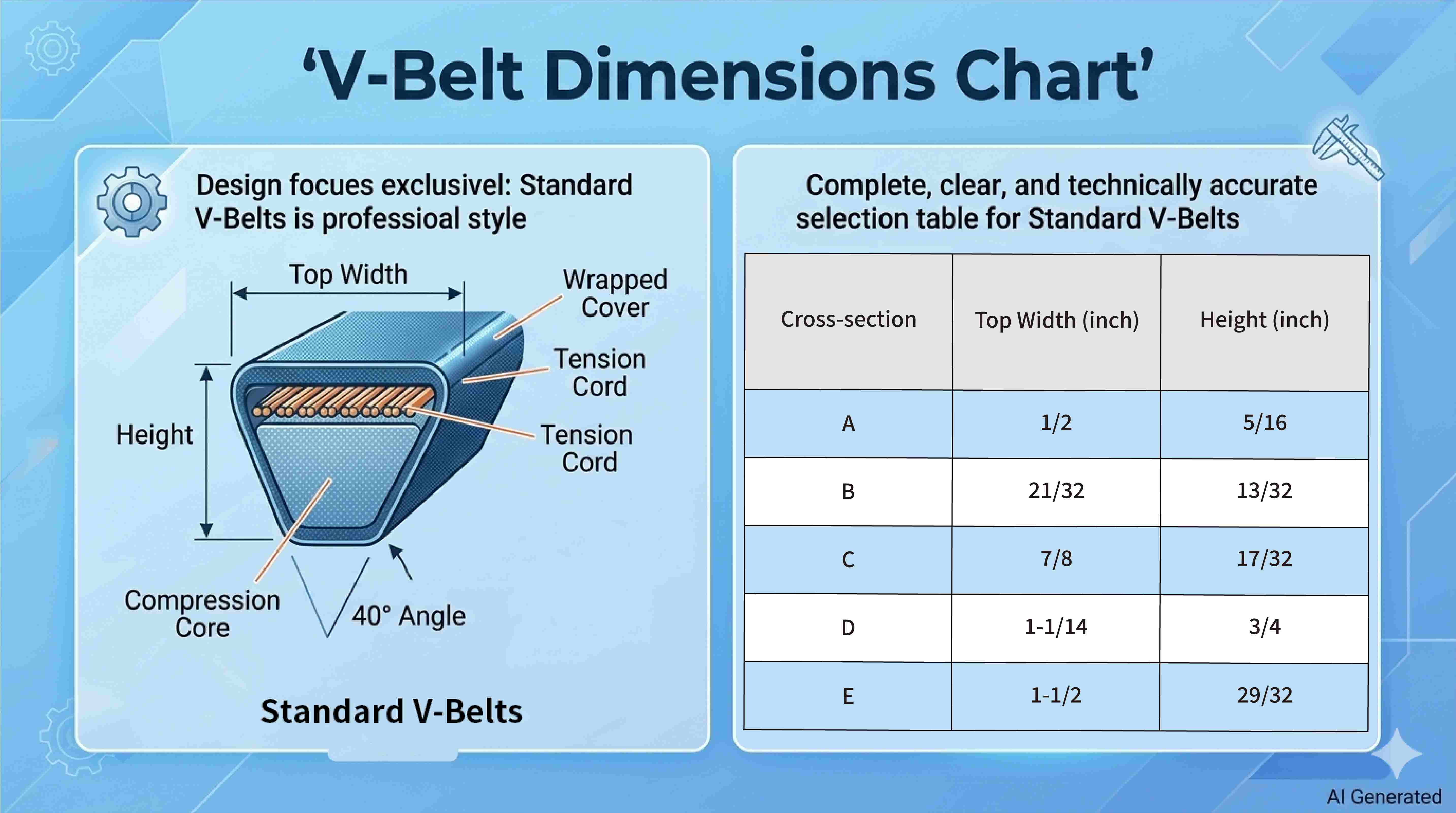
Standard V-Belt (Vee Belt) Dimensions
The cross-section of a V-belt determines its load capacity and suitability for specific applications. Standard profiles follow consistent V-belt dimensions, allowing proper matching to drive requirements.
| Section | Top Width (mm) | Height (mm) | Typical Application |
| A | 13 | 8 | Light-duty drives |
| B | 17 | 11 | General industrial use |
| C | 22 | 14 | Medium to high power |
| D | 32 | 19 | Heavy-duty drives |
| E | 38 | 23 | Very high loads |
The section type identifies the belt profile, while width and height define tensile strength and flexibility. Proper section selection ensures the belt operates within the intended load range.
Narrow V-Belts Dimensions
Designed for higher speed and smaller pulleys. Common in European industrial drives.
| Section | Top Width (mm / in) | Height (mm / in) | Typical Lp Range (mm / in) |
| SPZ | 10 / 0.394 | 8 / 0.315 | 355–4000 / 14–157 |
| SPA | 13 / 0.512 | 8 / 0.315 | 355–6300 / 14–248 |
| SPB | 17 / 0.669 | 14 / 0.551 | 500–10000 / 20–394 |
| SPC | 22 / 0.866 | 18 / 0.709 | 710–16000 / 28–630 |
Wedge V-Belts Dimensions
| Section | Top Width (mm / in) | Height (mm / in) | Lp Range (mm / in) |
| 3V | 9.5 / 0.375 | 8 / 0.315 | 381–3810 / 15–150 |
| 5V | 15.9 / 0.625 | 13 / 0.512 | 381–7620 / 15–300 |
| 8V | 25.4 / 1.00 | 16 / 0.630 | 406–9650 / 16–380 |
Hexagonal / Double V-Belts Dimensions
Used in heavy industrial machinery where two belts are combined in a single profile.
| Type | Width (mm / in) | Height (mm / in) | Lp Range (mm / in) |
| Hexagonal / 2VX | 13 / 0.512 | 8 / 0.315 | 355–6300 / 14–248 |
| Double V / 2V | 17 / 0.669 | 14 / 0.551 | 500–10000 / 20–394 |
Fractional Horsepower (FHP) V-Belts
Designed for low-power, small motors, and compact appliances.
| Section | Top Width (mm / in) | Height (mm / in) | Lp Range (mm / in) |
| 3/8 A | 9.5 / 0.375 | 6 / 0.236 | 305–1016 / 12–40 |
| 1/2 A | 12.7 / 0.500 | 8 / 0.315 | 305–2032 / 12–80 |
| 5/8 A | 15.9 / 0.625 | 10 / 0.394 | 381–2032 / 15–80 |
Important Notes for Practical Selection
- Always verify section and pitch length (Lp) with both pulley geometry and load requirements.
- For multi-belt systems, matched sets are recommended to ensure even load distribution.
- When switching between metric and imperial systems, round cautiously; even small differences affect tension and seating.
- Groove angle, belt profile, and pulley material all influence actual performance beyond charted dimensions.
V-Belt Lengths and Measurement Charts
V-belt length can be expressed in multiple ways. Correct identification prevents common errors in selection and installation.
| Term | Abbreviation | Description |
| Inside Length | Li | Inner surface of the belt |
| Pitch Length | Lp | Neutral axis of the belt (most important) |
| Outside Length | Lo | Outer surface of the belt |
Pitch length (Lp) is typically used in catalogs for proper pulley fit. Approximate conversions from outside to pitch length can be applied as follows:
| Section | Lo → Lp Adjustment (mm) |
| A | −36 |
| B | −43 |
| C | −56 |
For field identification, V-belt measurement charts allow classification based on physical dimensions. Essential steps include:
- Measure top width using calipers.
- Measure outer circumference to estimate pitch length.
- Confirm belt height to verify the section.
| Measured Width (mm) | Likely Section |
| ~13 | A |
| ~17 | B |
| ~22 | C |
Careful measurement is crucial when belts are worn or markings are missing, ensuring proper replacement without relying solely on nominal size.
Pulley Groove Compatibility
Belt performance depends heavily on proper engagement with the pulley. Groove angles typically range from 34° to 40°, but correct seating on the sidewalls is more important than exact numbers. Belts that bottom out in the pulley groove are prone to heat generation, wear, and slippage, even if the size matches.
Formulas Supporting Belt Selection
While dimension charts define potential matches, calculations verify system feasibility.
Belt Length for Two-Pulley Drives
Calculation formula: L = 2*C + (π*(D + d))/2 + ((D - d)^2)/(4*C)
- C = center distance between pulleys
- D = large pulley diameter
- d = small pulley diameter
This formula confirms whether the selected belt length fits the intended pulley arrangement.
Belt Speed
Calculation formula: v = (π * D * n) / 60
- v = belt speed (m/s)
- D = pulley diameter (m)
- n = rotational speed of pulley (rpm)
Belt speed impacts efficiency and wear. Maintaining an appropriate speed range ensures reliable operation.
Power Transmission Concept
Calculation formula: P = (T1 - T2) * v
- P = transmitted power
- T1 = tight side belt tension
- T2 = slack side belt tension
- v = belt speed
Although catalog tables often provide rated power, this formula explains the principles behind the ratings and how tension differences contribute to transmitted power.
Multi-Belt Systems and Load Distribution
In drives with multiple belts, tension is rarely evenly distributed. Correct installation and the use of matched sets help ensure balanced load sharing. Uneven tension can cause premature wear or ineffective transmission.
Practical Considerations
Key factors in belt selection and application include:
- Section size relative to load requirements
- Accurate length measurement and verification of pulley geometry
- Pulley groove design and proper belt seating
- Multi-belt load distribution
Charts, measurement tables, and formulas collectively guide proper selection and installation, ensuring smooth operation and minimizing maintenance issues.
This approach combines V-belt dimensions and measurement methods, providing a structured framework for practical design and maintenance.
Precision V-Belts for Every Drive — JLCMC
When it comes to V-belt dimensions, precision and reliability are non-negotiable. At JLCMC, our V-belts are engineered to fit perfectly, transmit power efficiently, and last longer under demanding industrial conditions.
From standard to narrow and wedge-profile belts, our components are designed to deliver smooth operation, reduce slippage, and maintain consistent tension across a wide range of machinery. Every belt is manufactured to stringent quality standards, ensuring your drives operate at peak performance and your production lines stay running without interruption.
Trust JLCMC V-Belts for durable, high-performance products that keep your equipment working safely and efficiently, while providing the precision fit and reliability your operations demand.
Frequently Asked Questions
What is the difference between standard V-belt sizes and narrow V-belts?
Standard V-belts (sections A, B, C, D, E) are used for general industrial drives and are defined by their top width and height. Narrow V-belts, such as SPZ, SPA, SPB, and SPC, have smaller cross-sections designed for higher-speed drives or smaller pulleys. They transmit similar power with less bulk and are often listed in both metric and imperial units in V-belt size charts.
How can a V-belt measurement chart help identify a worn belt?
A V-belt measurement chart allows identification when markings are missing or worn. By measuring top width, height, and outer circumference, it is possible to determine the belt section (A, B, C, etc.) and estimate pitch length (Lp). This ensures the replacement belt matches the pulley system and avoids issues like slippage or premature wear.
Are fractional horsepower V-belts included in standard size charts?
Yes, fractional horsepower (FHP) belts are a specialized category for low-power motors and small machinery. They have smaller widths and heights compared to standard belts and are usually included in extended V-belt standard sizes charts alongside top width, height, and length ranges in both metric and imperial units.
Why is pulley groove geometry important for selecting the correct V-belt?
Even if a V-belt size matches the catalog, incorrect pulley groove angles or depths can cause the belt to bottom out or slip. Proper groove engagement ensures sidewall contact and uniform tension distribution. Most charts assume standard groove geometry, but verification against actual pulley dimensions is critical for reliable operation.
Popular Articles
Keep Learning
The Engineering Logic Behind the V-Belt Size Chart
V-belt selection is based on transmission system operating parameters (e.g., power, speed, and transmission ratio) and the geometric relationships between pulley diameters and center distance. In practice, JLCMC engineers emphasize that, beyond standard size charts, relevant design formulas—such as power correction, wrap angle factors, and belt length calculations—must be applied to ensure the selected V-belt type, length, and quantity satisfy performance and service life requirements. Standard V-Belt......
Universal joints:How to choose & Where to buy
What is a universal joint? The universal joint resides at the heart of any intricate mechanical system, a versatile mechanical component that seamlessly connects two rotating shafts, facilitating torque transmission and rotational motion across varying angles. Essentially, it's a bridge that ensures smooth power transfer, even when the axes are misaligned. The significance of selecting the right universal joint cannot be overstated, as it directly impacts the performance, durability, and efficiency of......
Selecting Bearing Accessories for Optimal Performance
Bearing accessories play an important role in maintaining and improving mechanical performance. Learn how to select and replace the appropriate bearing accessories, understand the types, their uses, and how they affect mechanical performance. While bearing accessories may not be as well-known as the bearings themselves, does that mean they are any less important? Read on to discover their crucial role. What are bearing accessories and what functions do they Serve? Bearing accessories are not an indivi......
Which Compressed Air Quick Connect is Best, and Where to Buy It?
Introduction Fig. 1 A picture of Air Hose Fittings and Quick Connect Air Fittings A compressed air quick-connect coupler is the cornerstone of any efficient pneumatic system. These small, unsung heroes allow you to rapidly swap between tools without bleeding the entire air system, ensuring maximum uptime and efficiency in your workshop or industrial setting. Choosing the right quick connect, however, can be surprisingly complex due to the multitude of standards and profiles on the market. The "best" c......
One-Piece vs. Split Aluminum Enclosures: How to Choose
Introduction Aluminum itself is a versatile material used in many applications because of its rugged durability, lightweight and corrosion resistance; aluminum enclosures are no exception. To protect sensitive electronics or hardware, you need the right type of enclosure. However, you are always in the dilemma of one-piece and split aluminum enclosures. By contrasting these two choices, you will be able to choose the right one for your project. What Are One-Piece and Split Aluminum Enclosures? The mat......
Spline Shaft Basics: What to Know Before You Buy
Fig. 1 A picture of Splined Shafts Your machine isn’t missing a bolt or belt, but something’s still off. Torque stutters. Alignment drifts. And after weeks of chasing minor faults, the real problem shows itself: a misfit spline shaft. In power transmission systems—especially in high-speed automation or retrofitted CNC lines—the shaft isn’t just a connector. It’s the spine of your drivetrain. When it’s underspecified or poorly matched to the hub, small errors become big breakdowns: backlash, chatter, p......