Sealed vs Shielded Bearings: What 2RS and ZZ Mean
7 min
- Sealed vs Shielded Bearings at a Glance
- What ZZ and 2RS Commonly Mean
- Reading a Bearing Designation: 682ZZ as an Example
- Contact Seals, Non-Contact Seals, and Shields
- Protection, Friction, and Speed Trade-Offs
- What a Suffix Does Not Tell You
- FAQ about Bearing Seals and Shields
Key Takeaways
Suffix definitions: ZZ commonly means metal shields on both sides. 2RS commonly means seals on both sides, often contact seals. Always confirm the exact definition in the manufacturer's catalog.
Design difference: A metal shield typically uses a non-contact clearance or labyrinth path at the inner ring, while a contact seal uses a sealing lip that contacts the mating surface, directly affecting contaminant exclusion and friction.
"Sealed" variations: "Sealed" does not always mean "contact sealed"—non-contact and light-contact designs also exist.
Suffix limits: Neither suffix alone proves waterproofing, a particular speed rating, or suitability as a direct replacement.
Two bearings can look similar while using different closures around the rolling elements. Understanding those closures helps you read product descriptions and ask more precise questions about the bearing's operating conditions.
This guide focuses on seals, shields and suffixes. For an overview of bearing designs, see our ball bearing types and applications guide.
Sealed vs Shielded Bearings at a Glance
A closure helps retain lubricant and limit contamination. The useful comparison is not simply “covered versus uncovered,” but how that cover interacts with the rotating ring.
| Feature | Metal Shield (ZZ) | Contact Seal (2RS) |
|---|---|---|
| Interface with inner ring | Non-contact clearance or labyrinth path; no seal-lip rubbing | Preloaded sealing lip contacts a mating surface; geometry varies |
| Main trade-off | Low closure drag, but a gap remains | Stronger barrier at the lip, with added friction |
| Protection | Helps keep debris out; not a liquid-tight barrier | Can improve exclusion of contaminants; actual protection depends on design |
| Speed capability | No seal-lip friction; still subject to the bearing's published limits | Lip friction can constrain speed; use the specific product rating |
Design Comparison Note
This table compares typical shields with contact seals, not every design sold as a sealed bearing. Non-contact seals require a separate look.
What ZZ and 2RS Commonly Mean
ZZ commonly identifies a bearing with a metal shield on each side. 2RS commonly identifies a bearing with a seal on each side, often a rubber contact seal. These are useful starting points, not a universal specification language.
Manufacturers can use different suffix systems. Read the designation key for the actual bearing instead of assuming that similar letters guarantee identical construction or performance.
Reading a Bearing Designation: 682ZZ as an Example
Separate the example into two parts: 682 is the base designation, while ZZ identifies the shield arrangement in the relevant catalog. Here, ZZ means shields on both sides.
The practical lesson is to read the base designation and suffix together. Use the associated dimensional table to confirm bore, outside diameter and width; do not try to obtain those dimensions from ZZ. Likewise, this example does not establish a speed rating, lubricant specification or interchangeable JLCMC product.
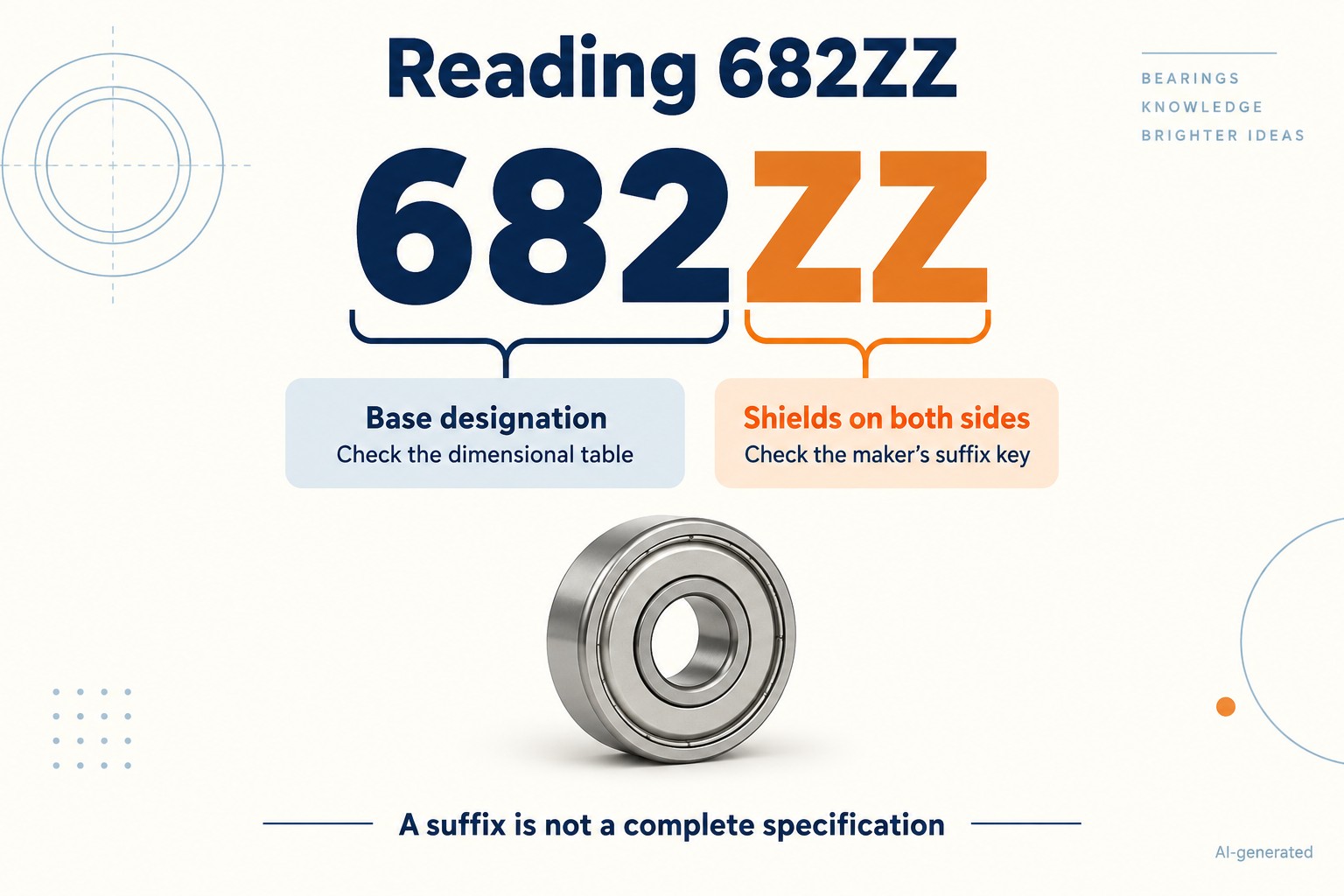
Figure 1. Reading a 682ZZ bearing designation: base designation and shield suffix.
Contact Seals, Non-Contact Seals, and Shields
A metal shield typically attaches to the outer ring and forms a non-contact clearance or labyrinth path near a stepped or grooved surface of the inner ring. This avoids seal-lip rubbing while creating a more restrictive entry path than a simple straight gap. Exact geometry varies.
A non-contact seal uses a shaped lip that follows a groove or labyrinth profile without touching the mating surface. A small clearance remains, so “non-contact” should not be read as “waterproof.”
A contact seal uses a flexible lip held in elastic preload against a mating surface, often a groove flank. Light-contact designs use a lower-drag contact arrangement. The lip angle, groove and materials vary by design.
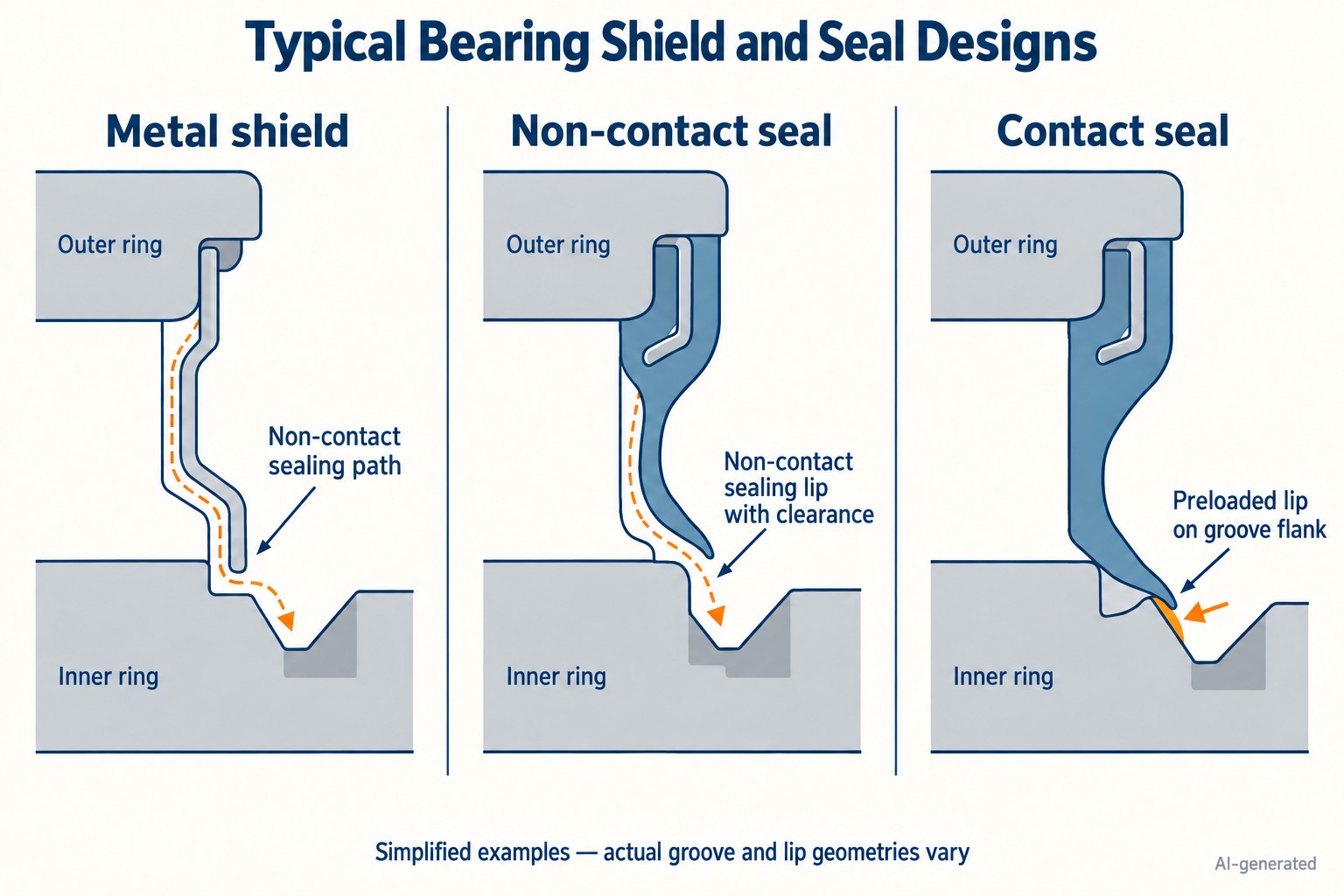
Figure 2. Simplified examples of a metal-shield labyrinth path, a contoured non-contact seal and a preloaded contact seal. Actual groove and lip geometries vary.
Protection, Friction, and Speed Trade-Offs
The closure is one part of the operating system. A cover that limits contamination more effectively can introduce additional drag, while a low-drag clearance design does not create a liquid-tight barrier. There is no single “best” suffix for every environment.
Frame the choice around the actual problem:
- What contaminants can reach the bearing?
- How critical is low starting torque?
- What speed and temperature will the bearing experience?
- Is the surrounding housing providing additional secondary protection?
These questions are more useful than treating 2RS and ZZ as quality grades. Compare published limits for the specific variants under consideration; a speed or temperature value from one catalog is not automatically valid for another product with a similar suffix.
What a Suffix Does Not Tell You
A closure suffix is only part of a bearing specification. It does not, by itself, establish the following:
- Dimensions and load ratings: Always read the dimensional and rating data for the complete designation.
- Internal clearance and tolerance class: Confirm the separate specification rather than inferring them from ZZ or 2RS.
- Lubrication details: Identify the specific grease type and grease fill percentage. Operating conditions dictate lubricant life.
- Environmental suitability: Confirm exact rubber material and sealing limits for corrosive, washdown, or high-temperature environments.
Keep these details separate when comparing product records. A matching closure description is not proof of a complete match.
FAQ about Bearing Seals and Shields
Q: Are sealed bearings waterproof?
Do not assume so from 2RS or the word “sealed.” Better resistance to contaminant entry is not a blanket approval for immersion or pressure washing. Ask for evidence that the specific bearing and surrounding assembly suit the exposure.
Q: Do shielded bearings need lubrication?
The rolling elements still require lubrication, but many shielded bearings are supplied pre-lubricated with grease. This does not necessarily mean that the user needs to add grease during normal operation. Follow the bearing manufacturer's and equipment manufacturer's maintenance instructions, and do not remove the shields simply to add grease.
Q: Does “sealed for life” mean the bearing lasts forever?
No. If a product is described that way, confirm the conditions behind the claim. Grease can age or be lost, and operating conditions influence lubrication needs. It is not a promise of unlimited service life.
Q: Can I replace a ZZ bearing with a 2RS bearing?
Not from the suffix alone. Changing the closure can change drag and allowable operating conditions. Confirm the complete specification and the equipment requirements before treating the variants as substitutes.
Conclusion: Suffix Meaning & Closure Selection
Start by understanding the closure, then confirm the full bearing specification. ZZ and 2RS are useful clues, but they are not complete answers about protection, speed or replacement suitability.
Explore JLCMC bearings and review the specifications of the product you are considering. If a closure or operating limit is unclear, ask for confirmation with the full designation and application conditions.
References
- EZO / Kitanihon Seiki — Types and Characteristics of Cages, Shields and Seals. See “Shields and Seals” for ZZ, 2RS and non-contact construction conventions.
- NSK — Seals and Shields Protect Bearing Investment, Technical Insight TI/E/0003. Closure types and protection/friction trade-offs.
- NTN — Ball Bearings: Shield and Seal Types. Contact, non-contact and low-torque designs.
- NTN-SNR — Lubrication of Bearings: The Advice from Our Experts. Lubricant choice, operating conditions, grease retention and ageing.
- NSK — 682ZZ Series. Base designation and shield suffix verification.
- JLCMC — Ball Bearing Types and Their Applications Guide. Related introductory reading.
Keep Learning
Sealed vs Shielded Bearings: What 2RS and ZZ Mean
Key Takeaways Suffix definitions: ZZ commonly means metal shields on both sides. 2RS commonly means seals on both sides, often contact seals. Always confirm the exact definition in the manufacturer's catalog. Design difference: A metal shield typically uses a non-contact clearance or labyrinth path at the inner ring, while a contact seal uses a sealing lip that contacts the mating surface, directly affecting contaminant exclusion and friction. "Sealed" variations: "Sealed" does not always mean "contac......
Pillow Block Bearing: Fully Utilizing Through 4 Aspects
"Pillow block bearing" is also called "pillow block". It is a common type of "mounted bearing" and often referred to as "block bearing". Pillow block bearings are essential components in mechanical and industrial applications. They provide support and stability for rotating shafts to ensure smooth and efficient operation. JLCMC will analyze the definition, function, maintenance, and installation of pillow block bearings to help you optimize and apply them more effectively. What is a pillow block beari......
Ball Bearing Types and Their Applications Guide
Bearings are essential components in almost all mechanical systems that reduce friction between moving parts and also manage the loads placed on these components to facilitate smooth, efficient motion. Of the numerous types of bearings available, ball bearings are the most commonly offered due to their versatility and overall performance capabilities in a variety of loading conditions. This guide introduces all the major types of ball bearings, describes their operating principles and performance aspe......
What is a Track Roller Bearing and How to Choose?
In the world of industrial machinery and automation, smooth, guided linear motion is paramount. At the heart of many systems that provide this functionality is a critical component: the track roller bearing. Whether you're a seasoned engineer or managing facility maintenance, understanding this component is key to optimizing performance and preventing downtime. At JLCMC, we specialize in providing robust solutions for all your industrial rollers and bearing needs. This article will demystify track rol......
Ball Bearings 101: A Quick Guide
Introduction: The Unseen Revolution of Ball Bearings In nearly every piece of rotating machinery, from the smallest home appliance to the largest industrial system, an unassuming component plays a critical role in efficiency and smooth operation: the ball bearing. These ingenious devices are fundamental to reducing friction and enabling seamless motion, silently powering countless applications that define our modern world. Whether you're a seasoned engineer, a procurement specialist, or simply curious......
Thrust Bearings 101: Types, Applications, and How They Work
Thrust bearings are key mechanical components that handle axial loads with rolling elements or fluid films, reducing friction and stabilizing shafts. Essential in industrial gearboxes, marine drives, and heavy machinery, they boost reliability and efficiency. This article covers their definitions, types, and industrial applications for engineering reference. What is a Thrust Bearing? A thrust bearing is a specialized type of bearing designed to handle axial loads, preventing movement along the shaft's......