Lead Screw and Ball Screw: Key Features Compared
7 min
- The Fundamental Difference Between Lead Screws and Ball Screws
- Components and Lead Considerations
- Efficiency, Speed, and Power Consumption
- Load Capacity and Stiffness
- Accuracy, Backlash, and Positional Repeatability
- Cost, Life Expectancy, and Maintenance
- Application Suitability
- Conclusion
- FAQs
Linear motion systems are essential components in a wide range of automated machinery. When converting rotary motion into linear motion, two types of screws dominate the industry: lead screws and ball screws.
While both accomplish the same basic task, they operate in fundamentally different ways, resulting in variations in efficiency, precision, load capacity, lifespan, and suitability for specific applications. Understanding these differences is essential for creating, pairing, and optimizing systems to enhance performance and ensure mechanical reliability.
If you're not yet familiar with what lead screws and ball screws are, we recommend reviewing JLCMC's detailed insights before continuing with this article. This comprehensive set of learning resources will help enrich your knowledge of linear motion systems, enabling you to make the best decisions when selecting and applying these components.
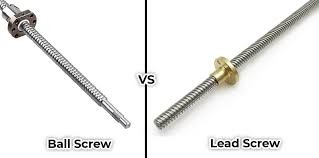
The Fundamental Difference Between Lead Screws and Ball Screws
The primary distinction between lead screws and ball screws lies in the mechanism of motion transmission. Lead screws operate using sliding friction, where the nut slides directly over the screw threads during movement.
This sliding action generates significant resistance, a characteristic leveraged in many designs for static load retention (self-locking). Self-locking ensures that the screw will hold its position without additional braking mechanisms, making lead screws ideal for vertical loads or systems requiring load retention when power is off.
Ball screws, in contrast, rely on rolling friction. Small, hardened steel balls circulate between the helical raceways of the screw and the nut, allowing motion to occur with minimal resistance.
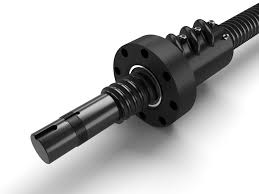
This rolling action reduces wear on both the screw and the nut, increases operational efficiency, and allows smoother, faster, and more precise movement. The lower friction also results in less heat generation, which is particularly advantageous in high-speed or continuous operations.
Components and Lead Considerations
Lead screw assemblies typically consist of the screw and a mating nut, and in some cases, a worm or gearbox may be included to convert motion or adjust speed. Ball screw assemblies include the screw, nut, and one or more sets of recirculating balls that transfer load between the raceway threads and the nut.
The term lead refers to the linear distance the nut travels per full revolution of the screw. A higher lead results in faster linear movement but reduces the mechanical advantage in converting torque to thrust, while a lower lead increases force capacity but limits speed. Ball screws are often designed with higher leads for high-speed applications, while lead screws may be optimized for self-locking and load retention.
Efficiency, Speed, and Power Consumption
Efficiency is one of the most noticeable differences between lead screws and ball screws. Lead screws, which rely on sliding friction, typically achieve efficiencies between 20 and 50 percent depending on the materials, lubrication, and thread profile.
In comparison, ball screws achieve efficiencies of 90 to 98 percent. This high efficiency reduces the torque required from the motor, enables higher speeds, and minimizes heat generation. As a result, ball screws are the preferred choice for applications requiring continuous operation, high-speed movement, or significant power savings.
Lead screws, while less efficient, remain suitable for applications where speed is less critical, and self-locking capabilities provide safety and load retention without requiring braking mechanisms. This makes lead screws particularly advantageous for low-speed lifting systems, medical equipment, and adjustable positioning devices.
Load Capacity and Stiffness
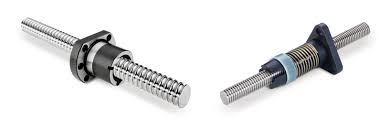
Load capacity and stiffness are important considerations when selecting a screw for mechanical transmission. Lead screws can carry substantial axial loads, particularly when larger diameters and finer pitches are used. However, because they rely on sliding contact, lead screws are more susceptible to bending or deflection under heavy loads, limiting stiffness and long-term accuracy.
Ball screws, on the other hand, efficiently support both axial thrust radial and axial loads due to the rolling action of the balls and their uniform load distribution. This increased stiffness contributes to greater accuracy and reliability, making ball screws ideal for precision applications such as CNC machines, robotics, and aerospace manufacturing. For projects where high load capacity, stiffness, and repeatable positioning are critical, ball screws consistently outperform lead screws.
Accuracy, Backlash, and Positional Repeatability
Backlash refers to the small free movement between the screw and nut when reversing direction. In lead screws, some backlash is unavoidable due to the clearance between the threads. Anti-backlash nuts can reduce this effect, but they rarely eliminate it. However, ball screws can be preloaded so that the balls maintain constant contact with the threads under all load conditions, effectively eliminating backlash.
This difference has a direct impact on positional repeatability. Ball screw systems can achieve micrometer-level accuracy, while lead screws are suitable for moderate precision but may fall short in demanding applications requiring high-resolution motion control. Engineers must carefully consider the required level of precision when choosing between the two types of screws.
Cost, Life Expectancy, and Maintenance
Cost and maintenance requirements are other differentiating factors. Lead screws are generally less expensive to manufacture and require simpler maintenance routines. They can operate with minimal lubrication and do not require complex recirculating mechanisms. This makes lead screws a practical choice for applications where budget constraints exist, and operational demands are moderate.
Ball screws, while more expensive upfront, offer longer service life and higher efficiency. The rolling motion of the balls distributes wear evenly across the nut and screw, reducing degradation even under heavy loads and high-speed operation. Ball screws do require periodic lubrication, and maintenance is more involved compared to lead screws, but the benefits in longevity, reliability, and performance often justify the additional cost, particularly in high-precision or industrial automation applications.
Application Suitability
Lead screws are well-suited for low-speed, light-duty applications where simplicity and self-locking are important. They are commonly used in manual adjustment mechanisms, laboratory automation, medical devices, and systems with intermittent cycling. The inherent self-locking feature allows them to hold positions without additional components, providing safety and reducing operational complexity.
Ball screws excel in high-speed, continuous-operation environments that demand precision and efficiency. CNC machines, industrial robots, automated assembly lines, and aerospace equipment often rely on ball screws for their superior positional accuracy, smooth motion, and load capacity.
While initial investment is higher, the reduced wear, higher repeatability, and efficiency make ball screws the preferred option for demanding applications where downtime and maintenance costs must be minimized.
Conclusion
The choice between a lead screw and a ball screw depends on several factors, including efficiency, load capacity, accuracy, cost, and operational requirements. Lead screws offer simplicity, cost-effectiveness, and self-locking capabilities, making them ideal for light-duty or low-speed applications. Ball screws provide high efficiency, precision, repeatability, and long-term durability, making them suitable for high-speed, heavy-duty, or precision motion systems.
Engineers and designers must evaluate the specific requirements of their application, considering factors such as duty cycle, load, speed, and budget, to select the optimal screw. By understanding the trade-offs between efficiency, stiffness, accuracy, and cost, a well-informed choice can ensure reliable performance, extended service life, and reduced operational issues.
FAQs
Q1: Lead Screw Vs Ball Screw, How to Choose?
Check load, speed, accuracy, and duty cycle. Both lead screw and ball screw systems have advantages; the choice depends on performance requirements, cost, and maintenance preferences.
Q2: What Causes the Life Difference Between Ball Screw and Lead Screw?
The primary factor is the friction mechanism. Ball screws utilize rolling friction via circulating steel balls, which significantly reduces heat and material fatigue. In contrast, lead screws rely on sliding friction, leading to faster surface wear and degradation—especially under high-speed or heavy-load conditions.
Additionally, ball screws offer superior thermal stability. Lower frictional heat prevents lubricant breakdown, ensuring a predictable and extended service life, whereas lead screws face more rapid, wear-based failure.
Q3: What is More Costly, a Ball Screw or a Lead Screw?
Ball screws have higher upfront costs but are more efficient, accurate, and durable. Over a lifetime, they can be more cost-effective depending on the application.
Keep Learning
AC and DC Servo Motors: Differences, Types, and How to Choose
Open a control-systems textbook and an AC servo motor is a two-phase induction machine with a high-resistance rotor. Open a supplier catalog and an AC servo motor is a permanent-magnet synchronous motor (PMSM) with a 24-bit absolute encoder. These are not the same device, and the gap between those two descriptions is where most confusion about AC and DC servo motors begins. This guide is about that gap. The goal is not to defend the academic definitions but to explain why the textbook and the catalog ......
Cost of a Production Servo Motor: A Complete Servo Axis Pricing Guide
Two quotations arrive for the same axis. Same frame size, same rated torque, same voltage class. One is substantially higher than the other, and nothing on either datasheet explains the gap. Complete servo axis components including servo motor, drive, encoder, gearbox and cables The cost of a production servo motor is best understood as the cost of a complete servo axis rather than a single component. In many industrial servo systems, the servo motor and servo drive represent a major portion of the ax......
What are the types of gears & How to Choose the Right Gears
Gears are components that are arranged in a sawtooth shape and usually appear in a circular or circular-like structure. Gears are key mechanical components that can precisely mesh with their teeth to achieve efficient power transmission and improve motion efficiency. They can freely change the direction of power at any time, and can also accurately change the speed and torque by themselves to further achieve long-distance transmission. It is not an exaggeration to say that it is an indispensable "powe......
Lead Screw and Ball Screw: Key Features Compared
Linear motion systems are essential components in a wide range of automated machinery. When converting rotary motion into linear motion, two types of screws dominate the industry: lead screws and ball screws. While both accomplish the same basic task, they operate in fundamentally different ways, resulting in variations in efficiency, precision, load capacity, lifespan, and suitability for specific applications. Understanding these differences is essential for creating, pairing, and optimizing systems......
Ball and Screw Actuator: Evaluation of Accuracy and Precision
Ball and screw actuators are a cornerstone in the field of precision motion control for machines due to their superior accuracy and precision. Commonly referred to as "ball screws" or "linear screws", they have even changed the production model of factory machine tools, automation systems, and even aerospace applications. The Fundamentals of ball and screw actuator The basic principle of ball and screw actuators is to combine a simple screw mechanism with rolling elements that require extremely high a......
Upgrade your Furniture by Using JLCMC Mechanical Parts
The service life and practicality of furniture are unavoidable issues in daily life. As usage time and frequency increase, furniture is prone to loosening, damage, or functional deficiencies. How can this challenge be addressed? This is the focus of this article: JLCMC mechanical parts — the solution for furniture upgrades. How Do JLCMC Mechanical Parts Improve Furniture Performance? By selecting high-standard, high-quality, and highly durable JLCMC mechanical parts for furniture upgrades, and leverag......