Ball Screw Mechanism: Definition, Components & Uses
6 min
- Component Defined: What Is a Ball Screw?
- Operational Principles of Ball Screw Systems
- Classification: Production Type of Ball Screws
- Performance Benefits and Specifications
- Fitness and Eligibility Criteria for an Application
- Maintenance and Longevity Tips
- In a Nutshell!
In today's industrial field, many high-precision machines extensively use a highly efficient mechanical linkage known as the ball screw. It provides pure reciprocating motion with minimal friction and offers high-speed feeding, enabling smooth and rapid operation in precision machining. These features not only enhance equipment performance but also revolutionize how manufacturers, OEMs, and machine builders view motion control, making the ball screw an indispensable part of modern machinery.
Understanding what a ball screw is—and how its mechanism works—helps improve machine operation, increase accuracy, and extend equipment lifespan. Ball screws are widely used, from CNC machines to robotics, and offer significant advantages over traditional lead screw systems, including lower energy consumption and reduced wear.
JLCMC is committed to providing precision support for demanding applications. Leveraging our manufacturing expertise, we offer a wide range of high-precision ball screw that meet rigorous tolerance standards. Our products enhance operational stability and empower manufacturers and system integrators to achieve higher production efficiency.
Component Defined: What Is a Ball Screw?
Function and Operating Principle
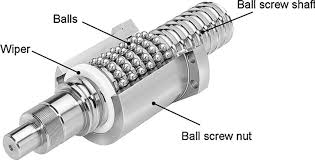
A ball screw is a device that converts rotary motion into linear motion. And instead of sliding like traditional screws, it is the work of little steel balls. These balls ride along the thread of the screw and nut.
- Rolling reduces friction
- Less friction increases efficiency
- Heavy load saves power
Machines can move smoothly and precisely thanks to a ball screw mechanism. This is one of the reasons ball screws are used in precision applications.
Key Components and Terminology
A ball screw has several components:
- Screw: A Rod with a helical thread that turns
- Ball nut: Contains balls and guides them
- Recirculating Balls: Small steel balls that ride in a nut to distribute the load
These factors work together to produce a ball screw mechanism that is free from roughness, highly accurate, and durable. It is required to know these elements for using and choosing ball screws correctly.
Operational Principles of Ball Screw Systems
The ball screw mechanism relies on recirculating steel balls.
- They carry the axial load of the screw in relation to the nut
- The balls roll rather than slide to transmit motion and load.
- This reduces wear and increases lifetimes
Because of the circulating balls, ball screws can withstand high loads and achieve very smooth movement while being efficient.
Ball Return Systems: Internal vs. External
The ball return mechanism moves the balls continuously.
- There is a track in the nut through which balls roll
- They are fed back out through a circulation tube
This ensures smooth, continuous motion. Jamming is eliminated, and the system runs quietly because of the load equalizing ball return.
Classification: Production Type of Ball Screws
Standard VS Rolled Type Ball Screws
The greatest distinction between rolled and ground ball screws is the manufacturing process.
Rolled Ball Screws
- Threads are rolled on steel
- Less expensive
- Not quite so accurate, but for the common needs, perfect
Ground Ball Screws
- The thread is ground with thread grinding machines
- Very precise and smooth
- More costly, used in precision applications
The two types have a common ball screw mechanism, but varying manufacturing methods enable different accuracies, load capacities, and surface finishes.
Internal vs External Recirculation Ball Housings
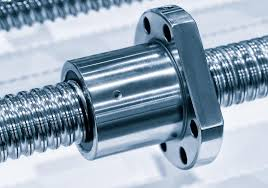
The method of recirculation of the balls is also different between ball screws:
- External recirculation: Pipes on the outside of the nut
- Internal Reservoir: The passages throughout the nut
Nut size, load rating, and maintenance are influenced by the design. Engineers select by space, application, and desired performance.
Performance Benefits and Specifications
High Efficiency and Low Drive Torque
The ball screw unit has a small backlash and efficiency.
- Efficiency often exceeds 90%
- Minimal friction reduces driving torque
- Machines can operate faster and with less energy
These advantages, driven by ball screw efficiency, have made them highly popular in automated machinery, which requires high-speed and continuous production.
Accuracy, Rigidity, and Backlash Removal
Preloaded ball screws are common:
- Remove axial play or backlash
- Improve stiffness
- Increase accuracy and repeatability
Applications where such precision is needed, like in CNC or robotics, use the properties of rigidity to position correctly.
Fitness and Eligibility Criteria for an Application
Industrial Applications of Ball Screws
Ball screws are widely used in systems where precise, efficient, and reliable linear motion is required. Unlike ordinary fastening screws, these ball screws are designed to transmit motion rather than hold parts together. Common applications include:
- CNC Machines and Machining Centers – providing smooth, high-speed movement of tool heads and worktables with minimal friction.
- Precision Robotics and Automation – enabling accurate linear positioning in assembly lines, pick-and-place operations, and automated manufacturing systems.
- Linear Actuators and Mechanical Presses – transmitting rotary motion into controlled linear motion for pressing, clamping, or lifting tasks.
- Lifting Jacks and Positioning Systems – supporting heavy loads with minimal drive torque while maintaining accuracy and repeatability.
- Valve Actuators and Industrial Motion Equipment – converting rotary input from motors into precise linear displacement for valves, slides, and gates.
Selecting the Best Ball Screw
Ball screw selection: When choosing a ball screw, there are several factors to consider:
- Dynamic Load: The load the screw carries while operating
- Critical Speed: No vibration when rotating at maximum speed
- Accuracy Class: Precision level required
- Recirculation Options: Internal or external
- Length and Dia: As per travel length and machine size
Choosing the right ball screw will result in high efficiency, long life, and low maintenance.
Maintenance and Longevity Tips
The ball screw is a durable component, but it will need proper attention:
- To minimize wear, make sure the screws are well-lubricated
- Examine for damage or contamination
- Clean balls and nuts regularly
- Avoid exposure to harsh environments
Care improves the operation of the ball screw and prolongs the life of the machine.
In a Nutshell!
For engineers and designers, understanding what a ball screw is and how it functions is crucial. Ball screws efficiently convert rotary motion to linear motion, are typically able to achieve low-friction operation, and can accommodate heavy loads.
Ball screws are a staple for high-performance equipment, which includes robotics, CNC machinery, as well as medical and aerospace equipment. Knowing how the ball screw works can help engineers choose the proper type of ball screws and keep it operating well for many years.
Frequently Asked Questions
What is the frequency for ball screw lubrication?
It is important to check ball lead screws on a regular basis for wear and contamination. Lubricate them to minimize standard friction and ensure maximum longevity. The general rule of thumb is to grease the ball screws for most machines every three months, but frequency may be adjusted.
What is the life of a ball screw?
A ball screw can have an operational life in excess of tens of thousands of hours, provided that it is properly cared for. Numerous precision ball screws work for more than 40,000 hours.
Can a ball screw be used vertically?
Yes, you can use ball screws in a vertical setup, though it requires extra care. It is critical for preload, which prevents backlash and maintains accuracy. Appropriate support and alignment are required.
Keep Learning
Ball Screw Types Explained: Features, Differences & Applications
You need accurate motion control for your industrial equipment. A ball screw changes rotary drive into linear movement with high efficiency. You will find many ball screw types across modern hardware shops today. Each design serves a specific role in your setup. This guide helps you pick the best model for your next project. Key Takeaways People select specific models based on simple mechanics. Production methods affect the accuracy level of the screw shaft. Nut designs control how steel balls circula......
Why Does Your Stepper Motor Always Make a Squealing Noise?
A squealing stepper motor is almost never a mechanical grinding issue. The noise is electrical: PWM chopping, magnetic resonance, or current misconfiguration exciting the stator laminations. This article provides a four-step workflow to isolate the root cause and fix it without losing torque or steps. Key Causes of Stepper Motor Squealing 1. PWM Chopping Frequency in the Audible Range Motor drivers control current by rapidly switching MOSFETs. If the chopping frequency sits below 20 kHz, each switchin......
Linear Guide Rails and Bearings: What's the Difference and Which Should You Use?
Pick any machine that moves in a straight line — a CNC router, a pick-and-place unit, a 3D printer gantry — and somewhere inside it you will find either a linear bearing riding on a round shaft or a linear guide rail carrying a carriage block. Although they are sometimes discussed interchangeably, round-shaft linear bearings and profiled linear guide rails are two different linear motion systems designed for different levels of precision, rigidity, and load capacity. Both deliver low-friction, guided,......
What Actually Goes Into a Linear Guide Rail System
A linear guide rail system is more than one rail. On its own, the rail cannot provide guided motion. What supports the load and maintains positioning accuracy is how the rail, carriage, rolling elements, and seals work together. This is a quick tour of those parts, and how they add up to a complete motion axis. For engineers speccing a new axis and buyers matching a system to a machine. If you just need the basics — what a linear guide is or the different types of linear rails — start with those two g......
What Are Linear Guides and Why Do They Matter in Factory Automation?
Every CNC machine, every pick-and-place robot, every wafer handler on a semiconductor line — they all share one fundamental need: moving something in a straight line, accurately and repeatedly. That's where linear guides come in. Despite being one of the most widely used components in factory automation, linear guides are often misunderstood — partly because the industry can't agree on what to call them. This article breaks down what linear guides actually are, what's inside them, the main types of li......
Exploring Mechanical Shaft Collars and Their Different Types
Though quite elementary in design, shaft collars serve an important mechanical purpose. In simple terms, a shaft collar is a round clamping device that can be used for axial positioning of components, acting as mechanical stops, or securing parts in place along a shaft. While they may look like simple components, shaft collars must be chosen wisely to ensure performance, accuracy, and longevity of the system. This article focuses on the common types of mechanical shaft collars in transmission systems,......