How Shaft Collars Support Critical Industries and Applications
6 min
- Industries Where Shaft Collars Are Applicable
- Tips to Choose the Right Shaft Collar for Your Industry
- FAQs
- Conclusion
Small components often determine whether a machine achieves its intended service life or suffers premature failure. Shaft collars are a good example. By controlling shaft position and preventing unwanted movement, they help maintain alignment, reduce vibration, and protect critical components.
Because modern machines demand accuracy and reliability, shaft collars are now used in a wide range of applications—from factory automation to renewable energy systems.
Understanding where and how they are used makes it easier to choose the right solution and avoid costly performance issues.
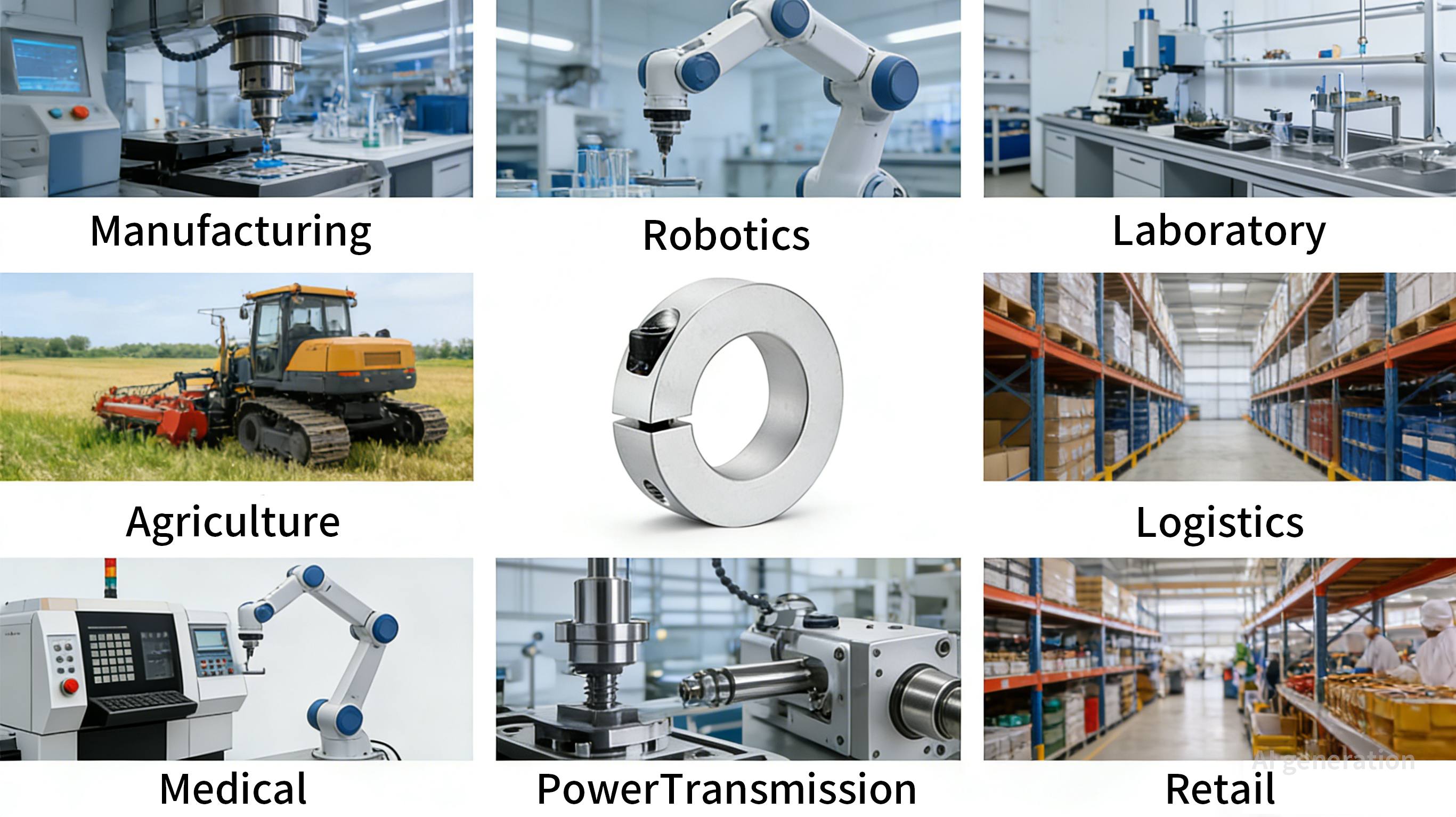
Industries Where Shaft Collars Are Applicable
Shaft collars appear anywhere motion must be controlled accurately and reliably. The following sectors represent the core industries utilizing shaft collars, along with the specific performance needs that drive their use.
Manufacturing and Industrial Automation
In modern factories, shaft collars are used in:
- Conveyor systems
- Packaging and labeling machines
- Assembly lines
- Material handling equipment
- Servo-driven positioning systems
Automation depends on consistent positioning. Even slight axial movement can affect product quality or sensor accuracy. Clamp-style collars are commonly used to maintain spacing between pulleys, gears, and encoders.
As production speeds increase and tolerances tighten, manufacturing remains one of the largest sectors using shaft collars.
Automotive and Electric Mobility
In automotive systems, shaft collars help secure and align components in:
- Steering assemblies
- Transmission systems
- Engine accessories
- Drivetrain and suspension mechanisms
Electric vehicles introduce additional requirements such as high-speed motors, compact gearboxes, and thermal expansion control.
In these applications, reliable shaft positioning directly affects efficiency, noise levels, and component life.
The shift toward electrification is expanding shaft collar applications in transportation and mobility systems.
Medical and Laboratory Equipment
Precision and cleanliness are essential in medical environments. Shaft collars help position components in:
- MRI and CT scanners
- Laboratory automation systems
- Diagnostic analyzers
- Surgical positioning equipment
Stainless steel and engineered plastics are commonly used because they resist corrosion and tolerate frequent cleaning.
Accurate positioning ensures consistent imaging, sample handling, and device performance.
Food Processing and Packaging
Food production equipment must operate reliably under washdown conditions. Shaft collars are installed in:
- Bottling and filling lines
- Conveyor drives
- Mixing and processing systems
Stainless steel collars are preferred for corrosion resistance and hygiene compliance.
Proper shaft positioning also reduces product waste and unplanned downtime in high-volume operations.
Renewable Energy and Power Generation
Energy systems operate continuously under heavy loads and harsh environments.
Shaft collars are used in:
- Wind turbine drivetrain and pitch systems
- Solar tracking mechanisms
- Generators, pumps, and turbines
High clamping strength and fatigue resistance are essential.
As renewable infrastructure expands globally, energy is becoming one of the fastest-growing sectors utilizing precision shaft collars.
Robotics and Mechatronics
Robotic systems require precise and repeatable motion. Shaft collars secure components in:
- Robotic joints and arms
- CNC machines
- 3D printers
- Linear motion modules
Even minor axial drift can affect calibration or product accuracy.
Split and clamp collars allow quick adjustments during setup and maintenance, making them ideal for flexible automation environments.
Marine, Agriculture, and Heavy Equipment
Harsh environments put extra stress on both equipment and components.
In these conditions, shaft collars do more than position parts. They prevent movement caused by vibration, shock, and heavy loads.
Marine systems
Shaft collars are used in propulsion systems, pumps, and steering assemblies.
They hold couplings, bearings, and seals in precise positions. This prevents axial drift caused by propeller thrust and continuous rotation.
Because marine equipment operates in saltwater, stainless steel or coated collars are commonly used to resist corrosion and extend service life.
Agriculture
Tractors, harvesters, irrigation drives, and grain systems rely on shaft collars to secure sprockets, pulleys, and drive components.
These machines operate for long hours in dusty, high-vibration conditions. Shaft collars keep components aligned and prevent shifting under changing loads.
This reduces wear on belts and chains and helps avoid unexpected downtime during critical seasons.
Construction and mining
Conveyors, crushers, mixers, and screening equipment use shaft collars to control the position of heavy rotating parts.
They maintain spacing between bearings and gears and act as mechanical stops under high torque.
In many systems, collars also help absorb axial forces created by impact or uneven loading. In these sectors, holding strength and durability are essential.
Dust, moisture, and continuous loading demand robust materials and secure clamping designs.
Reliable shaft positioning also plays a key role in keeping heavy equipment operating safely and efficiently.
Tips to Choose the Right Shaft Collar for Your Industry
Choosing the right shaft collar affects reliability, maintenance frequency, and overall equipment life.
The following factors help match the collar to specific operating conditions and application needs.
| Factor | Considerations | Recommended Collar Type |
| Confirm Shaft Size and Load | - Exact shaft diameter and tolerance - Axial load requirements - Operating speed and vibration levels | Two-piece clamp collars for high loads or dynamic applications |
| Consider the Operating Environment | - Stainless steel for corrosion, washdown, marine, or food environments - Aluminum for lightweight/low-inertia systems - Carbon steel for heavy-duty industrial use - Plastic/composite for chemical resistance or electrical isolation | Material-based selection based on environmental conditions and required durability |
| Select the Appropriate Design | - Set screw: Cost-effective for fixed installations - Clamp: Precision positioning without shaft damage - Two-piece split: Easy installation/maintenance - Quick-release: Frequent adjustments or modular systems | Clamp-style designs for precision equipment and automation, Two-piece split for easy maintenance |
| Check Compliance Requirements | - Medical materials and hygiene requirements - Food-grade or washdown compliance - Industry-specific certifications | Compliance with safety/performance standards for specific industries (e.g., medical, food) |
| Evaluate Total Cost of Ownership | - Holding strength and reliability - Surface finish and concentricity - Material durability - Maintenance frequency | Precision collars can reduce operating costs by improving system stability and reducing downtime In many cases, precision collars reduce overall operating costs by improving system stability. |
FAQs
How do you install a shaft collar?
The installation method of a shaft collar varies depending on its type: the set screw type is fixed with screws, suitable for simple installations; the clamp type uses evenly tightened screws for precise positioning; the two-piece split type is easy to install and maintain, ideal for heavy-duty applications; and the quick-release type is designed for frequent adjustments and disassembly, offering convenience.
What are the different types of shaft collars?
Set screw, one-piece clamp, two-piece clamp, split collars, and quick-release designs.
Can shaft collars be reused?
Yes, most shaft collars can be removed and reused if they are not damaged and the clamping surfaces remain intact.
How does a shaft collar work?
It grips the shaft to create a mechanical stop, maintain spacing, and prevent axial movement during operation.
Conclusion
Shaft collars play a critical role in maintaining alignment, improving safety, and extending equipment service life across modern machinery.
From automation and robotics to energy and heavy industry, their applications continue to expand as systems demand higher accuracy and reliability.
JLCMC provides precision-engineered shaft collars in multiple materials and configurations. With consistent dimensional accuracy and strict quality control, our products support reliable performance across a wide range of industrial applications.
Contact us today, and we will be more than happy to help.
Popular Articles
Keep Learning
Threaded Standoff vs Spacer: What Is the Difference?
Key Takeaways Threaded standoffs provide both spacing and threaded attachment points, making them ideal for modular assemblies and PCBs. Spacers are unthreaded sleeves that work with through-bolts to maintain gaps in clamped assemblies, offering a simpler and more economical solution. The right choice depends on the load path, assembly sequence, material, and service environment - not just appearance or catalog naming. A threaded standoff and a spacer can look almost identical on a workbench. Both cre......
How to Choose a Threaded Standoff for PCB and Mechatronic Assemblies
Key Takeaways Select the right configuration: Choose male-female, female-female, or male-male thread configurations based on the two mating interfaces and the intended assembly sequence. Treat height as a tolerance stack: Standoff body length must satisfy clearance, electrical, thermal, and connector requirements across the full tolerance range, not just the nominal dimension. Verify thread engagement: Check male thread length against tapped-hole depth and upper screw length against usable female thre......
Threaded Standoff Guide: Types, Sizes, Materials and Applications
Key Takeaways Thread configuration first: Choose female-female, male-female or male-male based on how both sides of the assembly attach — thread config is the most practical way to classify a threaded standoff. Body length is the critical dimension: Standoff length refers to the distance between supporting faces, not total physical length. Reading the wrong length causes incorrect mounting height or screw bottoming. Material affects more than strength: Brass, stainless steel, carbon steel, aluminum an......
Ball Nose End Mill Stepover: Scallop Height and Effective Diameter
Key Takeaways Geometric Control: Stepover directly controls geometric scallop height, but it does not automatically guarantee a measured Ra value. Cusp Height Formula: For a ball radius $R$ and pass spacing $s$ on a flat surface, the ideal cusp height is $h = R - \sqrt{R^2 - \frac{s^2}{4}}$. Tool Radius Advantage: A larger ball can use wider spacing for the same ideal cusp, provided it can reach the required geometry without gouging. Effective Diameter: The active cutting diameter near the tool tip ca......
Manual SMT Stencil Printer Sizing: Print Area, PCB Support and Frame Fit
Key Takeaways Different dimensions: Worktable size, effective print area, board envelope, and stencil frame size are different dimensions. Check the full pattern: Check the whole aperture pattern in its intended orientation, including clearance for the printing stroke. Thickness is not enough: A compatible board thickness does not prove that a populated underside or a support fixture will fit. Support and contact: Stable support and close stencil-to-board contact are necessary for a repeatable printin......
Blind Rivet Guide: Types, Sizes, Uses, Installation and Removal
A blind rivet may be small, but choosing one correctly involves more than matching a rivet to the nearest drill bit. The diameter, grip range, hole size, body material, mandrel material, head style and installation tool all influence the finished joint. A rivet that looks perfectly acceptable before installation can still spin, loosen, pull through the sheet or form incorrectly on the blind side if one of these factors is overlooked. Blind rivets are widely used in sheet-metal fabrication, electrical ......