Shaft Collar Basics: Types and Applications
10 min
- What Is a Shaft Collar?
- How Does a Shaft Collar Work?
- Types of Shaft Collars: And When to Use Each One
- Specialty Shaft Collars
- Common Misconceptions About Shaft Collars
- Applications of Shaft Collars Across Industries
- How to Choose the Right Shaft Collar for Your Application
- When Should You Upgrade from a Set Screw to a Clamp-Style Shaft Collar?
- FAQs
- Final Thoughts
Shaft collars are among the simplest components in machine design, yet they often determine whether an assembly performs reliably or fails prematurely. In many cases, it is not the motor, gearbox, or bearing that causes downtime.
So, understanding how they function, how their different styles perform under load, and how to match them to application requirements is essential for long-term reliability.
The right choice improves uptime. The wrong one quietly compromises the entire assembly.
What Is a Shaft Collar?
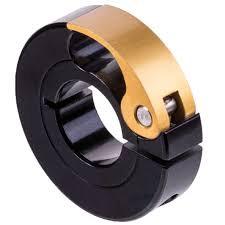
A shaft collar is a simple yet critical mechanical component used to control the positioning of bearings, sprockets, and gears on a rotating shaft, or to serve as a mechanical stop.
To fully understand what a shaft collar is, it helps to think in terms of motion control. Rotating shafts transmit power. Components mounted on those shafts must remain in precise positions. A shaft collar provides that positional control.
At its heart, a shaft collar is a precision-machined ring with a bore sized to match a shaft. Once installed and secured, it prevents axial movement along the shaft. Depending on design, it may also assist with torque transfer or serve as a reaction surface for bearings.
Primary functions include:
- Positioning gears, bearings, and sprockets
- Maintaining consistent spacing between components
- Utilized as a high-strength mechanical limit or hard stop.
- Supporting axial loads
- Mounting shafts or tubes to flat surfaces
You will find shaft collars in motors, gearboxes, packaging lines, conveyors, robotics, agricultural machinery, and precision laboratory systems.
Anywhere controlled rotational motion exists, a shaft collar likely plays a role.
If you're selecting the right shaft collar for your project, you can also expand your knowledge with our article "Top Applications of Shaft Collars Across Industries".
How Does a Shaft Collar Work?
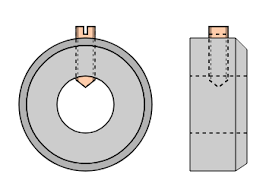
Understanding how a shaft collar works is essential before selecting one. Most designs rely on one of two holding mechanisms: impingement or compression.
Set screw shaft collars use a threaded screw tightened directly against the shaft surface.
When properly torqued, the screw tip presses into the shaft, creating localized deformation and friction that resists movement.
Clamp-style shaft collars use compressive force. Tightening one or more screws contracts the collar evenly around the shaft circumference.
The holding force is distributed uniformly rather than concentrated at a single point.
This difference matters.
Point contact from a set screw creates high localized stress and can reduce repositioning capability.
Compressive contact from a clamp collar increases surface area engagement and typically delivers significantly greater holding power.
In many real-world applications, properly installed clamp collars can provide up to twice the axial holding strength of comparable set screw designs.
Torque application is equally important. Under-tightening risks slippage. Over-tightening can distort the collar body, reducing the effective contact area.
A calibrated torque wrench is not optional in precision systems; it is a requirement.
Types of Shaft Collars: And When to Use Each One
Set Screw Shaft Collars
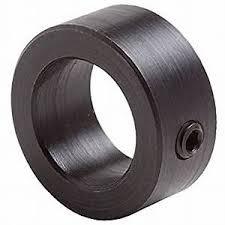
Set screw collars are among the earliest shaft collar designs and remain widely used due to simplicity and cost-effectiveness.
They function by driving a hardened screw into the shaft surface. This impingement creates resistance against axial movement.
The effectiveness of this mechanism depends heavily on material compatibility. If the shaft is harder than the screw, the screw cannot properly bite into the shaft, and holding strength is reduced.
Advantages:
- Simple construction
- Low cost
- Compact design
- Effective in light-duty or permanent installations
Limitations:
- Permanent shaft marring
- Formation of burrs at the contact point
- Difficult repositioning
- Reduced performance on hardened shafts
Set screw collars are best suited for applications where repositioning is unlikely and shaft damage is not a concern.
They are common in agricultural equipment, basic conveyors, and non-critical assemblies.
When evaluating what a shaft collar is best suited for, set screw designs are appropriate for controlled environments with minimal vibration and moderate loads.
Quick-Clamping Shaft Collars
Quick-clamping shaft collars represent a significant performance improvement over impingement-based designs.
Instead of digging into the shaft, these collars compress uniformly around it. This distributes holding forces evenly and preserves shaft integrity.
Because the shaft is not damaged, the collar can be repositioned or removed without difficulty.
Key advantages include:
- Higher axial holding power
- Even circumferential force distribution
- No shaft marring
- Improved performance on hardened shafts
- Greater reliability under vibration
In applications with shock loads, quick-clamping can be paired with shaft undercuts to create a positive mechanical stop. This dramatically improves resistance to axial displacement.
Modern automation, robotics, and precision manufacturing systems overwhelmingly favor clamp-style designs.
For engineers prioritizing repeatability and long-term maintenance reduction, quick-clamping are typically the superior choice.
One-Piece vs Two-Piece Shaft Collars
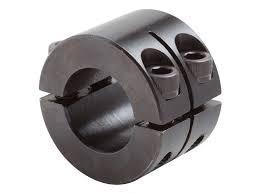
Clamp collars are available in one-piece and two-piece configurations. The difference is more than convenience.
One-piece collars must slide over the shaft end during installation. Tightening the screw simultaneously bends the collar and clamps the shaft.
Some seating torque is consumed in collar flexing.
Two-piece collars consist of two symmetrical halves. They can be assembled anywhere along the shaft without sliding.
All seating torque is directed toward the clamping force rather than deformation.
As a result, two-piece collars often provide greater holding power. They are especially valuable when:
- The shaft cannot be accessed from the end
- Multiple components block installation
- Higher clamping strength is required
- Field retrofits are necessary
From a performance standpoint, two-piece collars are frequently the optimal solution for demanding industrial environments.
Specialty Shaft Collars
Not all shafts are round, and not all applications are standard.
Specialty collars include:
- Hinged collars for quick installation
- Threaded shaft collars for axial adjustment
- Hex and square bore collars for non-round shafts
- Keyed shaft collars hold parts and stop shaft movement.
- Custom-machined designs for extreme environments
When corrosion resistance, temperature exposure, or unique geometry is involved, material selection becomes critical.
Stainless steel, aluminum, engineered plastics, and specialty alloys each serve specific roles.
Understanding what a shaft collar is capable of in custom form opens opportunities for improved reliability in highly specialized systems.
Common Misconceptions About Shaft Collars
Does a Larger Outer Diameter Increase Holding Power?
No. Holding power is primarily determined by screw size, screw grade, and torque capacity.
Increasing outer diameter without increasing screw capacity can reduce effective clamping force. The same screw must flex a larger mass of material, decreasing the net force transferred to the shaft.
Additionally, larger collars increase weight, which may introduce added static load in vertical applications.
Does Adding a Set Screw Improve Performance?
In clamp-style collars, adding a set screw often reduces performance. The set screw can counteract compressive forces and create uneven stress distribution.
It also damages the shaft surface, undermining the primary advantage of clamp designs.
Is Over-Torquing Better?
Over-torquing can warp the collar body. Warping reduces the effective contact surface area and weakens holding strength.
Always follow manufacturer torque guidelines and use calibrated tools.
Can Shaft Collars Compensate for Shaft Tolerance Issues?
High-performance collars are manufactured with precise tolerances.
Attempting to use undersized shafts and compensating with extra torque reduces holding power and increases deformation risk.
For optimal performance:
- Use nominal shafting
- Verify bore tolerance compatibility
- Match material hardness appropriately
- Misunderstanding these principles is a common cause of premature slippage.
Applications of Shaft Collars Across Industries
Power Transmission and Gear Assemblies
In gearboxes and motor assemblies, shaft collars position bearings, pulleys, and sprockets. They maintain alignment under rotational load and prevent axial drift.
Automation and Conveyor Systems
In automated lines, shaft collars maintain spacing between moving components. They frequently act as mechanical stops for actuators and pneumatic cylinders.
Heavy Equipment and Vehicles
Vibration and shock loads are common in heavy equipment.
Clamp-style collars provide improved resistance to displacement and preserve shaft integrity under harsh conditions.
Precision Equipment and Medical Systems
In optical instruments, laboratory frames, and imaging equipment, positioning tolerances are tight. Even slight axial movement can compromise accuracy.
Shaft collars ensure consistent component placement and repeatable calibration.
Across industries, understanding what a shaft collar is used for ultimately comes down to one principle: controlled motion with reliable positioning.
How to Choose the Right Shaft Collar for Your Application
Selecting a shaft collar should never be an afterthought. It directly affects system reliability.
Consider Load Type: Static vs Shock
Steady loads may allow for simpler designs. Shock loads require higher clamping force and often benefit from two-piece collars or shaft modifications.
Shaft Material and Hardness
Set screw collars depend on impingement. Hardened shafts reduce their effectiveness.
Clamp collars are generally preferred for hardened materials.
Installation Constraints
If components block shaft ends, a two-piece collar simplifies installation and maintenance.
Environmental Conditions: Corrosion, Temperature
Select materials appropriate for exposure. Stainless steel resists corrosion. Aluminum reduces weight. Engineered plastics offer electrical isolation.
Torque Requirements and Holding Power
Confirm screw size and torque rating match load requirements.
Use manufacturer specifications and apply torque precisely.
Quick Selection Checklist:
- Verify shaft diameter and tolerance
- Identify load magnitude and type
- Determine if repositioning is required
- Choose clamp or set screw style accordingly
- Confirm torque specifications
- Evaluate environmental exposure
Thoughtful specification reduces downtime, prevents misalignment, and extends equipment lifespan.
When Should You Upgrade from a Set Screw to a Clamp-Style Shaft Collar?
Upgrading becomes advisable when:
- Shafts are hardened
- Vibration or shock loads are present
- Frequent repositioning is required
- Surface damage must be avoided
- Higher axial holding power is needed
Clamp-style collars provide greater reliability and easier maintenance.
Although initial cost may be higher, reduced downtime and improved longevity often lower total ownership costs.
For engineers evaluating what a shaft collar is best suited for long-term performance, clamp designs frequently offer the most dependable solution.
FAQs
What Are the Common Applications for Shaft Collars?
Shaft collars are commonly used to position bearings, gears, pulleys, and sprockets on rotating shafts while preventing axial movement.
They also act as mechanical stops in automation systems, conveyors, gearboxes, and heavy equipment.
In precision equipment, they maintain tight alignment tolerances to ensure consistent performance.
How Does a Shaft Collar Work?
A shaft collar works by gripping onto a shaft using either a set screw that impinges into the shaft surface or a clamp mechanism that compresses evenly around it.
The holding force creates friction or mechanical interference that resists axial movement.
Proper torque and correct shaft pairing are essential for reliable performance.
What Are the Basic Types of Collars?
The basic types of shaft collars include set screw collars, one-piece (solid) collars, two-piece (split) collars, and hinged collars.
Set screw collars tighten directly onto the shaft, while solid and split collars clamp evenly around it for stronger holding power.
Hinged collars allow quick installation and removal, making them suitable for applications requiring frequent adjustments.
What Are the Advantages of Using a Split Shaft Collar?
A split shaft collar provides even clamping force without damaging the shaft surface.
It can be installed or removed without sliding over the shaft end, simplifying maintenance and retrofitting.
Compared to set screw designs, it offers better holding power and improved concentricity in precision applications.
Final Thoughts
Choosing the right shaft collar design is crucial for accuracy, vibration resistance, and system durability. Even small specification errors can lead to slippage, wear, and premature failure.
A carefully selected shaft collar does more than just hold components in place—it is key to maintaining the integrity of the entire mechanical system. Choose wisely, apply the correct torque, and your equipment will perform as expected for years to come.
Contact our experts today to help you select the ideal shaft collar design for your needs, ensuring long-term reliability and optimal performance. JLCMC offers professional support to keep your equipment running at its best, now and in the future.
Act now and safeguard the future of your equipment!
Popular Articles
Keep Learning
Threaded Standoff vs Spacer: What Is the Difference?
Key Takeaways Threaded standoffs provide both spacing and threaded attachment points, making them ideal for modular assemblies and PCBs. Spacers are unthreaded sleeves that work with through-bolts to maintain gaps in clamped assemblies, offering a simpler and more economical solution. The right choice depends on the load path, assembly sequence, material, and service environment - not just appearance or catalog naming. A threaded standoff and a spacer can look almost identical on a workbench. Both cre......
How to Choose a Threaded Standoff for PCB and Mechatronic Assemblies
Key Takeaways Select the right configuration: Choose male-female, female-female, or male-male thread configurations based on the two mating interfaces and the intended assembly sequence. Treat height as a tolerance stack: Standoff body length must satisfy clearance, electrical, thermal, and connector requirements across the full tolerance range, not just the nominal dimension. Verify thread engagement: Check male thread length against tapped-hole depth and upper screw length against usable female thre......
Threaded Standoff Guide: Types, Sizes, Materials and Applications
Key Takeaways Thread configuration first: Choose female-female, male-female or male-male based on how both sides of the assembly attach — thread config is the most practical way to classify a threaded standoff. Body length is the critical dimension: Standoff length refers to the distance between supporting faces, not total physical length. Reading the wrong length causes incorrect mounting height or screw bottoming. Material affects more than strength: Brass, stainless steel, carbon steel, aluminum an......
Ball Nose End Mill Stepover: Scallop Height and Effective Diameter
Key Takeaways Geometric Control: Stepover directly controls geometric scallop height, but it does not automatically guarantee a measured Ra value. Cusp Height Formula: For a ball radius $R$ and pass spacing $s$ on a flat surface, the ideal cusp height is $h = R - \sqrt{R^2 - \frac{s^2}{4}}$. Tool Radius Advantage: A larger ball can use wider spacing for the same ideal cusp, provided it can reach the required geometry without gouging. Effective Diameter: The active cutting diameter near the tool tip ca......
Manual SMT Stencil Printer Sizing: Print Area, PCB Support and Frame Fit
Key Takeaways Different dimensions: Worktable size, effective print area, board envelope, and stencil frame size are different dimensions. Check the full pattern: Check the whole aperture pattern in its intended orientation, including clearance for the printing stroke. Thickness is not enough: A compatible board thickness does not prove that a populated underside or a support fixture will fit. Support and contact: Stable support and close stencil-to-board contact are necessary for a repeatable printin......
Blind Rivet Guide: Types, Sizes, Uses, Installation and Removal
A blind rivet may be small, but choosing one correctly involves more than matching a rivet to the nearest drill bit. The diameter, grip range, hole size, body material, mandrel material, head style and installation tool all influence the finished joint. A rivet that looks perfectly acceptable before installation can still spin, loosen, pull through the sheet or form incorrectly on the blind side if one of these factors is overlooked. Blind rivets are widely used in sheet-metal fabrication, electrical ......