Stepper Motor Noise: Causes, Diagnosis, and Reduction Strategies
6 min
- Anatomy of Stepper Motor Noise
- Causes and Mechanisms
- Measurement and Diagnostics
- Practical Noise Reduction Strategies
- Maintenance and Longevity
- FAQ
- Conclusion
Stepper motor noise is a system-level problem. It emerges from the interaction between electromagnetic excitation, mechanical structure, and control strategy. Eliminating it requires distinguishing whether the root cause sits in the drive waveform, the mechanical assembly, or the resonance characteristics of the full system.
Anatomy of Stepper Motor Noise
Stepper motor noise splits into three categories with distinct spectral signatures.
| Noise Type | Primary Source | Frequency Range | Tonal Quality |
| Mechanical | Bearings, gears, couplings | Broadband, >1 kHz | Harsh, irregular |
| Electromagnetic | Torque ripple, cogging | Step frequency + harmonics | Whining, humming |
| Aerodynamic | Rotor ventilation | >3 kHz | Air rush |
Torque ripple generated by discrete phase commutation is the dominant source of electromagnetic noise in most hybrid stepper motors. It arises from rotor-stator slot interaction, creating periodic disturbances that drive structural vibration at low speeds.
Bearing condition affects high-frequency noise; worn bearings produce impulsive spikes distinguishable from sinusoidal torque ripple.
Mounting rigidity determines transmission efficiency—a motor bolted to thin sheet metal radiates significantly more stepper motor noise than one on a damped frame.
Full-step drive produces a characteristic "wailing" sound at low speeds. Microstepping shifts energy toward higher frequencies; At very high microstepping resolutions such as 1/128 or 1/256, tonal noise is often significantly reduced, although PWM switching noise and mechanical vibration may still remain.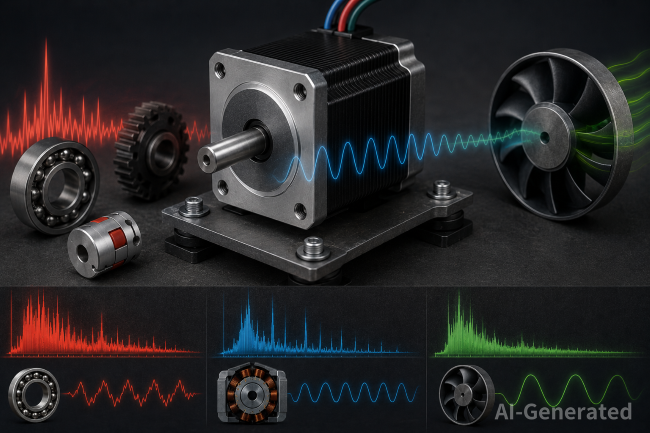
Causes and Mechanisms
Drive Mode Determines Excitation
The control algorithm is the largest controllable variable in stepper motor noise generation.
| Drive Mode | Torque Ripple | Vibration Level | Best Speed Range |
| Full-step | Highest | High | Very low speed |
| Half-step | High | Medium–High | Low speed |
| 1/4–1/8 microstep | Medium | Medium | General purpose |
| 1/16 microstep | Low | Low | Low-to-mid speed |
| 1/64–1/256 microstep | Very low | Very low | Mid-to-high speed Start at 70–90% of rated current |
Current and Resonance
Current setting is frequently overlooked. Overcurrent drives magnetic saturation, increasing vibration and heat. Start at 70–90% of rated current, then tune downward if torque margin allows.
Resonance appears between 50–200 RPM for most hybrid motors. At these speeds, vibration amplitude spikes and the motor may stall even under no load. Load inertia and coupling type determine severity:
- Rigid couplings: Transmit vibration directly; high precision, high noise
- Jaw couplings: Damp high-frequency content; slight backlash
- Bellows couplings: Maintain precision while absorbing minor misalignment
Measurement and Diagnostics
Effective diagnosis of stepper motor noise requires quantification, not guesswork.
| Tool | Measures | Use Case | Accessibility |
| Sound level meter | dB(A) | Overall level, compliance | Low |
| Triaxial accelerometer | g RMS | Vibration magnitude, directionality | Medium |
| FFT analyzer | Frequency spectrum | Tonal vs. broadband separation | Medium–High |
| MEMS IMU | Accel + gyro | Motor-mounted resonance detection | Low |
FFT interpretation rules:
- Step-frequency fundamental: Electromagnetic, drive-related
- Harmonics at integer multiples: Current distortion or PWM artifacts
- Broadband >2 kHz: Bearing wear or gear meshing
- Narrowband at structural frequency: Mounting or frame coupling issue
Diagnostic sequence:
- Run at constant speed in full-step. Note dominant tonal frequency.
- Switch to 1/16 microstepping at same mechanical speed. If tone drops significantly, root cause is drive excitation.
- If high-frequency noise persists across all modes, inspect bearings and alignment.
- Apply light load manually. Noise that changes with load direction indicates coupling or gearbox issues.
Practical Noise Reduction Strategies
Drive Optimization
- Microstepping: Start with 1/16 for low speed. Higher microstepping resolutions may help distribute excitation energy over a broader frequency range and reduce audible tonal components, although results depend on the driver architecture and mechanical system.
- Current tuning: Set to 70% rated current; increase in 5% increments until missed steps disappear; back off 10% for thermal margin.
- Motion profiling: Use S-curve or trapezoidal ramps. Jerk limitation prevents impulse loading that triggers resonance.
Mechanical Improvements
- Vibration isolation: Rubber dampers or elastomer washers between motor face and mounting plate reduce structure-borne transmission by 5–15 dB.
- Fastener discipline: Torque to spec, use thread-locking compound, inspect after 50 hours. Loose hardware converts vibration into panel-radiated stepper motor noise.
- Lubrication: PTFE-impregnated grease for light loads; lithium-complex for moderate loads. Re-lubricate every 500–1000 hours.
Environmental Containment
- Acoustic foam lining absorbs 500 Hz–5 kHz content
- Mass-loaded vinyl barriers block low-frequency rumble
- Sealed cable glands prevent leakage through openings
Implementation example: A desktop CNC mill producing 68 dB(A) during rapids achieved 54 dB(A) through sequential changes: 1/32 microstepping drivers (–6 dB), S-curve firmware (eliminated resonance growl), rubber isolation washers (–4 dB), and 25 mm melamine foam lining (–4 dB).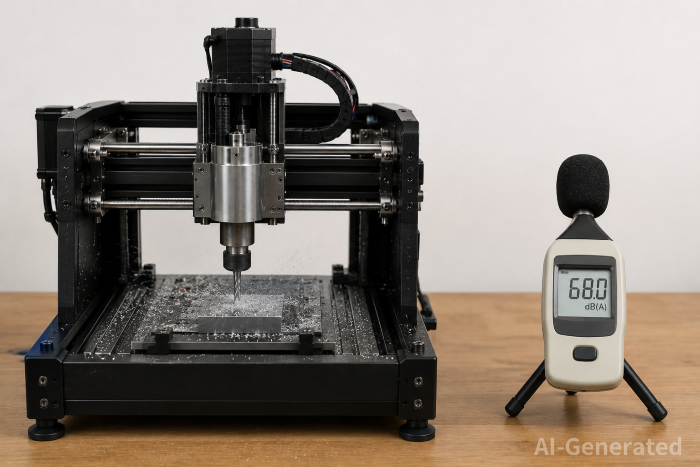
Maintenance and Longevity
Bearing life decreases exponentially with vibration amplitude. Motors running at higher microstepping resolutions experience lower cyclic stress, extending service intervals. Inspect and re-torque mounting hardware every six months in industrial environments.
Resonance avoidance tactics:
- Shift operating speed by 20% or more from resonant band
- Add viscous damper to shaft extension
- Use closed-loop control with encoder feedback
Overload protection: Running above rated torque forces repeated missed-step recovery, producing a distinct "grinding" sound and accelerating wear. Size motors with at least 30% torque margin.
Trend monitoring: Establish baseline vibration signatures at commissioning. Track overall g RMS, step-frequency harmoics, and bearing frequency bands. A 3 dB increase or new spectral peaks indicates degradation before it becomes audible.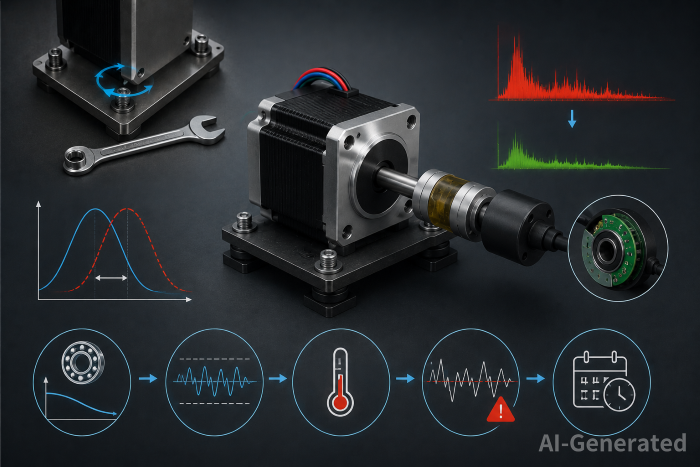
FAQ
Q: Does higher microstepping always reduce stepper motor noise?
A: In most applications, increasing microstepping up to 1/16 significantly reduces vibration and audible noise. Beyond 1/32 or 1/64, the improvement becomes increasingly application-dependent and often provides diminishing returns.
Q: Can stepper motor noise be eliminated entirely?
A: No. Even at 1/256, broadband noise from bearings and air turbulence remains. The goal is to push tonal electromagnetic noise out of the audible band.
Q: Why does my motor get louder at specific speeds?
A: Mechanical resonance, typically 50–200 RPM for hybrid steppers. Avoid continuous operation in that range or add damping.
Q: Cheapest first step to reduce stepper motor noise?
A: Reduce drive current to the minimum reliable level and increase microstepping to 1/16. Zero hardware cost.
Q: Is a noisy stepper motor a sign of failure?
A: Not necessarily. Electromagnetic noise is a normal characteristic of stepper motors. However, grinding, rattling, sudden increases in noise level, or vibration that changes significantly over time may indicate bearing wear, loose mechanical components, or alignment issues that require inspection.
Conclusion
Stepper motor noise is rarely a single-point failure. Electromagnetic excitation from torque ripple interacts with mechanical resonance and mounting dynamics to produce the final acoustic output. Effective control follows a sequence: optimize the drive, match the mechanics, contain what remains, and monitor over time. In most field implementations, moving from full-step to 1/16 microstepping with basic isolation hardware reduces noise by 10–15 dB—enough to move equipment from workshop-tolerable to office-compatible. Measurement is the critical enabler; without FFT-based diagnostics, noise reduction remains guesswork rather than engineering.
Keep Learning
How to Choose a Shaft Coupling: Rigid vs Beam vs Jaw vs Universal Joint
Key Takeaways Shaft Coupling Basics: A shaft coupling transmits torque between driving and driven shafts while accommodating misalignment, vibration, and thermal expansion. The core choice is between rigid (zero flexibility, maximum torque density) and flexible (misalignment-tolerant, vibration-damping) designs. Four Primary Types: Rigid couplings offer zero backlash but require perfect alignment; helical beam couplings provide precision motion for light-duty drives; jaw couplings deliver versatile vi......
Roller Chain Size Chart: ANSI and BS Sizes in mm and Inches
Key Takeaways Identify the chain series first: ANSI and BS-series size codes belong to different dimensional families; changing the units does not change the chain type. Check four details together: Pitch, roller diameter, inner width and number of rows. Matching pitch alone is not enough to choose a replacement. Use the millimeter columns for comparison: Inch equivalents appear beside them, so there is no need to interpret two units in one cell. Count the gaps when measuring pitch: Six consecutive pi......
How to Choose Between Closed-Loop and Open-Loop Stepper Motors
People need the right motor for machine projects. Picking between a closed-loop and open-loop stepper motor shapes machine accuracy and total cost. You can build simple 3D printers with open-loop drives. You can run fast industrial equipment with closed-loop systems. This guide helps you pick the correct motor for your build. Key Takeaways Open-loop stepper systems operate without position feedback, while closed-loop systems use an encoder to monitor actual shaft position. Open-loop systems cannot det......
What Are Pillow Block Bearings? Definition, Working Principle & Applications
Key Takeaways A pillow block bearing is a self-contained bearing unit that combines a rolling-element bearing insert with a rigid housing, designed for shaft support on a flat mounting surface with the shaft axis parallel to the mounting plane. The housing provides structural alignment and load distribution, while the bearing insert handles radial and limited axial loads. Common locking mechanisms include set screws, eccentric collars, and adapter sleeves; each suits different shaft tolerances, vibrat......
Main Types of Servo Motors: AC, DC, and Everything in Between
1. Introduction By leveraging closed-loop feedback to precisely control position, velocity, and torque, servo motors serve as the backbone of modern automation. Yet, application success hinges on matching the right architecture to your load requirements—a task made challenging by the sheer variety of servo motor types available today. In this article, we map motor technology to application requirements through a practical taxonomy covering electrical topology, mechanical construction, performance spec......
Quiet Servo Motors: How to Select Low-Noise Servo Motors for Precision Automation
Noise has quietly become a specification. Medical device makers, semiconductor equipment builders, and packaging OEMs now arrive at the design review with a dB(A) target alongside torque and settling time — and the motion axis is usually the first thing they point at. This guide is written for engineers and buyers specifying industrial AC and brushless servo systems, covering small to medium power ranges commonly used in precision automation equipment. It is not about RC hobby servos: the plastic-gear......