Servo Motor vs Stepper Motor: Comparison of 5 Key Differences
9 min
- Introductions
- Stepper Motor vs. Servo Motor: Working Principles
- Stepper Motor vs. Servo Motor: Control Methods
- Stepper Motor vs. Servo Motor: Performance Comparison
- Stepper Motor vs. Servo Motor: Advantages and Disadvantages
- Stepper Motor or Servo Motor? Application Scenarios Analysis
- Choosing Reliable JLCMC Stepper and Servo Motor Solutions for Precision Applications
- Frequently Asked Questions
- Conclusion
Introductions
During initial exposure to motion control systems in additive manufacturing equipment, the operation of a stepper motor is often immediately recognizable by its characteristic, rhythmic clicking. Unlike conventional motors that deliver continuous rotation, stepper motors advance in discrete increments, much like the ticking motion of a clock hand.
In contrast, servo motors used in industrial robotic systems operate with minimal audible noise while achieving high-speed, highly responsive motion that can be difficult to visually track. This stark difference in performance often raises a fundamental question: what truly distinguishes these two motor technologies?
A common source of confusion, particularly among beginners, is the assumption that RC servos and industrial servo systems are equivalent. In reality, they represent fundamentally different categories of actuation solutions. Stepper motors rely on incremental motion—"stepping"—to achieve positioning, whereas servo motors depend on continuous feedback to dynamically correct and refine their motion.
While this distinction may appear straightforward at first glance, it has significant implications for their respective roles, performance characteristics, and suitability within industrial applications.
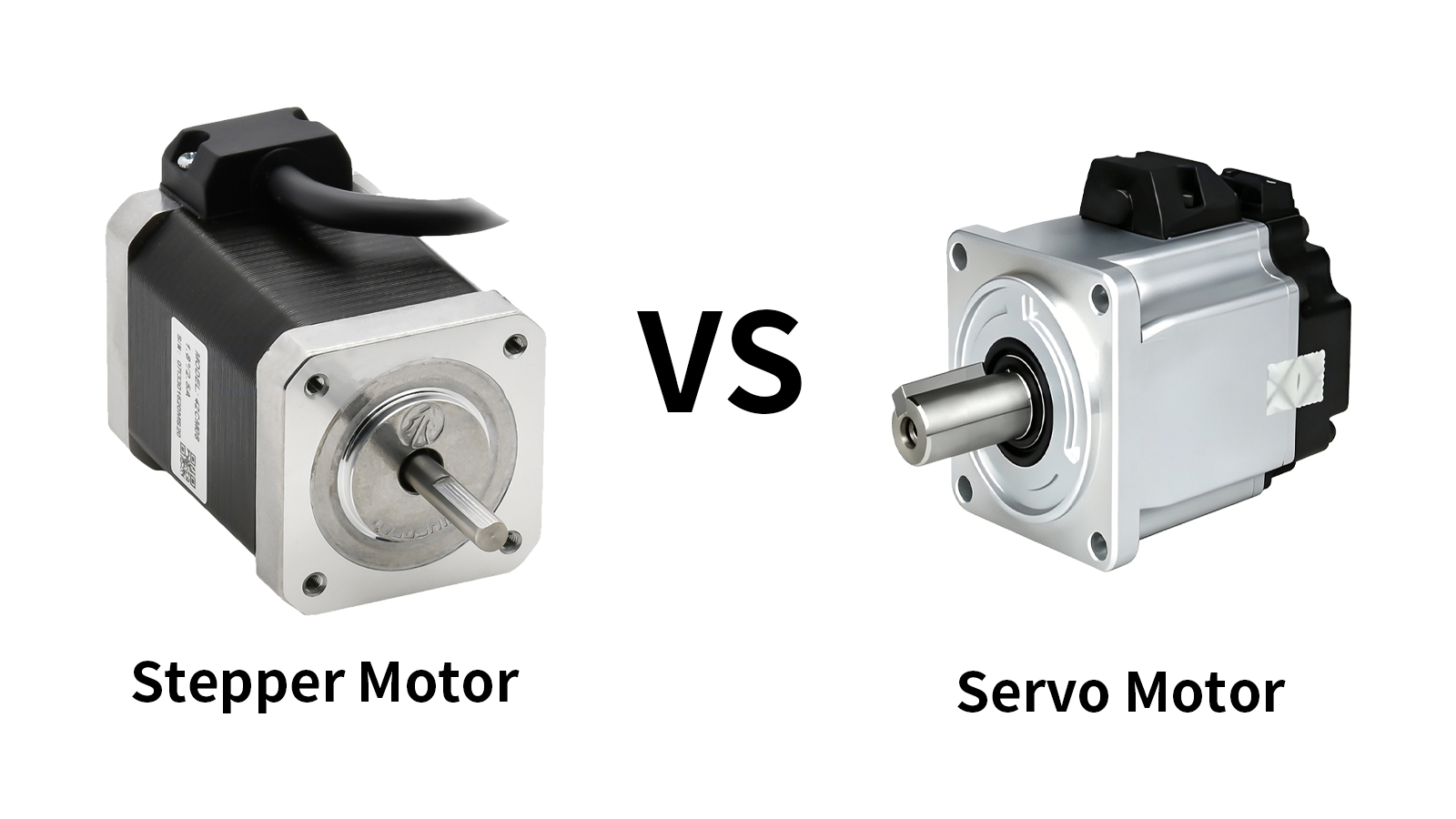
Stepper Motor vs. Servo Motor: Working Principles
Stepper Motor — Open-Loop Pulse Control
A stepper motor is essentially a digital motor. Each electrical pulse you send corresponds to a fixed angular movement. For a common 1.8° stepper motor, one full revolution equals 200 steps. The controller only needs to count pulses to estimate the rotor's position.
This "open-loop" logic makes the system extremely simple: no sensors, no complex feedback algorithms. When pulses are sent, the motor moves step by step. However, this also means that if the load suddenly increases or acceleration is too fast, the rotor may fail to keep up with the electromagnetic field switching—resulting in "missed steps." The system has no awareness of this error. It continues counting pulses, assuming the motor has reached the correct position, while in reality, a positional deviation has occurred.
Servo Motor — Closed-Loop Feedback Control
A servo motor is a complete closed-loop system, typically composed of a motor, an encoder, and a servo drive. The encoder acts as the "eyes" of the system, continuously monitoring the rotor's actual position and feeding data back to the drive.
The drive constantly compares the "target position" with the "actual position." Once a deviation is detected, it immediately adjusts the current to correct it. This process can occur thousands of times per second.
In other words, a servo motor does not simply "step forward blindly." Instead, it continuously monitors its position and corrects itself in real time. This self-correction capability allows it to maintain high accuracy under varying loads and high-speed conditions.
Stepper Motor vs. Servo Motor: Control Methods
Stepper Motor — Pulse Drive Method
Stepper motor control is relatively "coarse." Most systems require only two signal lines: one for pulses (step commands) and one for direction (forward/reverse).
When pulses are received, the stepper driver switches the energization sequence of the motor windings, causing rotation. There is no feedback or error correction; everything is based on the assumption that "as long as I do not overload it, no steps will be lost."
This simplicity is both its strength and its weakness—once the assumption fails, errors accumulate silently.
Servo Motor — PID Closed-Loop Control
Servo control is significantly more complex. The drive must process high-frequency encoder signals and execute PID control algorithms while computing current vectors in real time.
When tuned properly, the system runs smoothly and precisely. When poorly tuned, the motor may vibrate, emit noise, or even become unstable. This complexity raises the technical barrier but also provides true "intelligence"—the ability to sense disturbances and respond accordingly, something stepper motors cannot do.
Stepper Motor vs. Servo Motor: Performance Comparison
| Item | Stepper Motor | Servo Motor |
| Control Method | Open-loop, no feedback | Closed-loop with real-time feedback |
| Accuracy | Medium, depends on microstepping | High, depends on encoder resolution |
| Speed Range | Good at low speed; torque drops above ~1000 RPM | Excellent; can exceed 4000+ RPM |
| Torque Characteristics | High at low speed, decreases at high speed | Stable across wide range |
| Vibration & Noise | Higher, resonance at mid-speed | Low, smooth operation |
| Cost | Lower | Higher |
| Control Complexity | Simple, plug-and-play | Complex, requires tuning |
| Efficiency | Lower; energized even at standstill | Higher; current output on demand |
A commonly misunderstood point is that stepper motors offer excellent repeatability due to their fixed step angles. However, this does not equate to absolute accuracy. Mechanical backlash and load variations can still cause deviations.
Servo motor accuracy, on the other hand, depends on encoder resolution and control algorithms. Industrial encoders can reach 20-bit or higher resolution, dividing one rotation into over one million positions—essential for applications like semiconductor lithography and aerospace machining.
Stepper Motor vs. Servo Motor: Advantages and Disadvantages
Stepper Motor Pros & Cons
Stepper motors are valued for their simplicity. Their straightforward structure makes them inexpensive, reliable, and easy to maintain. They can operate without deep knowledge of control theory—simply connect the driver, and they work.
They also provide strong holding torque when stationary, making them useful for applications requiring position retention without power.
However, their drawbacks are significant. Missed steps are a critical issue: sending 1000 pulses does not guarantee 1000 actual steps. At high speeds, torque drops sharply, and resonance in mid-speed ranges is difficult to eliminate even with microstepping.
Servo Motor Pros & Cons
Servo motors offer comprehensive performance advantages: wide speed range, high dynamic response, and strong torque consistency.
Their closed-loop nature prevents silent failure—if the motor cannot reach its position, it triggers an alarm instead of pretending the task is complete. This reliability is crucial in automated production lines where undetected errors can lead to batch-level defects.
The main disadvantages are cost and complexity. A servo system typically costs 20–30% more than an equivalent stepper system. Tuning also requires expertise in PID parameters, inertia matching, and system rigidity.
Stepper Motor or Servo Motor? Application Scenarios Analysis
Typical Stepper Motor Applications:
- 3D printers: low speed, stable load, cost-sensitive
- Entry-level CNC machines: hobby engraving or small milling
- Printers and scanners: fixed travel paths and predictable loads
Typical Servo Motor Applications:
- Industrial robots: multi-axis coordination and variable loads
- High-end CNC machines: high-speed cutting with precise interpolation
- Automation production lines: high-speed pick-and-place systems
- Precision positioning systems: semiconductor and optical equipment requiring micron or nanometer accuracy
Choosing Reliable JLCMC Stepper and Servo Motor Solutions for Precision Applications
In many automation projects, users often face challenges such as unstable motion accuracy, complex system integration, and limited installation space. To address these pain points, JLCMC offers flexible configurations for a wide range of applications, including CNC equipment, 3D printers, robotics, packaging machinery, and automated production lines. The product lineup covers stepper motors, servo motors, integrated motors, motor drives, power supply systems, and essential accessories, helping engineers simplify wiring, improve system compatibility, and achieve more stable and efficient machine performance.
Explore JLCMC industrial motor today to select the right motion control solutions for your application. Whether you need a compact integrated solution or a high-performance motion control setup, our professional engineers can provide tailored recommendations to help you build a more efficient and reliable automation system.
Frequently Asked Questions
What is the main difference between stepper and servo motors?
The control philosophy. Stepper motors run open-loop, moving in fixed increments without feedback. Servo motors run closed-loop, continuously adjusting position, speed, and torque using feedback devices like encoders.
Which is more precise—stepper or servo?
Generally, servo motors achieve higher precision because real-time feedback corrects positioning errors dynamically. Stepper motors can be precise at low speeds, but lost steps under load degrade accuracy in demanding applications.
When should I choose a stepper motor over a servo motor?
Steppers make sense when you need a low-cost, simple positioning solution at low-to-moderate speeds with stable loads. They're standard in 3D printers, small CNC machines, and basic automation where extreme precision isn't critical.
Why are servo motors more expensive than stepper motors?
Servo systems include feedback devices (encoders), advanced control electronics, and more complex system architecture. These components enable higher speeds, better torque control, and superior accuracy—but they also increase cost and commissioning complexity.
My project requires linear motion. Should I choose a stepper/servo motor or a linear actuator?
This comes down to comparing a core component (servo and stepper motor) to an integrated system (linear actuator).
- Choose a Linear Actuator: If you want a plug-and-play solution for straightforward pushing, pulling, lifting, or positioning, and want to skip the hassle of designing the mechanical drivetrain yourself.
- Choose a Stepper or Servo Motor: If you are building custom, high-speed, or multi-axis equipment (like 3D printers or CNC machines), where you need to engineer and assemble your own custom linear rails and drive mechanisms.
Conclusion
Choosing between stepper and servo motors is essentially a trade-off between "simple sufficiency" and "performance redundancy."
Many projects overuse servo systems where stepper motors would suffice, wasting potential performance. Conversely, forcing stepper motors into high-speed, high-dynamic applications often leads to missed steps and unreliable operation.
A simple guideline:
- If speed is below 1000 RPM, load is stable, cost is limited, and minor positioning errors are acceptable → stepper motors are likely the practical choice.
- If high speed, variable load, strict accuracy, or fault detection is required → servo systems should be seriously considered.
Today, hybrid "closed-loop stepper" systems also exist, adding encoders to stepper motors to prevent missed steps. While they improve reliability, they still cannot fully match true servo performance.
Ultimately, motor selection is not black and white. Understanding their underlying principles—one relying on assumptions, the other on feedback—leads to better engineering decisions that you won't regret later.
Keep Learning
Different-Wire Stepper Motors Wiring & Diagrams Explained
The number of wires coming from a stepper motor tells you how many winding terminals are accessible in the motor, but it does not, by itself, determine the motor type or how the motor should be driven. The internal winding configuration determines which wiring methods are possible, including bipolar, unipolar, series, and parallel connections. This guide explains how a 4 wire stepper motor, 5 wire stepper motor, 6 wire stepper motor, and 8 wire stepper motor are configured, how to identify their windi......
How to Choose a Shaft Coupling: Rigid vs Beam vs Jaw vs Universal Joint
Key Takeaways Shaft Coupling Basics: A shaft coupling transmits torque between driving and driven shafts while accommodating misalignment, vibration, and thermal expansion. The core choice is between rigid (zero flexibility, maximum torque density) and flexible (misalignment-tolerant, vibration-damping) designs. Four Primary Types: Rigid couplings offer zero backlash but require perfect alignment; helical beam couplings provide precision motion for light-duty drives; jaw couplings deliver versatile vi......
Roller Chain Size Chart: ANSI and BS Sizes in mm and Inches
Key Takeaways Identify the chain series first: ANSI and BS-series size codes belong to different dimensional families; changing the units does not change the chain type. Check four details together: Pitch, roller diameter, inner width and number of rows. Matching pitch alone is not enough to choose a replacement. Use the millimeter columns for comparison: Inch equivalents appear beside them, so there is no need to interpret two units in one cell. Count the gaps when measuring pitch: Six consecutive pi......
How to Choose Between Closed-Loop and Open-Loop Stepper Motors
People need the right motor for machine projects. Picking between a closed-loop and open-loop stepper motor shapes machine accuracy and total cost. You can build simple 3D printers with open-loop drives. You can run fast industrial equipment with closed-loop systems. This guide helps you pick the correct motor for your build. Key Takeaways Open-loop stepper systems operate without position feedback, while closed-loop systems use an encoder to monitor actual shaft position. Open-loop systems cannot det......
What Are Pillow Block Bearings? Definition, Working Principle & Applications
Key Takeaways A pillow block bearing is a self-contained bearing unit that combines a rolling-element bearing insert with a rigid housing, designed for shaft support on a flat mounting surface with the shaft axis parallel to the mounting plane. The housing provides structural alignment and load distribution, while the bearing insert handles radial and limited axial loads. Common locking mechanisms include set screws, eccentric collars, and adapter sleeves; each suits different shaft tolerances, vibrat......
Main Types of Servo Motors: AC, DC, and Everything in Between
1. Introduction By leveraging closed-loop feedback to precisely control position, velocity, and torque, servo motors serve as the backbone of modern automation. Yet, application success hinges on matching the right architecture to your load requirements—a task made challenging by the sheer variety of servo motor types available today. In this article, we map motor technology to application requirements through a practical taxonomy covering electrical topology, mechanical construction, performance spec......