Understanding 1D Barcode Technology: Types, Standards, and Applications
9 min
- What Is a 1D Barcode?
- How 1D Barcodes Work: Structure and Technology
- Types of 1D Barcodes and Their Applications
- 1D vs 2D Barcode: Key Differences
- Industry Applications of 1D Barcodes
- Benefits and Limitations of 1D Barcodes
- Conclusion
- Frequently Asked Questions (FAQs)
In today's fast-paced business environment, efficiency and accuracy are paramount. The 1D barcode, also known as a linear barcode, stands as one of the most transformative technologies in data capture and inventory management. From the checkout counters of retail stores to the complex supply chains of global logistics, these simple yet powerful codes have revolutionized how businesses track, manage, and process information.
This comprehensive guide explores the world of 1D barcodes, examining their structure, functionality, various types, and the industries that depend on them. Whether you're a business owner looking to implement barcode technology or a professional seeking to deepen your understanding, this article provides the insights you need to leverage linear barcode technology effectively.
To fully master data orchestration, it is worth exploring how 2D Barcodes expand upon these linear foundations by housing significantly more data in compact matrices. Understanding this technological leap ensures you select the most future-proof format for your specific workflow. To bring these strategies to life, the JLCMC Code Scanner series provides the professional-grade precision needed to capture both classic and high-density codes with unwavering accuracy.
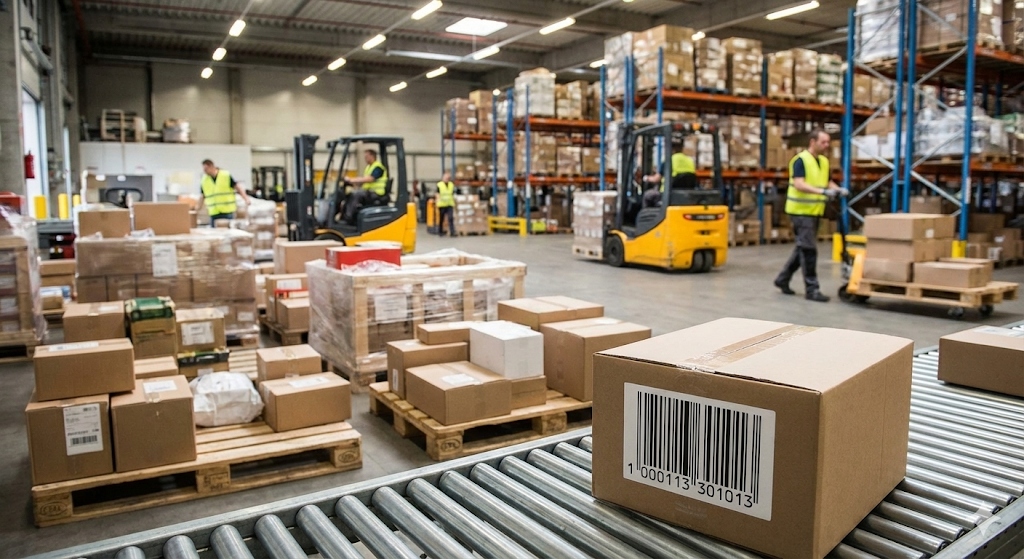
Packages with barcode labels attached in the warehouse.
What Is a 1D Barcode?
A 1D barcode, commonly referred to as a linear barcode, is a visual representation of data that consists of parallel lines and spaces of varying widths. These patterns encode alphanumeric information that can be quickly scanned and decoded by barcode readers. The term "1D" refers to one-dimensional, indicating that data is encoded in a single direction horizontally.
The fundamental principle behind a linear barcode is straightforward: the varying widths of black bars and white spaces represent binary data. When scanned, these patterns are converted into readable information such as product codes, serial numbers, or inventory identifiers. This simplicity is what makes 1D barcodes remarkably reliable and cost-effective for countless applications.
How 1D Barcodes Work: Structure and Technology
Understanding the anatomy of a 1D barcode reveals why this technology has remained relevant for decades. A typical linear barcode consists of three essential components:
1. Bars and Spaces: The black bars represent binary "1" values, while white spaces represent "0" values. The specific pattern encodes the data.
2. Quiet Zone: Clear margins on both sides of the barcode that ensure scanners can properly detect the code boundaries.
3. Start and Stop Characters: Special patterns that signal the beginning and end of the encoded data.
The scanning process involves a laser or image-based scanner emitting light onto the barcode. The black bars absorb light while white spaces reflect it back to the scanner. By measuring the reflected light patterns, the scanner decodes the information into a readable format that can be processed by computer systems.
Types of 1D Barcodes and Their Applications
The world of linear barcodes encompasses numerous symbologies, each designed for specific use cases. Here are the most widely adopted 1D barcode types:
UPC (Universal Product Code)
UPC-A is the most recognized 1D barcode in retail, consisting of 12 digits that uniquely identify products. Its compact variant, UPC-E, uses 6 digits for smaller packaging. These barcodes are essential for retail checkout systems and inventory management worldwide.
EAN (European Article Number)
EAN-13 is the international standard for retail products outside North America, encoding 13 digits. EAN-8 provides a shorter alternative for small items with limited label space. Both formats ensure global product identification consistency.
Code 128
Known for its high density and versatility, Code 128 can encode all 128 ASCII characters. This makes it ideal for logistics, shipping labels, and applications requiring alphanumeric data encoding. Its compact size allows more information in less space compared to other linear barcodes.
Code 39
One of the oldest alphanumeric barcodes, Code 39 supports uppercase letters, numbers, and select special characters. It remains popular in industrial manufacturing, defense, and government asset tracking due to its robustness and widespread scanner compatibility.
Interleaved 2 of 5 (ITF)
ITF is a numeric-only barcode commonly used on corrugated packaging and cartons. Its high density makes it suitable for warehouse management and pallet tracking in logistics operations.
1D vs 2D Barcode: Key Differences
Understanding the distinction between one-dimensional and two-dimensional codes helps organizations select appropriate technology. The
1D 2D barcode comparison reveals fundamental architectural differences:
| Characteristic | 1D Barcode | 2D Barcode |
| Data Structure | Linear bars and spaces | Matrix patterns (dots/squares) |
| Data Capacity | Limited (20-25 characters) | Extensive (thousands of characters) |
| Scanning Technology | Laser or linear imager | Camera-based imager |
| Error Correction | Basic checksum | Advanced Reed-Solomon |
| Reading Orientation | Horizontal alignment required | Any orientation |
| Implementation Cost | Lower | Moderately higher |
When evaluating 1D vs 2D barcode scanner requirements, consider your operational environment. Linear scanners using laser or CCD technology excel at reading 1D codes quickly from varying distances, while 2D imagers provide versatility for mixed environments. Many modern scanners now support both formats, offering investment protection as operational needs evolve.
Industry Applications of 1D Barcodes
The versatility of linear barcode technology has led to its adoption across diverse industries:
Retail and Inventory Management
Retail represents the most visible application of 1D barcodes. Every product on store shelves carries a UPC or EAN barcode that enables rapid checkout, accurate pricing, and real-time inventory tracking. This automation has transformed retail operations, reducing human error and improving customer experience.
Logistics and Supply Chain
In warehouses and distribution centers, Code 128 and ITF barcodes track packages from receipt through shipping. These linear barcodes enable efficient sorting, routing, and delivery confirmation, forming the backbone of modern supply chain management.
Healthcare
Hospitals and pharmacies rely on 1D barcodes for patient identification, medication tracking, and medical equipment management. Barcode verification at the point of care reduces medication errors and enhances patient safety.
Manufacturing
Manufacturing facilities use linear barcodes to track work-in-progress, manage parts inventory, and ensure quality control throughout the production process. This visibility enables lean manufacturing and just-in-time inventory practices.
Benefits and Limitations of 1D Barcodes
Understanding the strengths and weaknesses of linear barcode technology helps organizations make informed implementation decisions.
Key Benefits:
1. Cost-Effective: 1D barcodes are inexpensive to generate and print, making them accessible for businesses of all sizes.
2. Fast Scanning: Laser scanners can read linear barcodes instantaneously, enabling high-throughput operations.
3. Universal Compatibility: Decades of standardization ensure 1D barcodes work with virtually all scanning equipment.
4. Simple Integration: Existing business systems readily incorporate 1D barcode data without complex modifications.
Limitations:
1. Limited Data Capacity: 1D barcodes typically store only 20-25 characters, restricting the amount of information encoded.
2. Line-of-Sight Required: Scanners must have a clear view of the entire barcode, which can be challenging in certain environments.
3. Damage Sensitivity: Smudges, scratches, or partial damage can render a linear barcode unreadable.
Conclusion
The 1D barcode remains an indispensable technology in our data-driven world. Despite the emergence of 2D alternatives, linear barcodes continue to dominate retail, logistics, healthcare, and manufacturing due to their simplicity, reliability, and universal compatibility. As businesses seek efficient ways to capture and manage data, understanding 1D barcode technology provides a foundation for implementing effective tracking and identification systems.
Whether implementing a new barcode system or optimizing existing processes, the principles outlined in this guide provide the knowledge needed to leverage linear barcode technology effectively. As technology evolves, 1D barcodes will undoubtedly adapt, but their fundamental role in data capture will remain essential for years to come.
Frequently Asked Questions (FAQs)
What is the difference between a 1D barcode and a linear barcode?
There is no difference. "1D barcode" and "linear barcode" are interchangeable terms referring to the same technology. Both describe barcodes consisting of parallel lines and spaces that encode data in a single horizontal dimension.
Which 1D barcode type should I use for retail products?
For retail products in North America, use UPC-A. For international retail, EAN-13 is the standard. Both require registration with GS1 to obtain legitimate product identification numbers.
Can 1D barcodes store website URLs?
While technically possible with certain symbologies like Code 128, 1D barcodes have limited capacity. For URLs, 2D barcodes like QR codes are more appropriate as they can store significantly more data.
What equipment do I need to scan 1D barcodes?
1D barcodes can be scanned using laser scanners, linear imagers, or camera-based devices. Laser scanners are most common in retail, while handheld mobile computers with scanning capabilities are popular in warehouses.
How do I create a 1D barcode?
1D barcodes can be generated using online barcode generators, dedicated software like BarTender or NiceLabel, or programming libraries. Ensure you use the correct symbology for your application and maintain proper print quality for reliable scanning.
Are 1D barcodes still relevant with 2D barcode technology available?
Absolutely. 1D barcodes remain the standard for retail and many logistics applications due to their simplicity, lower cost, and universal scanner compatibility. Many businesses use both technologies for different purposes.
What is the minimum size for a 1D barcode?
Minimum size depends on the symbology and scanning environment. Generally, maintain an X-dimension (narrowest bar width) of at least 0.33 mm and ensure adequate quiet zones on both sides. Always test barcodes in their intended scanning environment.
Are 1D barcodes becoming obsolete with 2D technology available?
Despite 2D advancements, linear barcodes remain highly relevant due to their simplicity, cost-effectiveness, and established infrastructure. Many organizations utilize both technologies strategically, deploying 1D codes for basic identification and 2D codes for applications requiring enhanced data capacity or error correction.
What is the primary advantage of 1D barcodes over 2D alternatives?
Linear barcodes offer superior scanning speed, lower implementation costs, and compatibility with legacy equipment. Their simple structure enables reliable reading from greater distances and wider angles using laser scanners, making them ideal for high-volume retail and warehouse environments.
Keep Learning
The Essence of Barcode Symbology: A System of Data Encoding Rules
Introduction Most people only notice barcodes when something moves through a checkout counter or gets sorted in a warehouse. It's a quick flash of light, sometimes a beep, and then the moment is gone. But what's actually happening is more structured than it looks. A barcode is not just a visual pattern—it's a structured relationship between how data is encoded and how machines interpret it under imperfect conditions. In practice, that agreement is called a barcode symbology. And once you start looking......
Spot Common Barcode Scanner Issues Early to Prevent Business Losses
Barcode scanning sits quietly at the center of modern operations. From warehouse receiving docks to hospital inventory rooms and retail checkout counters, it enables speed, traceability, and accuracy at scale. When scanning works, workflows move seamlessly. When it doesn’t, even a small disruption can trigger inventory discrepancies, shipping delays, or reconciliation errors that ripple through the system. A recurring problem with barcode scanners rarely stems from sudden device failure. Instead, most......
Understanding 1D Barcode Technology: Types, Standards, and Applications
In today's fast-paced business environment, efficiency and accuracy are paramount. The 1D barcode, also known as a linear barcode, stands as one of the most transformative technologies in data capture and inventory management. From the checkout counters of retail stores to the complex supply chains of global logistics, these simple yet powerful codes have revolutionized how businesses track, manage, and process information. This comprehensive guide explores the world of 1D barcodes, examining their st......
Explore Barcode Scanner Types: Technology, Form Factor, and Practical Uses
If you have ever stood in a checkout line, watched a warehouse worker pull items from shelves, or seen a nurse scan a patient's wristband, you have witnessed barcode scanning in action. It is one of those technologies that has become so integrated into routine workflows that most people rarely think about what is actually happening when that red light flashes across a label. But for the people responsible for choosing, implementing, or maintaining these systems, the differences between scanner types m......
Barcode Scanner Basics: What It Is & How It Works
Originally used as a simple retail tool, barcodes have now evolved into a core technology widely applied across industries such as logistics, healthcare, manufacturing, and asset management. They play a key role in inventory management, compliance tracking, and real-time data processing, ensuring operational accuracy across various sectors. To truly understand the capabilities of barcode scanner technology, one must look beyond the printed label. The real impact comes from how quickly information is t......
Scan Code Types: What They Are & Why They Matter
Barcodes and matrix symbols quietly move products and components through every industry—from retail checkout lanes to medical equipment parts. Choosing the right scan code affects scanning speed, data accuracy, label durability, and long-term scalability. Some codes excel at rapid retail scanning. Others are engineered for tiny or curved surfaces, like surgical instruments, electronics, or micro-packaging. The right type ensures readable codes even when space is limited, or labels are damaged, while t......