Scan Code Types: What They Are & Why They Matter
10 min
- Understanding The Core Types of Scan Codes
- 1D vs. 2D Scan Codes - Key Technical Differences
- How to Choose the Right Scan Code
- FAQs
- Final Thoughts
Barcodes and matrix symbols quietly move products and components through every industry—from retail checkout lanes to medical equipment parts. Choosing the right scan code affects scanning speed, data accuracy, label durability, and long-term scalability.
Some codes excel at rapid retail scanning. Others are engineered for tiny or curved surfaces, like surgical instruments, electronics, or micro-packaging. The right type ensures readable codes even when space is limited, or labels are damaged, while the wrong choice can bottleneck workflows or require costly reprints.
In this guide, we'll break down each of these considerations and show how different types of scan codes perform in various environments—from fast-paced retail checkouts to tiny, precision-labeled components.
Understanding these factors will help you choose the right code for your products, workflow, and long-term scalability.
Understanding The Core Types of Scan Codes
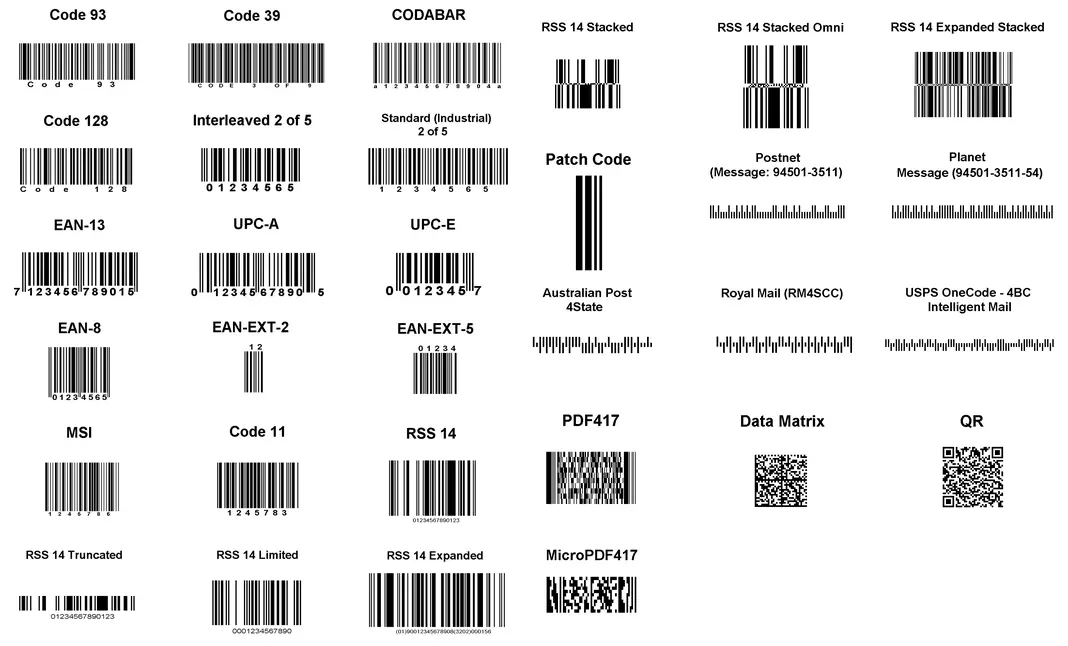
A picture of different Scan Code Types
All scan codes fall into three structural categories:
- Linear (1D) codes
- Matrix (2D) codes
- Hybrid or composite codes
These categories differ in data capacity, error tolerance, hardware requirements, and physical adaptability, which makes them suitable for different operational environments.
Understanding these categories helps businesses select codes that maximize workflow efficiency and label readability, even on challenging surfaces such as thin packaging, curved labels, or micro-components.
Each category also comes with trade-offs: speed versus capacity, compatibility versus durability, and label size versus readability.
Linear (1D) Types of Scan Codes
Linear codes store data along a single horizontal axis using bars of varying widths and spacing.
These codes are primarily numeric or short alphanumeric identifiers and remain popular due to their simplicity and speed.
Key Characteristics:
- Horizontal encoding only
- Limited data capacity
- Compatible with laser scanners
- Minimal built-in error correction
- Extremely fast scanning
Applications and notes for thin/small Surfaces:
- Retail: UPC and EAN codes dominate packaging, but for very small items such as cosmetics, jewelry, or micro-packaged products, reduced-size symbologies are required.
Compact variants or narrow-bar GS1 DataBar codes ensure readability.
- Logistics: Code 128 and ITF codes are standard for cartons, pallets, and shipping labels.
High-density Code 128 variants compress more data into narrow labels, reducing the footprint for thin packages.
- Industrial/Healthcare: Code 39 for automotive components; Codabar for blood samples or medical vials.
Labels on small or narrow surfaces benefit from high-contrast thermal transfer printing or Direct Part Marking (DPM) for long-term durability on metallic substrates.
Technical Guidance:
- Print resolution and contrast matter for small surfaces.
- Micro-printing can create readable linear codes on tiny components, but higher-grade scanners may be required to maintain accuracy.
Advantages of 1D Codes:
- Extremely fast scanning for high-volume environments
- Simple printing and lower production cost
- Broad legacy scanner compatibility
To fully leverage the speed of linear symbologies, pairing these codes with JLCMC's precision-engineered scanners ensures seamless data capture and maximum throughput for your entire workflow.
Matrix (2D) Types of Scan Codes
The QR code (2D Scan Code) example from the JLCMC website
Matrix codes store data both horizontally and vertically in a grid.
They allow much higher data density than linear codes and include error correction, making them suitable for thin, curved, or damaged surfaces.
Key Characteristics:
- High data density
- Built-in error correction (e.g., Reed-Solomon)
- Smartphone and imaging scanner compatible
- Ideal for small, curved, or reflective surfaces
Applications and notes for thin/small surfaces:
- Consumer-facing: QR Codes store URLs, contact data, and dynamic content.
- Mini QR variants fit on micro-packaging like single-use vials or cosmetic samples.
- Industrial traceability: Data Matrix codes are used for electronics and medical devices, allowing millimeter-scale codes to be etched onto metal or plastic surfaces.
- Government/ID: PDF417 and Aztec Codes fit on identification cards, permits, or wristbands with limited space while maintaining readability.
Technical Guidance:
- Smaller module sizes allow compact symbols but require precise printing and higher-resolution scanners.
- Error correction ensures reliability on curved or partially damaged labels.
- Optimal contrast between code and substrate is essential for micro-label applications.
Advantages of 2D Codes:
- Stores thousands of characters, including serialized data
- Maintains readability even when partially damaged
- Supports advanced applications like serialization, batch tracking, and mobile engagement
Maximizing the speed of linear symbologies requires pairing them with high-performance, precision decoding scanners, ensuring seamless data capture and optimal workflow throughput. JLCMC barcode scanners achieve this perfectly with their advanced image processing algorithms and fast response technology.
Hybrid & Composite Types of Scan Codes
Hybrid codes combine a linear (1D) component with a matrix (2D) component on a single label.
The 1D part ensures compatibility with legacy scanners, while the 2D section carries expanded data for modern imaging systems.
Applications:
- Retail environments transitioning to 2D scanning
- Supply chains requiring dual-readability for both POS systems and traceability scanners
- Medical or industrial components needing both traditional and modern verification
Thin/Small Surface Guidance:
- Hybrid codes are less common for extremely small parts but can be used on medium-sized labels where dual-readability is essential.
- Designers must balance linear bar width with matrix module density to prevent scanning errors on small or curved surfaces.
Advantages of Hybrid Codes:
- Ensures continuity while upgrading systems
- Expands data capacity without disrupting workflows
- Reduces operational risk during transitions
Widely Used Linear Codes
Retail-Oriented Linear Codes
Retail prioritizes speed, universal compatibility, and global standards.
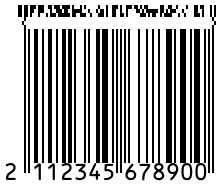
A picture of the international Scan Code
UPC (Universal Product Code):
- 12 numeric digits, standard in North America
- Integrates with POS systems for instant pricing and stock lookup
EAN (European Article Number):
- 8 or 13 digits for global markets
- Compatible with international retail systems
Thin/Small Surface Guidance:
- GS1 DataBar variants encode additional product data without enlarging the label footprint.
- Ideal for small consumer goods, cosmetic vials, or pharmaceutical samples.
Advantages:
- Sub-second scanning speed
- Established global standards
- Low printing costs
- Broad hardware compatibility
- Trend: Many retailers now pair 1D codes with 2D QR or Data Matrix codes for richer data capture and digital engagement.
Supply Chain & Logistics Codes
Logistics environments demand durability, flexibility, and high-density labeling.
Code 128:
- Full ASCII set, compact for small labels
- Suitable for cartons, pallets, and narrow shipping labels
ITF (Interleaved 2 of 5):
- Reliant on corrugated cardboard
- Common in distribution centers for large volume shipments
Thin/Small Surface Guidance:
- Compact high-density codes reduce label size while maintaining readability.
- Conveys more information in a smaller space, saving costs and reducing errors.
Industrial & Healthcare Codes
Code 39: Popular in the automotive sector for durable labeling.
Codabar: Widely used for blood banks, medical vials, and inventory labels.
Thin/Small Surface Guidance:
- High-resolution printing ensures readability on micro-components.
- Supports compliance and traceability in regulated environments.
Advantages:
- Serialized tracking
- Reduced human entry errors
- Regulatory compliance
Compact & Specialty Linear Codes
GS1 DataBar: Encodes product data like expiration dates, lot numbers, and weight on small labels.
MSI Plessey: Common in inventory tracking and small retail items.
Applications for thin/small surfaces:
- Small consumables, sample packaging, or micro-products benefit from compact formats.
- Labels remain scannable without increasing footprint.
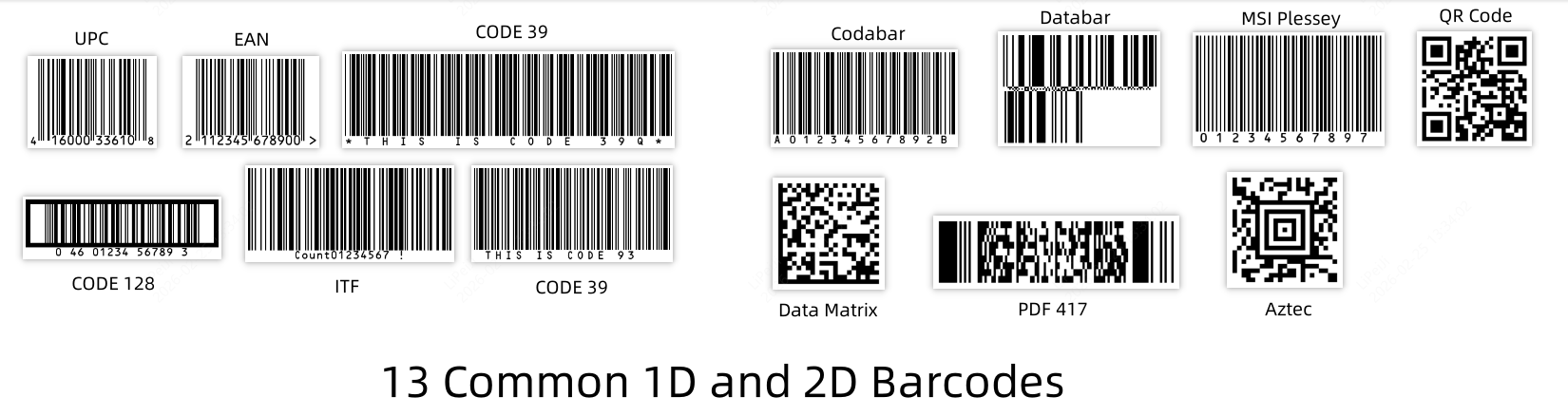
A picture of 13 Common 1D and 2D Barcodes
High-Capacity Matrix Codes
Consumer-Facing & Marketing Codes
QR Codes:
- Store URLs, contact info, and promotions
- Natively scanned by smartphones
- Bridges physical packaging and digital content
Thin/small surface guidance:
- Mini QR Codes allow applications on tiny labels, sample packs, or curved packaging.
- Error correction ensures readability even if damaged or partially obstructed.
Industrial Traceability Codes
Data Matrix:
- Space-efficient for tiny parts in electronics and medical devices
- Maintains readability on curved, reflective, or laser-etched surfaces
Thin/small surface guidance:
- Millimeter-scale modules make it ideal for micro-components
- Ensures lifetime traceability and compliance
Government & Identification Codes
PDF417: Stores large structured datasets for IDs, licenses, and permits.
Aztec Code: Performs well on mobile tickets, ID cards, and curved surfaces.
Thin/small surface guidance:
Compact Aztec or PDF417 codes fit in a limited space without losing readability or data integrity.
1D vs. 2D Scan Codes - Key Technical Differences
Data Capacity:
- 1D: Numeric or short alphanumeric
- 2D: Thousands of characters, serialized data, URLs
Error Detection & Correction:
- 1D: Check digits
- 2D: Advanced algorithms for damage resilience
Hardware Requirements:
- Laser scanners: 1D only
- Imaging scanners: 1D & 2D
- Smartphones: Primarily 2D
Print Surface Considerations:
- Corrugated cardboard: ITF
- Micro-components: Data Matrix
- Glossy/curved: High-error-tolerance 2D codes
How to Choose the Right Scan Code
By Industry:
- Retail: Speed and POS integration
- Healthcare: Traceability and compliance
- Logistics: Durability
- Government: Data density and security
By Data Needs:
- Simple product IDs: 1D
- Batch tracking, serialization, or digital interaction: 2D
By Scanning Environment:
- High-speed checkout, warehouse lighting, outdoor conditions
- Thin, curved, or reflective surfaces require error-tolerant, high-resolution codes
By Future Scalability:
- 2D formats reduce the risk of relabeling and support richer data ecosystems
- Micro-components, pharmaceuticals, and high-value electronics benefit most from forward-looking choices
Emerging Trends
- 2D at Retail POS: Enables richer product data without sacrificing speed.
- Smart Packaging: Web-enabled codes allow dynamic content updates without new labels.
- Unified Data Standards: Standardized encoding frameworks improve global interoperability.
- Micro-Labeling: High-density codes for thin, curved, or tiny components are increasingly necessary.
FAQs
1. What are the different types of scan codes?
Scan codes can be grouped into three main types: linear (1D), matrix (2D), and hybrid/composite codes. Linear codes store data along a single horizontal axis and are best for numeric or short alphanumeric data. Matrix codes encode data both horizontally and vertically, offering higher capacity and built-in error correction, making them ideal for small surfaces or micro-components.
Hybrid codes combine 1D and 2D elements, balancing legacy scanner compatibility with modern data needs.
2. Which is better for QR codes, SVG or PNG?
SVG (Scalable Vector Graphics) is generally preferred for QR codes because it can be resized infinitely without losing quality, ensuring that the QR code remains scannable at any size, even on micro-packaging or curved surfaces.
PNG is a raster format, which can become pixelated when scaled up, potentially making the code unreadable.
For printing or labeling on small, thin surfaces, SVG provides sharper edges and more reliable scanning across different printers and substrates.
3. What are the five types of scanners?
The five main types of barcode scanners are laser scanners, linear imaging scanners, 2D area imaging scanners, CCD (charge-coupled device) scanners, and smartphone-based scanners.
Laser scanners read 1D codes using a laser beam and are fast for retail environments. 2D imaging scanners can read both linear and matrix codes and are suitable for mobile or industrial applications.
CCD scanners use an array of sensors to capture the code image and are often used in POS systems. Smartphone scanners use built-in cameras and software to decode QR and 2D codes, offering mobility and flexibility.
Final Thoughts
Choosing the right type of scan code is strategic. On thin or micro surfaces, compact 2D codes like Data Matrix or GS1 DataBar provide readability, traceability, and data density.
Across industries, selecting the right code improves efficiency, compliance, and workflow scalability, while the wrong choice can slow operations and increase costs. Considering hardware, data needs, and surface constraints ensures smooth operations and future-proof labeling solutions.
Need to upgrade your scanning infrastructure? From rugged handhelds for logistics to fixed-mount scanners for automated lines, explore JLCMC's range of industrial barcode scanners and mounting brackets. Ensure your system can read every code at any time.
Keep Learning
The Essence of Barcode Symbology: A System of Data Encoding Rules
Introduction Most people only notice barcodes when something moves through a checkout counter or gets sorted in a warehouse. It's a quick flash of light, sometimes a beep, and then the moment is gone. But what's actually happening is more structured than it looks. A barcode is not just a visual pattern—it's a structured relationship between how data is encoded and how machines interpret it under imperfect conditions. In practice, that agreement is called a barcode symbology. And once you start looking......
Spot Common Barcode Scanner Issues Early to Prevent Business Losses
Barcode scanning sits quietly at the center of modern operations. From warehouse receiving docks to hospital inventory rooms and retail checkout counters, it enables speed, traceability, and accuracy at scale. When scanning works, workflows move seamlessly. When it doesn’t, even a small disruption can trigger inventory discrepancies, shipping delays, or reconciliation errors that ripple through the system. A recurring problem with barcode scanners rarely stems from sudden device failure. Instead, most......
Understanding 1D Barcode Technology: Types, Standards, and Applications
In today's fast-paced business environment, efficiency and accuracy are paramount. The 1D barcode, also known as a linear barcode, stands as one of the most transformative technologies in data capture and inventory management. From the checkout counters of retail stores to the complex supply chains of global logistics, these simple yet powerful codes have revolutionized how businesses track, manage, and process information. This comprehensive guide explores the world of 1D barcodes, examining their st......
Explore Barcode Scanner Types: Technology, Form Factor, and Practical Uses
If you have ever stood in a checkout line, watched a warehouse worker pull items from shelves, or seen a nurse scan a patient's wristband, you have witnessed barcode scanning in action. It is one of those technologies that has become so integrated into routine workflows that most people rarely think about what is actually happening when that red light flashes across a label. But for the people responsible for choosing, implementing, or maintaining these systems, the differences between scanner types m......
Barcode Scanner Basics: What It Is & How It Works
Originally used as a simple retail tool, barcodes have now evolved into a core technology widely applied across industries such as logistics, healthcare, manufacturing, and asset management. They play a key role in inventory management, compliance tracking, and real-time data processing, ensuring operational accuracy across various sectors. To truly understand the capabilities of barcode scanner technology, one must look beyond the printed label. The real impact comes from how quickly information is t......
Scan Code Types: What They Are & Why They Matter
Barcodes and matrix symbols quietly move products and components through every industry—from retail checkout lanes to medical equipment parts. Choosing the right scan code affects scanning speed, data accuracy, label durability, and long-term scalability. Some codes excel at rapid retail scanning. Others are engineered for tiny or curved surfaces, like surgical instruments, electronics, or micro-packaging. The right type ensures readable codes even when space is limited, or labels are damaged, while t......