2D Barcode: The Complete Guide to Modern Data Encoding
7 min
- What Is a 2D Barcode?
- How Do 2D Barcodes Work?
- Types of 2D Barcodes
- Key Benefits of 2D Barcodes
- Industry Applications
- The Future of 2D Barcode Technology
- Frequently Asked Questions
In today's digital-first world, the 2D barcode has become an indispensable tool for businesses, consumers, and industries worldwide. In contrast to traditional linear barcodes, 2D barcodes encode data both horizontally and vertically, allowing them to store much larger amounts of information in a smaller, more compact format. From QR codes on restaurant menus to Data Matrix codes on pharmaceutical packaging, these sophisticated data carriers are transforming how we access, share, and manage information.
To master this innovation, reviewing the 1D Barcode's logic is vital for selecting optimal encoding strategies across applications. Whether using high-density 2D codes or classic linear tracking, JLCMC Barcode Scanners provide the essential high-performance hardware for precise data capture. Explore our series to secure your digital transformation with industrial-grade speeds and superior decoding algorithms.
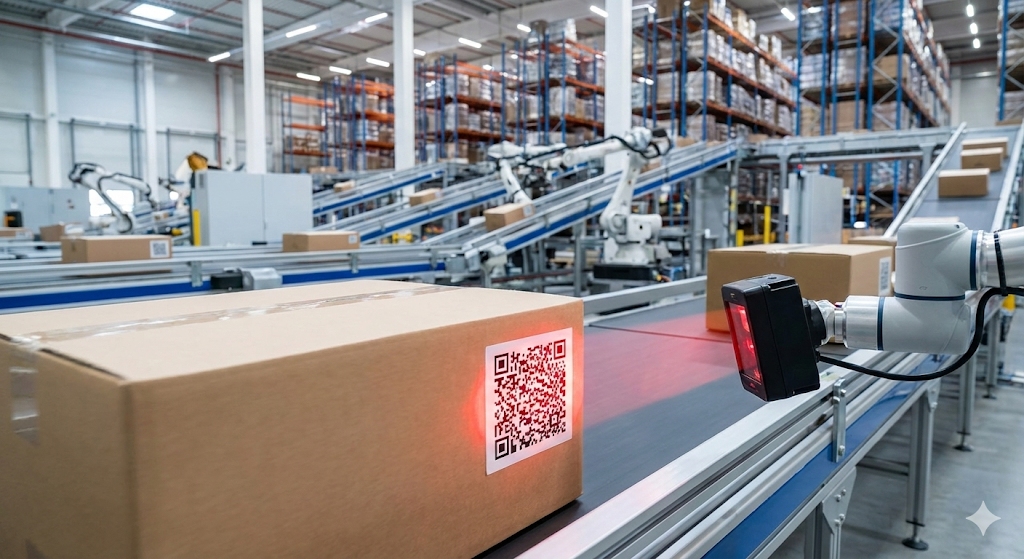
The barcode scanner scans the 2D barcode on the package to classify it.
What Is a 2D Barcode?
A 2D barcode (two-dimensional barcode) is a machine-readable optical label that encodes information in both horizontal and vertical directions. Unlike 1D barcodes, which store data in a single linear pattern, 2D barcodes use a combination of squares, dots, hexagons, and other geometric shapes to represent data across two dimensions. This innovative design allows 2D barcodes to store up to 7,089 numeric characters or 4,296 alphanumeric characters—far exceeding the 20-25 character limit of traditional linear barcodes.
The most widely used types of 2D barcodes are QR codes (Quick Response codes), Data Matrix codes, PDF417, and Aztec codes. Each of these barcode types provides distinct benefits, depending on the specific application, scanning conditions, and the amount of data that needs to be stored. QR codes, for instance, have gained massive popularity due to their fast readability and ability to store URLs, contact information, and even Wi-Fi credentials.
How Do 2D Barcodes Work?
The functionality of a 2D barcode relies on sophisticated encoding algorithms that convert data into visual patterns. When a barcode scanner or smartphone camera captures the image, specialized software analyzes the pattern, decodes the information, and presents it to the user. The process includes several crucial components:
1. Data Encoding: Information is converted into a binary format and arranged in a two-dimensional grid pattern
2. Error Correction: Advanced algorithms add redundancy, allowing successful scanning even if part of the code is damaged or obscured
3. Pattern Recognition: Scanners use image sensors to capture and analyze the geometric patterns
4. Decoding: Software translates the visual patterns back into readable data
Modern smartphones have democratized 2D barcode scanning, eliminating the need for specialized hardware. Built-in cameras combined with free scanning applications have made QR codes accessible to billions of users globally, driving their adoption in marketing, payments, and information sharing.
Types of 2D Barcodes
QR Code (Quick Response Code)
Developed by Denso Wave in 1994, QR codes are the most widely recognized 2D barcode format. Their distinctive square shape with three positioning markers in the corners enables rapid scanning from any angle. QR codes can store URLs, text, contact cards, calendar events, and even encrypted data, making them incredibly versatile for marketing campaigns, product authentication, and contactless payments.
Data Matrix
Data Matrix codes feature a square or rectangular pattern of black and white cells arranged in a grid. They excel in applications requiring small, high-density codes, such as marking electronic components, pharmaceutical packaging, and aerospace parts. Their robust error correction capabilities make them ideal for harsh industrial environments.
PDF417
PDF417 (Portable Data File) is a stacked linear barcode that resembles multiple 1D barcodes layered on top of each other. It can store over 1,800 bytes of data and is commonly used on driver's licenses, boarding passes, and shipping labels. Its linear structure makes it compatible with traditional laser scanners while offering 2D data capacity.
Key Benefits of 2D Barcodes
Higher Data Capacity: 2D barcodes store exponentially more information than 1D alternatives, eliminating the need for multiple barcodes or external databases.
Error Correction: Advanced Reed-Solomon error correction allows 2D barcodes to be read even when partially damaged, dirty, or obscured.
Omni-Directional Scanning: Unlike 1D barcodes that require precise alignment, 2D codes can be scanned from any angle, improving efficiency and user experience.
Smartphone Compatibility: Built-in cameras on mobile devices can scan 2D barcodes without additional hardware, reducing implementation costs.
Enhanced Security: 2D barcodes support encryption and digital signatures, making them suitable for secure applications like authentication and access control.
Industry Applications
The versatility of 2D barcode technology has led to widespread adoption across diverse industries. In retail and e-commerce, QR codes enable seamless mobile payments, product information access, and loyalty program enrollment. Healthcare organizations use Data Matrix codes for patient identification, medication tracking, and medical device management, improving safety and regulatory compliance.
Manufacturing and logistics companies leverage 2D barcodes for inventory management, asset tracking, and supply chain visibility. The aerospace and automotive industries rely on durable Data Matrix markings for part traceability throughout the product lifecycle. Marketing professionals use creatively designed QR codes to bridge offline and online experiences, driving engagement through interactive campaigns, augmented reality experiences, and social media connections.
The Future of 2D Barcode Technology
As technology continues to evolve, 2D barcode applications are expanding into new frontiers. The integration of blockchain technology with QR codes is creating tamper-proof supply chain tracking systems. Artificial intelligence is enhancing barcode scanning capabilities, enabling faster and more accurate reads in challenging conditions. The emergence of GS1 Digital Link standards is transforming traditional barcodes into web-enabled connections, allowing a single code to provide different information depending on the scanning context.
Contactless interactions accelerated by global health concerns have permanently shifted consumer behavior toward digital solutions. 2D barcodes are at the forefront of this transformation, enabling touch-free menus, payments, check-ins, and information access. As businesses continue to prioritize efficiency, security, and customer experience, the adoption of 2D barcode technology will only accelerate across industries worldwide.
Frequently Asked Questions
Q: What is the difference between 1D and 2D barcodes?
A: 1D barcodes encode data in horizontal lines of varying widths, with a capacity to store only 20-25 characters. In contrast, 2D barcodes store information both horizontally and vertically through geometric patterns, allowing them to hold thousands of characters, including text, URLs, and binary data. Furthermore, 2D barcodes feature error correction and can be scanned from any direction, offering greater flexibility and reliability.
Q: Can any smartphone scan 2D barcodes?
A: Most modern smartphones can scan 2D barcodes like QR codes using the built-in camera app or free scanning applications. iPhones running iOS 11 and later have native QR scanning capability in the Camera app. Android devices typically require a dedicated QR scanner app, though many newer models include native scanning features.
Q: How much data can a 2D barcode store?
A: Storage capacity varies by barcode type. QR codes can store up to 7,089 numeric characters, 4,296 alphanumeric characters, or 2,953 bytes of binary data. Data Matrix codes can hold up to 3,116 numeric or 2,335 alphanumeric characters. PDF417 codes can store up to 1,850 ASCII characters or 2,725 digits.
Q: Are 2D barcodes secure?
A: 2D barcodes themselves are not inherently secure as the data is visible and can be read by anyone with a scanner. However, they can be used securely by encoding encrypted data, digital signatures, or URLs that lead to authenticated systems. For sensitive applications, additional security measures like encryption, access controls, and time-limited tokens should be implemented.
Q: What industries benefit most from 2D barcode technology?
A: Healthcare, manufacturing, logistics, retail, and marketing industries benefit significantly from 2D barcodes. Healthcare uses them for patient safety and medication tracking. Manufacturing employs them for part traceability and quality control. Logistics companies rely on them for package tracking. Retailers use them for inventory management and mobile payments. Marketing teams leverage QR codes for customer engagement campaigns.
Q: Can 2D barcodes be damaged and still work?
A: Yes, thanks to built-in error correction algorithms (typically Reed-Solomon), 2D barcodes can often be read even when partially damaged, dirty, or obscured. QR codes have four error correction levels (L, M, Q, H) that can recover data even if up to 30% of the code is unreadable. Higher error correction levels increase reliability but reduce data capacity.
Keep Learning
The Essence of Barcode Symbology: A System of Data Encoding Rules
Introduction Most people only notice barcodes when something moves through a checkout counter or gets sorted in a warehouse. It's a quick flash of light, sometimes a beep, and then the moment is gone. But what's actually happening is more structured than it looks. A barcode is not just a visual pattern—it's a structured relationship between how data is encoded and how machines interpret it under imperfect conditions. In practice, that agreement is called a barcode symbology. And once you start looking......
Spot Common Barcode Scanner Issues Early to Prevent Business Losses
Barcode scanning sits quietly at the center of modern operations. From warehouse receiving docks to hospital inventory rooms and retail checkout counters, it enables speed, traceability, and accuracy at scale. When scanning works, workflows move seamlessly. When it doesn’t, even a small disruption can trigger inventory discrepancies, shipping delays, or reconciliation errors that ripple through the system. A recurring problem with barcode scanners rarely stems from sudden device failure. Instead, most......
Understanding 1D Barcode Technology: Types, Standards, and Applications
In today's fast-paced business environment, efficiency and accuracy are paramount. The 1D barcode, also known as a linear barcode, stands as one of the most transformative technologies in data capture and inventory management. From the checkout counters of retail stores to the complex supply chains of global logistics, these simple yet powerful codes have revolutionized how businesses track, manage, and process information. This comprehensive guide explores the world of 1D barcodes, examining their st......
Explore Barcode Scanner Types: Technology, Form Factor, and Practical Uses
If you have ever stood in a checkout line, watched a warehouse worker pull items from shelves, or seen a nurse scan a patient's wristband, you have witnessed barcode scanning in action. It is one of those technologies that has become so integrated into routine workflows that most people rarely think about what is actually happening when that red light flashes across a label. But for the people responsible for choosing, implementing, or maintaining these systems, the differences between scanner types m......
Barcode Scanner Basics: What It Is & How It Works
Originally used as a simple retail tool, barcodes have now evolved into a core technology widely applied across industries such as logistics, healthcare, manufacturing, and asset management. They play a key role in inventory management, compliance tracking, and real-time data processing, ensuring operational accuracy across various sectors. To truly understand the capabilities of barcode scanner technology, one must look beyond the printed label. The real impact comes from how quickly information is t......
Scan Code Types: What They Are & Why They Matter
Barcodes and matrix symbols quietly move products and components through every industry—from retail checkout lanes to medical equipment parts. Choosing the right scan code affects scanning speed, data accuracy, label durability, and long-term scalability. Some codes excel at rapid retail scanning. Others are engineered for tiny or curved surfaces, like surgical instruments, electronics, or micro-packaging. The right type ensures readable codes even when space is limited, or labels are damaged, while t......