Conveyor Belt Dimensions and Practical Guidelines for Effective Replacements
9 min
- Replacement projects expose what the original sizing overlooked
- Conveyor belt width issues rarely show up immediately
- Conveyor belt length becomes a constraint during retrofits
- Belt speed and capacity mismatches become visible at replacement
- Tension problems are often misdiagnosed as belt quality issues
- Material evolution quietly invalidates original assumptions
- Structural constraints limit how much "same size" really means
- Why is replacement the best moment to revisit sizing
- A pattern that repeats more often than expected
- Upgrade Your Operations with JLCMC Conveyor Belt Replacement
- Frequently Asked Questions for Conveyor Belt Dimensions
The conversations usually start the same way.
A client reaches out because a conveyor belt needs replacing. The old one wore out too quickly, or it started drifting, or throughput never quite matched expectations. They're not redesigning the system—they just want a "same spec" replacement.
And that's where things tend to go wrong.
Because in many of these cases, the original conveyor belt dimensions were never fully aligned with how the system actually operates today.
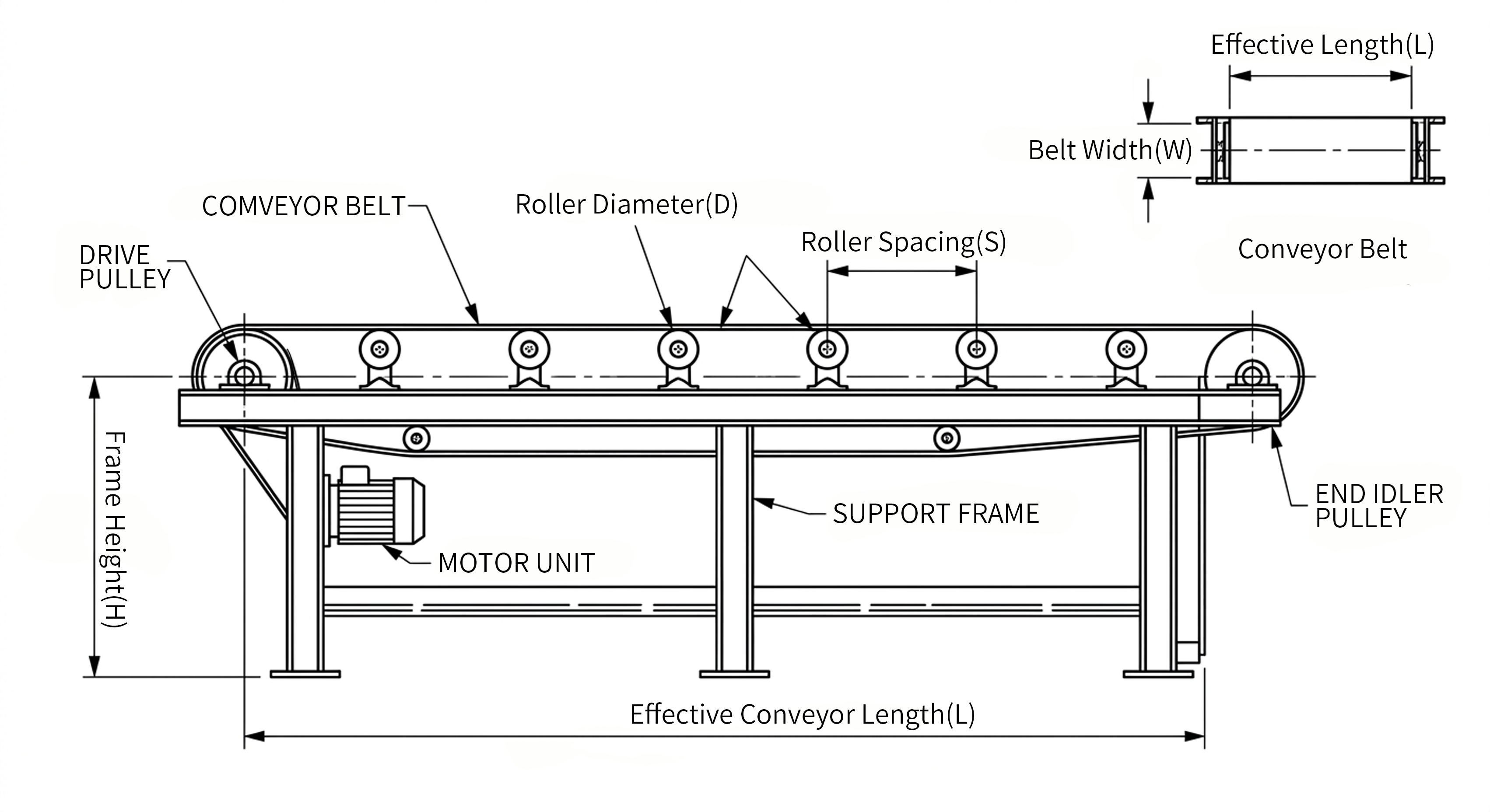
Replacement projects expose what the original sizing overlooked
What looks like a simple swap is often the first real audit of the system.
Before even touching calculations, I usually try to reconstruct the original logic:
- What throughput was the system designed for?
- What material assumptions were made?
- What belt width and speed were chosen to support that?
Most of the time, that logic is either missing or outdated.
So instead of jumping straight into ordering a belt, it helps to re-anchor the discussion in one equation:
Q = ρ × A × v
This is still the backbone of conveyor belt sizing, even in replacement scenarios.
- Q (throughput) is often higher today than at commissioning
- ρ (bulk density) may have shifted with suppliers or moisture
- v (belt speed) is usually fixed by the drive system
Which leaves A—the cross-sectional area—as the only adjustable variable.
And A is directly tied to conveyor belt width and trough geometry.
Conveyor belt width issues rarely show up immediately
A replacement request that specifies "same width" deserves a second look.
Because belt width is not just a number—it defines how material occupies space.
For troughed conveyors, the usable cross-sectional area A is typically approximated as:
A ≈ k × B²
Where:
- B = belt width
- k = coefficient based on trough angle and material surcharge angle
Typical k values (rough reference):
| Trough Angle | k Value Range |
| 20° | 0.06 – 0.08 |
| 35° | 0.08 – 0.11 |
| 45° | 0.10 – 0.14 |
So a small increase in width produces a nonlinear gain in capacity.
But in replacement projects, the more critical check is not capacity—it's stability.
A practical constraint often overlooked:
Belt width ≥ 3–5 × maximum lump size
If production has introduced larger particles over time, the original width may now sit below this threshold. That's when you start seeing:
- edge spillage
- asymmetric loading
- accelerated edge wear
So even if the theoretical capacity is sufficient, the effective conveyor belt dimensions are no longer adequate.
Conveyor belt length becomes a constraint during retrofits
Length tends to be treated as fixed. In reality, it's one of the first constraints you run into during replacement.
The standard length formula for a two-pulley system is:
L = 2C + (π/2)(D + d) + (D − d)² / (4C)
Where:
- C = center distance
- D, d = pulley diameters
This gives a baseline. But replacement work happens in a system that has already aged.
So we need to layer in real-world adjustments:
1. Elastic stretch under tension
Delta_L_elastic = (T * L) / (E * A_belt)
2. Permanent elongation (creep)
Delta_L_creep ≈ L * creep_rate
Typical:
creep_rate = 0.002 to 0.005 (i.e., 0.2% – 0.5%)
So:
Delta_L_creep ≈ L * (0.002 ~ 0.005)
Where:
- Delta_L_creep = permanent elongation (m)
- L = original length (m)
3. Thermal expansion (if exposed)
Delta_L_thermal = alpha * L * Delta_T
Where:
- Delta_L_thermal = thermal elongation (m)
- alpha = coefficient of thermal expansion (1/°C)
- L = original length (m)
- Delta_T = temperature change (°C)
4. Total elongation
Delta_L_total = Delta_L_elastic + Delta_L_creep + Delta_L_thermal
Rule of thumb for take-up allowance:
- Short conveyors: ≥ 1% of center distance
- Long conveyors: 2–3% or more
If the existing take-up system cannot absorb these variations, even a correctly calculated conveyor belt length will fail in practice.
Belt speed and capacity mismatches become visible at replacement
When a new belt is installed, the system loses its "adapted state."
Operators often discover that throughput and stability no longer align.
To reassess, it helps to rearrange the capacity equation:
v = Q / (ρ × A)
This gives the required belt speed for a given width.
Then compare it to the actual operating speed.
Typical engineering ranges:
- Light packages: 0.5 – 1.5 m/s
- Bulk solids: 1 – 4 m/s
- High-speed logistics: > 5 m/s
If the required speed exceeds these ranges, the system is relying on unstable behavior.
That's often why replacement belts appear to “underperform”—they're simply operating closer to physical limits.
Tension problems are often misdiagnosed as belt quality issues
When clients say a new belt "doesn't last," tension is usually involved.
The fundamental relationship:
T₁ / T₂ = e^(μθ)
But for replacement projects, we need to go one step further and estimate total belt tension:
T_total = T_friction + T_lift + T_acceleration
Where:
- T_friction = resistance from idlers, belt, and material
- T_lift = ρ × g × H (if there is elevation)
- T_acceleration = m × a (during startup)
Motor power then follows:
P = T_total × v
What changes during replacement is not just the belt, but how these forces distribute.
A slightly different belt stiffness or surface condition can shift load sharing, especially if the original conveyor belt dimensions were already marginal.
Material evolution quietly invalidates original assumptions
Replacement decisions often assume material consistency. That assumption rarely holds.
To reconnect material properties with conveyor belt sizing, focus on:
- Bulk density (ρ): directly affects Q
- Surcharge angle: affects cross-sectional area A
- Moisture: influences flowability and adhesion
For example:
- Higher moisture → lower effective A (material spreads less)
- Wider particle distribution → higher packing efficiency
These shifts change the real capacity without changing nominal dimensions.
A quick field check—observing how material settles on a stopped belt—can reveal whether original assumptions still apply.
Structural constraints limit how much "same size" really means
Even if the belt dimensions are unchanged, supporting structures redefine how those dimensions behave.
Two quick checks that often get skipped:
1. Idler spacing vs. belt sag
Approximate sag ratio:
Sag ≈ (w × l²) / (8 × T)
Where:
- w = load per unit length
- l = idler spacing
- T = belt tension
Excessive sag reduces effective cross-section and alters material distribution.
2. Pulley diameter vs. belt thickness
Minimum pulley diameter is typically proportional to belt thickness and construction.
If a replacement belt differs slightly in construction, existing pulleys may no longer be ideal—affecting fatigue life.
Why is replacement the best moment to revisit sizing
A full redesign is rarely necessary. But a partial recalculation often is.
A practical revalidation workflow looks like this:
Step 1 — Reconfirm throughput (Q)
Use actual production data, not design values
Step 2 — Estimate current material parameters (ρ, lump size)
Even rough field estimates are useful
Step 3 — Back-calculate required area (A)
A = Q / (ρ × v)
Step 4 — Check against existing belt width (B)
Using trough-based area relationships
Step 5 — Verify tension and take-up capacity
Ensure the system can support real loads
This takes a few hours, not weeks—but it often explains years of recurring issues.
A pattern that repeats more often than expected
Replacement requests come in as product questions: "What belt should we use?"
But once you run even a light check on conveyor belt dimensions, the conversation shifts:
- Is the width still appropriate for the current material?
- Is the length compatible with actual system behavior?
- Is the speed aligned with physical limits?
Most systems don't fail because a belt wears out.
They struggle because the dimensions stopped matching reality—and no one revisited them when it mattered.
Replacement just happens to be the moment when that mismatch becomes impossible to ignore.
Upgrade Your Operations with JLCMC Conveyor Belt Replacement
The efficiency, safety, and reliability are the backbone of every production line. A worn or outdated conveyor belt can slow operations, increase maintenance costs, and risk downtime.
At JLCMC, we provide high-quality conveyor belt replacement solutions tailored to the specific needs of a wide range of industries, from food and beverage processing, where food-grade and hygienic belts are essential, to pharmaceuticals, packaging, logistics, and heavy manufacturing, where durability, chemical resistance, and precision are critical. Our belts are engineered to withstand demanding conditions, reduce wear on machinery, and improve energy efficiency, while our expert team ensures fast, seamless installation with minimal disruption.
Choosing JLCMC Conveyor Belt means investing in reliability, compliance, and long-term performance, keeping your operations safe, efficient, and uninterrupted across every sector.
Frequently Asked Questions for Conveyor Belt Dimensions
Why can't I just replace a conveyor belt with the "same width" as the old one?
Belt width affects both capacity and material stability. Over time, particle size or moisture content may change, making the original width insufficient to prevent spillage or uneven loading. When replacing, always check current material characteristics and production requirements instead of relying solely on the old spec.
What factors should I consider when determining conveyor belt length for a replacement?
Belt length depends on center distance and pulley diameters, but real-world factors like elastic stretch, permanent elongation (creep), and thermal expansion also matter. Total elongation must be accommodated by the take-up system; otherwise, even a correctly calculated belt may slip or run too tight.
How do I know if my belt speed is adequate for the current throughput?
Use the formula v=Q/(ρ×A)v = Q / (ρ × A)v=Q/(ρ×A), where Q is actual throughput, ρ is material density, and A is the effective cross-sectional area. If the required speed exceeds safe operating limits, the belt may appear to underperform, indicating a need to adjust width or cross-section rather than just replacing the belt.
Why does a new belt wear out quickly, even if it's high quality?
Belt wear is often related to tension and load distribution rather than material quality. Friction, lift, and acceleration forces can accelerate edge wear if the system is marginally sized. When replacing, re-evaluate total tension and system capacity to ensure the new belt achieves its expected lifespan.
Keep Learning
Leveling Casters: Load Transfer and Workbench Setup
Key Takeaways Load Separation: Assess rolling loads and stationary support loads separately; a general capacity label does not explain every operating condition. Total Weight Sizing: Include the bench, equipment, fixtures and maximum payload in the load estimate. Corner Reaction Differences: Four installed casters do not guarantee four equal reactions, especially on uneven floors or with equipment concentrated at one end. Mounting & Clearance Checks: Check adjustment access, wheel sweep and pad cleara......
How to Identify V Belts and Their Types to Improve Factory Automation Efficiency
What Is a V-Belt? A V-belt is a flexible power transmission belt with a trapezoidal (V-shaped) cross-section. It transmits torque through the friction generated between the belt’s sidewalls and the grooves of a pulley. Typically constructed from rubber compounds reinforced with fiber or steel cords, V-belts combine strength with flexibility. They are designed to improve transmission efficiency, reduce slippage, and dampen vibration and noise. As a result, V-belts are widely used in applications such a......
How to Tension a Belt: Exact Methods for Peak Drive Performance
Belt tensioning is the single variable that determines whether a power transmission system operates efficiently or consumes itself from the inside out. Get it wrong, and the damage extends far beyond the belt itself—bearings overload, pulleys wear unevenly, and shaft seals begin leaking. There is no warning siren before a belt snaps; the first indication of trouble is often slippage under load or the acrid smell of overheated rubber. By that point, the failure has already propagated through the drive ......
Types of Conveyor Belt in Warehouse Operations Across Industries
A few years ago, I walked through a mid-sized distribution center in the Midwest that had just finished its first automation retrofit. What struck me wasn't the robotics or the software dashboards—it was the conveyor belt. Hundreds of meters of it, running at different speeds, handling everything from fasteners to equipment hardware, all while the floor manager tracked throughput on a tablet. That single piece of equipment, often overlooked, turned out to be the backbone of the entire operation. Conve......
V-Belt Measurement for Accurate Sizing and Replacement
A V-belt is a power transmission belt with a V-shaped cross-section that efficiently transmits motion between pulleys through wedging friction. How to Measure a V-Belt (Vee Belt) Beginners often make several common mistakes when measuring V-belt size, such as estimating length by folding the belt, using a simple ruler for approximate measurement, ignoring the belt cross-section, or measuring the belt in a slack condition. These are incorrect practices and can lead to improper belt selection or even da......
Best Conveyor Belt Materials & Their Uses
Conveyor belts are the backbone of modern manufacturing and distribution, silently driving efficiency across countless operations. But their performance isn't just about motors or pulleys—it hinges on one critical factor: the material used for conveyor belt construction. Choosing the wrong conveyor belt material can quickly lead to operational headaches—premature wear, product damage, contamination risks, and soaring maintenance costs. A conveyor belt works under constant stress. It bends around pulle......