How to Identify V Belts and Their Types to Improve Factory Automation Efficiency
5 min
- What Is a V-Belt?
- Internal Structure and Material Selection
- How a V-Belt Works
- Main Types of V-Belts
- Choose JLCMC Industrial V-Belts for Efficient Automation
- Frequently Asked Questions
- Conclusion
What Is a V-Belt?
A V-belt is a flexible power transmission belt with a trapezoidal (V-shaped) cross-section. It transmits torque through the friction generated between the belt’s sidewalls and the grooves of a pulley. Typically constructed from rubber compounds reinforced with fiber or steel cords, V-belts combine strength with flexibility.
They are designed to improve transmission efficiency, reduce slippage, and dampen vibration and noise. As a result, V-belts are widely used in applications such as automotive engines, industrial fans, pumps, and machine tools. With today’s diverse industrial environments, different types of V-belts can be selected to match specific application requirements.
Internal Structure and Material Selection
Using a conventional V-belt as an example, its internal structure generally consists of four layers:
- Top Layer (Cover Fabric): Acts as a protective layer to resist oil contamination, abrasion, and environmental wear.
- Tension Layer (Tensile Member): Typically made of polyester cords or aramid fibers, aligned longitudinally to carry the load.
- Rubber Body (Compression Section): Usually composed of neoprene or EPDM rubber compounds, providing flexibility and grip.
- Bottom Layer (Contact Surface): Interfaces with the pulley to transmit power.
This design balances strength and traction. However, some heavy-duty V-belts use reinforced fabric or raw-edge (unwrapped) sidewalls instead of a fabric cover. While this increases grip, it reduces resistance to environmental damage.
Material selection is critical. EPDM offers superior heat resistance, while neoprene provides better oil resistance. Choosing the wrong material for the operating environment can cause the belt to harden or swell within just a few months.
How a V-Belt Works
A V-belt operates by wedging into the groove of a pulley. The sidewalls of the belt press firmly against the pulley walls, generating a frictional force. This wedging action significantly increases grip compared to flat belts.
As belt tension increases, the wedging effect becomes stronger, allowing higher torque transmission with reduced risk of slipping. However, excessive tension can shorten belt life and overload bearings.
Main Types of V-Belts
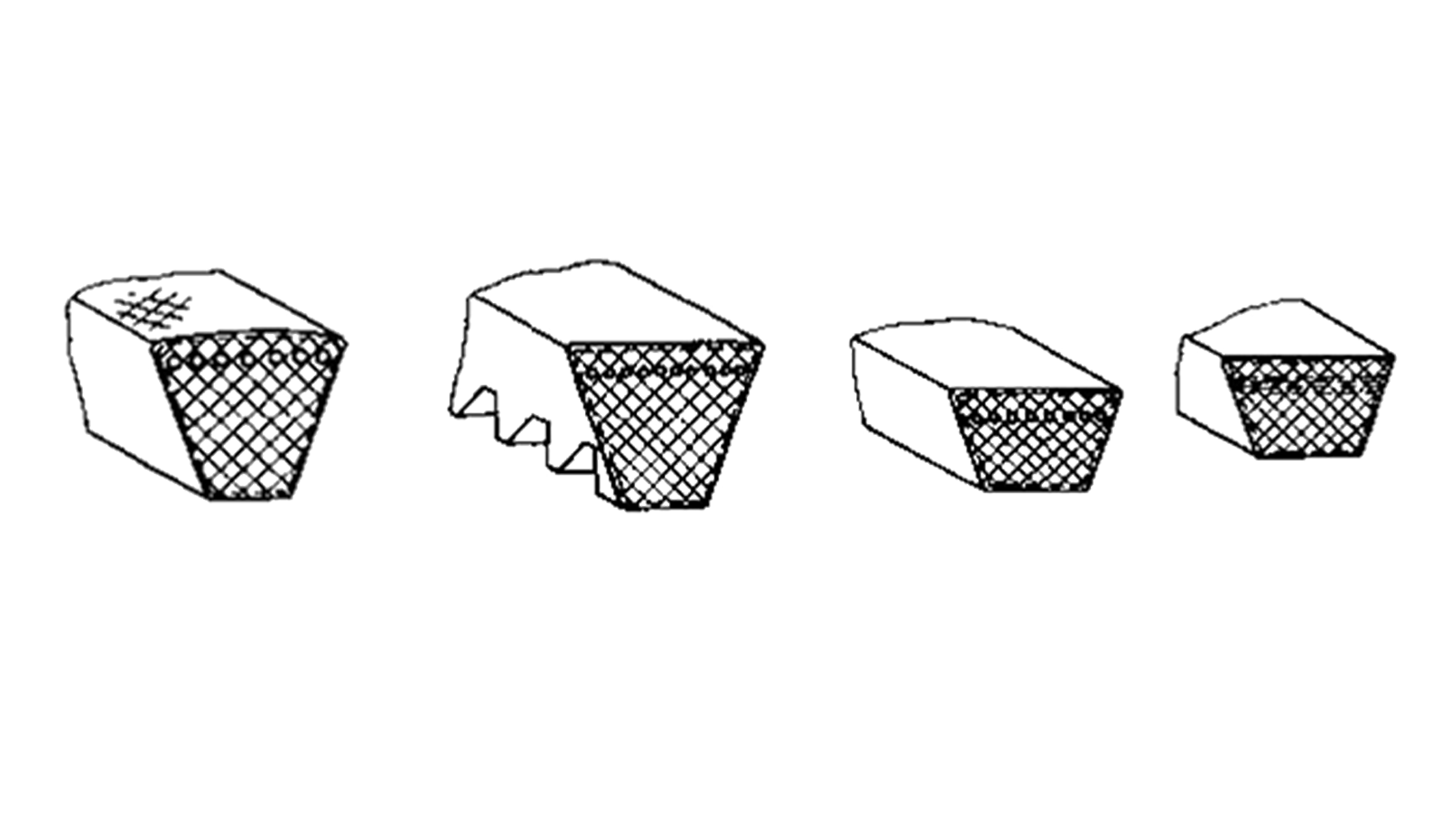
In industrial applications, V-belts are commonly classified into the following categories:
- Classical V-Belts (A, B, C, D, E sections): Features a wider top and deeper cross-section. Suitable for general-purpose drives but require more space and are less efficient than newer designs.
- Narrow Wedge V-Belts (SPZ, SPA, SPB, SPC): Designed with steeper sidewall angles and narrower tops, allowing higher power transmission in a more compact space. Ideal for smaller pulleys and higher torque applications.
- Fractional Horsepower (FHP) V-Belts (3L, 4L, 5L): Lightweight belts used in low-power applications (typically under 1 HP), such as fans and small appliances. They resemble scaled-down classical belts but cannot handle heavy loads.
- Double-Sided V-Belts: Feature V-shaped profiles on both sides, enabling them to drive multiple pulleys simultaneously. Suitable for serpentine or compact drive systems, such as textile machinery or packaging lines, where shafts rotate in opposite directions.
- Variable Speed V-Belts: Characterized by a wider and thinner cross-section, designed for adjustable-pitch pulleys. Commonly used in machine tools, gym equipment, and conveyors to vary speed ratios by changing the effective pulley diameter.
Choose JLCMC Industrial V-Belts for Efficient Automation
JLCMC provides a comprehensive range of industrial V-belt for factory automation, including:
- Classical V-belts (A/B/C/D/E)
- Narrow V-belts (SPZ/SPA/SPB/SPC and 3V/5V/8V series)
- Cogged V-belts (XPZ/XPA/XPB/XPC and NX series)
- Fractional horsepower V-belts (Z/Y types)
These belts offer excellent wear resistance, stable transmission efficiency, and extended service life. They are suitable for applications ranging from light-duty equipment to high-load transmission systems.
Contact our engineers today to find the right V-belt solution for your specific operating conditions.
Frequently Asked Questions
Can I replace a classical V-belt with a narrow wedge belt?
No. The groove angle and width differ, preventing proper seating and leading to slippage or accelerated wear.
How tight should a V-belt be?
A common rule of thumb is to press the belt at its midpoint using moderate thumb pressure. The deflection should be approximately 1% of the center distance. For multi-belt drives, using a belt tension gauge is highly recommended.
Why does my belt squeal during startup?
This is usually caused by insufficient tension, worn pulley grooves, or contamination. Oil or grease on the sidewalls can quickly reduce friction.
What is the typical lifespan of a V-belt?
Under clean conditions with proper tension, a V-belt typically lasts 3–5 years. In high-temperature, oily, or misaligned environments, lifespan may drop to around one year. If you are replacing the same belt every few months, the issue likely lies in installation or drive design rather than belt quality.
Conclusion
V-belts may not be the most eye-catching technology in industrial automation. They lack the precision of servo systems and the intelligence of connected sensors. However, they remain a mature, cost-effective solution for the majority of power transmission tasks.
In auxiliary systems, conveyors, and continuous operation environments, a properly selected V-belt is often the most practical choice. Understanding what a V-belt is—and selecting the right type—can significantly improve the safety and efficiency of factory automation systems.
Keep Learning
Leveling Casters: Load Transfer and Workbench Setup
Key Takeaways Load Separation: Assess rolling loads and stationary support loads separately; a general capacity label does not explain every operating condition. Total Weight Sizing: Include the bench, equipment, fixtures and maximum payload in the load estimate. Corner Reaction Differences: Four installed casters do not guarantee four equal reactions, especially on uneven floors or with equipment concentrated at one end. Mounting & Clearance Checks: Check adjustment access, wheel sweep and pad cleara......
How to Identify V Belts and Their Types to Improve Factory Automation Efficiency
What Is a V-Belt? A V-belt is a flexible power transmission belt with a trapezoidal (V-shaped) cross-section. It transmits torque through the friction generated between the belt’s sidewalls and the grooves of a pulley. Typically constructed from rubber compounds reinforced with fiber or steel cords, V-belts combine strength with flexibility. They are designed to improve transmission efficiency, reduce slippage, and dampen vibration and noise. As a result, V-belts are widely used in applications such a......
How to Tension a Belt: Exact Methods for Peak Drive Performance
Belt tensioning is the single variable that determines whether a power transmission system operates efficiently or consumes itself from the inside out. Get it wrong, and the damage extends far beyond the belt itself—bearings overload, pulleys wear unevenly, and shaft seals begin leaking. There is no warning siren before a belt snaps; the first indication of trouble is often slippage under load or the acrid smell of overheated rubber. By that point, the failure has already propagated through the drive ......
Types of Conveyor Belt in Warehouse Operations Across Industries
A few years ago, I walked through a mid-sized distribution center in the Midwest that had just finished its first automation retrofit. What struck me wasn't the robotics or the software dashboards—it was the conveyor belt. Hundreds of meters of it, running at different speeds, handling everything from fasteners to equipment hardware, all while the floor manager tracked throughput on a tablet. That single piece of equipment, often overlooked, turned out to be the backbone of the entire operation. Conve......
V-Belt Measurement for Accurate Sizing and Replacement
A V-belt is a power transmission belt with a V-shaped cross-section that efficiently transmits motion between pulleys through wedging friction. How to Measure a V-Belt (Vee Belt) Beginners often make several common mistakes when measuring V-belt size, such as estimating length by folding the belt, using a simple ruler for approximate measurement, ignoring the belt cross-section, or measuring the belt in a slack condition. These are incorrect practices and can lead to improper belt selection or even da......
Best Conveyor Belt Materials & Their Uses
Conveyor belts are the backbone of modern manufacturing and distribution, silently driving efficiency across countless operations. But their performance isn't just about motors or pulleys—it hinges on one critical factor: the material used for conveyor belt construction. Choosing the wrong conveyor belt material can quickly lead to operational headaches—premature wear, product damage, contamination risks, and soaring maintenance costs. A conveyor belt works under constant stress. It bends around pulle......