Pressure Angle in Gears: Design, Effects, and Selection Guide
8 min
- Introduction
- The Pressure Angle in Gears Explained
- Effect of Gear Pressure Angle on the Force Transmission
- Pressure Angle Effect on the Geometry of Gear Tooth
- Performance Trade-offs and Optimization
- Selection Criteria and Non-Standard Pressure Angle Gears
- Conclusion
- FAQs
Introduction
The pressure angle is a fundamental parameter in involute gear design, dictating the direction of force transmission between mating teeth. While it may seem like a subtle geometric detail, it exerts a decisive influence on tooth strength, bearing loads, noise levels, and overall manufacturability.
In essence, the pressure angle determines the efficiency and smoothness of motion. However, in engineering practice, this must be balanced with backlash—the clearance between mating pairs—which, alongside the pressure angle, defines the system's instantaneous responsiveness. To master precision optimization through clearance control, we recommend exploring our in-depth guide on [What Is Gear Backlash].
This reference provides a comprehensive overview of pressure angle concepts, explaining the logic behind standard values and offering actionable insights for selecting the optimal angle for any specific application.
The Pressure Angle in Gears Explained
Geometric Definition of the Pressure Angle in Gears
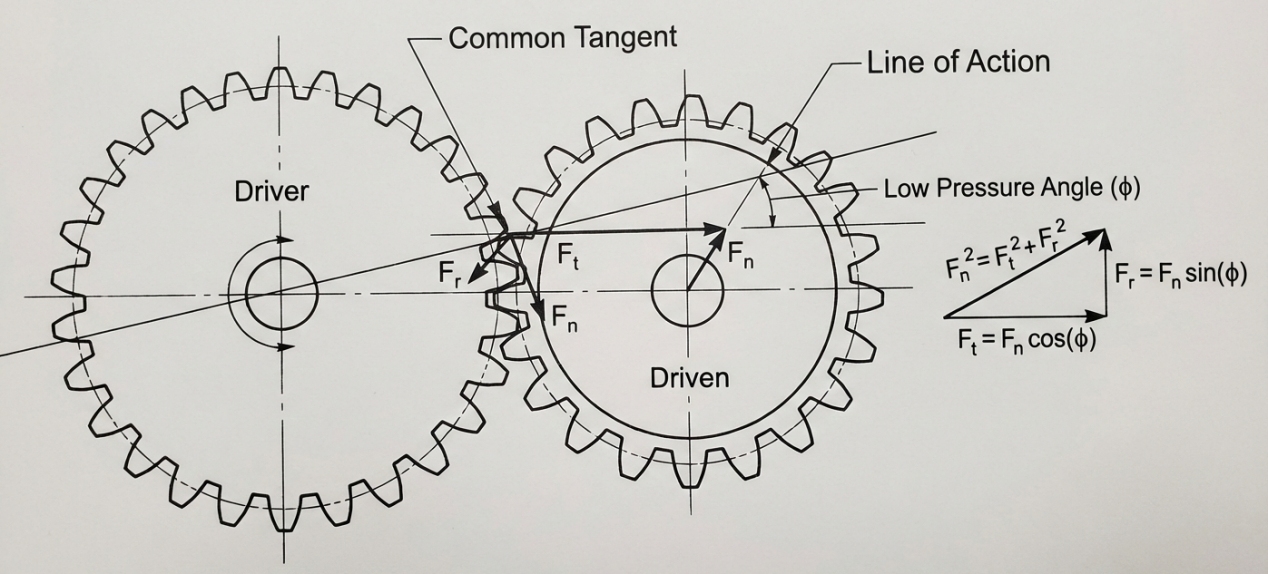
In gears, the angle pitch is the angle between the line of action (also referred to as pressure or simply power) and a plane tangent to the pitch surface.
The line of action is the direction along which force is transmitted from one gear tooth to another. Since involute gears transmit motion through the fixed line, the pressure angle is constant throughout engagement. This is the geometry that enables helical gears to run with a constant velocity ratio despite there being minor center distance errors.
The pressure angle, from a design standpoint, is not just an abstract number. It is the actual maximum slope along which gear teeth push on one another in operation.
Standard Pressure Angle Gear Values
Some pressure angle values have been given standard definitions over the years. Some of the most common pressure angles used in gears are 14.5° and 20°, but the 20-degree pressure angle is by far the most commonly used in modern gear design.
14.5° gears were once commonly used as they produced very smooth and quiet operation. They were prone to undercutting, especially in pinions with fewer teeth. As power density and gearbox size decreased, there was an increasing demand for stronger teeth, leading to the dominance of 20° pressure angle gears.
The 20° pressure angle gear is now the most satisfactory compromise between strength, durability, and ease of manufacture available for general-purpose industrial and automotive applications.
Effect of Gear Pressure Angle on the Force Transmission
Radial and Tangential Force Components
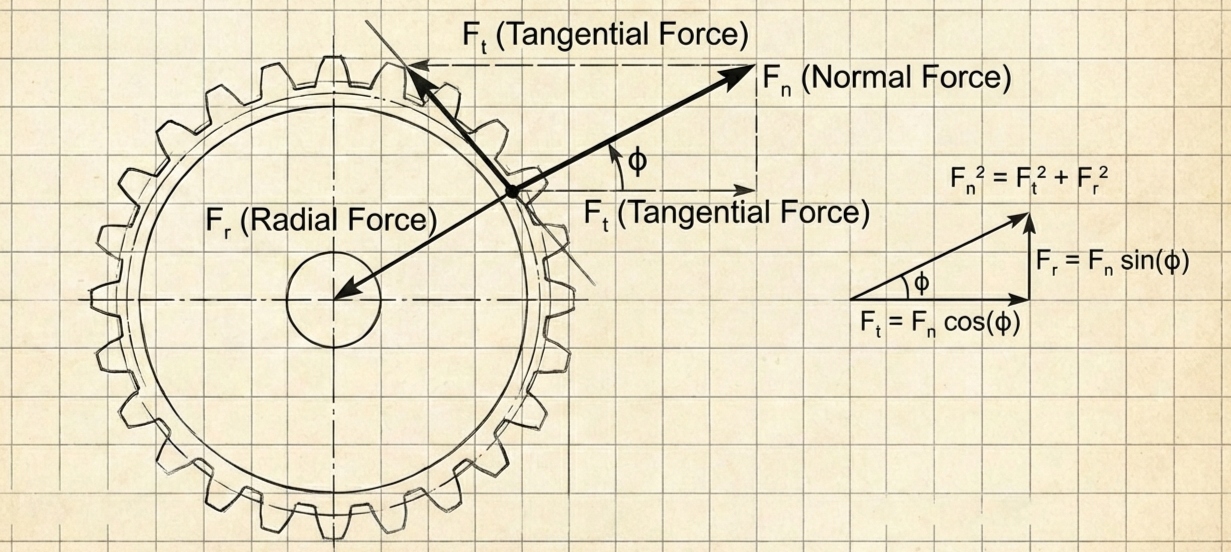
In the meshing of two gears, the total force between teeth can be divided into:
- The tangential force, that is, the transferable torque
- Radial load is the force that tries to separate the gears
This gear pressure angle is the ratio of this pair. A greater pressure angle brings about an increase in the radial component, and the part that is a tangential component also grows larger, but a smaller pressure angle weakens this part.
Here, the tangential force is effective for power transfer, where as radial force is unwanted but needs to be taken by shafts and bearings/housings.
The Effect of Angle on Bearing Load
The bearing loads are sensitive to the radial force created by gear meshing. The magnitude of this separating force varies with the pressure angle.
It's generally known that with lesser pressure angles in gears, the radial component is increased, and also bearing loads and shaft deflection can increase. Excessive deflection may result in misaligned teeth, poor tooth contact, and a quick reduction of teeth.
This is how pressure angle matters; it's not only about the gear teeth, but it relates to the whole mechanical system where your gears are installed.
Pressure Angle Effect on the Geometry of Gear Tooth
Relation to the Base Circle Diameter
The base circle in involute gear design is the starting point for generating the tooth profile. The addendum circle is one of the basic elements of an epicycloid, and the pressure angle affects the proportion between the pitch circle and base circle.
The greater the pressure angle is, the smaller the base circle is considered; contrarily, for small gear pressure angles, the base circle has a value approximately equal to the pitch circle diameter. This fact has an influence on the profile of the tooth flank and the length of the contact line.
In fact, considering that the involute curve is generated from the base circle, pressure angle selection becomes critical to the entire tooth shape.
Prevention of Undercutting and Minimum Number of Teeth
The tooth is weakened when too much of the root is machined away. This phenomenon is appreciably widespread in pinions having a limited number of teeth.
The lower the pressure angle of a gear, the greater the chance of undercut, and thus the higher the minimum pinion tooth. Undercutting can be decreased or eliminated to allow for the use of smaller pinions without reducing strength by increasing the pressure angle.
This is a principal reason that gears with a 20° pressure angle are used for planetary gear drives.
Performance Trade-offs and Optimization
Strength Versus Radial Load
The choice of pressure angle in gears is an optimization problem. Elevating the pressure angle increases tooth strength by expanding tooth root width and reducing undercut. While this is true, the radial bearing loads are increased.
On the other hand, a decrease in pressure angle leads to reduced radial force but weaker teeth and a restriction on the number of teeth. Designers are required to engineer a compromise between these opposing effects, depending on the necessary load requirements, space limitations, and expected service life.
At the end, there's no such thing as a "one-size-fits-all" pressure angle.
Minimizing Noise and Vibration
Noise and vibration are key issues in many gear applications. The pressure angle determines the contact ratio, which represents the average number of tooth pairs in contact at all times.
Minor changes in the pressure angle of gears can influence the smoothness of teeth on engagement and disengagement. Larger contact ratios generally result in quieter, more vibration-free operation, whereas smaller ones may generate vibrations.
Pressure angle is not the only indicator that influences noise, but it assists in the acoustic performance.
Selection Criteria and Non-Standard Pressure Angle Gears
Selecting the Correct Gear Pressure Angle
During the choice of pressure angle, engineers would usually take into account:
- Level of loading and necessary tooth strength
- Bearing capacity and shaft stiffness
- Gear size and space constraints
- Noise and vibration requirements
A 20 degree pressure angle is generally suitable for high-load, compact gearboxes. Other angles may be used for precision instruments and lightly loaded systems where smoothness is vital.
Adapt the Pressure Angle to Your Application
Non-standard pressure angle gears can also be used in special gearboxes to achieve unique requirements. These factors can be center distance modification, strength increase in a small space, or matching non-standard tooth spacing.
Although the non-standard pressure angles render flexibility, they also add to the manufacturability of and expense of products. Accordingly, they are often used only for individual or high-performance gear sets, which have to be manufactured in small quantities and are therefore typically custom-engineered rather than off-the-shelf components.
Conclusion
The angle at which gear teeth meet is a fundamental design choice that affects how gears transfer force, how strong their teeth are, and even the way in which the surrounding mechanical system must be designed. It impacts virtually all aspects of gear performance through radial load influence, undercutting perils, noise, and manufacturability.
Here's the most important thing to know: By understanding the principles of pressure angle gears, designers can make intelligent decisions that balance strength with bearing loads and smoothness of operation. Precise pressure angle choice is critical for all gear design, even if specific values like 20° have become established industry standards.
Ready to apply these principles? Explore JLCMC's range of precision gears to find the perfect match for your next transmission project.
FAQs
Why is a pressure angle of 20 considered standard?
The reason is that it provides a good compromise in tooth strength, minimizes undercutting, allows bearing load, and improves workability. JLCMC standardizes on 20° to ensure maximum compatibility and strength for our customers.
What is the relationship between pressure angle and backlash?
Pressure angle is not a direct setting of backlash; it affects tooth geometry and contact conditions, thus has an indirect effect on the behavior.
What if the distance between the centers is not standard?
Nonstandard center distances can vary the effective pressure angle during operation, and possibly have an influence on contact ratio, load distribution, and noise.
Keep Learning
How to Choose a Shaft Coupling: Rigid vs Beam vs Jaw vs Universal Joint
Key Takeaways Shaft Coupling Basics: A shaft coupling transmits torque between driving and driven shafts while accommodating misalignment, vibration, and thermal expansion. The core choice is between rigid (zero flexibility, maximum torque density) and flexible (misalignment-tolerant, vibration-damping) designs. Four Primary Types: Rigid couplings offer zero backlash but require perfect alignment; helical beam couplings provide precision motion for light-duty drives; jaw couplings deliver versatile vi......
Roller Chain Size Chart: ANSI and BS Sizes in mm and Inches
Key Takeaways Identify the chain series first: ANSI and BS-series size codes belong to different dimensional families; changing the units does not change the chain type. Check four details together: Pitch, roller diameter, inner width and number of rows. Matching pitch alone is not enough to choose a replacement. Use the millimeter columns for comparison: Inch equivalents appear beside them, so there is no need to interpret two units in one cell. Count the gaps when measuring pitch: Six consecutive pi......
How to Choose Between Closed-Loop and Open-Loop Stepper Motors
People need the right motor for machine projects. Picking between a closed-loop and open-loop stepper motor shapes machine accuracy and total cost. You can build simple 3D printers with open-loop drives. You can run fast industrial equipment with closed-loop systems. This guide helps you pick the correct motor for your build. Key Takeaways Open-loop stepper systems operate without position feedback, while closed-loop systems use an encoder to monitor actual shaft position. Open-loop systems cannot det......
What Are Pillow Block Bearings? Definition, Working Principle & Applications
Key Takeaways A pillow block bearing is a self-contained bearing unit that combines a rolling-element bearing insert with a rigid housing, designed for shaft support on a flat mounting surface with the shaft axis parallel to the mounting plane. The housing provides structural alignment and load distribution, while the bearing insert handles radial and limited axial loads. Common locking mechanisms include set screws, eccentric collars, and adapter sleeves; each suits different shaft tolerances, vibrat......
Main Types of Servo Motors: AC, DC, and Everything in Between
1. Introduction By leveraging closed-loop feedback to precisely control position, velocity, and torque, servo motors serve as the backbone of modern automation. Yet, application success hinges on matching the right architecture to your load requirements—a task made challenging by the sheer variety of servo motor types available today. In this article, we map motor technology to application requirements through a practical taxonomy covering electrical topology, mechanical construction, performance spec......
Quiet Servo Motors: How to Select Low-Noise Servo Motors for Precision Automation
Noise has quietly become a specification. Medical device makers, semiconductor equipment builders, and packaging OEMs now arrive at the design review with a dB(A) target alongside torque and settling time — and the motion axis is usually the first thing they point at. This guide is written for engineers and buyers specifying industrial AC and brushless servo systems, covering small to medium power ranges commonly used in precision automation equipment. It is not about RC hobby servos: the plastic-gear......