Gear Pitch Explained: How Pitch Diameter Affects Gear Design
7 min
- Introduction
- Determination of Core Design Dimension: Gear Pitch Diameter
- The Two Systems Circular Pitch and Diametral Pitch Gear
- Significance of Gear Pitch in Matching of Components
- Conversion and Interaction with Gear Module
- Example Applications of Gear Pitch in Design
- Conclusion
- FAQs
Introduction
In any gear system, the size, spacing, and meshing of the teeth all impact the efficiency of power transmission. Pitch is one of the key parameters influencing these factors. The spacing between the teeth around the gear is determined by the pitch, which directly affects whether two gears can mesh correctly.
The pitch circle diameter is a key dimension in gear definition. It represents a theoretical circle around which all meshing tooth surfaces engage and roll. Pitch not only affects the precision of gear meshing but also determines the distribution of the gear toothing and the contact pattern. A precise pitch ensures even gear tooth distribution, optimizing gear performance and power transmission efficiency. As mentioned, without a matching pitch, even the best mechanical gears cannot work together effectively.
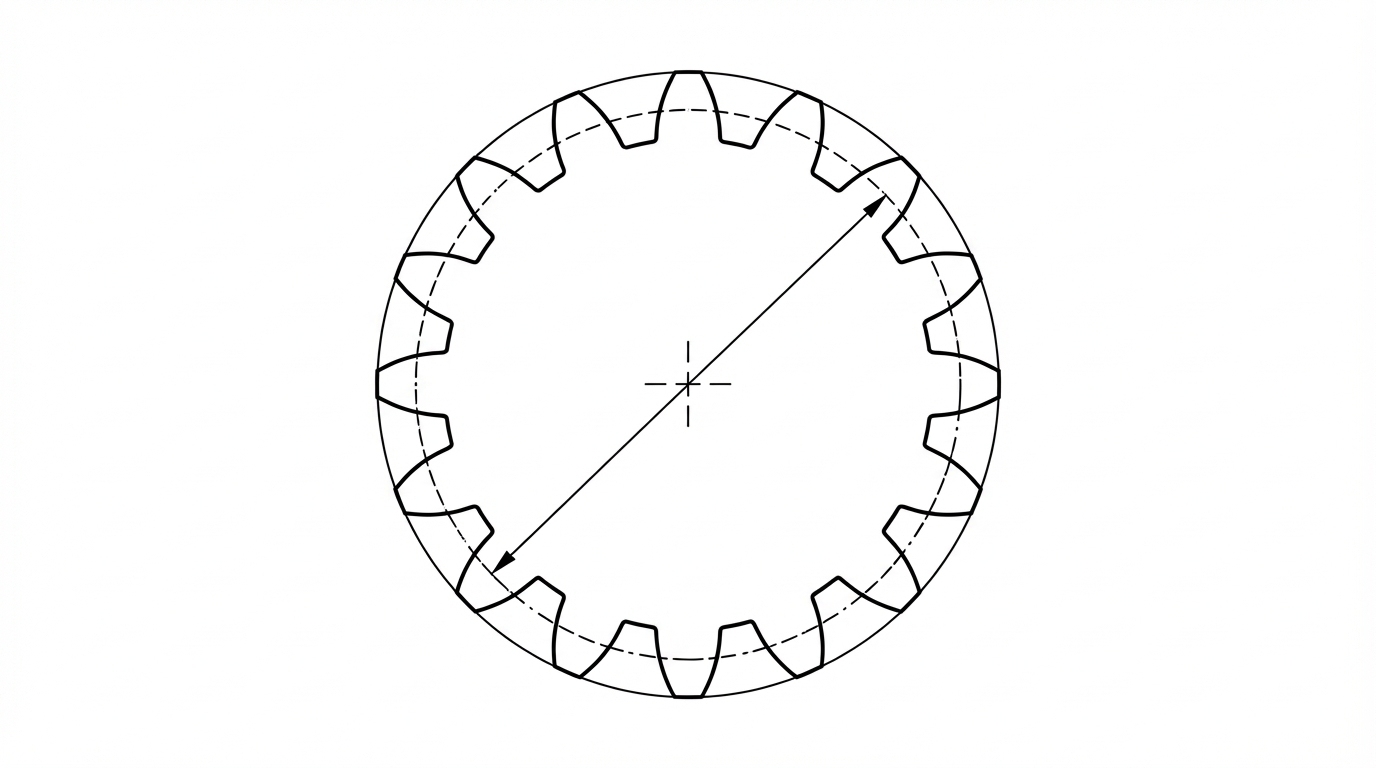
Determination of Core Design Dimension: Gear Pitch Diameter
The pitch diameter of a gear is an imaginary circle on which two gears are presumed to be rolling without any slippage. This circle itself is not an actual thing that's visible on the gear, but it is the most significant point to consider when performing calculations for gears.
The gear teeth roll at the pitch circle without any sliding taking place. Thus, it serves as a reference for gauging tooth distance, gear step, and speed ratios. Almost all the values of gear sizes, such as addendum, dedendum, and tooth thickness, are based on the pitch circle.
Simply put, pitch diameter is the "working size" of your gear. The OD or tooth form may be different, but it's the pitch diameter that decides how a gear is going to play with others.
Pitch Diametral and Center Distance Relationship
The pitch circles of the two gears in mesh tangentially touch each other at a single point. The complementary distance between the axes of two gears, called center distance, is also dependent on pitch diameters.
The center distance of two meshing gears is equal to half the sum of their pitch diameters. Gears mesh adapt; if the meshing distance error is too large, they are unable to match or may suffer excessive tooth bearing, noise, and wear. This is why gear pitch diameter design is so important during system layout and assembly.
The Two Systems Circular Pitch and Diametral Pitch Gear
Circular Pitch Gear: The Metric and Tangential System of Measurement
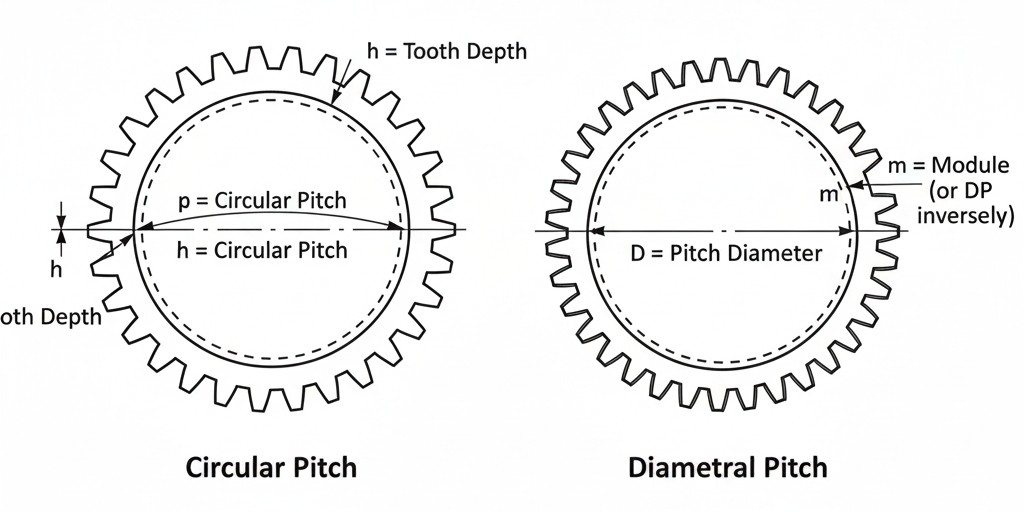
The circular pitch (Pₙ) is the distance between corresponding points of adjacent teeth, measured along the arc at the pitch circle. It is the arc length of one tooth plus one space.
It is widely used in metric-based gear systems and is closely related to the gear module. It indicates the manner in which teeth are spaced around the pitch circle and is natural in connection with tooth geometry.
Circular pitch is simply the length of the arc along a single tooth measured on the pitch circle. It gives an excellent representation of tooth spacing and, when tangential dimensions are important, can be used to develop precise profiles.
Diametral Pitch Gear System Explained
The diametral pitch gear system (Pₑ) is common to inch-based standards. Diametral pitch is the number of teeth per inch of diameter at the gear's pitch circle.
That is to say, it indicates how many teeth fit into a pitch diameter. The greater the diametral pitch, the more teeth are contained in a given diameter, resulting in smaller and finer teeth. Lower diametral pitch equals fewer teeth and bigger, stronger teeth.
There is a reciprocal system between the metric module and diametral pitch. The module is a direct description of tooth size, while the diametral pitch specifically describes how closely spaced the teeth are.
Significance of Gear Pitch in Matching of Components
The Golden Rule of Gearing
There is one ironclad rule when it comes to designing gears: for two gears to mesh, they must be of the same pitch. This applies to systems using circular, diametral, or module pitch.
The teeth on gears do not align if the pitch is wrong, which results in interference, noise, rapid wear, or total breakdown. Even the slightest disparity in pitch can prevent gears from meshing properly.
This is why gear pitch is usually the first thing engineers look at when designing gears into a new system or replacing gears in an existing one.
Derivation of the Number of Teeth from the Pitch Diameter
The gear number of teeth is a function depending only on gear pitch. In the diametral pitch system, the number of teeth is determined by multiplying the pitch diameter by the diametral pitch.
In the metric system, the number of teeth is determined by dividing the pitch diameter by the module. These relationships enable designers to optimize gear ratios, sizes, and speed relationships.
By setting pitch diameter and pitch system values, designers can cut gears that perform as desired without trial and error.
Conversion and Interaction with Gear Module
In worldwide machine making, both US and SI gear design systems are used. They require conversion in order to work together.
The formula expressing the relationship between diametral pitch and module is:
m = 25.4 / Pₑ
This equation converts the number of teeth per inch (diametral pitch) into module. Understanding this conversion enables engineers to transition designs between standards while maintaining correct tooth form.
Relation Between Gear Pitch, Tooth Size, and Strength
The size and load capacity of a gear tooth are directly affected by gear pitch. A higher value of diametral pitch results in smaller teeth. Smaller teeth provide smoother operation and higher resolution but carry lighter loads.
Conversely, smaller diametral pitch produces larger, thicker teeth that can accommodate greater torque and shock loads. This inverse relationship is a key factor when balancing strength and accuracy in gear design.
Example Applications of Gear Pitch in Design
The right gear pitch is highly application dependent. High-speed, low-load systems such as instruments or timing devices typically use fine-pitch gears with small teeth to achieve smooth and quiet operation.
For heavy-load applications such as industrial machinery or automotive drivetrains, gears are typically designed with larger, coarse-pitch teeth. These sacrifices smoothness for durability and load capacity. Optimal gear pitches are selected to minimize mechanical losses while maintaining performance and durability.
Checking Gear Pitch Diameter
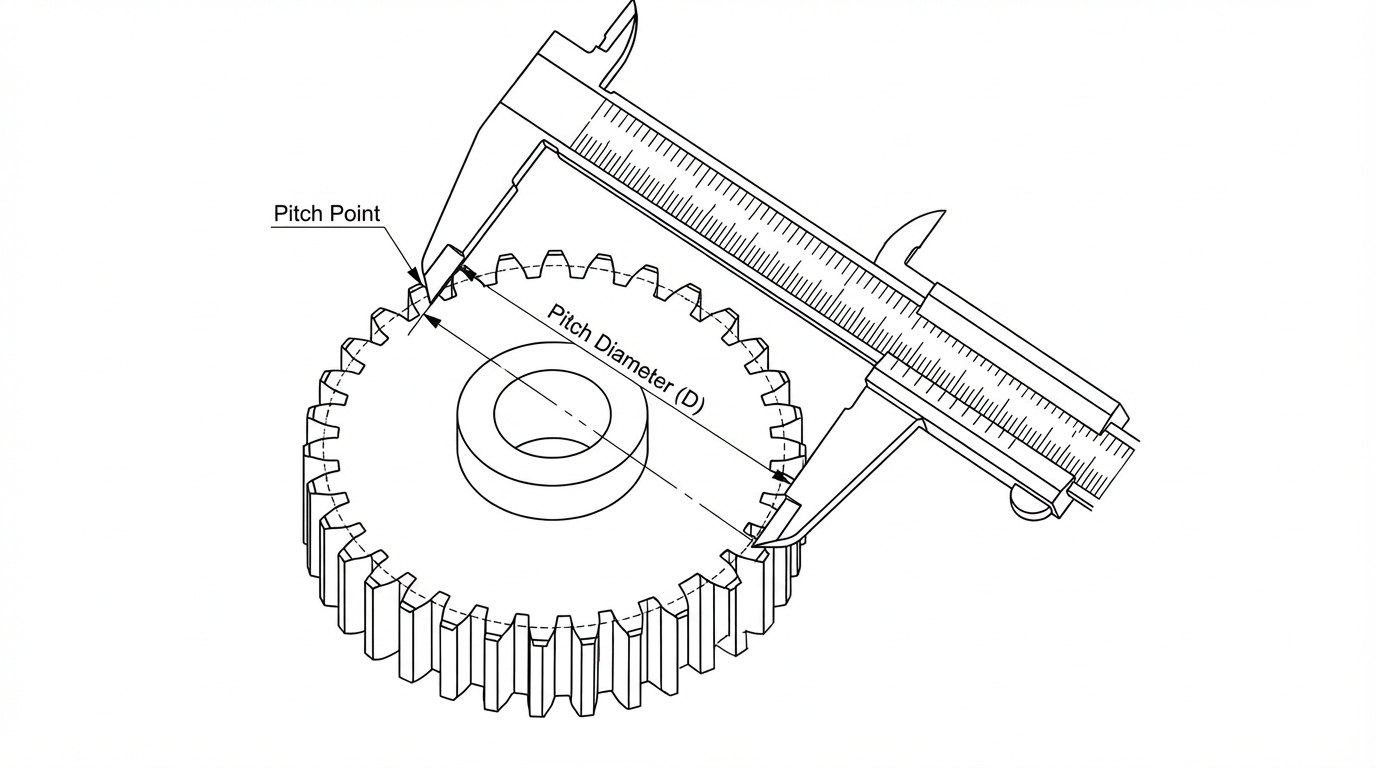
It is crucial to verify pitch diameter during gear production and testing. This is usually performed with specialized measuring machines, such as gear measuring centers, pitch diameter gauges, and analytical inspection units.
Accurate verification ensures that gears meet design requirements and mesh correctly in service. Even minor pitch diameter errors can produce compounded effects in assembled gear trains.
Conclusion
Gear pitch and module are the basic dimensional parameters that determine gear size and tooth spacing. The central reference in this concept is the gear pitch diameter, which governs how gears mesh, transmit motion, and carry loads.
JLCMC provides a diverse range of module gears, ensuring a precise fit from pitch circle to tooth profile. Explore our platform to source standardized components built for superior load capacity and seamless mesh.
FAQs
What is the difference between pitch and lead in gears?
Pitch describes the spacing of teeth around the pitch circle, while lead describes the axial distance a tooth advances in one revolution in helical or worm gears. They are related but apply to different aspects of gear geometry.
What is the impact of manufacturing errors on pitch diameter?
Manufacturing variations in pitch diameter can result in uneven tooth contact, noise, and accelerated wear. Precision machining and inspection help reduce these effects.
When will circular pitch be chosen over diametral pitch?
Circular pitch is generally used in metric-based systems where direct measurement of tooth spacing is preferred, while diametral pitch is more common in inch-based gear designs.
Keep Learning
How to Choose a Shaft Coupling: Rigid vs Beam vs Jaw vs Universal Joint
Key Takeaways Shaft Coupling Basics: A shaft coupling transmits torque between driving and driven shafts while accommodating misalignment, vibration, and thermal expansion. The core choice is between rigid (zero flexibility, maximum torque density) and flexible (misalignment-tolerant, vibration-damping) designs. Four Primary Types: Rigid couplings offer zero backlash but require perfect alignment; helical beam couplings provide precision motion for light-duty drives; jaw couplings deliver versatile vi......
Roller Chain Size Chart: ANSI and BS Sizes in mm and Inches
Key Takeaways Identify the chain series first: ANSI and BS-series size codes belong to different dimensional families; changing the units does not change the chain type. Check four details together: Pitch, roller diameter, inner width and number of rows. Matching pitch alone is not enough to choose a replacement. Use the millimeter columns for comparison: Inch equivalents appear beside them, so there is no need to interpret two units in one cell. Count the gaps when measuring pitch: Six consecutive pi......
How to Choose Between Closed-Loop and Open-Loop Stepper Motors
People need the right motor for machine projects. Picking between a closed-loop and open-loop stepper motor shapes machine accuracy and total cost. You can build simple 3D printers with open-loop drives. You can run fast industrial equipment with closed-loop systems. This guide helps you pick the correct motor for your build. Key Takeaways Open-loop stepper systems operate without position feedback, while closed-loop systems use an encoder to monitor actual shaft position. Open-loop systems cannot det......
What Are Pillow Block Bearings? Definition, Working Principle & Applications
Key Takeaways A pillow block bearing is a self-contained bearing unit that combines a rolling-element bearing insert with a rigid housing, designed for shaft support on a flat mounting surface with the shaft axis parallel to the mounting plane. The housing provides structural alignment and load distribution, while the bearing insert handles radial and limited axial loads. Common locking mechanisms include set screws, eccentric collars, and adapter sleeves; each suits different shaft tolerances, vibrat......
Main Types of Servo Motors: AC, DC, and Everything in Between
1. Introduction By leveraging closed-loop feedback to precisely control position, velocity, and torque, servo motors serve as the backbone of modern automation. Yet, application success hinges on matching the right architecture to your load requirements—a task made challenging by the sheer variety of servo motor types available today. In this article, we map motor technology to application requirements through a practical taxonomy covering electrical topology, mechanical construction, performance spec......
Quiet Servo Motors: How to Select Low-Noise Servo Motors for Precision Automation
Noise has quietly become a specification. Medical device makers, semiconductor equipment builders, and packaging OEMs now arrive at the design review with a dB(A) target alongside torque and settling time — and the motion axis is usually the first thing they point at. This guide is written for engineers and buyers specifying industrial AC and brushless servo systems, covering small to medium power ranges commonly used in precision automation equipment. It is not about RC hobby servos: the plastic-gear......