How Lead Screw Pitch Impacts Speed and Accuracy in Design
7 min
- Lead Screw Pitch vs. Lead: What's the Difference?
- Effect of Lead Screw Pitch on Speed and Resolution
- Load Capacity and Self-Locking Behaviour
- Knowledge about Common Specifications of the Lead Screw
- Guidelines for the Optimum Choice of Lead Screw Pitch
- Conclusion
- Frequently Asked Questions
Lead screw pitch is the critical specification that dictates a linear motion system's speed, load capacity, and positioning accuracy. Selecting the optimal pitch is a balancing act: an incorrect choice can compromise resolution, lead to inefficient cycle times, or jeopardize mechanical integrity. This guide provides a technical overview of lead screw pitch, analyzing its direct impact on velocity, mechanical advantage, and self-locking characteristics to help you confidently specify the right component for your application.
However, superior design logic ultimately requires high-standard hardware to achieve its potential. To help you translate these theoretical calculations into reliable mechanical performance, JLCMC offers a comprehensive range of lead screws in various pitch specifications. We invite you to explore our lead screw selection and find the perfect match for your engineering requirements.
Lead Screw Pitch vs. Lead: What's the Difference?
Defining Lead Screw Pitch and Lead
Pitch and lead are mistakenly interchanged despite being different concepts.
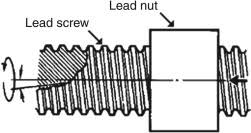
Lead screw pitch is the distance between threads. It is defined along the screw axis. In this manner, if the threads are 2 mm apart, we can say that the pitch is 2 mm.
Lead is defined as the linear distance the nut travels along the screw axis during one complete 360-degree revolution, as opposed to pitch. Lead is the actual linear motion per revolution.
On a single-start lead screw, pitch and lead are equal. They are different from multi-start screws. It is important to have this understanding when speed and resolution are taken into account.
The Lead Influence by Thread Starts
Starts of thread refer to the number of individual threads wrapped around the screw.
- Single-start screw: one continuous thread
- Double-start screw: two threads
- Four-start screw: four threads
The formula is simple:
Lead = Pitch × Number of Starts
For example:
Pitch = 2 mm
Starts = 4
Lead = 8 mm per revolution
The thread geometry is identified by the pitch. Starts define the speed at which movement takes place. Engineers frequently modify lead by varying the number of starts, holding pitch steady to maintain strength and ensure that the thread is producible.
Effect of Lead Screw Pitch on Speed and Resolution
High Pitch for High Speed Apps
A greater pitch or lead equals more linear travel per revolution. This equates to higher velocity at the same motor RPM.
Lead screws are most frequently used in:
- Automated handling systems
- Packaging equipment
- Rapid positioning stages
But high pitch lowers mechanical efficiency. More torque must be developed by the motor in order to turn the same load. Effectiveness will increase, but holding force will be reduced.
When it comes to speed, high-pitch screws are the favorable choice as fine positioning or self-locking behavior is an insignificant concern.
High Resolution with Fine Pitch
Fine-pitch lead screws travel less per revolution. This provides for better control and positioning.
They are ideal for:
- Medical devices
- Optical systems
- Laboratory automation
- Adjustment mechanisms
Mechanical advantage increases with a finer pitch, due to the reduction in torque required for load handling. This results in easier load handling. Resolution improves as each step of the motor results in less linear displacement.
The trade-off is speed. Fine-pitch units go lower in velocity, but they result in better accuracy and stability.
Load Capacity and Self-Locking Behaviour
Effect of Pitch on the Load-Carrying Capacity of Lead Screws
The lead screw pitch is directly related to the helix angle of the thread. The screw angle is small if the pitch of the thread is small. This improves load-holding capability.
Lower helix angles:
- Increase friction
- Improve static load capacity
- Reduce back-driving risk
The helix angle increases with higher pitch. This decreases the friction and makes it more efficient to operate, but also diminishes the screw’s capacity for holding a load against gravity.
In the case of heavy loads or vertical motion, pitch is particularly important.
Criteria for Self-Locking and Pitch Selection
A particular example of self-locking is the lead screw not being back-drivable while loaded. The nut is not allowed to move when the motor stops.
Self-locking depends on:
- Pitch or lead
- Thread geometry
- The friction of materials between the screw and the nut
Small-pitch screws tend to be self-locking. Most coarse-pitch screws back drive without the aid of a brake.
Self-lock is sometimes needed in, for example, lifting platforms or position-adjustable supports. Back drivability can actually be required or desired in high-speed motion systems.
Knowledge about Common Specifications of the Lead Screw
Available Standard Profile Diameter and Pitch Combinations
Lead screws are available in standardized profiles like ACME and Trapezoidal threads.
Typical combinations include:
- Fine pitch for light loads and small diameter
- Coarser pitch for heavier loads - large diameter sizes
For example:
- Tr8×2: 8 mm in diameter, with a 2 mm lead
- Tr16×4: 16 mm diameter, lead 4 mm
These criteria trade off strength, manufacturability, and performance. Standard sizes make sourcing and cost easier to control.
Influence of Material For The Screw: Pitch Tolerances
The material selected determines the way in which pitch behaves in actual systems.
Common combinations include:
- Steel screw with bronze nut
- Stainless steel screw and polymer nut
The nut materials are relatively softer and yield slightly in the presence of the screw. That reduces backlash and smoothes the ride. However, wear increases over time.
Harder engineering plastics pitch accuracy for a longer period; however, this may come at the expense of lubrication. The tandem material should be matched to loading, speed, and duty cycle demands.
Guidelines for the Optimum Choice of Lead Screw Pitch
Estimation of Resolution Based on Pitch
Resolution is a function of the lead and motor properties. A simple formula is:
Linear resolution = Lead ÷ Stepper Motor steps per revolution
Example:
- Lead = 4 mm
- Motor, 200 steps per revolution
- Resolution = 0.02 mm per step
If microstepping is employed, resolution is further increased. When considering pitch, engineers need to look at the best positioning, not just average movement.
Balancing Efficiency and Self-Locking Requirements
Efficiency and self-locking often conflict.
- Bigger pitch = better efficiency rating, worse self-locking
- Less pitch = Less efficient, but more self-locking
The key is balance.
Ask these questions:
- Does the load require a power-off brake?
- How much should I care about torque as opposed to speed?
- Is back-driving acceptable?
Knowing the answer to these will help you determine the right pitch range for your use case.
Conclusion
Lead screw pitch serves as the foundational parameter in screw-driven motion control, governing the critical interplay between velocity, positioning resolution, and axial force transmission.
A higher pitch is faster but has less mechanical advantage. While a smaller pitch offers higher resolution and mechanical advantage, it results in lower linear velocity (throughput). Conversely, a larger pitch enables high-speed travel but requires greater drive torque. Pitch selection is a function of thread starts, diameter, material, and load requirements.
Pitch is even more important for longer service life, predictable system performance, and optimal operation. Thoughtful selection always pays off.
For users with more in-depth lead screw calculation needs, you can read our lead screw calculation article, which will comprehensively assist you in mastering design methods and application details.
Frequently Asked Questions
Q1: Does the lead screw pitch take precedence over its diameter in design?
Speed and resolution are more dependent on pitch, typically. Strength and stiffness are influenced by diameter.
Q2: Is it possible to go faster and keep the pitch?
Yes, increasing the number of thread starts allows for higher lead and speed while maintaining the same pitch.
Q3: How to determine if a self-locking lead screw is required?
If your system needs to stay in place unpowered or braked, a fine-pitched, self-locking screw is often the answer.
Keep Learning
Ball Screw Types Explained: Features, Differences & Applications
You need accurate motion control for your industrial equipment. A ball screw changes rotary drive into linear movement with high efficiency. You will find many ball screw types across modern hardware shops today. Each design serves a specific role in your setup. This guide helps you pick the best model for your next project. Key Takeaways People select specific models based on simple mechanics. Production methods affect the accuracy level of the screw shaft. Nut designs control how steel balls circula......
Why Does Your Stepper Motor Always Make a Squealing Noise?
A squealing stepper motor is almost never a mechanical grinding issue. The noise is electrical: PWM chopping, magnetic resonance, or current misconfiguration exciting the stator laminations. This article provides a four-step workflow to isolate the root cause and fix it without losing torque or steps. Key Causes of Stepper Motor Squealing 1. PWM Chopping Frequency in the Audible Range Motor drivers control current by rapidly switching MOSFETs. If the chopping frequency sits below 20 kHz, each switchin......
Linear Guide Rails and Bearings: What's the Difference and Which Should You Use?
Pick any machine that moves in a straight line — a CNC router, a pick-and-place unit, a 3D printer gantry — and somewhere inside it you will find either a linear bearing riding on a round shaft or a linear guide rail carrying a carriage block. Although they are sometimes discussed interchangeably, round-shaft linear bearings and profiled linear guide rails are two different linear motion systems designed for different levels of precision, rigidity, and load capacity. Both deliver low-friction, guided,......
What Actually Goes Into a Linear Guide Rail System
A linear guide rail system is more than one rail. On its own, the rail cannot provide guided motion. What supports the load and maintains positioning accuracy is how the rail, carriage, rolling elements, and seals work together. This is a quick tour of those parts, and how they add up to a complete motion axis. For engineers speccing a new axis and buyers matching a system to a machine. If you just need the basics — what a linear guide is or the different types of linear rails — start with those two g......
What Are Linear Guides and Why Do They Matter in Factory Automation?
Every CNC machine, every pick-and-place robot, every wafer handler on a semiconductor line — they all share one fundamental need: moving something in a straight line, accurately and repeatedly. That's where linear guides come in. Despite being one of the most widely used components in factory automation, linear guides are often misunderstood — partly because the industry can't agree on what to call them. This article breaks down what linear guides actually are, what's inside them, the main types of li......
Exploring Mechanical Shaft Collars and Their Different Types
Though quite elementary in design, shaft collars serve an important mechanical purpose. In simple terms, a shaft collar is a round clamping device that can be used for axial positioning of components, acting as mechanical stops, or securing parts in place along a shaft. While they may look like simple components, shaft collars must be chosen wisely to ensure performance, accuracy, and longevity of the system. This article focuses on the common types of mechanical shaft collars in transmission systems,......