Exploring Mechanical Shaft Collars and Their Different Types
6 min
- Specialized and Application-Specific Shaft Collars
- Material Selection for Various Environments
- Engineering Considerations: Holding Force and Precision
- Bottom Line!
- FAQs
Though quite elementary in design, shaft collars serve an important mechanical purpose. In simple terms, a shaft collar is a round clamping device that can be used for axial positioning of components, acting as mechanical stops, or securing parts in place along a shaft. While they may look like simple components, shaft collars must be chosen wisely to ensure performance, accuracy, and longevity of the system.
This article focuses on the common types of mechanical shaft collars in transmission systems, such as clamping shaft collars and two-piece shaft collars. If you require positioning or spacer shaft collars, feel free to explore JLCMC's shaft collar series to find high-quality options that suit your project.
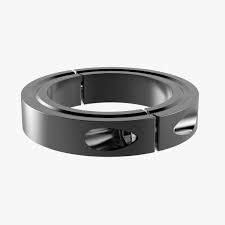
Types of Shaft Collars According to the Locking Mechanism
Shaft collars are classified by their method of attachment to the shaft. The two most common types are set screw collars and clamp-type collars. Each has its own pros and cons.
Set Screw Shaft Collars
Set screw collars use screws to directly dig into the shaft for a secure hold. This basic action makes them the cheapest to produce.
Pros and Cons:
- Affordable and easy to install.
- Can result in shaft damage (pits and burrs) if the screw comes in contact with the shaft.
- Output power is relatively low and can be used in light-loaded conditions.
Best Use:
Set screw collars are useful for axles that do not require frequent position adjustment and where holding power is less critical. They're found in low-load applications like light machinery and positioning components on non-critical shafts.
Clamp Style Shaft Collars (One-Piece)
One-piece clamping collars wrap around the shaft for a tamper-resistant connection and can be installed, adjusted, and removed without removing the screws. They don't mark the shaft as set screws do.
Pros and Cons:
- Better holding power than a set screw.
- They can be taken off and on again without harm to the shaft.
- Slightly more expensive than set screw collars.
Best Use:
One-piece clamp-on collars are used for stopping the ends of a shaft from running out. They're commonly used in robotics, conveyor belts, and other applications that require repeated positioning.
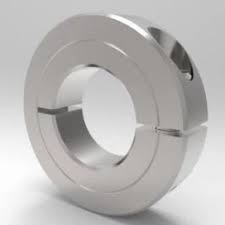
Two-Piece Clamp Shaft Collars
Two-piece collars are formed from two halves bolted together on the shaft. This collar's open construction allows installation without the need to slide it along the shaft, even after the shaft has been installed and components have been placed on it.
Pros and Cons:
- A clamp-style collar has greater holding power than a set screw.
- Can be mounted and dismounted without dismantling the plant.
- Larger footprint and more costly than one-piece collars.
Best Use:
Two-piece collars perform better than one-piece collars in heavy-duty applications, as they spread the compressing force over a wider area and remain almost completely concentric while clamping.
Specialized and Application-Specific Shaft Collars
In addition to the standard locking mechanisms, some applications require collars with unique features.
Threaded Shaft Collars
Threaded collars are adjustable, so you can move them to the exact position on your shaft. They offer accurate axial positioning and can control axial shock loads, making them suitable for equipment that vibrates or experiences sudden loads.
Hexagonal and Square Bore Collars
These collars are designed for use with non-round shafts to provide a tight fit and prevent slippage under increasing torque. They are used in drive shafts, for example.
Heavy-Duty and Quick-Clamping Designs
High-strength collars are reinforced for heavy-duty applications. Fixed-clamping collars have a solid ring to provide stability and support with high gripping force, and quick-clamping collars allow more control over clamping pressure with a lever. Quick-clamping collars are especially useful in production settings where job changeovers or setup adjustments are common.
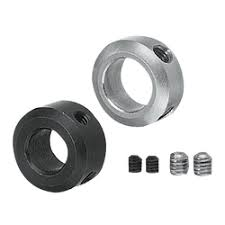
Material Selection for Various Environments
Material choice is important when choosing a shaft collar as it affects longevity, corrosion resistance, and overall performance in special environments.
- Carbon Steel: Industry standard for high strength, general industrial use.
- Stainless Steel (303/316): Offers superior corrosion resistance in food processing, medical, and marine applications.
- Aluminum: Lighter weight, for use in high-speed applications where balancing inertia is critical.
- Engineering Plastics (Nylon/Acetal): Nonconductive and corrosion-resistant, suitable for washdown or electrical applications.
The right material choice will result in predictable performance for load and environmental requirements.
Engineering Considerations: Holding Force and Precision
In the majority of shaft collar reviews, “holding power” is the most important performance feature. Grip strength is determined by several factors, including screw size, shaft-collar fit, and material properties.
Factors Affecting Holding Power:
- Size and quality of screws: Larger, high-quality screws transmit more torque to the collar. Forged screws are preferable to broached screws for consistency and strength.
- Shaft Tolerance: Collar clamping depends on accurate shaft size. A loose shaft provides less holding power, and a tight shaft holds sprockets or pulleys securely.
- Back Cut: Miniature one-piece clamping collars (MSCC-Series) may have a back cut behind the clamp cut. This reduces the force required to close the collar and concentrates more holding power than conventional styles.
Precision Considerations:
Clamp-style collars do not mar the shaft, provide high holding power, and are indefinitely adjustable. The choice between single-piece and two-piece collars usually depends on ease of installation rather than holding power, since a two-piece collar may only offer around a 5% increase.
Bottom Line!
The perfect shaft collar depends on your holding power, installation convenience, and shaft protection needs. Set screw collars are effective on hard and soft shafts and affordable for permanent installations, but they won’t hold up under heavy abuse. One-piece clamp collars are designed for use with a single piece of bar or tubing, and two-piece clamp collars must be installed by sliding the collar over the bar or tube.
Other collars, including threaded, hex bore, and quick-clamping types, cater to specific application requirements. In addition to enhancing performance in targeted environments, material selection is carefully prepared. Taking into account mechanical characteristics, application requirements, and mounting considerations will help you specify the best shaft collar.
JLCMC specializes in custom and bulk supply of high-quality mechanical components, with the goal of enhancing industrial projects' performance and sustainability. Contact us anytime for professional support or tailored solutions.
FAQs
What's the distinction between set screw and clamp-type shaft collars?
Set screw collars press directly against the shaft, potentially causing damage, while clamp-type collars apply even force, preventing surface deformation.
When should I select a two-piece shaft collar instead of a one-piece design?
Two-piece collars are ideal for applications where disassembling the shaft or removing adjacent components is impractical, as they can be installed anywhere along the shaft.
What role does the choice of materials play in shaft collar performance?
The selection of a material affects the suitability for durability, corrosion resistance, and application. Carbon steel provides strength, hardness, and resistance to wear. Stainless steel offers high resistance to corrosion.
Keep Learning
Ball Screw Types Explained: Features, Differences & Applications
You need accurate motion control for your industrial equipment. A ball screw changes rotary drive into linear movement with high efficiency. You will find many ball screw types across modern hardware shops today. Each design serves a specific role in your setup. This guide helps you pick the best model for your next project. Key Takeaways People select specific models based on simple mechanics. Production methods affect the accuracy level of the screw shaft. Nut designs control how steel balls circula......
Why Does Your Stepper Motor Always Make a Squealing Noise?
A squealing stepper motor is almost never a mechanical grinding issue. The noise is electrical: PWM chopping, magnetic resonance, or current misconfiguration exciting the stator laminations. This article provides a four-step workflow to isolate the root cause and fix it without losing torque or steps. Key Causes of Stepper Motor Squealing 1. PWM Chopping Frequency in the Audible Range Motor drivers control current by rapidly switching MOSFETs. If the chopping frequency sits below 20 kHz, each switchin......
Linear Guide Rails and Bearings: What's the Difference and Which Should You Use?
Pick any machine that moves in a straight line — a CNC router, a pick-and-place unit, a 3D printer gantry — and somewhere inside it you will find either a linear bearing riding on a round shaft or a linear guide rail carrying a carriage block. Although they are sometimes discussed interchangeably, round-shaft linear bearings and profiled linear guide rails are two different linear motion systems designed for different levels of precision, rigidity, and load capacity. Both deliver low-friction, guided,......
What Actually Goes Into a Linear Guide Rail System
A linear guide rail system is more than one rail. On its own, the rail cannot provide guided motion. What supports the load and maintains positioning accuracy is how the rail, carriage, rolling elements, and seals work together. This is a quick tour of those parts, and how they add up to a complete motion axis. For engineers speccing a new axis and buyers matching a system to a machine. If you just need the basics — what a linear guide is or the different types of linear rails — start with those two g......
What Are Linear Guides and Why Do They Matter in Factory Automation?
Every CNC machine, every pick-and-place robot, every wafer handler on a semiconductor line — they all share one fundamental need: moving something in a straight line, accurately and repeatedly. That's where linear guides come in. Despite being one of the most widely used components in factory automation, linear guides are often misunderstood — partly because the industry can't agree on what to call them. This article breaks down what linear guides actually are, what's inside them, the main types of li......
Exploring Mechanical Shaft Collars and Their Different Types
Though quite elementary in design, shaft collars serve an important mechanical purpose. In simple terms, a shaft collar is a round clamping device that can be used for axial positioning of components, acting as mechanical stops, or securing parts in place along a shaft. While they may look like simple components, shaft collars must be chosen wisely to ensure performance, accuracy, and longevity of the system. This article focuses on the common types of mechanical shaft collars in transmission systems,......