What Is a Load Cell? Working Principle, Types, Applications & How to Choose One
10 min
- Introduction
- What Is a Load Cell ?
- How Does a Load Cell Work?
- Types of Load Cells
- Applications of Load Cells
- How to Choose the Right Load Cell
- FAQs
- Conclusion
Introduction
Accurate weight measurement is essential in industrial processes such as batching, packaging, process control, and material handling. Even small errors can affect product quality, efficiency, and inventory accuracy.
In automation systems, load cells are widely used as the key sensing element for weight and force measurement. This article introduces what is a load cell, explains different load cell types, outlines common load cell applications, and highlights key selection considerations.
What Is a Load Cell ?
A load cell is a transducer that converts mechanical force into an electrical signal. The force may originate from weight, tension, compression, or another applied load.
In industrial weighing systems, the load cell acts as the primary sensing element. Without it, a controller cannot determine how much material is present, how much force is being applied, or whether a process is operating within acceptable limits.
Main Components of a Load Cell
- Elastic Element
The elastic element is the core mechanical structure that carries the load and deforms under force. It is typically made of alloy steel, stainless steel, or aluminum alloy. The material choice affects strength, corrosion resistance, fatigue life, and application suitability. Stainless steel is often used in harsh or washdown environments, while aluminum is common in light-duty systems.
- Strain Gauges
Strain gauges are bonded to the elastic element to detect microscopic deformation and convert it into resistance changes. They play a key role in measurement accuracy, stability, and repeatability. The quality of installation directly influences long-term performance and signal drift.
- Wheatstone Bridge Circuit
The Wheatstone bridge converts the small resistance changes from strain gauges into measurable voltage signals. It enhances sensitivity, enables temperature compensation, and ensures stable signal output for PLCs, indicators, and control systems.
- Protective Housing
The protective housing safeguards internal components from dust, moisture, corrosion, and mechanical shock. It is essential for maintaining reliability in industrial environments, especially in applications involving washdown, vibration, or outdoor exposure.
How Does a Load Cell Work?
Most industrial load cells use strain gauge technology. Despite the availability of alternative sensing methods, strain gauge designs remain dominant because they provide a practical balance of accuracy, reliability, durability, and cost.
The operating principle of a load cell is based on controlled deformation.
When force is applied, the metal body of the load cell deforms slightly. This deformation is measured by strain gauges bonded to the elastic element. As the strain gauges stretch or compress, their electrical resistance changes.
The measurement process can be summarized as follows:
- External force is applied.
- The elastic element deforms.
- Strain gauge resistance changes.
- The Wheatstone bridge detects the variation.
A proportional electrical signal is generated.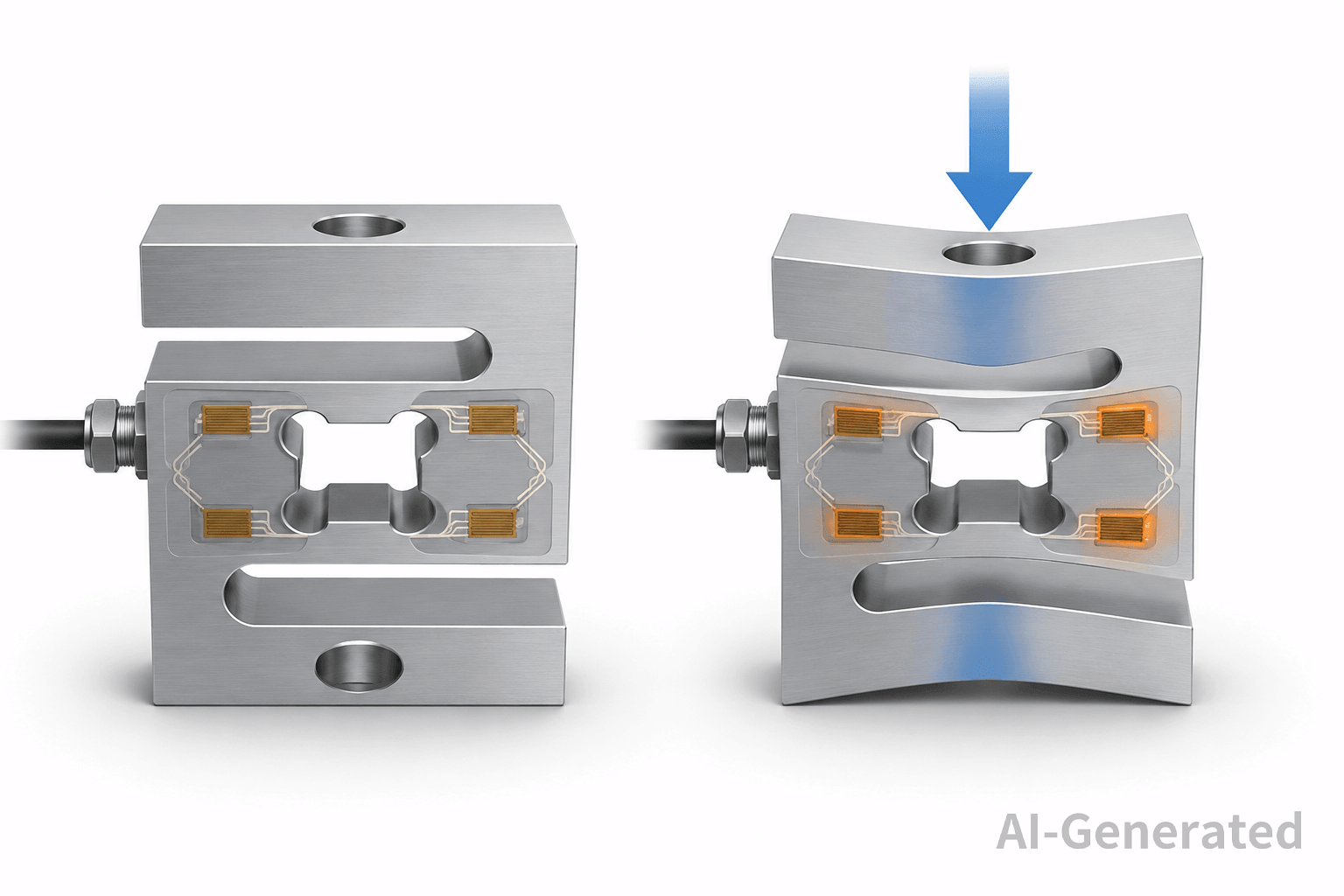
The deformation remains within the elastic range of the material. Once the load is removed, the sensor returns to its original shape without permanent distortion.
This ability to repeatedly deform and recover is one reason why quality load cells often remain in service for many years.
Types of Load Cells
Load cells are designed in different structural forms to match specific force directions, installation conditions, and application requirements. Selecting the correct type is essential to ensure accurate measurement and stable long-term performance.
Compression Load Cells
Compression load cells measure forces pushing directly into the sensor body.
They are commonly used in:
- Tank weighing systems
- Silo weighing systems
- Truck scales
- Their robust construction makes them suitable for high-capacity applications ranging from several tons to hundreds of tons.
Tension Load Cells
Tension load cells are designed for pulling forces.
Typical applications include:
- Crane scales
- Hoisting equipment
- Cable tension monitoring
- These sensors are often installed directly in the load path to measure tensile force accurately.
Beam Load Cells
Beam load cells are among the most widely used load cell designs in industrial weighing systems. They measure force through the deformation of a beam-shaped elastic element and are valued for their simple installation, reliable performance, and wide capacity range.
Common applications include:
- Platform scales
- Packaging machines
- Conveyor weighing systems
Shear Beam Load Cells
- Shear beam load cells are a specialized type of beam load cell that measures force primarily through shear deformation. Compared with standard bending beam designs, they offer several performance advantages:
- Higher measurement accuracy
- Better resistance to off-center loading
- Improved structural stability
Because of their high accuracy, strong resistance to off-center loading, and stable performance, shear beam load cells are widely used in hopper scales, tank weighing systems, and various process weighing applications where reliable and consistent measurements are essential.
They are particularly suitable for industrial environments where uneven loading and long-term stability are important considerations.
Applications of Load Cells
Load cells are used well beyond conventional weighing scales. In modern industrial environments, they function as core sensing elements in measurement, control, and automation systems. Their ability to convert mechanical force into precise electrical signals makes them essential across a wide range of engineering applications.
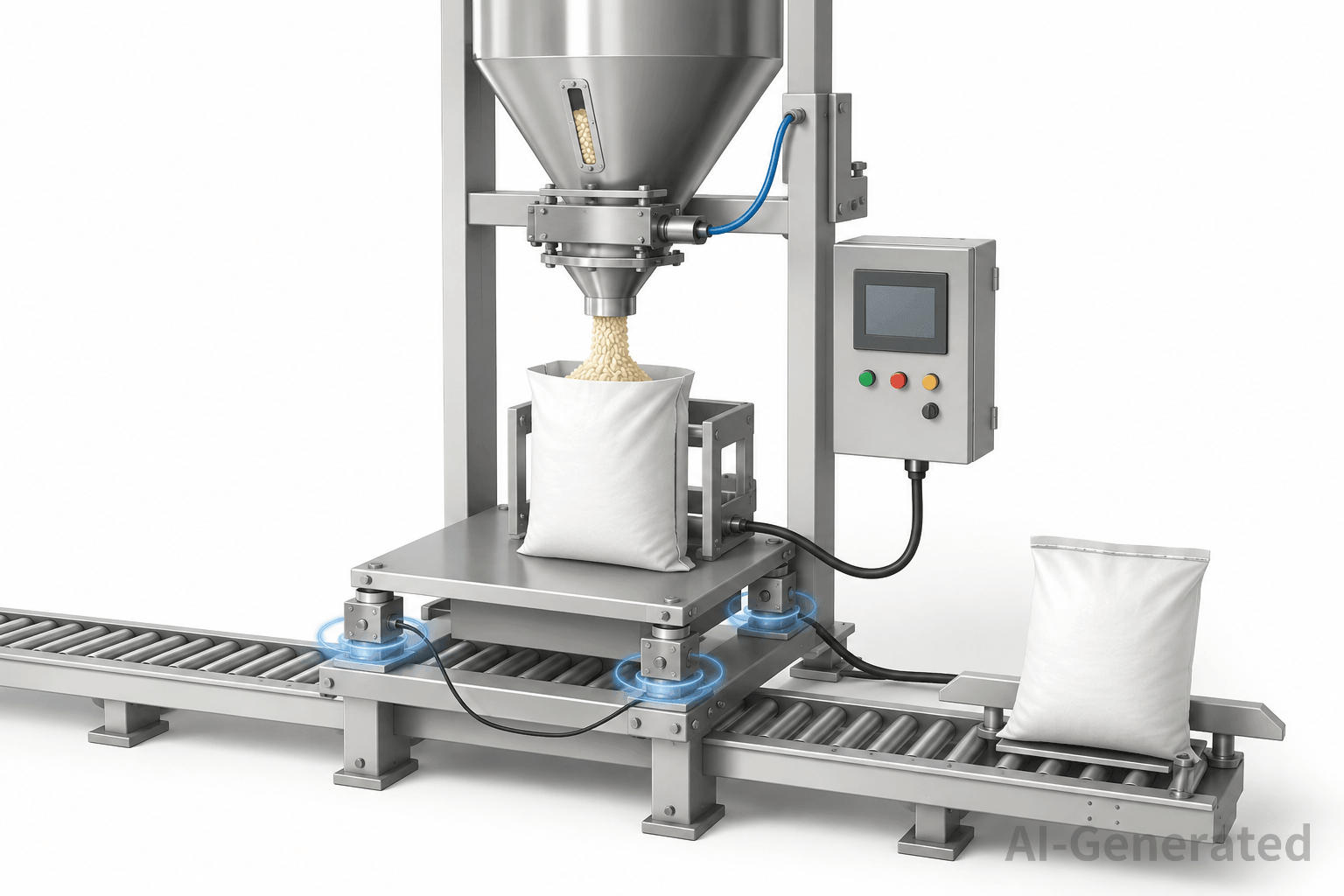
1.Automated Bag Filling System
One of the most common applications of load cells is in automatic filling and packaging machines.
Process Overview:
- Empty bags are automatically positioned beneath a filling hopper.
- Bulk material, such as salt, sugar, grain, or chemical powder, is discharged from a storage bin into the filling system.
- A load cell installed beneath the weighing platform continuously measures the weight of material being filled into the bag.
- The load cell converts the applied weight into an electrical signal and sends it to the PLC or weighing controller.
- As the target weight approaches, the controller reduces the material flow rate from fast fill to slow fill.
- When the preset weight is reached, the discharge gate closes automatically.
- The filled bag is sealed, discharged from the machine, and replaced by the next empty bag.
In this application, the load cell serves as the primary feedback device. It continuously provides real-time weight data to the control system, ensuring that each bag receives the correct amount of material. This improves filling accuracy, reduces product giveaway, and maintains consistent product quality.
Typical Industries:
- Food processing
- Chemical manufacturing
- Agricultural products
- Building materials
2.Hydraulic Press Force Control System
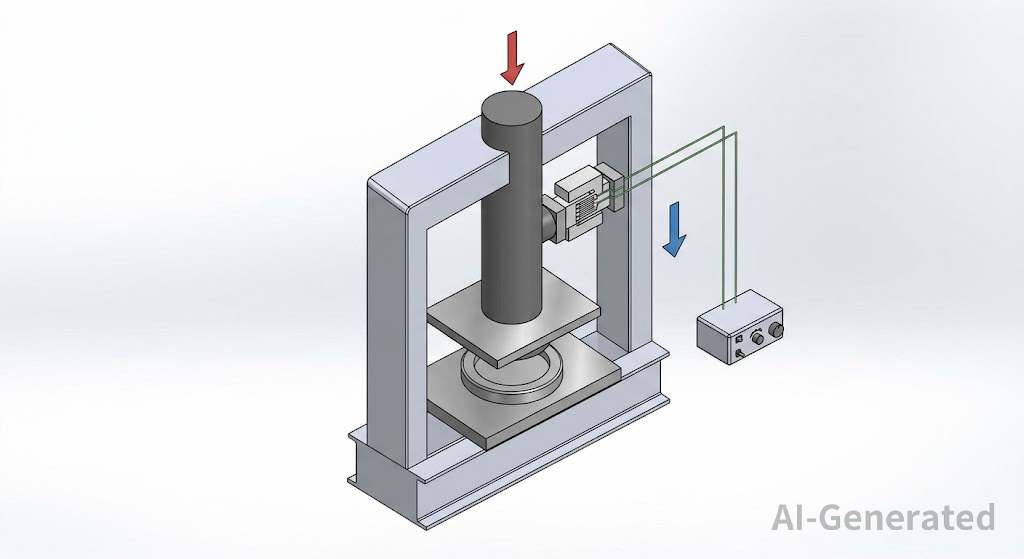
Load cells are also widely used for force measurement in pressing and forming operations.
Process Overview:
- A metal sheet is placed inside a press machine.
- The hydraulic or mechanical press begins moving downward toward the workpiece.
- As the press contacts the material, force starts to build.
- A compression load cell mounted on the press structure continuously measures the applied force.
- The load cell transmits force data to the controller in real time.
- Once the programmed force value is reached, the controller stops the downward movement or initiates the return stroke.
- The finished part is removed, and the next production cycle begins.
The load cell acts as a force-monitoring sensor rather than a weighing device. It ensures that the press applies the correct amount of force during each cycle. Insufficient force may result in incomplete forming, while excessive force can damage the product, tooling, or machine.
Benefits:
- Consistent product quality
- Improved process repeatability
- Reduced material waste
- Protection of dies and equipment
- Real-time force monitoring and data recording
How to Choose the Right Load Cell
Selecting a load cell requires balancing load requirements, force direction, environmental conditions, and system compatibility. A proper selection helps ensure stable measurement performance and long service life in industrial applications.
Determine the Load Range
The load capacity should include a safety margin to avoid overload and ensure long-term reliability:
Rated Capacity = Maximum Load × 1.25–1.5
| Application Scenario | Safety Factor | Notes |
| Stable static weighing | 1.25 | Low vibration, controlled conditions |
| General industrial systems | 1.3–1.4 | Moderate dynamic effects |
| Heavy-duty / impact loads | 1.5 | Shock, overload risk present |
Choosing too small a margin risks overload damage, while excessively large capacity may reduce measurement sensitivity.
Identify Load Direction
Load cells are designed for specific force directions, and selecting the wrong type will affect accuracy and safety.
| Load Type | Typical Sensor Type | Applications |
| Compression | Compression load cell | Tank weighing, platforms |
| Tension | S-type / tension load cell | Hanging systems, cranes |
| Complex load | Multi-axis load cell | Test rigs, R&D systems |
Correct force alignment is essential to ensure accurate signal output.
Consider Accuracy Requirements
Different applications require different precision levels:
- Basic industrial use: inventory control, general weighing
- Process control: batching, filling, mixing
- High-precision measurement: laboratory testing, calibration
- Higher accuracy typically requires more stable installation conditions and better environmental control.
Environmental Conditions
The operating environment has a direct impact on load cell performance and service life. Temperature variations can cause signal drift, while humidity may lead to corrosion or insulation degradation. Dust, oil, and chemical exposure can further accelerate wear or compromise sealing integrity. In addition, vibration and mechanical shock may affect structural stability over time. For demanding industrial environments, selecting a sealed stainless-steel load cell with appropriate protection ratings is often necessary to ensure long-term reliability.
Verify Mechanical Installation
Proper installation is critical to achieving accurate and reliable measurements. Even a high-accuracy load cell may produce inaccurate results if it is installed incorrectly.
When designing the installation, consider the following:
- Ensure the load is applied along the intended measurement axis.
- Minimize side loads, bending forces, and off-center loading.
- Use a rigid and stable mounting structure to reduce movement and vibration.
- Select appropriate mounting accessories for the application.
- Good mechanical design improves measurement accuracy, repeatability, and long-term reliability while helping protect the load cell from unnecessary stress and damage.
Ensure System Compatibility
Before selecting a load cell, verify that it is compatible with the weighing and control system.
Key factors to check include:
- PLC input requirements and excitation voltage
- Weighing indicators and transmitters
- Data acquisition (DAQ) systems
- Analog output types, such as mV/V, 0–10 V, or 4–20 mA
- Digital communication interfaces, such as RS-485 or Modbus
- Ensuring compatibility between the load cell and connected devices simplifies installation, reduces commissioning time, and helps maintain stable system performance. Selecting a load cell that matches both the mechanical and electrical requirements of the application will contribute to more reliable and accurate measurements.
FAQs
What is the difference between compression and tension load cells?
Compression load cells measure pushing forces applied directly to the sensor, while tension load cells measure pulling forces along the load path. The selection depends on whether the application involves compressive loading (e.g., tanks, silos) or tensile loading (e.g., cranes, lifting systems).
How is a load cell different from a pressure sensor?
A load cell measures mechanical force applied to a structure, typically in solid or structural systems. A pressure sensor measures fluid or gas pressure distributed over an area. In industrial automation, load cells are used for weighing and force measurement, while pressure sensors are used in hydraulic, pneumatic, and fluid systems.
Can load cells measure force as well as weight?
Yes. Weight is a force generated by gravity. Many load cells are specifically designed for force measurement applications.
How long does a load cell last in industrial environments?
With proper installation and protection, industrial load cells can operate reliably for 5–15 years or more. Lifespan depends on overload conditions, fatigue cycles, environmental exposure, and maintenance practices.
Conclusion
A load cell is a key device in industrial weighing and force measurement systems. It converts mechanical force into an electrical signal for accurate monitoring and control in applications such as batching, packaging, and material handling.
Selecting the right load cell depends on more than capacity. Load direction, accuracy requirements, environmental conditions, installation space, and signal output all affect performance. Careful selection helps ensure stable, reliable, and long-term operation.
Keep Learning
A Complete Guide to DIN Rail Terminal Blocks
Introduction In a control cabinet, field wiring from sensors, switches, valves, and other equipment must be connected to PLC I/O, power supplies, relays, and protection devices. Without a defined termination point, wiring becomes harder to trace, test, and maintain. DIN rail terminal blocks provide a structured interface between field wiring and internal cabinet circuits. Depending on the application, a terminal strip may include feed-through, PE, disconnect, fuse, distribution, or multi-level termina......
How to Choose Between Screw, Spring, and Push-In Terminal Blocks
Introduction The connection method is more than a choice between a screw, a spring, or a push-in mechanism. It determines how clamping force is generated, how the conductor is retained, how the connection responds to vibration and temperature changes, and how much time is required for installation and maintenance. Screw-clamp, spring-clamp, and push-in terminal blocks can all provide reliable electrical connections when correctly specified. The difference is how each design achieves that connection an......
How to Select a Terminal Block: A Complete Selection Guide
Introduction Choosing the right terminal block requires more than matching voltage and current ratings. Terminal block selection also depends on wire size, conductor type, connection method, mounting configuration, available space, operating environment, and safety requirements. In control panels and industrial equipment, the terminal block must provide a reliable electrical connection while supporting efficient wiring, testing, and maintenance. A practical selection sequence is: Application → Voltage......
What Is a Terminal Block? Types, Working Principles, and Applications
Introduction A terminal block is a modular electrical connector used to securely connect and organize multiple wires in electrical systems. It provides a reliable connection point for power distribution, signal transmission, and circuit management. Commonly used in industrial automation, control panels, and electrical equipment, terminal blocks help improve wiring organization, simplify maintenance, and enhance system reliability. In this guide, you will learn what a terminal block is, how it works, t......
5 Common Pressure Sensor Problems and How to Troubleshoot Them
Introduction: In previous articles, we explored “What Is a Pressure Sensor?”, “Pressure Sensors Explained: Working Principles, Types, and Applications,” and “How to Select the Right Pressure Sensor,” covering the fundamentals of pressure sensors, including their working principles, types, applications, and key selection considerations. However, even a properly selected pressure sensor may encounter performance issues during operation due to factors such as wiring errors, improper installation, harsh e......
How to Select the Right Pressure Sensor?
Introduction: In previous articles, we explored “What Is a Pressure Sensor?” and “Pressure Sensors Explained: Working Principles, Types, and Applications,” covering the fundamentals of pressure sensors, including how they work, different sensor types, and their applications across industrial automation systems. However, understanding how pressure sensors work is only the first step. In real industrial applications, selecting the right pressure sensor requires engineers to consider multiple factors, in......