Pressure Sensors Explained: Working Principles, Types, and Applications
9 min
- Introduction
- How Does a Pressure Sensor Work?
- What Are the Different Types of Pressure Sensors?
- FAQs
- Conclusion
Introduction
Pressure sensors are widely used in industrial automation, process control, hydraulic and pneumatic systems, HVAC, and medical equipment to measure the pressure of gases or liquids and convert it into electrical signals for PLCs, controllers, and monitoring systems. In our previous article, "What Is a Pressure Sensor? Definition & Applications" we introduced the definition and industrial applications of pressure sensors in detail. In this guide, we will explain the main types of pressure sensors and their working principles to help you better understand how pressure sensors operate and select the appropriate sensor for your application.
How Does a Pressure Sensor Work?
Pressure Sensor Working Principle
The pressure sensor working principle is based on converting the physical pressure of a gas or liquid into a measurable electrical signal. When pressure is applied to the sensor, a sensitive diaphragm inside the device undergoes a very small mechanical deformation. Although the movement is microscopic, it is sufficient for the sensing element to detect the change and convert it into an electrical signal. The sensor's internal electronics then amplify, filter, and compensate for the signal before generating a standardized analog or digital output. This entire process occurs continuously, allowing the pressure sensor to provide accurate, real-time pressure measurement for PLCs, controllers, HMIs, and industrial monitoring systems. Understanding how a pressure sensor works is essential for selecting the right sensor, improving measurement accuracy, and ensuring reliable automation performance.
Pressure Sensor Working Process
The operation of a pressure sensor can be summarized in the following steps:
- Pressure is applied – A gas or liquid exerts pressure on the sensor's pressure-sensitive diaphragm.
- Mechanical deformation occurs – The diaphragm deflects slightly in proportion to the applied pressure.
- Pressure is converted into an electrical signal – The sensing element detects the deformation and transforms it into a measurable electrical signal.
- Signal conditioning and temperature compensation are performed – Internal electronics amplify, filter, linearize, and compensate for temperature effects to improve measurement accuracy and stability across varying operating conditions.
- A standard output signal is generated – The processed signal is transmitted as an analog output (such as 4–20 mA or 0–10 V) or a digital output to PLCs, controllers, HMIs, or monitoring systems for real-time pressure monitoring and automatic process control.
This continuous pressure measurement process enables pressure sensors to deliver stable, accurate, and reliable data across a wide range of industrial automation, hydraulic, pneumatic, HVAC, and process control applications.
What Are the Different Types of Pressure Sensors?
Pressure sensors can be classified in two ways:
- By sensing technology (how pressure is detected)
- By pressure reference (what pressure is measured against)
For industrial users, classifying sensors by sensing technology is the most practical.
| Pressure Sensor Type | Working Principle | Typical Applications |
| Piezoresistive Pressure Sensor | Material resistivity changes under pressure | Hydraulic systems, pumps, industrial automation |
| Capacitive Pressure Sensor | Capacitance changes with diaphragm movement | Low-pressure measurement, HVAC, medical equipment |
| Piezoelectric Pressure Sensor | Generates electrical charge under dynamic pressure | Engine testing, vibration monitoring |
| Strain Gauge Pressure Sensor | Measures strain on a metal diaphragm | Industrial machinery, weighing systems |
| Optical Pressure Sensor | Detects pressure through light transmission changes | Medical devices, hazardous environments |
| Resonant Pressure Sensor | Measures frequency changes caused by pressure | High-precision laboratory and aerospace applications |
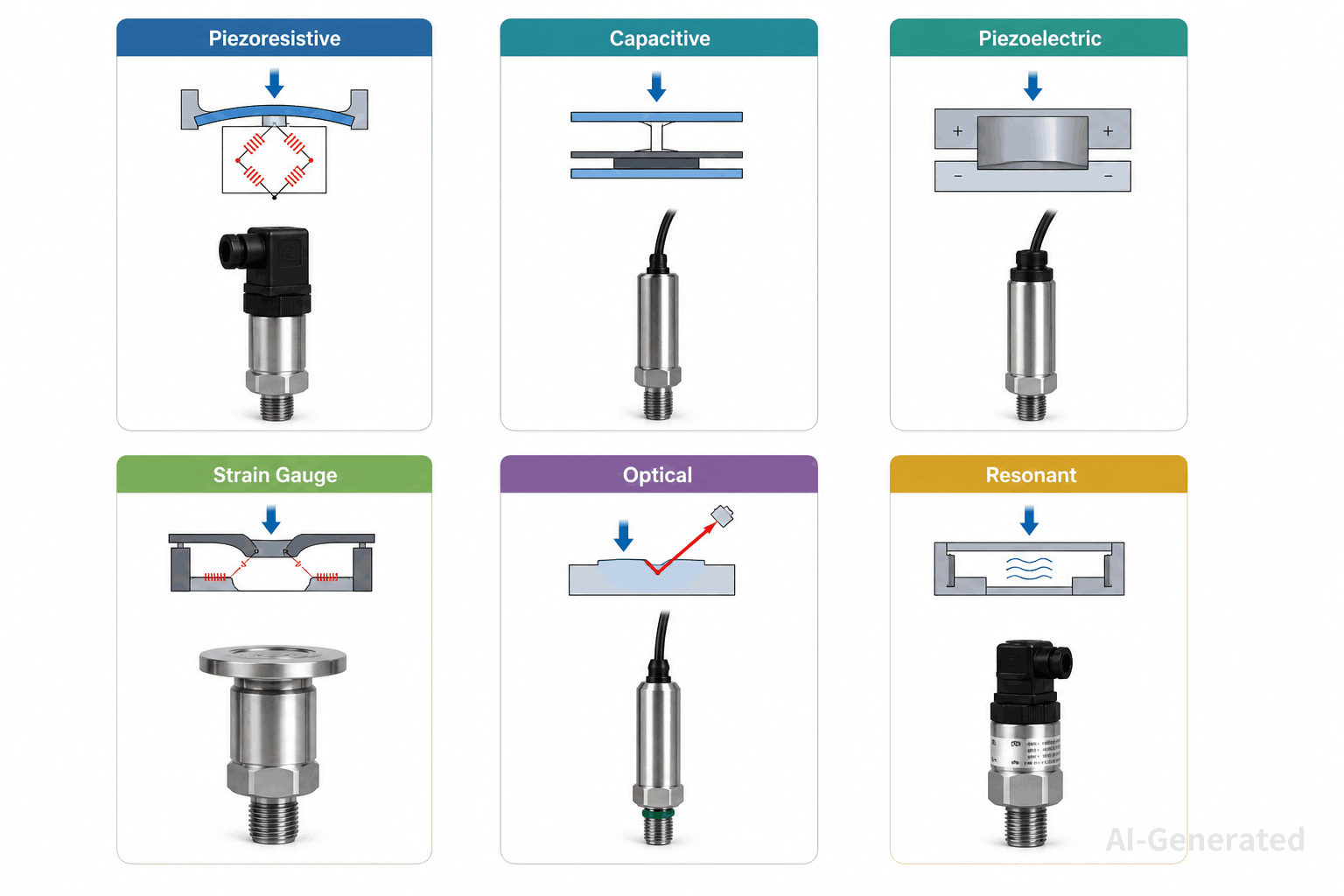
1. Piezoresistive Pressure Sensors
Piezoresistive pressure sensors are the most widely used type in industrial automation due to their excellent balance of accuracy, reliability, and affordability. They are commonly found in hydraulic systems, pneumatic equipment, water treatment facilities, and general industrial machinery.
How it works
When pressure is applied to the silicon sensing diaphragm, microscopic deformation changes the resistance of the integrated piezoresistive elements. A Wheatstone bridge circuit converts these resistance changes into a measurable electrical signal.
Key advantages
- High measurement accuracy with excellent repeatability
- Fast response to pressure changes
- Mature, cost-effective technology
- Suitable for both liquid and gas pressure measurement
- Wide pressure measuring range
Typical applications
- Hydraulic power units
- Air compressor systems
- Injection molding machines
- Industrial process control
- Water supply and pumping systems
2. Capacitive Pressure Sensors
Capacitive pressure sensors are designed for applications requiring extremely high sensitivity, particularly when measuring very low pressures or small pressure variations.
How it works
Inside the sensor, the diaphragm acts as one plate of a capacitor while a fixed electrode forms the other. As pressure changes, the diaphragm moves slightly,altering the capacitive geometry (such as the distance between the plates).This changes the capacitance, which the sensor electronics convert into a corresponding electrical output.
Because capacitance changes can be detected with exceptional precision, these sensors provide excellent resolution even at very low pressures.
Key advantages
- Extremely high sensitivity
- Excellent resolution for low-pressure measurements
- Low power consumption
- Outstanding long-term stability
- Minimal temperature drift
Typical applications
- HVAC differential pressure monitoring
- Cleanroom pressure control
- Medical equipment
- Environmental monitoring
- Precision laboratory instruments
3. Piezoelectric Pressure Sensors
Unlike other pressure sensors that measure continuous pressure, piezoelectric pressure sensors excel at capturing rapidly changing pressure events.
How it works
These sensors use piezoelectric materials such as quartz or specialized ceramics. When mechanical force is applied, the material generates an electrical charge proportional to the applied pressure. Since the electrical charge naturally dissipates over time, piezoelectric sensors are most effective for measuring dynamic rather than static pressure.
Their exceptionally fast response makes them ideal for applications involving vibration, impact, or transient pressure pulses.
Key advantages
- Ultra-fast response time
- High-frequency pressure measurement
- Excellent dynamic performance
- Suitable for harsh operating environments
Typical applications
- Engine combustion testing
- Explosion and shock wave measurement
- Vibration analysis
- Impact testing
- Research and laboratory measurements
Note: Piezoelectric pressure sensors are generally not recommended for continuous static pressure measurement because the generated electrical charge gradually decays over time.
4. Strain Gauge Pressure Sensors
Strain gauge pressure sensors use metallic strain gauges instead of semiconductor sensing elements. Although they typically provide slightly lower sensitivity than piezoresistive sensors, they are highly durable and well suited to heavy-duty industrial environments.
How it works
Metal foil strain gauges are bonded to a flexible diaphragm. When pressure causes the diaphragm to deform, the strain gauges stretch or compress. Unlike semiconductor piezoresistive sensors, whose response is dominated by changes in the material's resistivity, metal strain gauges derive most of their resistance change from changes in their physical dimensions during deformation. These resistance changes are then measured using a Wheatstone bridge circuit and converted into standardized electrical signals.
Key advantages
- Rugged and reliable construction
- Stable performance under heavy mechanical loads
- Good long-term durability
- Suitable for harsh industrial environments
- Cost-effective for medium-accuracy applications
Typical applications
- Industrial automation equipment
- Hydraulic cylinders
- Mechanical testing systems
- Force and load monitoring
- Heavy manufacturing machinery
5. Optical Pressure Sensors
Optical pressure sensors measure pressure by detecting changes in light transmission or optical properties within a sensing element, typically using fiber-optic technology. Unlike conventional electronic sensors, they do not rely on electrical signals at the sensing point, making them highly resistant to electromagnetic interference (EMI) and suitable for demanding environments.
How it works
Most optical pressure sensors use an optical fiber and a pressure-sensitive diaphragm. When pressure is applied, the diaphragm deforms slightly, altering a measurable optical property such as light intensity, wavelength, phase, or interference pattern. This optical change is transmitted through the fiber and analyzed by an optical interrogator, which converts it into an accurate pressure measurement.
Key advantages
- Immune to electromagnetic and radio-frequency interference (EMI/RFI)
- High measurement accuracy and excellent signal stability
- Suitable for remote and long-distance monitoring
- Corrosion-resistant sensing elements available for aggressive media
- Intrinsically safe for hazardous and explosive environments
Typical applications
- Oil and gas exploration and production
- Chemical and petrochemical processing
- Aerospace and aviation systems
- Medical equipment and MRI environments
- High-voltage electrical installations
- Structural health monitoring
6. Resonant Pressure Sensors
Resonant pressure sensors determine pressure by measuring changes in the resonant frequency of a vibrating sensing element. Known for their exceptional accuracy, repeatability, and long-term stability, they are commonly used in high-performance measurement and calibration applications where precision is critical.
How it works
A resonant pressure sensor contains a vibrating element, such as a quartz crystal or silicon resonator, whose natural resonant frequency changes when mechanical stress is applied by pressure. Electronic circuitry continuously excites the resonator and measures its frequency. Since frequency can be measured with extremely high precision, resonant pressure sensors provide highly accurate and stable pressure measurements with minimal long-term drift.
Key advantages
- Ultra-high measurement accuracy and repeatability
- Excellent long-term stability with minimal drift
- High resolution across a wide pressure range
- Outstanding temperature stability with compensation
- Ideal for calibration and precision instrumentation
Typical applications
- Pressure calibration laboratories
- Scientific research and metrology
- Aerospace and satellite systems
- Semiconductor manufacturing
- High-precision industrial process control
FAQs
1.How does a pressure sensor convert pressure into an electrical signal?
A pressure sensor uses a diaphragm that deforms under pressure. The sensing element detects this deformation and converts it into an electrical signal, which is then processed into a standardized output.
2.What is the most common pressure sensor technology?
Piezoresistive pressure sensors are the most widely used because they offer high accuracy, fast response, good stability, and competitive cost.
3.Which output signal is best for industrial automation?
The 4–20 mA current output is the preferred choice for industrial environments due to its strong resistance to electrical noise and reliable long-distance signal transmission.
4.How do I choose the right pressure sensor?
Consider the pressure range, measurement type (gauge, absolute, or differential), output signal, accuracy, operating environment, medium compatibility, and installation method to ensure optimal performance.
5. Can pressure sensors measure both gases and liquids?
Yes. Most industrial pressure sensors are designed to measure both gases and liquids when compatible materials are used.
Conclusion
Pressure sensors are essential components in modern industrial automation, providing accurate and reliable pressure measurement for a wide range of applications. By understanding pressure sensor working principles, exploring the different types of pressure sensors, and evaluating their industrial applications, you can select the right pressure sensor for your system. Whether you need a cost-effective solution for general automation or a high-precision sensor for demanding environments, choosing the appropriate industrial pressure sensor will improve measurement accuracy, system efficiency, operational safety, and long-term reliability.
Keep Learning
A Complete Guide to DIN Rail Terminal Blocks
Introduction In a control cabinet, field wiring from sensors, switches, valves, and other equipment must be connected to PLC I/O, power supplies, relays, and protection devices. Without a defined termination point, wiring becomes harder to trace, test, and maintain. DIN rail terminal blocks provide a structured interface between field wiring and internal cabinet circuits. Depending on the application, a terminal strip may include feed-through, PE, disconnect, fuse, distribution, or multi-level termina......
How to Choose Between Screw, Spring, and Push-In Terminal Blocks
Introduction The connection method is more than a choice between a screw, a spring, or a push-in mechanism. It determines how clamping force is generated, how the conductor is retained, how the connection responds to vibration and temperature changes, and how much time is required for installation and maintenance. Screw-clamp, spring-clamp, and push-in terminal blocks can all provide reliable electrical connections when correctly specified. The difference is how each design achieves that connection an......
How to Select a Terminal Block: A Complete Selection Guide
Introduction Choosing the right terminal block requires more than matching voltage and current ratings. Terminal block selection also depends on wire size, conductor type, connection method, mounting configuration, available space, operating environment, and safety requirements. In control panels and industrial equipment, the terminal block must provide a reliable electrical connection while supporting efficient wiring, testing, and maintenance. A practical selection sequence is: Application → Voltage......
What Is a Terminal Block? Types, Working Principles, and Applications
Introduction A terminal block is a modular electrical connector used to securely connect and organize multiple wires in electrical systems. It provides a reliable connection point for power distribution, signal transmission, and circuit management. Commonly used in industrial automation, control panels, and electrical equipment, terminal blocks help improve wiring organization, simplify maintenance, and enhance system reliability. In this guide, you will learn what a terminal block is, how it works, t......
5 Common Pressure Sensor Problems and How to Troubleshoot Them
Introduction: In previous articles, we explored “What Is a Pressure Sensor?”, “Pressure Sensors Explained: Working Principles, Types, and Applications,” and “How to Select the Right Pressure Sensor,” covering the fundamentals of pressure sensors, including their working principles, types, applications, and key selection considerations. However, even a properly selected pressure sensor may encounter performance issues during operation due to factors such as wiring errors, improper installation, harsh e......
How to Select the Right Pressure Sensor?
Introduction: In previous articles, we explored “What Is a Pressure Sensor?” and “Pressure Sensors Explained: Working Principles, Types, and Applications,” covering the fundamentals of pressure sensors, including how they work, different sensor types, and their applications across industrial automation systems. However, understanding how pressure sensors work is only the first step. In real industrial applications, selecting the right pressure sensor requires engineers to consider multiple factors, in......