How Does A Barcode Scanner Work?
8 min
- The Mechanics Behind Barcode Reading Technology
- Hardware Categories and Their Distinctive Traits
- Operational Challenges and Failure Modes
- Machine Learning Enhancements in Modern Scanning
- Commonly Asked Questions
- Final Thoughts
Walk into virtually any store, warehouse, or hospital today, and you'll encounter barcode scanning technology in action. These unassuming black-and-white patterns have revolutionized how organizations track products, manage supplies, and process transactions. Whether you're a business owner evaluating scanning equipment or simply curious about the technology behind everyday transactions, grasping the mechanics of barcode readers opens doors to smarter implementation decisions. This in-depth exploration breaks down the inner workings of barcode recognition systems, examines various hardware categories, and addresses typical operational hurdles you might encounter.
To maximize the effectiveness of these systems, it is essential to align your hardware with the specific symbology demands of your workflow. Delving into our comparison of 1D vs 2D barcode scanners will provide the technical clarity needed to distinguish between simple linear tracking and high-density data matrix applications. Once you have identified the ideal scanning logic, the next step is deploying equipment that can withstand the rigors of your environment. We invite you to explore the JLCMC Industrial Barcode Scanner series, engineered to deliver relentless precision and rapid decoding for even the most demanding enterprise operations.
The Mechanics Behind Barcode Reading Technology
At its foundation, barcode recognition operates on a straightforward optical principle: specialized hardware identifies variations in reflectivity between dark printed strips and light background areas, translating these visual distinctions into machine-readable electronic pulses. To fully appreciate how a barcode reader functions, one must examine the sequential stages that transform printed patterns into actionable digital information.
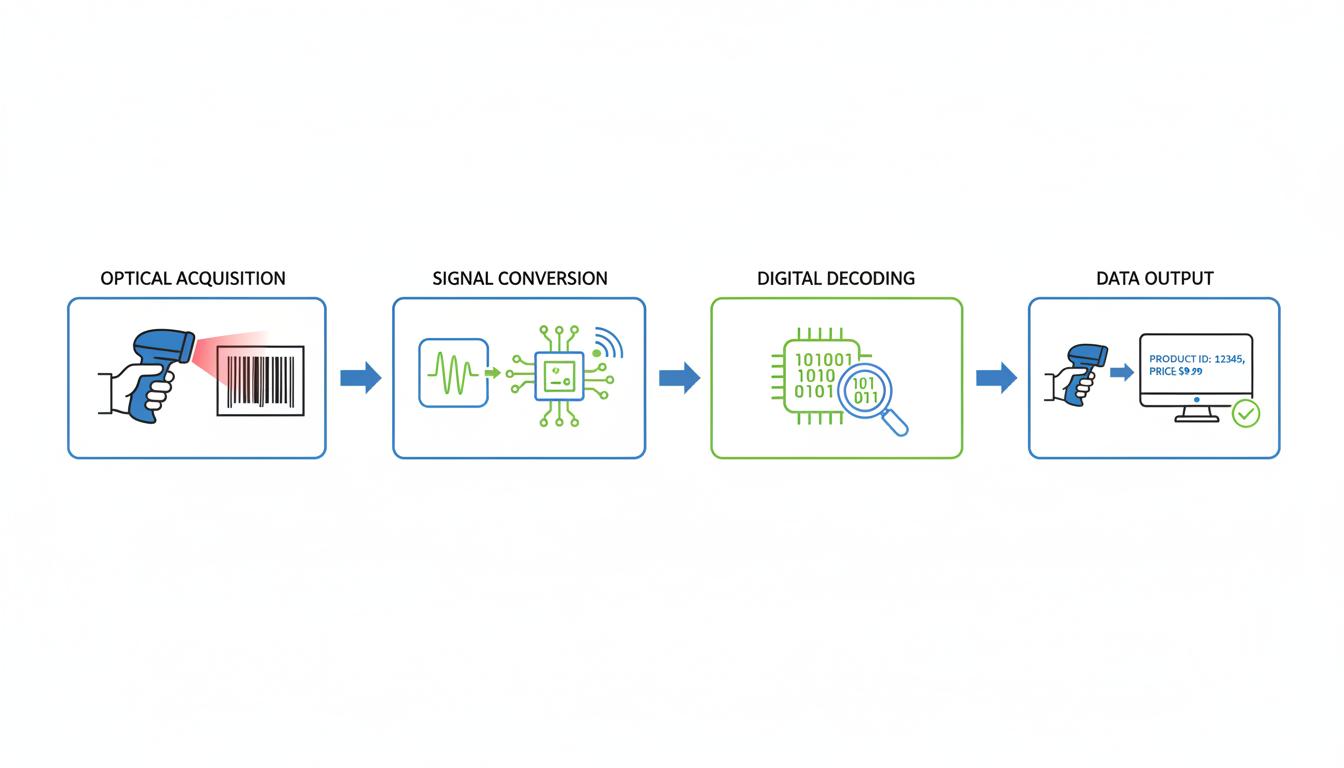
Diagram showing the four stages of barcode scanning: acquisition, conversion, decoding, and output.
Stage One: Optical Acquisition
The reading sequence commences when detection hardware acquires visual data from the printed symbol. Various scanning methodologies employ distinct approaches during this acquisition phase:
• Laser-based systems project coherent light beams onto surfaces and measure backscattered radiation
• Linear imagers (CCD technology) employ light-emitting diode arrays paired with photosensitive chips to photograph codes
• Area imagers and mobile device cameras record ambient illumination through optical sensors to create digital photographs
Stage Two: Analog-to-Digital Transformation
Once optical data reaches the sensing element, the hardware converts photonic energy into fluctuating voltage signals via semiconductor photosensitivity. Dark printed regions absorb illumination, generating minimal electrical response, whereas reflective spaces produce amplified signals. These oscillating voltages mirror the precise spatial arrangement of the encoded symbol.
Stage Three: Pattern Interpretation
Subsequent processing translates analog waveforms into binary numerical sequences representing the encoded data. The onboard processor must recognize specific encoding protocols to decipher these bit patterns correctly. Widely adopted standards encompass Universal Product Code (UPC), Code 39 specifications, Code 128 alphanumeric formats, plus two-dimensional variants such as Quick Response matrices and Data Matrix configurations.
Stage Four: Information Delivery
The concluding phase presents decoded information through human-readable or machine-actionable formats. Output destinations include visual displays, relational databases, enterprise resource planning platforms, or automated control systems that initiate predefined workflows based on scanned identifiers.
Hardware Categories and Their Distinctive Traits
Commercially available scanning equipment exhibits considerable diversity in design philosophy, operational capabilities, and optimal deployment scenarios. Below we examine the principal classifications prevalent across industrial and commercial settings.
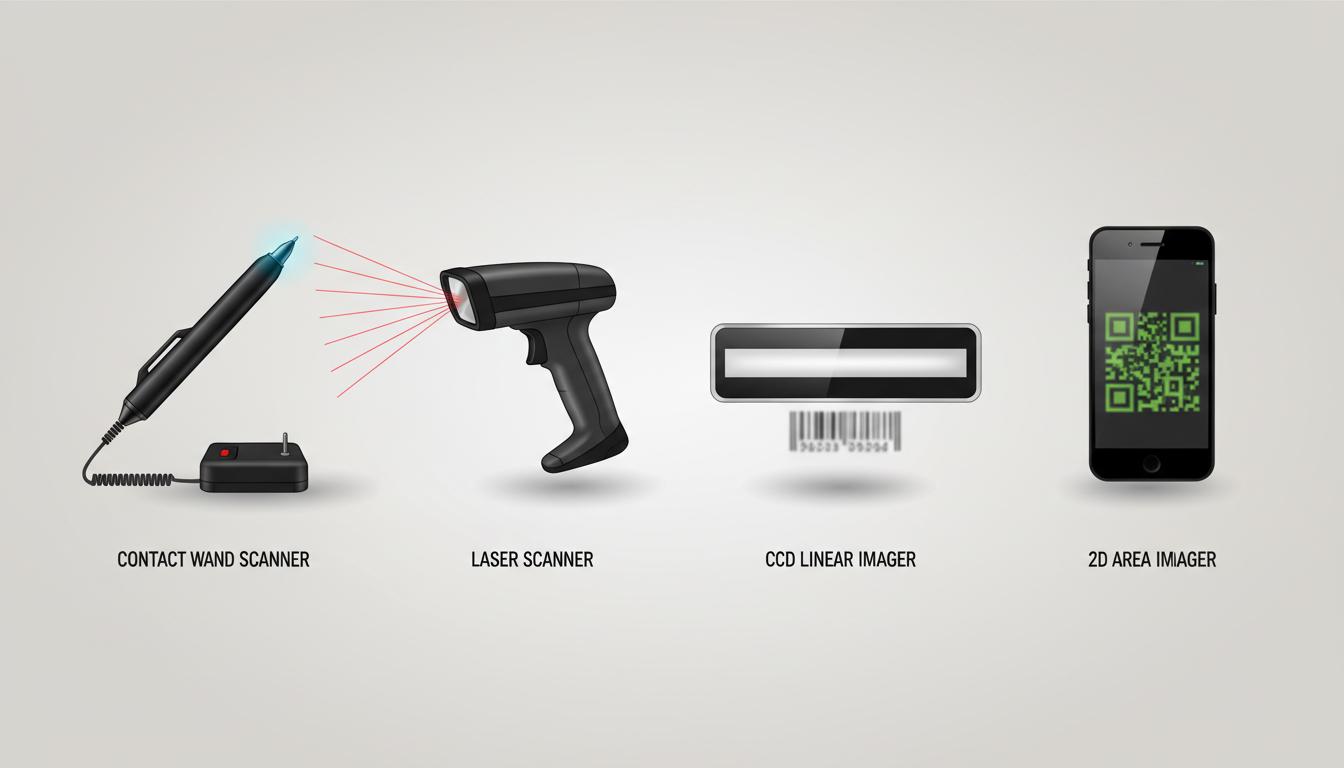
Comparison of four types of barcode scanners: wand, laser, CCD, and 2D imager.
Contact-Style Wand Readers
Wand-style devices represent the most elementary scanning implementation. Users physically drag the instrument tip across printed codes, triggering photosensors to register luminance variations along the symbol's length. Physical contact requirements limit throughput velocity, relegating these tools to occasional, budget-conscious applications rather than high-frequency operations.
Laser Projection Systems
Laser apparatuses rotate or oscillate coherent beams across target surfaces, capturing returning photons through photodiode receivers. Contemporary iterations frequently incorporate rastering or omnidirectional beam configurations enabling multi-angle code detection. Such characteristics suit rapid retail checkout environments admirably, though specular reflections from glossy packaging occasionally interfere with reliable acquisition.
Charge-Coupled Device Imagers
CCD instruments, alternatively marketed as linear imagers, photograph entire code segments simultaneously using densely packed pixel arrays. Absence of mechanical components enhances shock resistance and longevity. However, constrained depth-of-field demands precise positioning proximity, potentially slowing operator workflows compared to extended-range alternatives.
Two-Dimensional Area Imagers
Area imaging platforms leverage megapixel optical sensors identical to those powering contemporary mobile telecommunications devices. This architectural approach delivers unmatched format flexibility, accommodating both traditional linear symbologies and complex matrix codes. Moreover, sophisticated image processing algorithms compensate for suboptimal illumination, label degradation, and non-perpendicular viewing angles. Advanced implementations even support simultaneous multi-code capture and augmented reality visual guidance superimposed atop live video feeds.
Operational Challenges and Failure Modes
Despite technological sophistication, reading equipment occasionally malfunctions due to label deterioration, adverse surroundings, or capability mismatches. The following sections enumerate predominant failure categories practitioners should anticipate.
Protocol Incompatibility
Encountering unsupported encoding formats forces manual transcription, introducing latency and transcription inaccuracies. Procurement decisions should verify comprehensive symbology coverage against present and anticipated future requirements, favoring expandable platforms over limited-purpose devices.
Ambient Environmental Stressors
Surrounding conditions profoundly influence equipment effectiveness. Distribution centers present extremes ranging from dimly illuminated storage aisles to intensely reflective lighting installations. Consumer-facing establishments contend with humidity fluctuations and accidental impacts. Such stressors accelerate component wear, elevate maintenance expenditures, and trigger operational interruptions. Successful deployments incorporate environmental hardening and adaptive signal processing to mitigate these variables.
Acquisition Performance Limitations
Reading velocity and precision fluctuate based on print contrast, symbol dimensions, separation distance, angular orientation, and surrounding illumination. Repeated acquisition attempts necessitate item repositioning, consuming valuable labor resources. Contemporary solutions address these constraints through expanded acceptance angles, extended working distances, and computational optimization techniques.
Communication Infrastructure Dependencies
Certain architectures transmit captured imagery to remote servers for interpretation, rendering functionality contingent upon persistent network availability. Disconnected or intermittent connectivity, common during field service or rural delivery scenarios, paralyzes dependent operations. Autonomous processing capabilities eliminate such vulnerabilities while simultaneously enhancing information security by retaining sensitive data locally.
Human Factors and Interface Design
Equipment usability substantially influences adoption rates and productivity outcomes. Counterintuitive controls, uncomfortable ergonomics, or confusing feedback mechanisms generate operator resistance and elevated error frequencies. Selecting solutions engineered around human-centered design principles preempts these organizational challenges.
Enterprise System Integration Complexity
Connecting scanning infrastructure with established business applications frequently encounters technical obstacles. Aging equipment may lack contemporary communication protocols or standardized programming interfaces. Open-source alternatives might offer insufficient documentation or professional support channels for mission-critical deployments. Partnering with experienced vendors possessing proven integration expertise minimizes deployment timelines and ongoing technical debt.
Machine Learning Enhancements in Modern Scanning
Contemporary recognition systems increasingly incorporate neural network methodologies to transcend traditional hardware limitations. Intelligent algorithms augment conventional optical capture and decoding pipelines with predictive modeling capabilities that interpret environmental context and operator intent.
This situational awareness empowers scanners to extract richer meaning from sensor inputs and anticipated user objectives. Practical manifestations include autonomous selection of relevant codes within cluttered visual fields, fallback optical character recognition when barcode decoding proves impossible, and dynamic parameter adjustment responding to illumination variations.
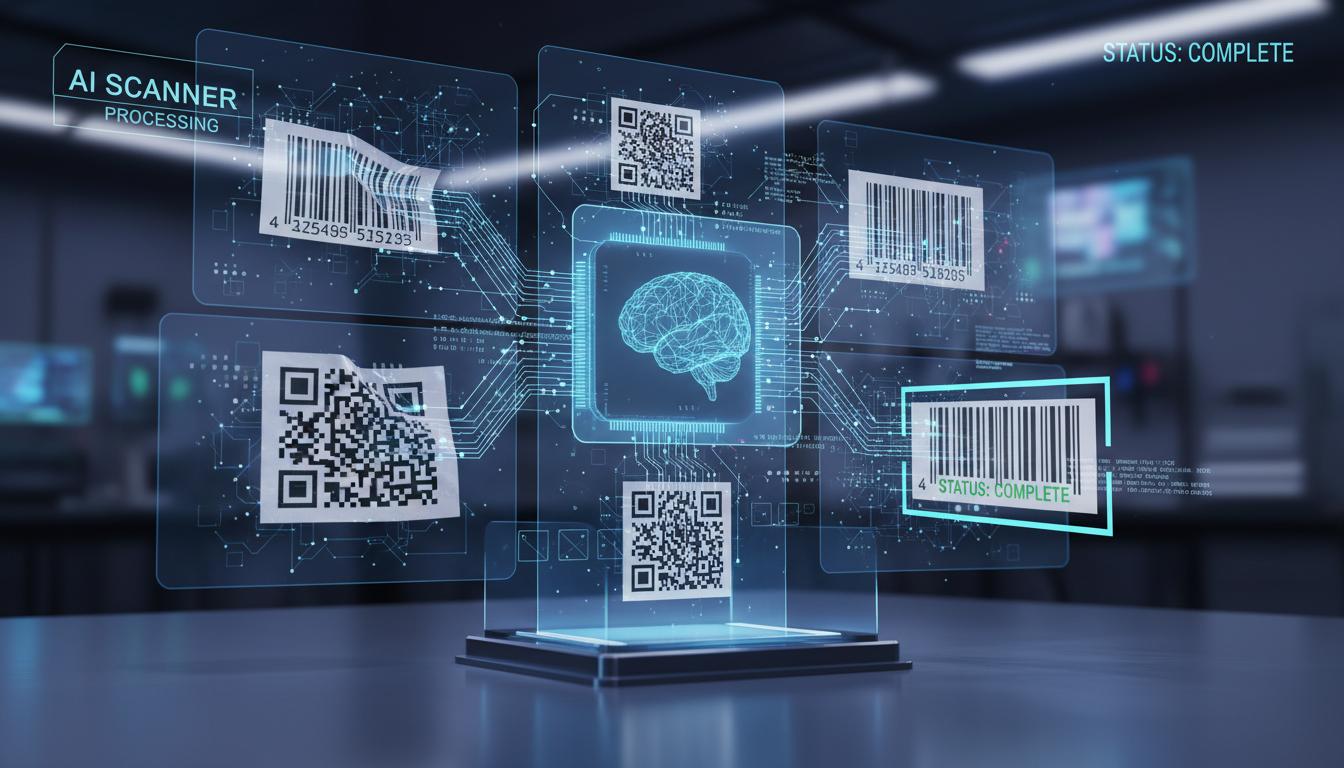
Futuristic AI-powered barcode scanning with neural networks processing multiple codes.
Commonly Asked Questions
| Question | Answer |
| Is it possible to scan worn or damaged labels? | Contemporary recognition systems equipped with sophisticated algorithms can often extract data from compromised labels provided sufficient visual information remains discernible. Area imagers incorporating computational enhancement generally deliver superior results with imperfect codes. |
| Which barcode formats can today's readers handle? | Current-generation hardware accommodates virtually all established symbologies, encompassing linear standards like UPC, EAN, Code 39, and Code 128 alongside matrix formats including QR codes, Data Matrix, and PDF417. Area imaging platforms provide the most extensive format compatibility. |
| How do readers perform under poor lighting? | Advanced systems employ signal processing algorithms to reconstruct readable data from dimly lit captures. Area imagers can additionally adjust exposure parameters and activate supplementary illumination when hardware permits. |
| What working distances do different scanner types offer? | Contact wands require physical touching. Linear imagers operate effectively within several centimeters. Laser systems typically function across half-meter ranges. Area imagers can capture codes from multiple meters depending on optical resolution and symbol dimensions. |
| Can mobile phones serve as reliable scanning devices? | Modern smartphones running specialized recognition software achieve professional-grade scanning performance. These pocket-sized platforms offer exceptional versatility, broad format support, and access to advanced capabilities including batch capture and augmented reality visualization. |
| What advantages does artificial intelligence provide? | Intelligent algorithms deliver contextual awareness, enabling autonomous code selection within visually dense environments, fallback text recognition when barcode extraction fails, and automatic adaptation to challenging conditions including reflections, damage, and insufficient illumination. |
Final Thoughts
Comprehending barcode reading mechanics empowers organizations to select appropriate technological solutions aligned with specific operational demands. From fundamental optical detection through advanced intelligent processing, this field continues rapid evolution addressing contemporary business challenges. Careful evaluation of deployment environments, required symbology support, and integration requirements ensures successful implementations delivering measurable efficiency improvements and accuracy enhancements.
Keep Learning
The Essence of Barcode Symbology: A System of Data Encoding Rules
Introduction Most people only notice barcodes when something moves through a checkout counter or gets sorted in a warehouse. It's a quick flash of light, sometimes a beep, and then the moment is gone. But what's actually happening is more structured than it looks. A barcode is not just a visual pattern—it's a structured relationship between how data is encoded and how machines interpret it under imperfect conditions. In practice, that agreement is called a barcode symbology. And once you start looking......
Spot Common Barcode Scanner Issues Early to Prevent Business Losses
Barcode scanning sits quietly at the center of modern operations. From warehouse receiving docks to hospital inventory rooms and retail checkout counters, it enables speed, traceability, and accuracy at scale. When scanning works, workflows move seamlessly. When it doesn’t, even a small disruption can trigger inventory discrepancies, shipping delays, or reconciliation errors that ripple through the system. A recurring problem with barcode scanners rarely stems from sudden device failure. Instead, most......
Understanding 1D Barcode Technology: Types, Standards, and Applications
In today's fast-paced business environment, efficiency and accuracy are paramount. The 1D barcode, also known as a linear barcode, stands as one of the most transformative technologies in data capture and inventory management. From the checkout counters of retail stores to the complex supply chains of global logistics, these simple yet powerful codes have revolutionized how businesses track, manage, and process information. This comprehensive guide explores the world of 1D barcodes, examining their st......
Explore Barcode Scanner Types: Technology, Form Factor, and Practical Uses
If you have ever stood in a checkout line, watched a warehouse worker pull items from shelves, or seen a nurse scan a patient's wristband, you have witnessed barcode scanning in action. It is one of those technologies that has become so integrated into routine workflows that most people rarely think about what is actually happening when that red light flashes across a label. But for the people responsible for choosing, implementing, or maintaining these systems, the differences between scanner types m......
Barcode Scanner Basics: What It Is & How It Works
Originally used as a simple retail tool, barcodes have now evolved into a core technology widely applied across industries such as logistics, healthcare, manufacturing, and asset management. They play a key role in inventory management, compliance tracking, and real-time data processing, ensuring operational accuracy across various sectors. To truly understand the capabilities of barcode scanner technology, one must look beyond the printed label. The real impact comes from how quickly information is t......
Scan Code Types: What They Are & Why They Matter
Barcodes and matrix symbols quietly move products and components through every industry—from retail checkout lanes to medical equipment parts. Choosing the right scan code affects scanning speed, data accuracy, label durability, and long-term scalability. Some codes excel at rapid retail scanning. Others are engineered for tiny or curved surfaces, like surgical instruments, electronics, or micro-packaging. The right type ensures readable codes even when space is limited, or labels are damaged, while t......