O-Ring Material Guide: NBR, FKM, EPDM, Silicone and FFKM
13 min
- Key Takeaways
- 1. Why O-Ring Material Selection Matters
- 2. O-Ring Material Comparison at a Glance
- 3. Common O-Ring Materials
- 4. Specialty Materials
- 5. O-Ring Chemical Compatibility Guide
- 6. How Operating Conditions Affect Material Choice
- 7. O-Ring Hardness and Compound Formulation
- 8. How to Choose the Right O-Ring Material
- 9. O-Ring Material Selection for Mechatronic Equipment
- 10. Common O-Ring Material Selection Mistakes
- Frequently Asked Questions
- Conclusion
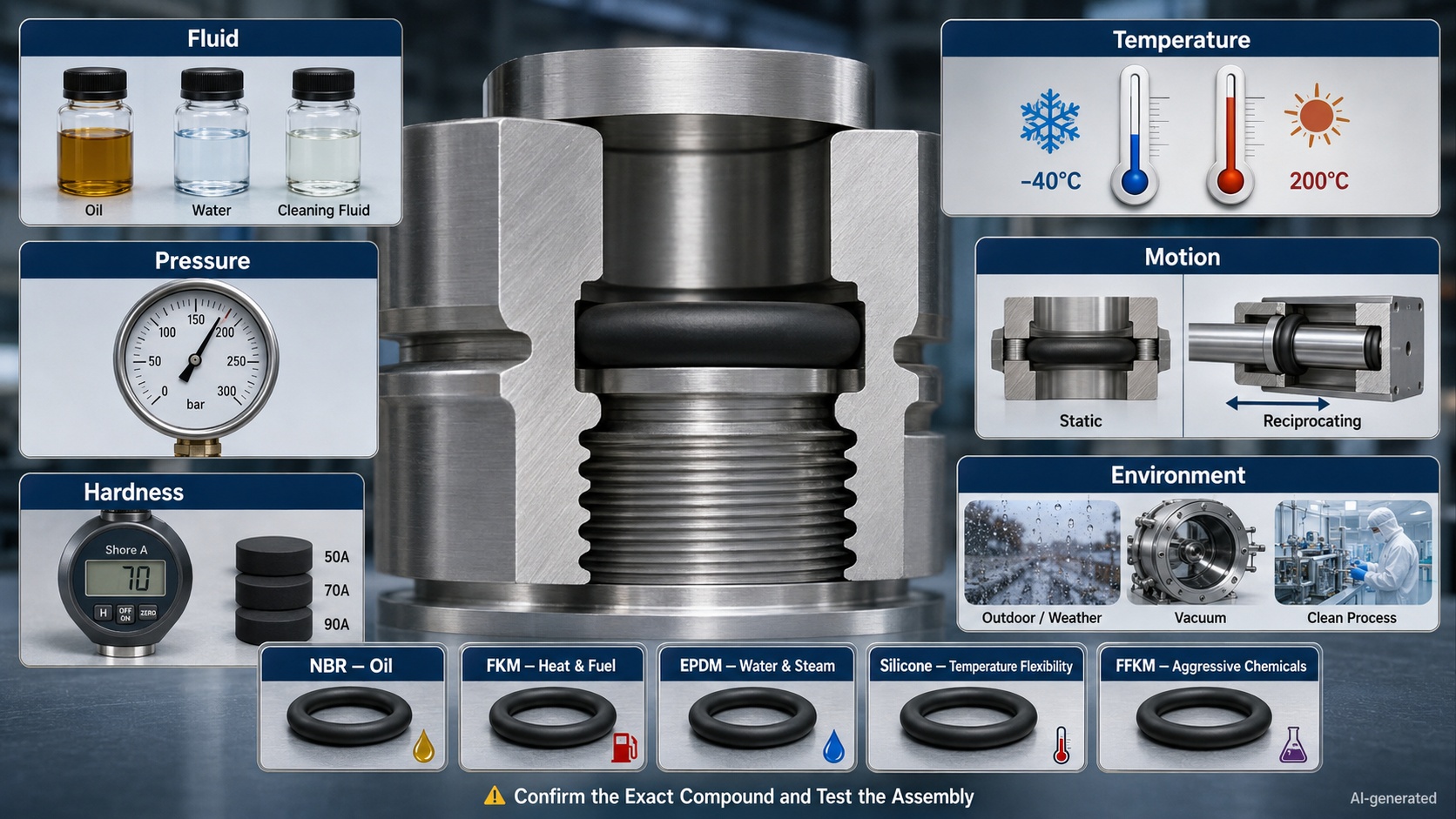
Choosing an O-Ring material is not simply a choice between "rubber" and "better rubber." The seal must remain flexible, chemically stable and mechanically supported throughout the actual operating cycle.
A material that performs well in mineral oil may fail in steam. Another may tolerate high temperature but become too stiff during a cold startup. Even within the same polymer family, different compounds can deliver different hardness, compression set, cleanliness and service life.
This guide compares the most common O-Ring materials and explains how fluid, temperature, pressure, motion and hardness affect material selection.
Key Takeaways
• NBR is a practical starting point for many mineral-oil and general industrial applications.
• FKM is commonly selected for higher temperatures, fuels, oils and broader chemical exposure.
• EPDM is generally better suited to water, steam, ozone and outdoor environments.
• Silicone provides excellent temperature flexibility but has limited tear and abrasion resistance.
• FFKM is used for demanding chemical, thermal and high-purity applications.
• Material family, compound formulation, hardness, size and groove design must be evaluated together.
• O-Ring color is not a universal material-identification system.
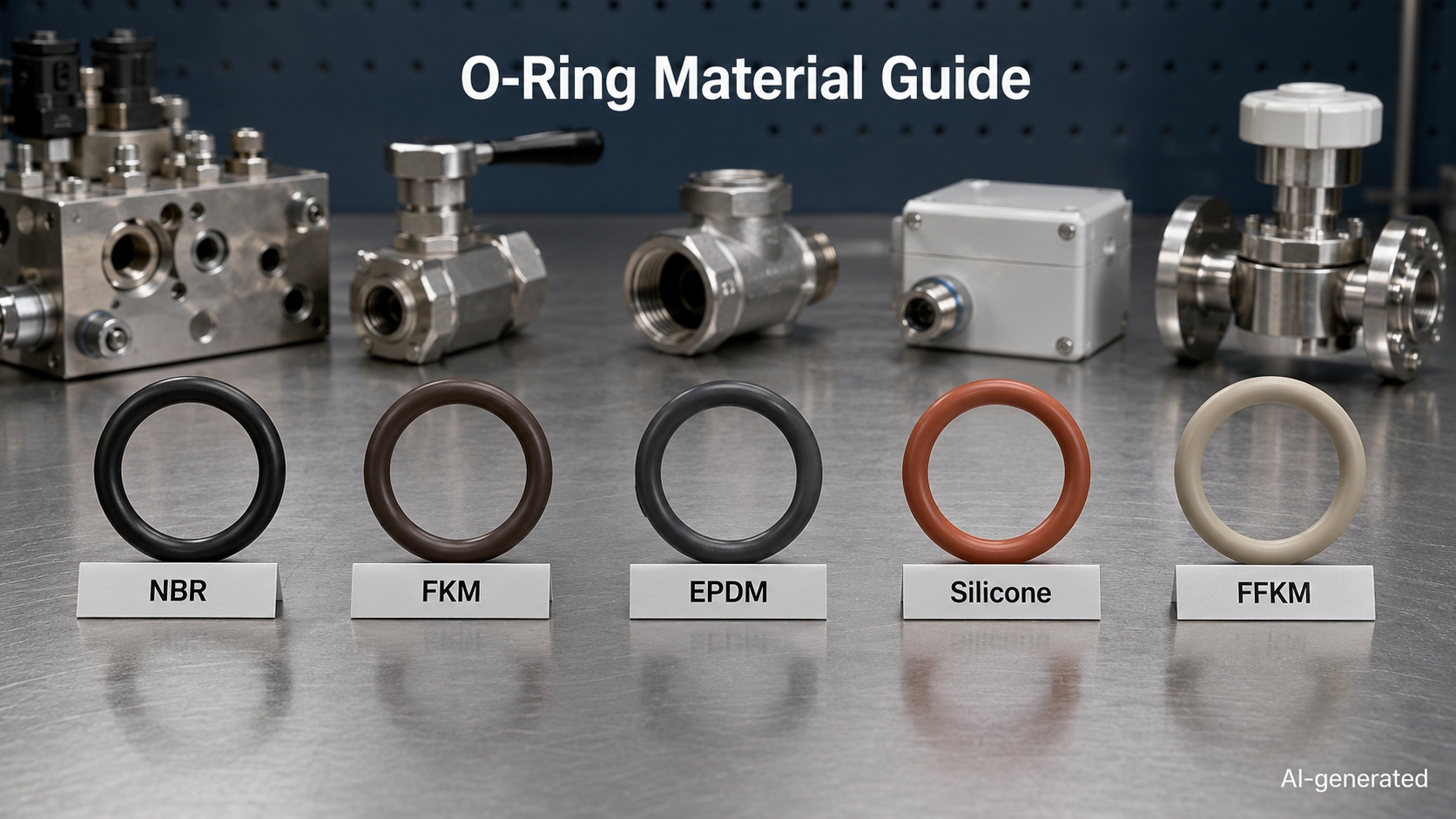
1. Why O-Ring Material Selection Matters
The material determines how the O-Ring responds to:
• Operating fluids and cleaning chemicals
• Continuous and peak temperatures
• Pressure and decompression
• Static, reciprocating or rotary motion
• Ozone, weather and ultraviolet exposure
• Vacuum and gas permeability
• Compression and long-term deformation
• Regulatory, cleanliness and traceability requirements
An incompatible material may swell, shrink, soften, harden, crack or lose strength. The result may be leakage, excessive friction, contamination or complete seal failure.
The correct choice is therefore a specific compound matched to the complete application - not merely a familiar polymer name.
2. O-Ring Material Comparison at a Glance
| Material | Typical starting applications | Main strengths | Main limitations |
| NBR | Mineral oil, grease, hydraulics and pneumatics | Economical, good oil resistance and useful wear properties | Limited resistance to ozone, weather, steam and some high-temperature fluids |
| FKM | Fuel, oil, heat and many industrial chemicals | Strong heat, fuel, ozone and chemical resistance | Higher cost and potentially limited low-temperature flexibility |
| EPDM | Water, steam, glycol coolant and outdoor equipment | Good water, weather, ozone and temperature-aging resistance | Generally unsuitable for petroleum oil and fuel |
| Silicone | Static seals, sensors and broad-temperature applications | Excellent low-temperature flexibility and wide temperature capability | Lower tear, abrasion and dynamic-wear resistance |
| FFKM | Aggressive chemicals, high heat and high-purity processing | Exceptionally broad chemical and thermal resistance | Very high cost and grade-specific performance |
| HNBR | Demanding oil, hydraulic and dynamic applications | Better strength, wear and heat resistance than standard NBR | Compatibility still depends on the exact fluid and compound |
| FVMQ | Fuel exposure combined with low temperature | Better fuel resistance than standard silicone with useful cold flexibility | Limited mechanical and wear performance in demanding motion |
| PTFE | Aggressive chemicals and low-friction sealing systems | Broad chemical resistance and low friction | Not a conventional elastomer; groove and energizing requirements differ |
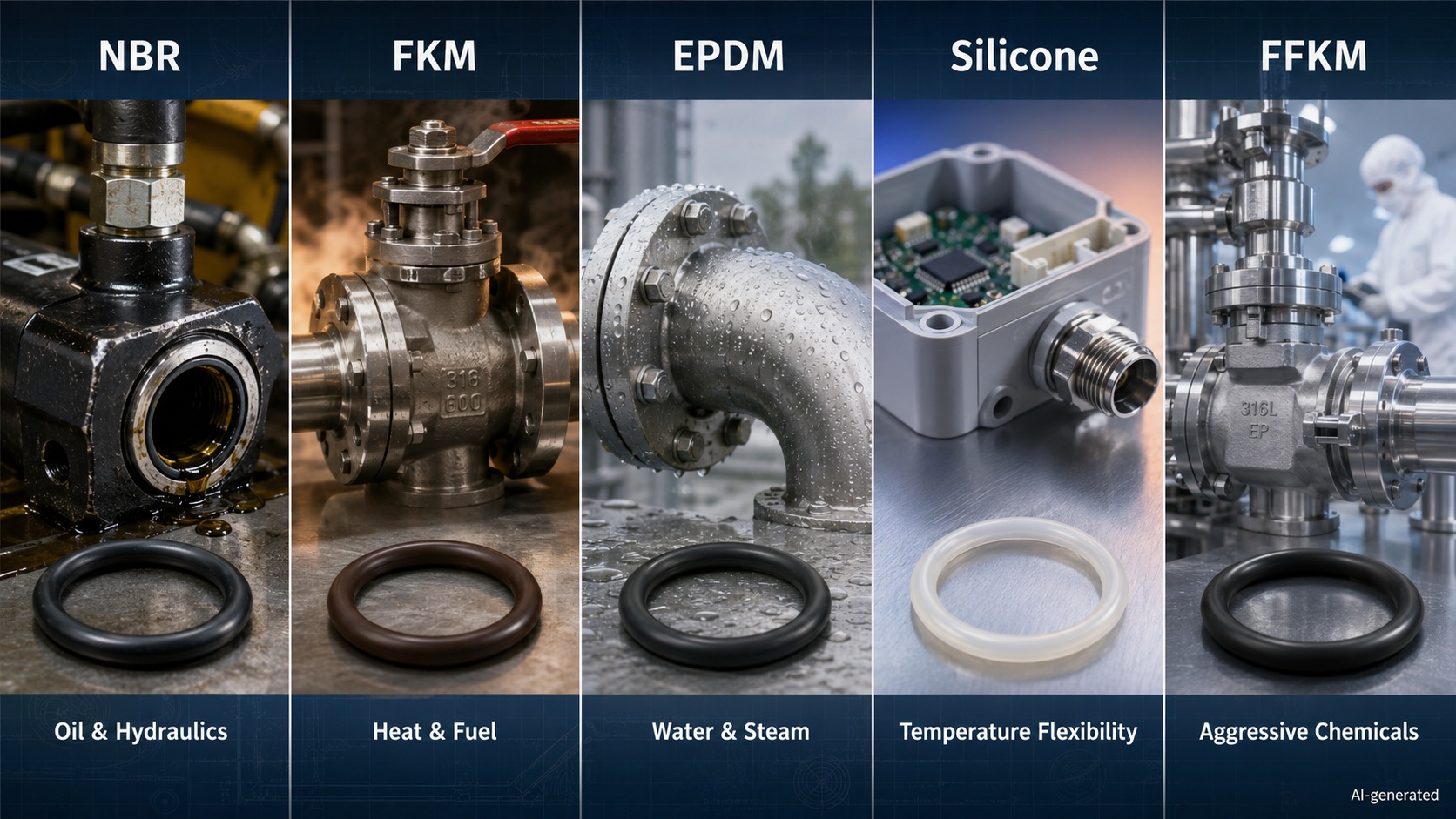
This table is a screening tool. Final approval must be based on the exact compound, fluid composition and operating conditions.
3. Common O-Ring Materials
NBR O-Ring
Nitrile rubber, or NBR, is one of the most widely used industrial sealing materials.
• Best suited to: Mineral oil, grease, hydraulic fluid and many pneumatic systems
• Main strengths: Economical cost, good oil resistance and useful abrasion resistance
• Check carefully: Temperature extremes, fuel formulation, additives and outdoor exposure
• Generally unsuitable for: Ozone, prolonged weather exposure, steam and many aggressive chemicals
Choose NBR when the application involves moderate temperatures and conventional oil-based service without demanding weather or chemical exposure.
FKM O-Ring
FKM is commonly selected when NBR cannot provide sufficient resistance to heat, fuel or chemicals.
• Best suited to: Fuel, petroleum oil, elevated temperatures and many industrial chemicals
• Main strengths: Heat resistance, fuel resistance, ozone resistance and low gas permeability
• Check carefully: Low-temperature flexibility, hot water, steam and dynamic lubrication
• Generally unsuitable for: Certain amines, ketones, low-molecular-weight organic acids and application-specific chemicals
FKM is a polymer classification. Viton® is a registered trade name associated with specific fluoroelastomer products, so the two terms should not be treated as completely interchangeable.
EPDM O-Ring
EPDM is often the preferred starting point for water-based and outdoor sealing applications.
• Best suited to: Water, steam, glycol coolant, ozone and weather exposure
• Main strengths: Water resistance, outdoor durability and temperature-aging performance
• Check carefully: Coolant additives, cleaning agents, steam temperature and compression set
• Generally unsuitable for: Mineral oil, petroleum grease and hydrocarbon fuel
EPDM is common in water valves, cooling systems, outdoor enclosures and selected food-processing equipment when the exact compound has the required approval.
Silicone O-Ring
Silicone rubber is valued for its flexibility across a broad temperature range.
• Best suited to: Static seals, cold environments, sensor housings and clean equipment
• Main strengths: Low-temperature flexibility, temperature stability and availability in clean or approved grades
• Check carefully: Gas permeability, fluid compatibility and compression set
• Generally unsuitable for: High-wear reciprocating or rotary applications without careful validation
Silicone may work in dynamic service, but its relatively low tear and abrasion resistance often makes it more suitable for static sealing.
FFKM O-Ring
Perfluoroelastomer, or FFKM, is used when conventional elastomers cannot survive the chemical or thermal environment.
• Best suited to: Aggressive process chemicals, high temperatures and high-purity equipment
• Main strengths: Exceptionally broad chemical resistance and strong thermal capability
• Check carefully: Exact chemical, temperature, plasma exposure, cleanliness and decompression conditions
• Main limitation: Significantly higher cost
FFKM does not resist every chemical under every condition. Grade selection remains essential - no acronym can repeal chemistry.
4. Specialty Materials
Several additional materials may be appropriate when the five common families do not meet the application requirements.
• HNBR: Provides improved strength, wear resistance and heat capability compared with standard NBR. It is useful in demanding oil, hydraulic and dynamic applications.
• FVMQ: Combines some fuel resistance with better low-temperature flexibility than standard FKM. Mechanical performance must still be checked.
• PTFE: Provides broad chemical resistance and low friction but does not behave like an elastomer. PTFE sealing systems may require different grooves, energizers or installation methods.
Specialty materials should be selected using supplier data for the exact grade rather than a generic family description.
5. O-Ring Chemical Compatibility Guide
Chemical compatibility depends on more than whether the fluid immediately attacks the seal.
An incompatible fluid may cause:
• Swelling or shrinkage
• Softening or hardening
• Loss of tensile strength
• Cracking or surface damage
• Increased compression set
• Excessive permeation
• Lubricant removal
• Reduced service life
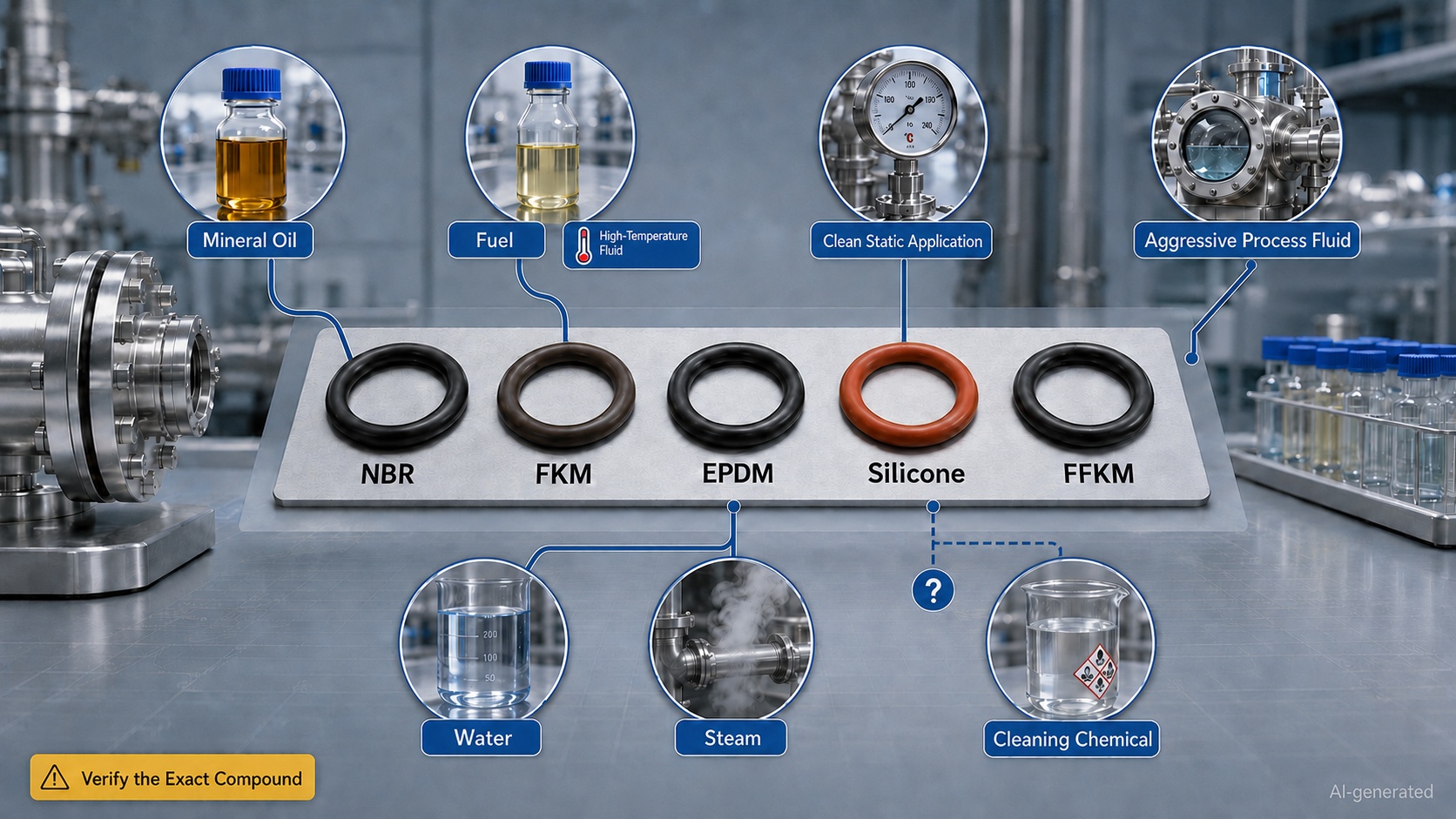
Common Starting Points
| Medium or environment | Likely starting materials | Main points to verify |
| Mineral oil and grease | NBR, HNBR or FKM | Oil type, additives and temperature |
| Fuel | FKM or FVMQ | Fuel formulation, alcohol content and movement |
| Water and glycol coolant | EPDM or an approved NBR compound | Additives, corrosion inhibitors and temperature |
| Steam | EPDM, selected FKM or specialty FFKM | Temperature, pressure and steam-cycle duration |
| Outdoor exposure | EPDM, silicone or FKM | Fluid exposure, housing design and temperature cycling |
| Aggressive chemicals | Selected FFKM, FKM, EPDM or PTFE | Exact chemical, concentration, temperature and mixture |
| Vacuum | NBR, FKM, FVMQ or a specialty compound | Permeability, outgassing, cleanliness and compression set |
Always evaluate:
• Exact chemical name and formulation
• Concentration
• Continuous and peak temperature
• Exposure duration
• Pressure or vacuum
• Static or dynamic motion
• Cleaning and flushing fluids
• Lubricants and assembly aids
• Required approvals
Published charts often evaluate pure chemicals, while real fluids may contain water, dyes, inhibitors, surfactants, dissolved gases and degradation products. When the formulation is proprietary, confirm compatibility with both the fluid supplier and the seal supplier.
Chemical and temperature limits should never be treated as unrelated checkboxes. Higher temperature can accelerate permeation, swelling and chemical reaction.
6. How Operating Conditions Affect Material Choice
Low Temperature
At low temperature, an elastomer becomes harder and less responsive.
Pay particular attention to:
• Cold startup
• Outdoor equipment
• Refrigeration systems
• Cold-storage automation
• Housing contraction
• Dynamic breakaway force
Silicone and FVMQ often provide useful low-temperature flexibility. Standard FKM may become too stiff for some cold dynamic applications.
High Temperature
High temperature may:
• Accelerate chemical attack
• Increase compression set
• Reduce tensile strength
• Degrade lubricants
• Increase permeation
• Shorten service life
A published maximum temperature may represent short laboratory exposure rather than continuous operation under pressure.
Pressure and Extrusion
Extrusion resistance depends on:
• Compound hardness and strength
• Operating temperature
• Clearance gap
• Pressure direction and cycling
• O-Ring cross-section
• Groove support
• Backup-ring use
A harder O-Ring may help, but it cannot correct an oversized clearance gap. See the O-Ring Groove Design Guide for squeeze, stretch, gland fill and clearance guidance.
Dynamic Motion
For reciprocating, oscillating or slow rotary service, verify:
• Abrasion resistance
• Friction and lubrication
• Surface finish
• Heat generation
• Cycle rate
• Breakaway force
• Misalignment
NBR and HNBR often provide useful general wear performance. Silicone normally requires more caution in dynamic service.
Rapid Gas Decompression
High-pressure gas can diffuse into an elastomer. Rapid pressure release may then produce internal blisters, cracks or rupture.
High-pressure gas applications may require a compound specifically qualified for rapid gas decompression resistance. Selecting only by polymer family is not sufficient.
7. O-Ring Hardness and Compound Formulation
O-Ring hardness is commonly reported on the Shore A scale.
| Approximate hardness | Typical behavior | Common use considerations |
| 50-60 Shore A | Soft and highly conformable | Low-pressure sealing and delicate or slightly irregular surfaces |
| 70-75 Shore A | Balanced general-purpose behavior | Common static and dynamic industrial applications |
| 80-90 Shore A | Harder and more resistant to extrusion | Higher pressure or mechanically demanding service |
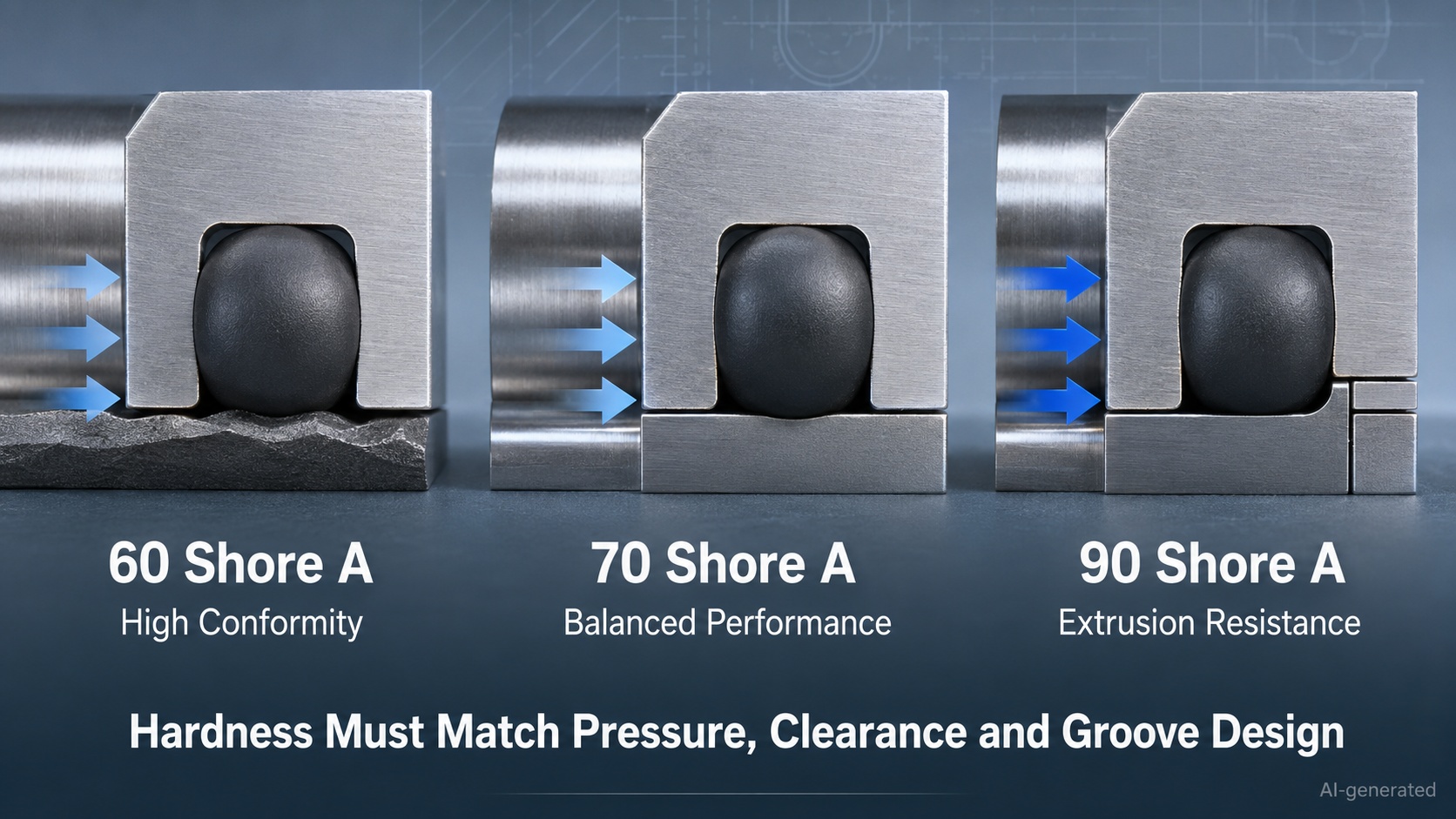
In general:
• Softer compounds conform more easily and require less assembly force but are more vulnerable to extrusion and damage.
• Harder compounds improve mechanical support but may increase squeeze force and dynamic friction.
• Compound formulation matters: Fillers, plasticizers, curing agents and specialty additives can change chemical resistance, compression set and cleanliness.
• Color is not a specification: Black, brown, red or translucent O-Rings may follow supplier conventions, but color does not reliably identify the material.
Specify the polymer family, compound or product code, hardness and required approval. Do not purchase an O-Ring based only on color.
8. How to Choose the Right O-Ring Material
Step 1: Identify Every Fluid
Include fluids encountered during:
• Normal operation
• Startup and shutdown
• Cleaning
• Maintenance
• Lubrication
• Storage
• Accidental contamination
Step 2: Define the Temperature Profile
Record the minimum startup temperature, normal operating temperature, maximum continuous temperature and short-duration peak.
Also include frictional heat and cleaning or sterilization temperatures.
Step 3: Define Motion and Pressure
Confirm:
• Static, reciprocating, rotary or oscillating service
• Normal and peak pressure
• Vacuum level
• Pressure pulsation
• Decompression rate
• Clearance gap
• Cycle rate
Step 4: Create a Material Shortlist
Common starting points include:
• Mineral oil: NBR
• Demanding oil or wear: HNBR
• Higher-temperature oil or fuel: FKM
• Water, steam or outdoor exposure: EPDM
• Cold static sealing: Silicone or FVMQ
• Aggressive chemicals or high-purity processing: Selected FFKM
These are starting directions, not final approvals.
Step 5: Select the Compound and Hardness
Compare candidate compounds for:
• Exact chemical compatibility
• Continuous temperature capability
• Compression set
• Tensile and tear strength
• Abrasion resistance
• Gas permeability
• Hardness
• Cleanliness
• Regulatory approval
• Rapid gas decompression resistance
Step 6: Verify the Complete Assembly
Confirm the inside diameter, cross-section, squeeze, stretch and gland fill using the O-Ring Size Guide and the product drawing.
Validation may include fluid immersion, pressure cycling, thermal cycling, compression-set testing, dynamic wear, vacuum testing and accelerated aging.
For regulated or safety-critical applications, verify certification and traceability for the exact compound - not merely the polymer family.
9. O-Ring Material Selection for Mechatronic Equipment
| Application | Likely starting material | Main questions |
| Oil-lubricated pneumatic cylinder | NBR or HNBR | Lubricant, wear, cycle rate and temperature |
| Water solenoid valve | EPDM | Water additives, temperature and coil heat |
| Hydraulic manifold | NBR, HNBR or FKM | Oil type, pressure, clearance and peak temperature |
| Outdoor sensor enclosure | EPDM or silicone | Ozone, weather, temperature cycling and housing stiffness |
| Fuel-handling valve | FKM or FVMQ | Fuel formulation, temperature and motion |
| Vacuum gripper | NBR or FKM | Permeability, surface finish and compression set |
| Liquid-cooling module | Coolant-compatible EPDM or specialty compound | Glycol type, additives and cleaning fluid |
| Chemical dispenser | Selected FKM, EPDM or FFKM | Complete chemical mixture and flushing process |
Additional examples are covered in O-Ring Applications in Mechatronic Systems.
Once the requirements are defined, the JLCMC O-Ring category can be filtered by material, hardness, series and intended use. Always confirm the individual product drawing before ordering.
10. Common O-Ring Material Selection Mistakes
• Choosing by color: Color is not a universal material code.
• Choosing only by maximum temperature: The fluid, pressure and movement remain important.
• Checking only the primary fluid: Cleaning chemicals, lubricants and additives may cause the failure.
• Treating all compounds as identical: Polymer family does not define hardness, cure system or approvals.
• Assuming FKM is always better than NBR: FKM may be unnecessary or unsuitable for certain cold, water or steam applications.
• Using hardness to correct a bad groove: A harder compound cannot repair incorrect squeeze, clearance or surface finish.
• Replacing the seal without diagnosing the failure: Swelling, abrasion, hardening and blistering indicate different causes.
For structured diagnosis, see the O-Ring Failure Guide.
Frequently Asked Questions
What is the best O-Ring material?
There is no universal best material. The correct choice depends on the fluid, temperature, pressure, motion, groove and required service life.
What is the most common O-Ring material?
NBR is widely used because it combines oil resistance, useful mechanical properties and economical cost.
What is the difference between NBR and FKM?
NBR is commonly used with mineral oil and grease at moderate temperatures. FKM generally provides better resistance to heat, fuel, ozone and many chemicals but costs more and may have weaker low-temperature flexibility.
What is the difference between FKM and EPDM?
FKM is generally better suited to petroleum oil, fuel and elevated temperatures. EPDM is normally preferred for water, steam, glycol coolant and outdoor exposure.
Is Viton the same as FKM?
Not exactly. FKM is a generic fluoroelastomer classification, while Viton® is a registered trade name associated with specific fluoroelastomer products.
Can an EPDM O-Ring be used with oil?
EPDM is generally unsuitable for mineral oil and petroleum-based grease. Confirm the exact oil and compound before use.
What hardness should an O-Ring be?
Around 70 Shore A is common for general industrial service. Softer compounds improve conformity, while harder compounds improve extrusion resistance. Pressure, clearance, motion and housing stiffness determine the final choice.
Does O-Ring color identify its material?
No. Confirm the material designation, compound code and hardness rather than relying on color.
Conclusion
O-Ring material selection begins with the complete operating environment.
NBR is a dependable starting point for many oil-based systems. FKM extends performance into higher temperatures, fuels and broader chemical exposure. EPDM is well suited to water, steam and outdoor service. Silicone provides strong temperature flexibility for many static seals, while FFKM serves demanding chemical, thermal and high-purity processes.
The material name alone is not a complete specification. Fluid composition, temperature, pressure, motion, hardness, groove geometry and compound formulation must be evaluated together.
Define the application, shortlist the material, verify the exact compound and test the assembly. That is how a small O-Ring becomes a reliable engineering component.
Keep Learning
O-Ring Applications in Mechatronic Systems: Design and Selection Guide
An O-Ring in a mechatronic system does more than stop fluid from escaping. It may preserve pneumatic pressure, maintain vacuum holding force, protect a sensor from coolant, contain liquid around power electronics or keep a dispensing process repeatable. This matters because mechatronic equipment connects mechanical movement with electronics, sensors and automated control. A small sealing problem can therefore become a motion problem, a measurement problem or even a system shutdown. A leaking pneumatic......
O-Ring Material Guide: NBR, FKM, EPDM, Silicone and FFKM
Choosing an O-Ring material is not simply a choice between "rubber" and "better rubber." The seal must remain flexible, chemically stable and mechanically supported throughout the actual operating cycle. A material that performs well in mineral oil may fail in steam. Another may tolerate high temperature but become too stiff during a cold startup. Even within the same polymer family, different compounds can deliver different hardness, compression set, cleanliness and service life. This guide compares ......
O-Ring Guide: Types, Materials, Sizes and Applications
An O-Ring is a circular sealing element with a round cross-section. Installed in a properly designed groove, it is compressed between two mating surfaces to prevent liquid or gas from passing through the joint. The design could hardly be simpler, yet the O-Ring is used in everything from household fittings and automotive systems to pneumatic cylinders, vacuum equipment, industrial robots and semiconductor machinery. That small ring quietly prevents leaks, protects components and keeps pressure where i......
O-Ring Size Guide: How to Measure and Choose the Right Size
An O-Ring can have the correct material, suitable hardness and excellent chemical resistance—and still leak because its dimensions are wrong. Selecting the right O-Ring size begins with three measurements: inside diameter, cross-section and outside diameter. The arithmetic is simple. The engineering decision is not. Manufacturing tolerances, groove geometry, installation stretch, operating pressure and the condition of the old seal can all change which size is actually suitable. This O-Ring size guide......
How to Install an O-Ring Without Damaging It
Installing an O-Ring looks simple: place the ring in the groove, assemble the components and move on. In practice, many O-Ring failures begin during those few seemingly harmless seconds. A burr can cut the sealing surface. An incompatible lubricant can soften or swell the material. Excessive stretching can reduce the cross-section, while rolling the ring into the groove can create a twist that later develops into spiral failure. The frustrating part is that installation damage is not always immediatel......
O-Ring Failure Guide: Causes, Symptoms and Solutions
An O-Ring rarely fails without leaving clues. A flattened cross-section may suggest compression set. Ragged edges can point to extrusion. A soft, swollen seal often indicates chemical incompatibility, while fine surface cracks may reveal heat, ozone or environmental attack. The difficulty is that several problems can produce similar symptoms—and several causes can act together. For example, an incompatible fluid may soften an O-Ring. The softened material then becomes easier to extrude through a clear......