What Is a Terminal Block? Types, Working Principles, and Applications
10 min
- Introduction
- What Is a Terminal Block?
- Common Types of Terminal Block
- Spring-Clamp Terminal Blocks
- Push-In Terminal Blocks
- Advantages of Using Terminal Blocks
- Applications of Terminal Blocks
- FAQ
- Conclusion
Introduction
A terminal block is a modular electrical connector used to securely connect and organize multiple wires in electrical systems. It provides a reliable connection point for power distribution, signal transmission, and circuit management.
Commonly used in industrial automation, control panels, and electrical equipment, terminal blocks help improve wiring organization, simplify maintenance, and enhance system reliability.
In this guide, you will learn what a terminal block is, how it works, the different types available, and their common applications.
What Is a Terminal Block?
Terminal Block Definition
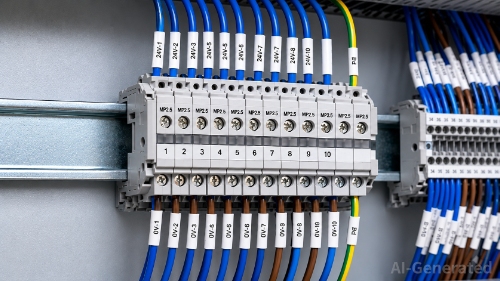
A terminal block is an insulated connector that provides a secure connection point for electrical wires. It allows wires to be connected, disconnected, tested, and maintained more easily compared with traditional wire splicing methods.
Terminal blocks are commonly installed on DIN rails, circuit boards, or electrical panels and are widely used in industrial control systems, automation equipment, and power distribution applications.
Main Functions of Terminal Blocks
- Wire Connection: Provides a secure connection between electrical conductors.
- Signal Distribution: Distributes power or signals across multiple circuits.
- Wire Organization: Keeps complex wiring systems structured and easy to manage.
- Easy Maintenance: Enables faster testing, replacement, and troubleshooting.
How Does a Terminal Block Work?
The operating principle is straightforward:
- The conductor is inserted into the terminal opening.
- A screw, spring, or push-in mechanism applies contact pressure.
- The conductor contacts the conductive metal element.
- Electrical current flows through the conductive element.
- The housing maintains insulation and physical separation between adjacent circuits.
- The mounting system secures the terminal block to a DIN rail, PCB, or panel.
The electrical performance of the connection depends heavily on maintaining adequate contact pressure and minimizing contact resistance. A connection that is mechanically loose can generate localized heating, voltage drop, and, under severe conditions, arcing.
Components of a Terminal Block
Insulating Housing
The housing separates conductive elements from each other and from the mounting structure. Common materials include engineering thermoplastics such as polyamide (PA), depending on the required temperature, flame-retardancy, and environmental performance.
For applications exposed to elevated temperatures or demanding fire-safety requirements, the material specification should be checked against the manufacturer's datasheet rather than assuming all PA housings have the same performance.
Conductive Metal Element
The conductive element carries current between connected conductors.
Copper and copper alloys are widely used because they combine electrical conductivity with mechanical strength. Surface treatments such as tin plating may be used to improve corrosion resistance and contact performance.
For high-current terminal blocks, the conductor size, contact geometry, temperature rise, and permissible current must be considered together. A larger nominal wire size does not automatically mean that a terminal can carry the same current under every installation condition.
Clamping Mechanism
The clamping mechanism establishes mechanical contact between the conductor and conductive element.
The three common mechanisms are:
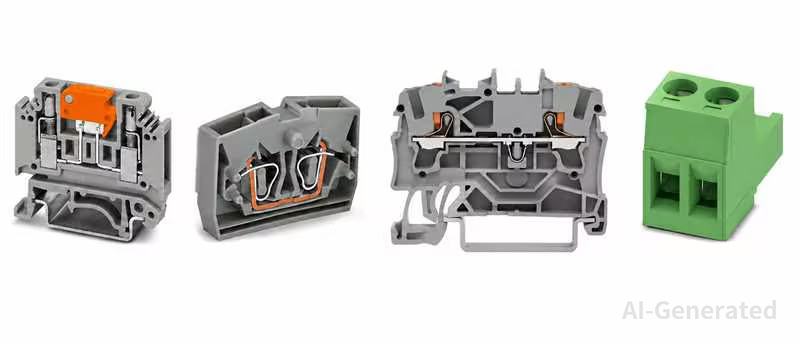
- Screw clamp: Mechanical pressure is generated by tightening a screw.
- Spring clamp: A spring maintains contact pressure as the conductor is inserted.
- Push-in: A spring mechanism allows prepared conductors to be inserted directly with minimal or no tightening operation.
The manufacturer's specified stripping length, conductor preparation, insertion method, and tightening torque should always take priority over generic installation values.
Mounting Structure
Terminal blocks may use different mounting systems depending on the application.
DIN rail terminal blocks are common in control cabinets, while PCB terminal blocks are soldered or otherwise mechanically attached to printed circuit boards.
For DIN rail applications, IEC 60715 defines standardized mounting rail dimensions, including TH35 top-hat rails, TH15 rails, and G32 rails. The 35 mm top-hat profile is widely used for modular control-panel equipment.
Common Types of Terminal Block
The best terminal block type depends on the required wiring speed, mechanical environment, current level, mounting method, and maintenance strategy.
Terminal Block Type Comparison
| Terminal Block Type | Connection Method | Installation Speed | Maintenance | Vibration Resistance | Typical Applications | Relative Cost |
| Screw Clamp | Screw applies clamping force | Medium | Periodic torque inspection may be required | Good when correctly tightened | Control cabinets, power distribution | Low–Medium |
| Spring Clamp | Spring maintains contact force | Fast | Low | Very good | Industrial automation, machinery | Medium |
| Push-In | Direct insertion into spring mechanism | Very fast | Low | Very good | High-density control panels, automation | Medium |
| Barrier Strip | Screw connection with physical barriers | Medium | Periodic inspection | Good | Power distribution, equipment wiring | Low–Medium |
| PCB Terminal Block | Screw/spring connection directly on PCB | Medium | Application-dependent | Depends on PCB and terminal design | Controllers, power supplies, electronic equipment | Low–Medium |
The table is a selection guide rather than a performance guarantee. Actual ratings and environmental performance vary by product family.
Screw-Clamp Terminal Blocks
Screw-clamp terminal blocks use a threaded screw to apply mechanical pressure to the conductor.
They remain a practical choice when the design requires broad conductor compatibility, straightforward visual inspection, and a familiar installation method.
A screw connection is not inherently unreliable. The main engineering concern is correct tightening. Excessive torque can damage the terminal or conductor, while insufficient torque can increase contact resistance and reduce mechanical retention.
Typical applications include:
- Industrial control cabinets
- Motor control systems
- Power distribution
- Building electrical equipment
- General machine wiring
For installations exposed to continuous vibration, engineers should verify the manufacturer's vibration testing and recommended maintenance procedure rather than relying only on the connection type.
Spring-Clamp Terminal Blocks
Spring-clamp terminal blocks use a resilient mechanical element to maintain contact pressure.
One advantage is that the contact force is less dependent on the installer achieving a specific screw torque. The spring can also accommodate limited conductor movement caused by vibration, thermal cycling, or material deformation.
This makes spring-clamp technology particularly attractive for:
- Factory automation
- Machine tools
- Transportation equipment
- Vibration-prone control cabinets
- Applications requiring frequent wiring
However, "spring clamp" should not automatically be interpreted as "maintenance-free under every condition." The terminal's rated conductor range, spring mechanism, vibration qualification, and environmental rating still need to be checked.
Push-In Terminal Blocks
Push-in terminal blocks use an internal spring mechanism that locks the conductor after insertion.
They are particularly useful when large numbers of identical connections must be completed quickly.
Typical advantages include:
- Fast conductor insertion
- Reduced installation steps
- Consistent clamping force
- High wiring density
- Reduced dependence on manual screw tightening
Solid conductors and ferruled stranded conductors are commonly compatible with push-in systems, but compatibility depends on the specific terminal design.
For stranded wire, always check whether the manufacturer requires a ferrule and whether a screwdriver is needed for conductor release.
Barrier Strips & PCB Mount Terminals
Barrier Strip Terminal Blocks
Barrier strips place physical insulating barriers between adjacent connection points.
The barriers reduce the likelihood of accidental contact between neighboring conductors and can be useful in applications where spacing and physical separation are important.
Common applications include:
- Power distribution
- Industrial machinery
- Motor wiring
- Equipment terminals
- Control equipment
Barrier strips are generally less modular than DIN rail terminal systems, so the choice depends on the required panel architecture.
PCB Terminal Blocks
PCB terminal blocks provide a removable or fixed wire interface directly on a printed circuit board.
They are useful when a PCB needs to connect external field wiring without soldering individual wires directly to the board.
Typical applications include:
- PLC and controller boards
- Power supplies
- Industrial controllers
- Embedded equipment
- Sensor and actuator interfaces
When selecting a PCB terminal block, engineers should consider pitch, pin count, wire entry direction, current rating, voltage rating, PCB thickness, and terminal orientation in addition to conductor size.
Advantages of Using Terminal Blocks
Organization & Maintenance
One of the primary benefits of terminal blocks is improved wiring organization.
In complex electrical systems, hundreds of wires may need to be connected and managed. Terminal blocks provide clearly separated connection points, making wiring easier to identify and maintain.
Benefits include:
- Simplified troubleshooting
- Faster component replacement
- Easier circuit modification
- Improved panel organization
Safety & Reliability
Terminal blocks improve electrical safety by providing insulated and secure connection points.
High-quality terminal blocks help minimize the risk of electrical issues, including:
- Loose connections
- Short circuits
- Electrical arcing
- Overheating caused by poor contact
Many terminal blocks are designed to meet international safety standards for industrial and electrical applications.
Flexibility & Scalability
Modular terminal blocks allow engineers to expand or modify electrical systems without completely redesigning the wiring structure.
For example, additional terminals can be added to existing DIN rail assemblies when equipment requires additional sensors, actuators, or control devices.
This flexibility makes terminal blocks ideal for systems that require future upgrades.
Cost-Effectiveness
Although terminal blocks add an additional component to electrical systems, they reduce long-term maintenance costs by improving accessibility and reducing downtime.
Their reusable design also allows wires to be disconnected and reconnected during system modifications or repairs.
Applications of Terminal Blocks
Industrial Automation & PLC Systems
Terminal blocks play an important role in industrial automation systems by connecting field devices with control equipment.
Common connections include:
- Sensors
- Motors
- Actuators
- PLC inputs and outputs
- Control modules
In PLC control cabinets, terminal blocks help organize large numbers of signal and power wires, making installation and maintenance more efficient.
Power Distribution & Switchgear
In electrical distribution systems, terminal blocks are used to distribute power safely between incoming and outgoing circuits.
Typical applications include:
- Electrical panels
- Switchgear systems
- Circuit protection equipment
- Power control cabinets
They help improve wiring reliability while allowing easier inspection and servicing.
Renewable Energy Systems
Renewable energy equipment requires reliable electrical connections for continuous operation.
Terminal blocks are commonly used in:
- Solar power systems
- Battery storage systems
- Wind energy equipment
- Energy management systems
They help connect power conversion equipment, monitoring devices, and control systems.
Telecommunications & Low-Voltage Signal Wiring
Terminal blocks are also used in communication systems where multiple signal connections need to be organized.
Applications include:
- Communication cabinets
- Telephone distribution
- Building automation systems
- Low-voltage signal wiring
They provide structured connections for low-voltage signals and communication wiring.
FAQ
How do I choose the right terminal block for my project?
Selecting the correct terminal block depends on several factors:
- Voltage and current rating: Ensure the terminal block can safely handle the electrical load.
- Wire size: Choose a terminal block compatible with the conductor diameter.
- Connection method: Select screw, spring, or push-in terminals based on installation requirements.
- Environment: Consider temperature, vibration, moisture, and chemical exposure.
- Mounting method: Check whether DIN rail, PCB, or panel mounting is required.
What’s the difference between spring and screw clamp terminals?
The main difference is the wire clamping mechanism.
Screw-clamp terminals use a screw to apply mechanical pressure, while spring-clamp terminals use spring force to maintain contact.
| Feature | Screw Clamp | Spring Clamp |
| Installation | Requires screw tightening | Faster installation |
| Maintenance | May require retightening | Usually maintenance-free |
| Vibration resistance | Moderate | Higher |
| Application | General electrical systems | Industrial automation environments |
Do I need a special tool for push-in terminal blocks?
Most push-in terminal blocks are designed for tool-free wiring when using solid wires or properly prepared conductors.
For stranded wires, ferrules may be recommended to ensure a secure connection. Some push-in designs may also require a screwdriver to release the spring mechanism during wire removal.
How Do You Choose a High-Quality Terminal Block?
Consider these key factors:
- Material quality: Use corrosion-resistant conductive materials and flame-retardant insulation.
- Electrical performance: Check voltage, current ratings, contact resistance, and insulation properties.
- Mechanical reliability: Ensure stable clamping force under vibration and temperature changes.
- Safety standards: Choose products that meet relevant industry certifications.
Conclusion
Terminal blocks are essential components for creating safe, organized, and reliable electrical connections. By providing secure wire connections, simplified maintenance, and flexible system expansion, they are widely used across industrial automation, power distribution, renewable energy, and communication systems.
Understanding the different types of terminal blocks—including screw-clamp, spring-clamp, push-in, barrier strip, and PCB mount designs—helps engineers select the right solution for their specific application requirements.
Whether used in a small electronic device or a large industrial control cabinet, a properly selected terminal block can significantly improve electrical system performance, safety, and long-term reliability.
Keep Learning
A Complete Guide to DIN Rail Terminal Blocks
Introduction In a control cabinet, field wiring from sensors, switches, valves, and other equipment must be connected to PLC I/O, power supplies, relays, and protection devices. Without a defined termination point, wiring becomes harder to trace, test, and maintain. DIN rail terminal blocks provide a structured interface between field wiring and internal cabinet circuits. Depending on the application, a terminal strip may include feed-through, PE, disconnect, fuse, distribution, or multi-level termina......
How to Choose Between Screw, Spring, and Push-In Terminal Blocks
Introduction The connection method is more than a choice between a screw, a spring, or a push-in mechanism. It determines how clamping force is generated, how the conductor is retained, how the connection responds to vibration and temperature changes, and how much time is required for installation and maintenance. Screw-clamp, spring-clamp, and push-in terminal blocks can all provide reliable electrical connections when correctly specified. The difference is how each design achieves that connection an......
How to Select a Terminal Block: A Complete Selection Guide
Introduction Choosing the right terminal block requires more than matching voltage and current ratings. Terminal block selection also depends on wire size, conductor type, connection method, mounting configuration, available space, operating environment, and safety requirements. In control panels and industrial equipment, the terminal block must provide a reliable electrical connection while supporting efficient wiring, testing, and maintenance. A practical selection sequence is: Application → Voltage......
What Is a Terminal Block? Types, Working Principles, and Applications
Introduction A terminal block is a modular electrical connector used to securely connect and organize multiple wires in electrical systems. It provides a reliable connection point for power distribution, signal transmission, and circuit management. Commonly used in industrial automation, control panels, and electrical equipment, terminal blocks help improve wiring organization, simplify maintenance, and enhance system reliability. In this guide, you will learn what a terminal block is, how it works, t......
5 Common Pressure Sensor Problems and How to Troubleshoot Them
Introduction: In previous articles, we explored “What Is a Pressure Sensor?”, “Pressure Sensors Explained: Working Principles, Types, and Applications,” and “How to Select the Right Pressure Sensor,” covering the fundamentals of pressure sensors, including their working principles, types, applications, and key selection considerations. However, even a properly selected pressure sensor may encounter performance issues during operation due to factors such as wiring errors, improper installation, harsh e......
How to Select the Right Pressure Sensor?
Introduction: In previous articles, we explored “What Is a Pressure Sensor?” and “Pressure Sensors Explained: Working Principles, Types, and Applications,” covering the fundamentals of pressure sensors, including how they work, different sensor types, and their applications across industrial automation systems. However, understanding how pressure sensors work is only the first step. In real industrial applications, selecting the right pressure sensor requires engineers to consider multiple factors, in......