How to Choose Between Closed-Loop and Open-Loop Stepper Motors
8 min
- Key Takeaways
- What Is Open-Loop Control of a Stepper Motor?
- What Is Closed-Loop Control of a Stepper Motor?
- Core Parts of Open-Loop and Closed-Loop Systems
- Differences Between Open-Loop and Closed-Loop Stepper Motors
- When to Choose Open-Loop or Closed-Loop Drives
- Common Misconceptions About Open-Loop and Closed-Loop Stepper Motors
- Frequently Asked Questions
- Conclusion
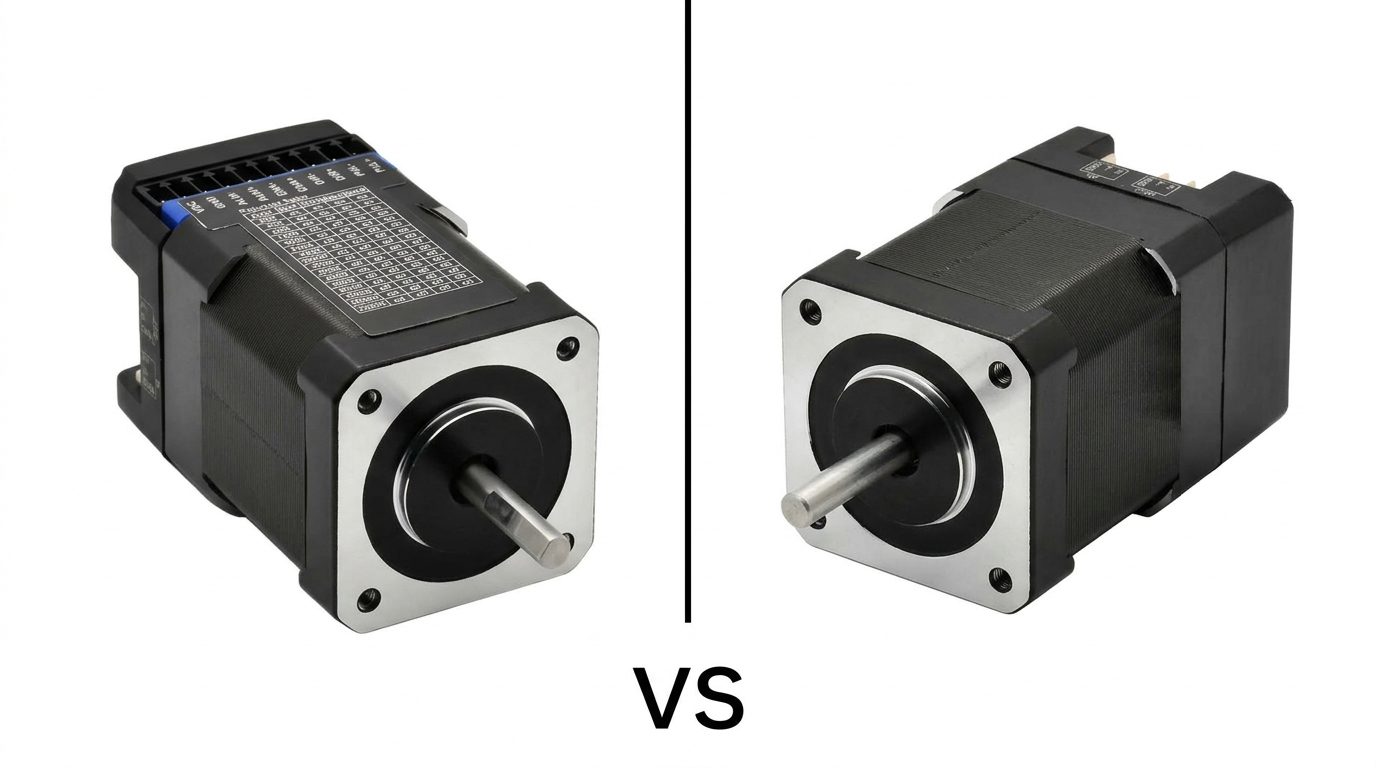
People need the right motor for machine projects. Picking between a closed-loop and open-loop stepper motor shapes machine accuracy and total cost. You can build simple 3D printers with open-loop drives. You can run fast industrial equipment with closed-loop systems. This guide helps you pick the correct motor for your build.
Key Takeaways
- Open-loop stepper systems operate without position feedback, while closed-loop systems use an encoder to monitor actual shaft position.
- Open-loop systems cannot detect lost steps, while closed-loop drives can detect and correct position errors within their operating limits.
- Closed-loop steppers can respond better to changing loads and higher-speed operation by adjusting motor output based on feedback.
- Open-loop steppers can generate more heat because they often maintain current while holding position, while closed-loop systems can reduce current under lighter loads.
- Choose open-loop steppers when loads are predictable and lower cost, simpler wiring, and straightforward control are the main priorities.
- Choose closed-loop steppers when position-error detection, changing loads, or demanding operating conditions justify the added cost and complexity.
What Is Open-Loop Control of a Stepper Motor?
Open-loop control of a stepper motor system sends step signals straight to the motor driver. The driver sends power pulses to internal motor parts. Each electrical pulse turns the motor shaft by one fixed step angle.
The controller assumes the motor shaft moves as told. The system has no sensor to check the real location. If an object blocks the shaft, the motor stalls. The controller keeps sending movement steps anyway. This setup gives you a simple driving system for basic work.
What Is Closed-Loop Control of a Stepper Motor?
A closed-loop stepper motor uses an encoder mounted on the motor shaft to provide position feedback. People call this sensor an encoder. The controller reads data from this encoder while the shaft turns.
The driver matches true shaft position against target data points. The driver compares the encoder feedback with the commanded position and adjusts motor control accordingly. Depending on the drive model, it may compensate for position errors or trigger an alarm when the error exceeds its limit. You gain continuous position feedback throughout the entire move.
Core Parts of Open-Loop and Closed-Loop Systems
Every open-loop and closed-loop control of a stepper motor system uses core parts to create a drive force:
- Command Controller: Outputs pulse signals based on user choices.
- Stepper Driver: Supplies high-current power to drive internal coils.
- Stepper Motor: Changes electric pulses into physical shaft movement.
- Encoder Sensor: Reads physical shaft location on closed-loop models only.
- Feedback Processor: Matches target path data against true shaft location.
Differences Between Open-Loop and Closed-Loop Stepper Motors
In practice, open-loop and closed-loop stepper motors differ across several key aspects, including their control, performance, efficiency, cost, and typical applications:
| Feature | Open-Loop Stepper Motors | Closed-Loop Stepper Motors |
| Control Architecture | Direct pulse control | Continuous feedback control |
| Feedback Mechanism | None | Rotary encoder |
| Position Tracking & Lost Steps | Can lose steps | Corrects position errors |
| Load & Disturbance Response | Stalls under heavy loads | Adjusts power for loads |
| Torque & Dynamic Performance | High low-speed torque | Strong low-speed torque; dynamic performance and position holding depend on system design |
| Heat & Energy Efficiency | Runs hot constantly | Runs cool under light loads |
| System Complexity | Few wires | Extra encoder wiring |
| Cost | Low purchase price | High purchase price |
| Typical Applications | Basic 3D printers | Industrial automation |
When to Choose Open-Loop or Closed-Loop Drives
You should consider the physical, performance, and application requirements of your system when choosing between open-loop and closed-loop drives.
Start With Speed Requirements
Determine the speed requirements for your application. Test both open-loop and closed-loop systems at the speeds your application requires to identify their practical performance limits.
Both systems operate within a defined speed range, and the actual limit depends on the motor, drive, power supply, and load. Closed-loop control can improve position tracking and response to changing loads, depending on the motor, encoder, drive, and control strategy.
Evaluate the Load and Mechanical System
Calculate friction and other mechanical loads before selecting the motor and drive. An open-loop drive can lose steps or stall when the required torque exceeds the motor's available torque. A closed-loop system may adjust motor current in response to detected errors, depending on the drive and control strategy. Its ability to compensate for increased load remains limited by the motor's available torque and the drive's capacity.
Determine Whether Feedback Is Actually Required
Consider whether missed steps or position errors could damage the workpiece or compromise the application. In some basic 3D-printing applications, minor position errors may be relatively easy to detect and correct, while missed steps in machining applications can damage expensive stock or compromise the workpiece. Applications where position errors carry significant consequences may justify the added cost and complexity of feedback.
Compare Total System Cost, Not Motor Price Alone
Look beyond the motor's purchase price. Open-loop drives generally have lower upfront system costs, while closed-loop drives typically cost more because they require additional feedback hardware and associated drive or control electronics. However, closed-loop control can reduce the risk of position-related errors, scrap, and downtime in applications where missed steps would otherwise be costly.
Validate the Selected System Under Real Operating Conditions
Test the selected components on the actual mechanical system whenever possible. Monitor motor temperature during extended operation and observe how the system responds to rapid direction changes and full-load conditions. Real-world testing can reveal limitations that may not be apparent from motor or drive specifications alone.
Common Misconceptions About Open-Loop and Closed-Loop Stepper Motors
Open-loop and closed-loop stepper systems are often described using overly simple assumptions. These misconceptions can create unrealistic expectations about position control, torque, accuracy, and system performance.
Misconception 1: Closed-Loop Means the Motor Cannot Lose Position
No. Closed-loop feedback detects position errors and may adjust motor output to reduce them. However, it cannot overcome physical limits. Excessive load, insufficient torque, or a mechanical obstruction can still prevent the motor from reaching its commanded position. Fault behavior depends on the drive.
Misconception 2: Closed-Loop Steppers Always Have More Torque
No. Encoder feedback does not inherently increase a motor's rated or holding torque. Torque depends on the motor, drive current, supply voltage, and speed. Closed-loop control can help maintain performance as loads change, but it cannot create additional torque beyond the system's available capacity.
Misconception 3: Open-Loop Steppers Are Inherently Inaccurate
No. An open-loop stepper can provide predictable positioning when operated within its torque and speed limits. Actual accuracy also depends on motor characteristics, mechanics, resonance, load, and system design. Its main limitation is that the controller cannot directly detect whether the commanded position was reached.
Misconception 4: Every Closed-Loop Stepper Uses the Same Control Method
No. Closed-loop stepper systems can use different feedback and control strategies. Depending on the drive, feedback may be used to detect position errors and adjust motor control, or support closed-loop regulation of position, velocity, current, or other control variables. Performance therefore varies with the motor, encoder, drive, control algorithm, and tuning. A closed-loop stepper is not automatically equivalent to a servo.
Frequently Asked Questions
Is a Closed-Loop Stepper Motor Better Than an Open-Loop Stepper Motor?
Not necessarily. Closed-loop steppers can improve position tracking and response to changing loads, while open-loop systems are typically simpler and less expensive. The better choice depends on load, speed, position-error tolerance, and overall system requirements.
Can an Open-Loop Stepper Motor Lose Steps?
Yes. An open-loop motor can lose steps when the required torque exceeds the available motor torque. A basic open-loop controller has no direct position feedback and therefore cannot normally detect that the motor has lost position.
Does a Closed-Loop Stepper Motor Require an Encoder?
Generally, yes. A closed-loop stepper system requires position feedback, typically from an encoder. The drive uses this feedback to detect position errors and, depending on its control strategy, adjust motor output. The encoder type and feedback arrangement vary by system.
Which Is More Cost-Effective: Open-Loop or Closed-Loop?
It depends on the application. Open-loop systems usually have lower upfront costs and may be more economical when position errors are acceptable. Closed-loop systems cost more but can reduce the risk of costly position errors, scrap, or downtime when missed steps have significant consequences.
When Should I Choose a Closed-Loop Stepper Instead of a Servo Motor?
It depends on the motion requirements. Closed-loop steppers can suit applications requiring high low-speed torque and moderate motion performance. Servos are often preferred when higher speeds, faster dynamic response, or broader continuous-motion performance are required.
Conclusion
Choosing between open-loop and closed-loop stepper systems depends on your application's speed, load, position-error tolerance, and budget. Open-loop systems can be a practical choice for predictable loads and acceptable position-error risk, while closed-loop systems add feedback for detecting and compensating for position errors within their operating limits. Compare your application requirements and system costs before selecting the right drive for your machine.
Explore JLCMC stepper motors to find the right motor for your next project. Browse our selection and choose the model that fits your needs.
Keep Learning
How to Choose a Shaft Coupling: Rigid vs Beam vs Jaw vs Universal Joint
Key Takeaways Shaft Coupling Basics: A shaft coupling transmits torque between driving and driven shafts while accommodating misalignment, vibration, and thermal expansion. The core choice is between rigid (zero flexibility, maximum torque density) and flexible (misalignment-tolerant, vibration-damping) designs. Four Primary Types: Rigid couplings offer zero backlash but require perfect alignment; helical beam couplings provide precision motion for light-duty drives; jaw couplings deliver versatile vi......
Roller Chain Size Chart: ANSI and BS Sizes in mm and Inches
Key Takeaways Identify the chain series first: ANSI and BS-series size codes belong to different dimensional families; changing the units does not change the chain type. Check four details together: Pitch, roller diameter, inner width and number of rows. Matching pitch alone is not enough to choose a replacement. Use the millimeter columns for comparison: Inch equivalents appear beside them, so there is no need to interpret two units in one cell. Count the gaps when measuring pitch: Six consecutive pi......
How to Choose Between Closed-Loop and Open-Loop Stepper Motors
People need the right motor for machine projects. Picking between a closed-loop and open-loop stepper motor shapes machine accuracy and total cost. You can build simple 3D printers with open-loop drives. You can run fast industrial equipment with closed-loop systems. This guide helps you pick the correct motor for your build. Key Takeaways Open-loop stepper systems operate without position feedback, while closed-loop systems use an encoder to monitor actual shaft position. Open-loop systems cannot det......
What Are Pillow Block Bearings? Definition, Working Principle & Applications
Key Takeaways A pillow block bearing is a self-contained bearing unit that combines a rolling-element bearing insert with a rigid housing, designed for shaft support on a flat mounting surface with the shaft axis parallel to the mounting plane. The housing provides structural alignment and load distribution, while the bearing insert handles radial and limited axial loads. Common locking mechanisms include set screws, eccentric collars, and adapter sleeves; each suits different shaft tolerances, vibrat......
Main Types of Servo Motors: AC, DC, and Everything in Between
1. Introduction By leveraging closed-loop feedback to precisely control position, velocity, and torque, servo motors serve as the backbone of modern automation. Yet, application success hinges on matching the right architecture to your load requirements—a task made challenging by the sheer variety of servo motor types available today. In this article, we map motor technology to application requirements through a practical taxonomy covering electrical topology, mechanical construction, performance spec......
Quiet Servo Motors: How to Select Low-Noise Servo Motors for Precision Automation
Noise has quietly become a specification. Medical device makers, semiconductor equipment builders, and packaging OEMs now arrive at the design review with a dB(A) target alongside torque and settling time — and the motion axis is usually the first thing they point at. This guide is written for engineers and buyers specifying industrial AC and brushless servo systems, covering small to medium power ranges commonly used in precision automation equipment. It is not about RC hobby servos: the plastic-gear......