Roller Chain Size Chart: ANSI and BS Sizes in mm and Inches
10 min
- The Roller Chain Dimensions to Check
- ANSI and BS-Series Roller Chains: Which Family Do You Have?
- Roller Chain Size Charts
- How to Measure Roller Chain Pitch in Millimeters
- What to Confirm Before Ordering
- FAQ about Roller Chain Sizing
Key Takeaways
Identify the chain series first: ANSI and BS-series size codes belong to different dimensional families; changing the units does not change the chain type.
Check four details together: Pitch, roller diameter, inner width and number of rows. Matching pitch alone is not enough to choose a replacement.
Use the millimeter columns for comparison: Inch equivalents appear beside them, so there is no need to interpret two units in one cell.
Count the gaps when measuring pitch: Six consecutive pin centers span five pitch intervals. Divide the measured span by five, not six.
Choosing a roller chain starts with identifying its size and series. A chain that looks similar to an existing one may have a different roller diameter or inner width, which matters when checking it against the sprocket.
This guide explains the key measurements, compares selected ANSI and BS-series sizes, and shows a simple way to measure pitch. Use it to narrow down the dimensions you need before confirming the product specification for your replacement or new drive.
The Roller Chain Dimensions to Check
Start with these four details. They describe different parts of the chain, so one measurement cannot replace the others.
| Parameter | What it means | What to check |
|---|---|---|
| Pitch | Distance from one pin center to the next adjacent pin center. | Measure center to center, not the overall length of a link plate. |
| Roller diameter | Outside diameter of the roller that engages the sprocket. | Measure the roller, not the smaller pin passing through the joint. |
| Inner width | Clear distance between the two inner link plates. | Do not confuse this gap with total width across the pin ends. |
| Number of rows | Parallel rows across the chain: one is simplex, two duplex, three triplex. | Match the number of rows; multi-row chains also need the correct spacing between rows. |
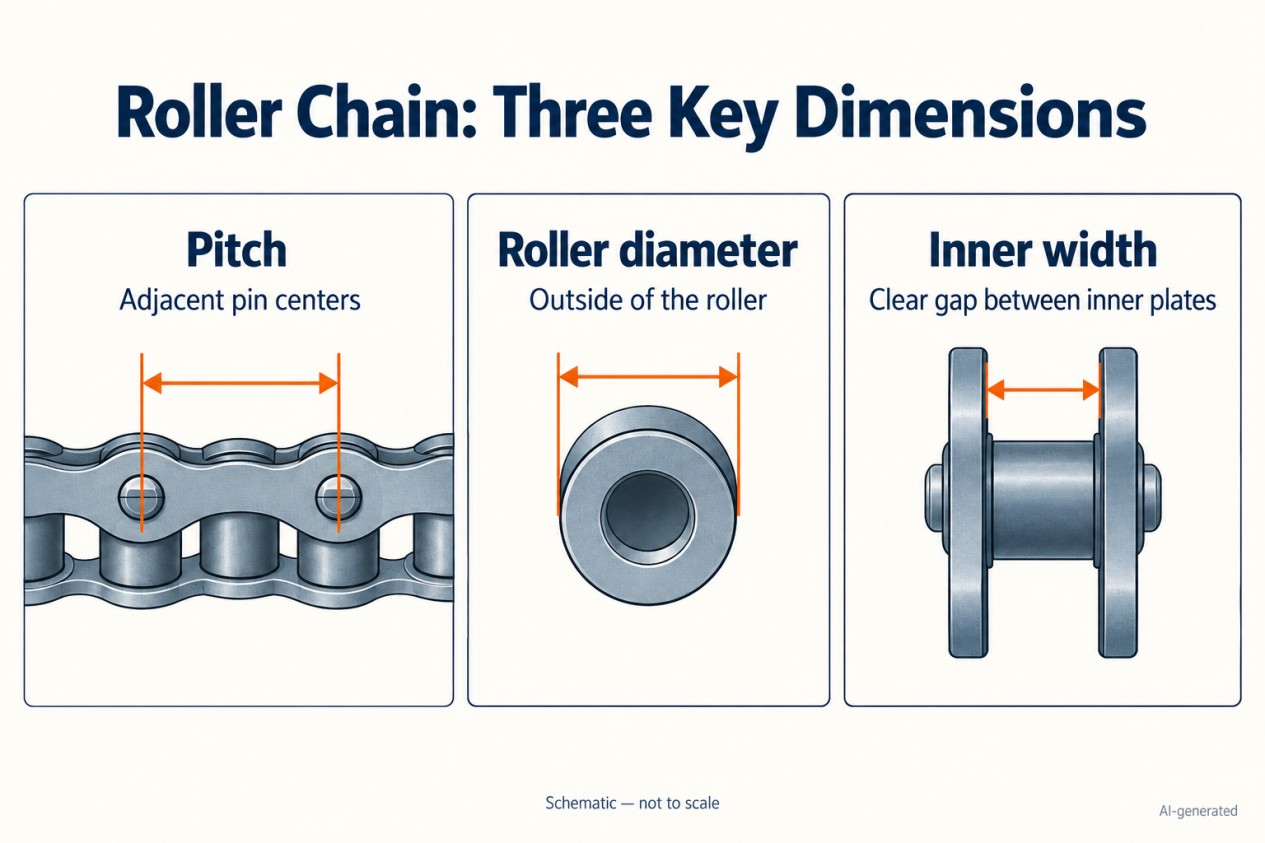
Figure 1. Roller Chain Dimensions: Pitch, Roller Diameter and Inner Width
For installation clearance, also check the overall width and connecting-link dimensions. The inner width describes the gap inside the chain; it does not tell you how much space the complete assembly needs.
ANSI and BS-Series Roller Chains: Which Family Do You Have?
Common ANSI designations include #40, #50 and #60. The American transmission-chain standard ASME B29.1 addresses chains and their associated sprockets. European-style chains are often listed as BS or B series, with codes such as 08B-1, 10B-1 and 12B-1. In those B-series examples, “-1” identifies a single-row chain.
ISO 606 is an international standard for short-pitch transmission roller and bush chains and their sprockets; it is not an exclusively European standard. Germany publishes an adoption as DIN ISO 606. For a practical comparison, keep the series designation alongside the measurements rather than identifying a chain only as “American,” “European” or “metric.”
Units and chain series are different things. A 12.7 mm pitch is the same distance as 0.500 inch. Expressing an ANSI chain in millimeters does not turn it into a B-series chain. The two tables below are separate references, not a list of interchangeable pairs.
Roller Chain Size Charts
The following tables cover selected single-row chains. Each dimension has its own adjacent mm and inch columns. These values are dimensional references only, rather than an inventory list or a substitute for the product's official drawings and application ratings.
Selected ANSI Roller Chain Sizes
| Size | Pitch mm | Pitch in | Roller Ø mm | Roller Ø in | Inner width mm | Inner width in |
|---|---|---|---|---|---|---|
| #40 | 12.700 | 0.500 | 7.925 | 0.312 | 7.925 | 0.312 |
| #41 | 12.700 | 0.500 | 7.772 | 0.306 | 6.375 | 0.251 |
| #50 | 15.875 | 0.625 | 10.160 | 0.400 | 9.525 | 0.375 |
| #60 | 19.050 | 0.750 | 11.913 | 0.469 | 12.700 | 0.500 |
| #80 | 25.400 | 1.000 | 15.875 | 0.625 | 15.875 | 0.625 |
| #100 | 31.750 | 1.250 | 19.050 | 0.750 | 19.050 | 0.750 |
| #120 | 38.100 | 1.500 | 22.225 | 0.875 | 25.400 | 1.000 |
Reference: [4], printed pp. 10–16. Inch values retain the source catalog's precision; mm values are calculated using 1 inch = 25.4 mm and rounded to three decimal places. These converted figures are not additional manufacturing tolerances.
Selected BS / B-Series Roller Chain Sizes
| Size | Pitch mm | Pitch in | Roller Ø max. mm | Roller Ø max. in ≈ | Inner width min. mm | Inner width min. in ≈ |
|---|---|---|---|---|---|---|
| 08B-1 | 12.700 | 0.500 | 8.51 | 0.335 | 7.75 | 0.305 |
| 10B-1 | 15.875 | 0.625 | 10.16 | 0.400 | 9.65 | 0.380 |
| 12B-1 | 19.050 | 0.750 | 12.07 | 0.475 | 11.68 | 0.460 |
| 16B-1 | 25.400 | 1.000 | 15.88 | 0.625 | 17.02 | 0.670 |
| 20B-1 | 31.750 | 1.250 | 19.05 | 0.750 | 19.56 | 0.770 |
| 24B-1 | 38.100 | 1.500 | 25.40 | 1.000 | 25.40 | 1.000 |
Reference: [5], printed p. 4. “Max.” and “min.” preserve the source table's dimensional limits. The inch equivalents for diameter and width are rounded reference conversions, not inspection limits; use the original mm values and applicable product specification for engineering checks.
Are #40 and #41 the Same Size?
No. #40 and #41 are different chain sizes. Both have a 12.7 mm pitch, but #41 is narrower between its inner plates and has a smaller roller diameter in the reference table. The equal spacing between pins does not make the complete chains identical. Do not choose one as a direct replacement for the other solely because their pitches match.
The same principle applies across series: #40 and 08B-1 both have a 12.7 mm pitch, but their roller diameters and inner widths differ. Confirm the full chain designation and the sprocket specification rather than treating the two tables as a conversion between products.
How to Measure Roller Chain Pitch in Millimeters
Use an accessible, straight section of chain. For an installed chain, stop and isolate the equipment under its approved procedure before measuring. Never measure a moving chain.
-
Find the Pin Centers
Identify consecutive centers along the chain.
-
Straighten the Section Gently
Take up slack without forcing a damaged or stiff joint.
-
Measure Across Several Intervals
Record the center-to-center distance between your chosen endpoints in mm.
-
Count the Spaces, Not the Pins
Six consecutive centers have five spaces between them.
-
Calculate and Cross-Check
Divide the span by the number of spaces, then measure roller diameter, inner width and row count to narrow down the size.
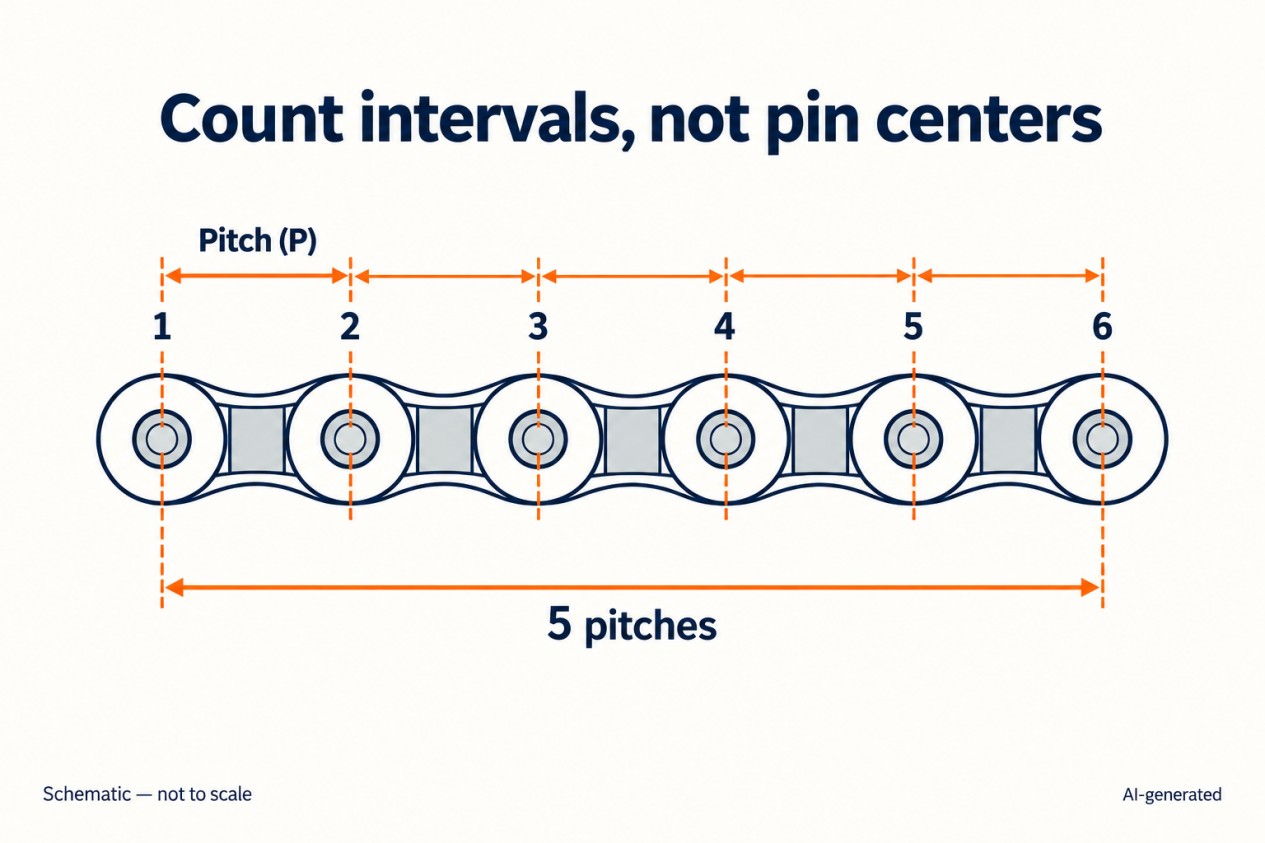
Figure 2. Measuring Roller Chain Pitch: Six Pin Centers, Five Intervals
Calculation Example
Example: A center-to-center span of 63.5 mm across five pitch intervals gives $63.5 \div 5 = 12.7\text{ mm}$ per pitch. This identifies a likely pitch, not a complete chain size. The calculation uses the same five-interval layout as Figure 2.
For a longer check, eleven consecutive pin centers span ten intervals. A 127 mm span divided by ten gives the same 12.7 mm average pitch. These are illustrative calculations, not measured inspection results.
Allow for wear when identifying an old chain. Wear at the pin-and-bushing joints can increase the measured span. Compare the reading with the chain markings and equipment specification; a slightly longer reading does not automatically indicate a different nominal size. Formal wear inspection should follow the relevant measuring conditions and service limits.
What to Confirm Before Ordering
Once you have a likely size, bring these details together:
- Chain designation and series: Include the full code and any special suffixes, not only the pitch.
- Dimensions and row count: Check pitch, roller diameter, inner width, overall clearance and connecting-link type.
- Sprocket specification: Confirm the chain series and row arrangement the sprocket is designed for.
- Required length: Specify the chain length or number of pitches using the supplier's ordering convention.
- Operating requirements: Confirm the selected product's ratings for the drive's load, speed, lubrication and environment. A dimensional match is one part of selection, not a load rating.
FAQ about Roller Chain Sizing
Q: Does a dimension in millimeters mean the chain is B series?
No. Millimeters describe the measurement unit, not the chain family. ANSI and B-series chain dimensions can both be written in mm. Check the size code and series as well.
Q: Which roller chains have a 12.7 mm pitch?
#40, #41 and 08B-1 are examples in these tables. They are different sizes with other dimensional differences, so pitch alone does not identify which one you need.
Q: Can I replace #40 chain with #41?
Do not assume they are direct substitutes. Their common pitch does not eliminate the differences in roller diameter and inner width. Confirm the specified chain and sprocket combination and the application's requirements.
Q: What does “-1” mean in 08B-1?
It identifies a single-row, or simplex, chain. The corresponding “-2” and “-3” designations identify two-row and three-row versions. Row count is different from the number of links along the chain.
Q: Why is my measured pitch slightly larger than the table value?
Check that the chain is straight, that the endpoints are pin centers and that you counted the intervals correctly. Wear can also increase the measured length. Use the chain markings and equipment information alongside your measurements.
Conclusion: Roller Chain Size Selection
Start with the chain series, then compare pitch, roller diameter, inner width and row count in millimeters. Measure across correctly counted intervals and use the full designation when checking a product or sprocket. This gives you a clearer basis for choosing a chain for replacement or a new drive.
With those details ready, explore JLCMC's sprockets and chains and check the specifications of the product you are considering.
References
- ASME B29.1-2011 (R2022), Precision Power Transmission Roller Chains, Attachments, and Sprockets. Official public description; paid standard text not accessed.
- ISO 606:2015, Short-pitch transmission precision roller and bush chains, attachments and associated chain sprockets. Official public scope and publication information; paid standard text not accessed.
- DIN ISO 606:2018-02. Official listing identifying the German adoption of ISO 606:2015.
- U.S. Tsubaki, Roller Chain General Catalog. ANSI dimensions, printed pp. 10–16: #41; #40/#50; #60/#80; #100/#120.
- Renold Roller Chain, manufacturer brochure hosted by RS. European (BS) Standard / ISO 606, printed p. 4 for simplex dimensions; pp. 5–6 for row designations. Historical dimensional reference, not evidence of current product availability.
- Tsubaki, Roller Chain Inspection. Section 7.3, item 6, for multi-interval measurement and wear. No manufacturer-specific wear threshold has been generalized.
- JLCMC, Essential Sprockets and Chains Guide, and JLCMC Sprockets / Chains. Related reading and product-category navigation, not the source of the reference dimensions.
Keep Learning
Different-Wire Stepper Motors Wiring & Diagrams Explained
The number of wires coming from a stepper motor tells you how many winding terminals are accessible in the motor, but it does not, by itself, determine the motor type or how the motor should be driven. The internal winding configuration determines which wiring methods are possible, including bipolar, unipolar, series, and parallel connections. This guide explains how a 4 wire stepper motor, 5 wire stepper motor, 6 wire stepper motor, and 8 wire stepper motor are configured, how to identify their windi......
How to Choose a Shaft Coupling: Rigid vs Beam vs Jaw vs Universal Joint
Key Takeaways Shaft Coupling Basics: A shaft coupling transmits torque between driving and driven shafts while accommodating misalignment, vibration, and thermal expansion. The core choice is between rigid (zero flexibility, maximum torque density) and flexible (misalignment-tolerant, vibration-damping) designs. Four Primary Types: Rigid couplings offer zero backlash but require perfect alignment; helical beam couplings provide precision motion for light-duty drives; jaw couplings deliver versatile vi......
Roller Chain Size Chart: ANSI and BS Sizes in mm and Inches
Key Takeaways Identify the chain series first: ANSI and BS-series size codes belong to different dimensional families; changing the units does not change the chain type. Check four details together: Pitch, roller diameter, inner width and number of rows. Matching pitch alone is not enough to choose a replacement. Use the millimeter columns for comparison: Inch equivalents appear beside them, so there is no need to interpret two units in one cell. Count the gaps when measuring pitch: Six consecutive pi......
How to Choose Between Closed-Loop and Open-Loop Stepper Motors
People need the right motor for machine projects. Picking between a closed-loop and open-loop stepper motor shapes machine accuracy and total cost. You can build simple 3D printers with open-loop drives. You can run fast industrial equipment with closed-loop systems. This guide helps you pick the correct motor for your build. Key Takeaways Open-loop stepper systems operate without position feedback, while closed-loop systems use an encoder to monitor actual shaft position. Open-loop systems cannot det......
What Are Pillow Block Bearings? Definition, Working Principle & Applications
Key Takeaways A pillow block bearing is a self-contained bearing unit that combines a rolling-element bearing insert with a rigid housing, designed for shaft support on a flat mounting surface with the shaft axis parallel to the mounting plane. The housing provides structural alignment and load distribution, while the bearing insert handles radial and limited axial loads. Common locking mechanisms include set screws, eccentric collars, and adapter sleeves; each suits different shaft tolerances, vibrat......
Main Types of Servo Motors: AC, DC, and Everything in Between
1. Introduction By leveraging closed-loop feedback to precisely control position, velocity, and torque, servo motors serve as the backbone of modern automation. Yet, application success hinges on matching the right architecture to your load requirements—a task made challenging by the sheer variety of servo motor types available today. In this article, we map motor technology to application requirements through a practical taxonomy covering electrical topology, mechanical construction, performance spec......