DC Motor vs. Stepper Motor: What Are They and How Do They Differ?
11 min
- Key Takeaways
- What Is a DC Motor?
- What Is a Stepper Motor?
- DC Motor vs Stepper Motor: Key Differences
- How to Choose Between a DC Motor and a Stepper Motor
- Frequently Asked Questions
- Conclusion
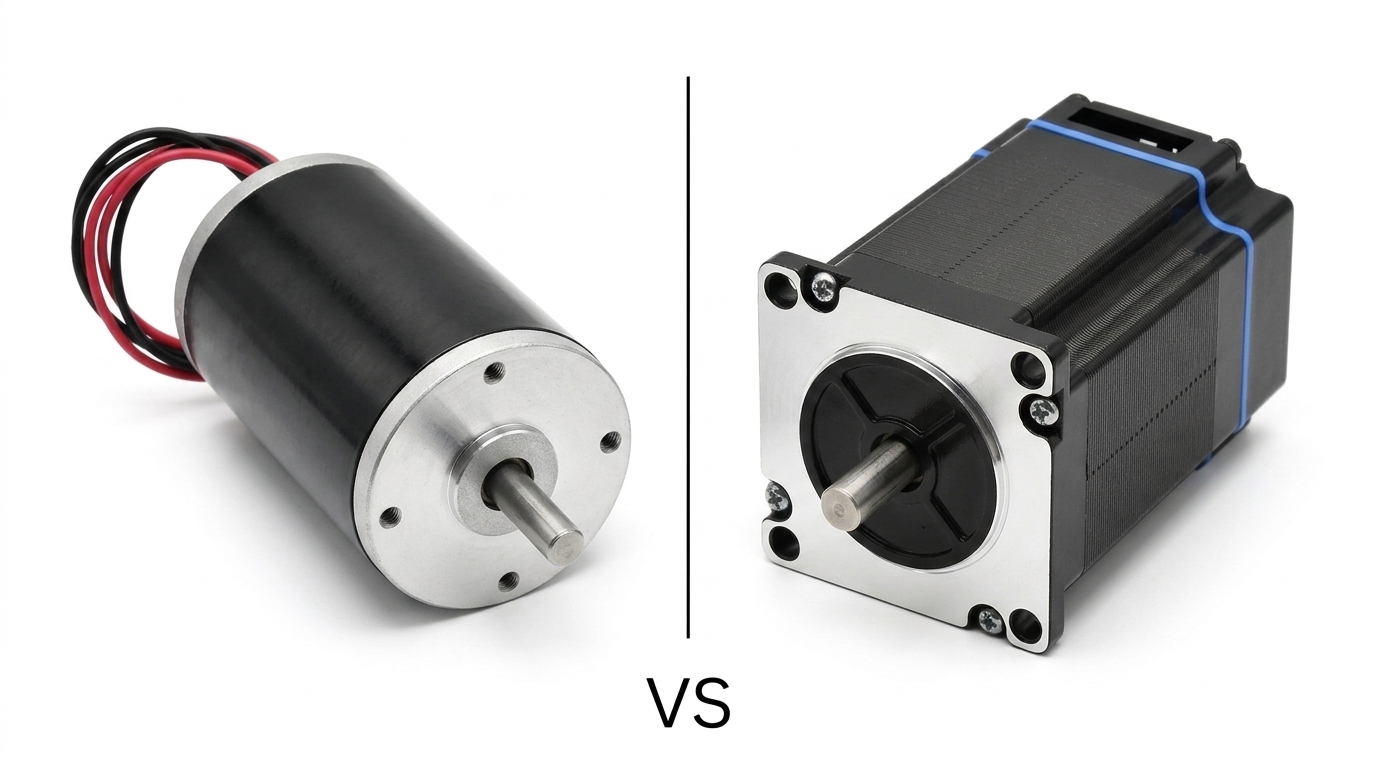
To clearly distinguish between DC motors and stepper motors, this article uses brushed DC motors as the primary reference for comparison.
A brushed DC motor is typically well suited for continuous rotation, high-speed operation, and variable-speed control, while a stepper motor is commonly used for low-speed positioning, indexing, and holding torque at standstill. When combined with an encoder and an appropriate controller, a brushed DC motor can also be used for closed-loop positioning. The right choice depends on the application’s requirements for speed, torque, positioning accuracy, duty cycle, and control method.
Key Takeaways
- Brushed DC motors are generally low-cost, provide continuous rotation, can operate at high speeds—including 10,000 RPM or more for some motor designs—and can be powered using a simple two-wire connection for basic operation.
- Stepper motors provide high holding torque at standstill and low speeds, but their available torque generally decreases as speed increases.
- The choice between a DC motor and a stepper motor depends mainly on whether the application prioritizes high-speed continuous motion or controlled incremental positioning.
- In simple terms, choose a DC motor for simple, continuous rotation, and a stepper motor when incremental positioning and holding torque are more important.
What Is a DC Motor?
A conventional brushed DC motor is primarily designed for continuous rotary motion, converting electrical power into mechanical rotation, but with appropriate feedback and control, it can also be used for positioning applications.
How Does a DC Motor Work?
A typical brushed DC motor uses a stator magnetic field, a rotor with armature windings, a commutator, and brushes. When DC power is applied, current flows through the brushes and commutator into the armature windings, creating a magnetic field. The interaction between the rotor and stator magnetic fields generates torque and turns the rotor. As the rotor rotates, the commutator switches the current direction in the armature windings so that torque continues in the same direction. Motor speed can be controlled by changing the applied voltage or by using pulse-width modulation (PWM).
Key Characteristics
- Simple electrical connection and straightforward speed control.
- Continuous rotation with a wide usable speed range.
- At a given load, increasing the applied voltage generally increases motor speed within the motor's rated operating range.
- High power-to-weight ratio and good acceleration performance in many applications.
Common Applications
- Electric toys, small vehicles, and mobile equipment.
- Power tools, fans, pumps, and handheld appliances.
- Automotive systems such as power windows, seat adjustment, and windshield wipers.
- Conveyor systems, cooling fans, pumps, and other continuous-rotation equipment.
What Is a Stepper Motor?
A stepper motor is an electromechanical motor that rotates in discrete angular increments and is commonly used for controlled incremental positioning.
How a Stepper Motor Works
A stepper motor has multiple stator windings and a rotor designed to align with the energized magnetic field. Depending on the motor type, the rotor may use permanent magnets, toothed iron, or both. A stepper driver energizes the motor windings in a controlled sequence to produce incremental rotor movement. Each commanded step causes the rotor to move toward a new magnetic equilibrium position. A common hybrid stepper motor has a 1.8° full-step angle, or 200 full steps per revolution.
Key Characteristics
- High holding torque at standstill and good torque at low speeds.
- Incremental open-loop positioning without an encoder, provided the motor remains within its torque and acceleration limits.
- Motor speed is controlled primarily by the commanded step-pulse frequency.
- High torque at low speeds and high holding torque at standstill, subject to the motor's rated torque and driver settings.
Common Applications
- 3D printers and desktop CNC routers.
- Camera positioning mounts that are automated.
- Medical fluid pumps and medical dosing equipment.
- Pick-and-place industrial machinery.
DC Motor vs Stepper Motor: Key Differences
The comparison of a DC and stepper motor brings out a few differences in the drive control, the speed profile, and the complexity of the mechanism.
Motion and Control
DC motors and stepper motors require different control methods. A brushed DC motor rotates when voltage is applied to its terminals. Reversing the polarity reverses the direction, while changing the applied voltage or PWM duty cycle changes speed. A stepper motor requires a suitable driver that receives step commands from a controller, PLC, motion controller, or microcontroller to command the required number of steps and control motor speed and direction.
Speed and Torque
A brushed DC motor is generally well suited to continuous rotation and high-speed operation. Its torque is strongly related to current, and it can produce high starting or stall torque, although continuous operation at stall can cause excessive current and heat.
A stepper motor provides high holding torque at standstill and useful torque at low speeds. However, its available torque decreases as speed increases, so the motor must be selected based on the required speed, acceleration, load torque, load inertia, and available driver voltage.
Positioning and Accuracy
A conventional DC motor does not provide controlled positioning by itself. Accurate angular positioning typically requires an encoder and closed-loop controller. Without feedback or braking, its final stopping position depends on inertia, load, friction, and the stopping method. A stepper motor moves in commanded angular increments determined by its step angle and drive mode. When the load remains within the motor's available torque and acceleration limits, the commanded position can be maintained without feedback. However, excessive load or acceleration can cause missed steps and position error.
Efficiency and Heat
A brushed DC motor typically draws less current as mechanical load decreases, so power consumption can be relatively low during light-load operation. However, efficiency depends on motor design, speed, load, and controller.
A stepper motor can draw substantial current even when stationary because current may need to be maintained in the windings to produce holding torque. As a result, stepper motors can generate significant heat during continuous operation, especially at high current settings.
Noise and Maintenance
In the standard DC motor, the carbon brushes maintain electrical contact with the rotating commutator. This mechanical contact causes brush and commutator wear and can produce electrical arcing and audible noise. Stepper motors have no brushes or mechanical commutator, so they do not have brush-related wear. However, stepper motors can produce vibration, resonance, and audible noise at certain speeds, particularly without suitable acceleration profiles or microstepping.
Drive and Control Requirements
A basic DC motor can be powered directly from a suitable DC supply, while speed or direction control may require PWM, an H-bridge, or another motor driver. PWM is commonly used for speed control, while an H-bridge can provide electronic direction control and PWM speed control. A dedicated stepper driver is required to control winding current and energize the phases in the commanded sequence.
Quick Comparison Table
| Feature | Brushed DC Motor | Stepper Motor |
| Motion | Continuous rotation | Incremental rotation; can also rotate continuously |
| Control | Applied voltage, PWM, or an H-bridge | Step pulses and a dedicated stepper driver |
| Speed | Generally better for high-speed operation | Generally better at low to moderate speeds |
| Torque | Good torque over a broad speed range; high-speed torque can be better than a stepper | High holding torque at standstill and strong low-speed torque; torque decreases as speed increases |
| Positioning | Requires an encoder and closed-loop control for accurate positioning | Can provide open-loop incremental positioning when steps are not lost |
| Holding Torque at Standstill | Generally low without a brake or closed-loop control | High |
| Efficiency | Efficiency varies with load, speed, and motor/controller design | Can consume significant power while holding position |
| Heat | Typically lower at light load | Can run relatively hot because current is maintained in the windings |
| Noise and Vibration | Brush noise and electrical commutation; generally smooth rotation | Can produce vibration and audible noise, especially at resonance |
| Maintenance | Brushes and commutator wear over time | No brushes; generally lower mechanical maintenance |
| Driver Requirement | Simple supply, PWM controller, or H-bridge depending on application | Dedicated current-controlled stepper driver |
| Typical Applications | Fans, pumps, power tools, conveyors, automotive actuators | 3D printers, CNC machines, positioning stages, pick-and-place systems |
| Best Fit | High-speed continuous rotation and simple control | Low-speed positioning, indexing, and holding applications |
How to Choose Between a DC Motor and a Stepper Motor
Motor selection should be based on motion profile, required speed, torque, positioning accuracy, duty cycle, control requirements, and total system cost.
Outline Your Movement Requirements
First, determine whether the application requires continuous rotation, incremental positioning, or closed-loop positioning. DC motors are generally suited to continuous rotation, while stepper motors are commonly used for incremental positioning and indexing.
Compare Speed, Torque, and Load Requirements
Determine the speed limits and torque curve for your system:
- Consider a DC motor when the application requires continuous rotation, especially when high speed, fast acceleration, or simple speed control is important.
- Consider a stepper motor when the application requires controlled low-speed motion, holding torque, or open-loop incremental positioning.
Evaluate Positioning Requirements
Use a stepper-based system when an arm or platform needs to move to specific positions without an encoder, provided the motor remains within its torque and acceleration limits. For applications that prioritize continuous rotation, higher operating speeds, and straightforward speed control, a DC motor system may be a better fit.
Consider the Drive and Control System
Evaluate your existing controller and drive setup. Brushed DC motors can often be driven using switches, relays, or PWM-based controllers, depending on the application. Stepper motors require a dedicated driver, typically controlled through step and direction signals from a microcontroller, PLC, or motion controller.
Choose a DC Motor When
- High-speed, continuous rotation is required.
- Simple speed and direction control is preferred.
- Fast acceleration or a broad operating speed range is important.
- The application does not require precise positioning without feedback.
- Low power consumption at light load or during idle operation is important.
Choose a Stepper Motor When
- Incremental positioning is required without an encoder.
- High holding torque at standstill or low speed is important.
- The application requires controlled low-speed motion.
- Step-and-direction control fits the system architecture.
- Brushless operation and low mechanical maintenance are preferred.
Frequently Asked Questions
Which Is Better, a DC Motor or a Stepper Motor?
Neither motor is universally better; the right choice depends on the motion requirements. For high-speed, continuous motion and simple electrical systems, a brushed DC motor is suitable. A stepper motor is generally better for low-speed positioning and holding applications, while a DC motor is generally better for continuous high-speed rotation.
Can a DC Motor Be Used for Accurate Positioning?
Yes. A DC motor can be used for accurate positioning when combined with a rotary encoder and a closed-loop controller. The encoder provides position feedback, allowing the controller to continuously compare the actual position with the target position and correct motor motion.
Does a Stepper Motor Have More Torque Than a DC Motor?
It depends on the motor size, winding design, operating speed, and load. A stepper motor typically provides strong holding torque at standstill and useful torque at low speeds. A DC motor can provide strong starting torque and generally maintains better performance at higher speeds. Motor torque should therefore be compared using the manufacturer's torque-speed curves rather than by motor type alone.
Is a Stepper Motor Suitable for CNC Machines?
Yes. Stepper motors are widely used in CNC machines and 3D printers because they provide controlled incremental motion and can be driven using step-and-direction signals. However, correct motor sizing is essential because missed steps can cause position errors in an open-loop system.
Is a Stepper Motor a DC Motor?
A stepper motor is generally driven from a DC power supply through an electronic driver, but it is not the same type of motor as a conventional brushed DC motor. A stepper motor uses multiple windings and controlled phase energization to produce incremental motion, while a brushed DC motor uses a commutator and brushes for continuous rotation.
Conclusion
The choice between a brushed DC motor and a stepper motor depends on the application's speed, torque, positioning, control, duty cycle, and cost requirements. Choose a brushed DC motor when continuous rotation, high speed, fast acceleration, and simple control are the main priorities. Choose a stepper motor when incremental positioning, holding torque, and low-speed motion are more important. For applications requiring accurate closed-loop positioning, a DC motor with an encoder and suitable controller may be a better solution than either motor operating open loop.
Building an automated motion system or selecting a motor for a new product? Contact JLCMC to discuss the motor, driver, and motion-control requirements for your application.
Keep Learning
Drill Bit Size Chart: Number, Letter, Fractional & Metric
Key Takeaways A drill bit size chart has to cover four systems — fractional (inches), number (#1–#80), letter (A–Z), and metric (mm) — because the same physical diameter can carry three different callouts. Number sizes provide intermediate diameters between standard fractional-inch drill sizes, allowing finer selection where 1/64-inch increments are too coarse — which is why a 1/4-20 tap takes a #7 drill (0.201 inch). Convert decimal inches to millimeters by multiplying by 25.4; the charts below give ......
2-Bolt vs. 4-Bolt Flange Bearing Units: Selection Differences That Matter
Key Takeaways Housing geometry and space: A two-bolt flange bearing unit normally uses an oval or diamond-shaped housing, making it ideal when the mounting face is narrow or access is limited. Bolt count vs. capacity: A four-bolt flange bearing unit normally uses a square housing suited for wider interfaces, but bolt count alone does not establish the unit's load capacity. Machine interface priority: Choose the housing pattern based on the machine interface first. Then verify shaft size, published loa......
NPT Thread Guide: Charts, Tap Drill Sizes, and Fitting Identification
Key Takeaways NPT (National Pipe Taper) is a U.S. standard tapered pipe thread defined by ASME B1.20.1: a 60° thread angle and a 1:16 taper on diameter, sealing through thread interference plus sealant. NPT tap drill sizes do not follow the diameter-minus-pitch formula used for straight machine threads — ASME B1.20.1 Appendix B provides guidance, and the tap manufacturer's data decides. The everyday sizes: 1/8 NPT (27 TPI, 0.405 inch major diameter), 1/4 NPT (18 TPI, 0.540 inch), 1/2 NPT (14 TPI, 0.84......
Tap Drill Chart: UNC, UNF, Metric & NPT Drill Sizes
Key Takeaways A tap drill creates the hole a tap cuts internal threads into; the drill diameter controls how much full thread the finished hole has. For Unified inch threads, drill size = major diameter − 1/TPI (rounded to the nearest standard drill) is a commonly used starting point for approximately 75 percent thread engagement; the actual percentage depends on thread geometry and the specified hole tolerance. For metric threads, the quick formula is drill = thread diameter − pitch in millimeters, r......
Comparing Brushless Motors and Stepper Motors: Principles, Structures & Applications
We have many machines around us that have electric motors to operate, including simple tools and complex robots. Brushless DC (BLDC) motors and stepper motors are two popular options for high precision and performance. They are both electrically commutated motors and have no physical brushes, but operate in different ways and are appropriate for different applications. Key Takeaways The advantages of BLDC motors are high-speed, smooth, continuous operation, and high efficiency. Stepper motors can be u......
DC Motor vs. Stepper Motor: What Are They and How Do They Differ?
To clearly distinguish between DC motors and stepper motors, this article uses brushed DC motors as the primary reference for comparison. A brushed DC motor is typically well suited for continuous rotation, high-speed operation, and variable-speed control, while a stepper motor is commonly used for low-speed positioning, indexing, and holding torque at standstill. When combined with an encoder and an appropriate controller, a brushed DC motor can also be used for closed-loop positioning. The right cho......