Pillow Block Bearing Size Charts, Dimensions, and Measurements
13 min
- Key Takeaways
- Common Pillow Block Bearing Types: UCP, UCF, UCFL, and UKP
- Key Dimensions of Pillow Block Bearings
- Pillow Block Bearing Sizes & Dimension Charts
- How to Measure a Pillow Block Bearing
- How to Select the Right Pillow Block Bearing
- How to Properly Replace a Pillow Block Bearing
- When a Pillow Block Bearing Needs to Be Replaced
- Frequently Asked Questions
- Conclusion
Pillow block bearings combine a rolling-element bearing with a mounted housing, making them the default choice for supporting rotating shafts in industrial equipment. Selecting the wrong size or mounting style leads to premature failure, misalignment, and unplanned downtime. This guide covers four common pillow block bearing unit configurations, including mounted bearing units and flange bearing units, provides actionable dimension reference tables, and outlines measurement, selection, and replacement procedures based on field practice.
Key Takeaways
- Bore diameter is the primary selection parameter, but bolt hole spacing (J) is a key mounting dimension to verify for retrofit replacement.
- UCP pillow blocks suit general base-mounted shaft support; UCF suits four-bolt flange applications; UCFL features a two-bolt oval flange for flexible mounting; UKP uses a tapered bore and adapter sleeve for secure shaft connection.
- Metric and imperial shafts are not interchangeable even when nominally close—e.g., 35 mm vs. 1-7/16" (36.51 mm) creates 1.5 mm of radial slack.
- Shaft condition, housing alignment, and torque sequence determine replacement success more than the bearing brand itself.
- Triple-lip seals or metal shields are required for dusty, wet, or high-temperature environments; standard open bearings fail quickly in contamination.
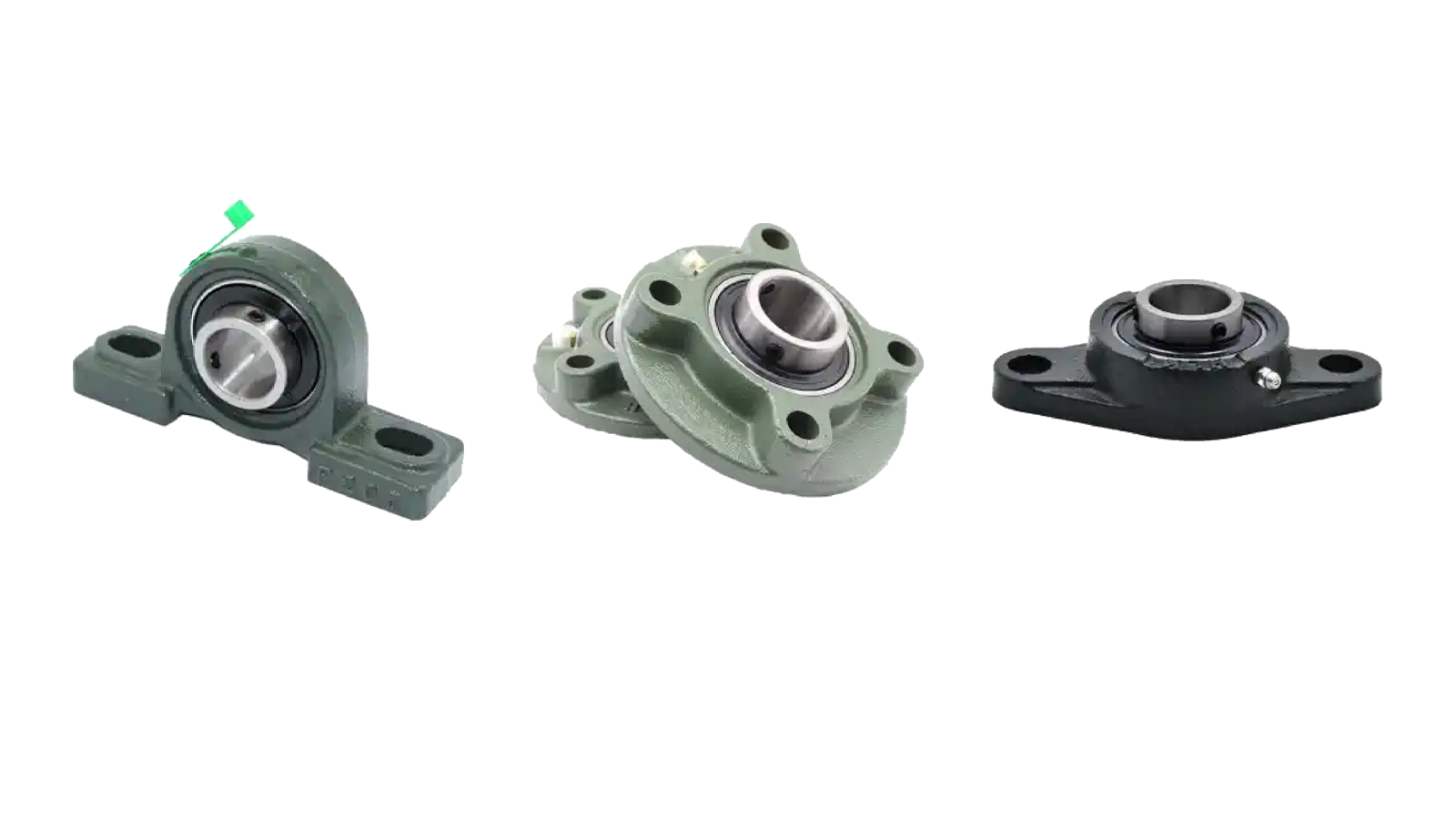
Common Pillow Block Bearing Types: UCP, UCF, UCFL, and UKP
Pillow block designations are not interchangeable. Each prefix corresponds to a specific housing geometry, bolt pattern, and load distribution model.
| Type | Housing Footprint | Bolt Holes | Typical Use Case |
| UCP | Rectangular base with two bolt holes | 2 | General-purpose horizontal shafts; conveyors, fans, pumps |
| UCF | Square flange with four bolt holes | 4 | Vertical or angular mounting; limited side access |
| UCFL | Oval (rhombus) flange with two bolt holes | 2 | Compact spaces; light-to-medium duty machinery |
| UKP | Tapered bore with adapter sleeve | 2–4 | High-vibration environments; shafts requiring frequent removal |
UCP pillow block bearings remain the most common variant in industrial maintenance. The two-bolt base design allows straightforward alignment on flat machine beds and simplifies replacement without full disassembly of adjacent components.
UCF pillow block bearings distribute load across four mounting points. This becomes relevant when the bearing must resist moment loads or when the housing mounts to a vertical surface rather than a horizontal frame.
UCFL pillow block bearings trade mounting rigidity for spatial efficiency. The oval flange fits into tighter envelopes, though the two-bolt pattern demands more precise hole alignment during installation.
UKP pillow block bearings use a tapered bore and adapter sleeve instead of a straight cylindrical bore. This design provides a secure clamping connection to the shaft under vibration and permits easier removal of worn or damaged shafts without press-fit extraction.
Key Dimensions of Pillow Block Bearings
Four measurements control interchangeability and fit. Get any one of them wrong, and the bearing may not fit or may fail prematurely.
| Dimension | Symbol | What It Controls |
| Shaft/Bore Diameter | d | Direct shaft fit; matches bearing to shaft diameter |
| Housing Length | L | Footprint on machine frame; affects bolt spacing |
| Bolt Hole Spacing (Center-to-Center) | J | Critical for retrofitting; must match existing drilled pattern |
| Overall Height | H | Vertical clearance; determines guard or coupling interference |
Bore diameter is the primary selection parameter. In maintenance scenarios, technicians often measure the shaft with calipers and order by bore size, but housing bolt spacing (J) is an often-overlooked dimension that can affect installation compatibility. A UCP210 with a 50 mm bore will not bolt onto a frame drilled for a UCP208 pattern even if the shaft diameter happens to match.
Pillow Block Bearing Sizes & Dimension Charts
The UCP200 series represents the workhorse range for metric and imperial shafts from 12 mm up to 60 mm (and imperial equivalents). Below are field-verified dimensions for the most commonly stocked sizes.
UCP200 Series Reference Sizes — Metric
The following dimensions are for reference only. Dimensions may vary slightly by manufacturer and model; verify the latest manufacturer catalog drawings before replacement or retrofit.
| Bearing No. | Shaft d (mm) | L (mm) | J (mm) | H (mm) | Bolt Size |
| UCP201 | 12 | 127 | 95 | 30.2 | M10 |
| UCP202 | 15 | 127 | 95 | 30.2 | M10 |
| UCP204 | 20 | 127 | 95 | 33.3 | M10 |
| UCP205 | 25 | 140 | 105 | 36.5 | M10 |
| UCP206 | 30 | 165 | 121 | 42.9 | M14 |
| UCP207 | 35 | 167 | 127 | 47.6 | M14 |
| UCP208 | 40 | 184 | 137 | 49.2 | M14 |
| UCP209 | 45 | 190 | 146 | 54.0 | M14 |
| UCP210 | 50 | 206 | 159 | 57.2 | M16 |
| UCP211 | 55 | 219 | 171 | 63.5 | M16 |
| UCP212 | 60 | 241 | 184 | 69.8 | M20 |
UCP200 Series Reference Sizes — Imperial
| Bearing No. | Shaft d (inch) | L (inch) | J (inch) | H (inch) | Bolt Size |
| UCP201-8 | 1/2 | 5.00 | 3.74 | 1.19 | 3/8" |
| UCP202-10 | 5/8 | 5.00 | 3.74 | 1.19 | 3/8" |
| UCP204-12 | 3/4 | 5.00 | 3.74 | 1.31 | 3/8" |
| UCP205-14 | 7/8 | 5.51 | 4.13 | 1.44 | 3/8" |
| UCP205-16 | 1 | 5.51 | 4.13 | 1.44 | 3/8" |
| UCP206-18 | 1-1/8 | 6.50 | 4.76 | 1.69 | 1/2" |
| UCP206-19 | 1-3/16 | 6.50 | 4.76 | 1.69 | 1/2" |
| UCP206-20 | 1-1/4 | 6.50 | 4.76 | 1.69 | 1/2" |
| UCP207-20 | 1-1/4 | 6.57 | 5.00 | 1.87 | 1/2" |
| UCP207-22 | 1-3/8 | 6.57 | 5.00 | 1.87 | 1/2" |
| UCP207-23 | 1-7/16 | 6.57 | 5.00 | 1.87 | 1/2" |
| UCP208-24 | 1-1/2 | 7.24 | 5.39 | 1.94 | 1/2" |
| UCP208-25 | 1-9/16 | 7.24 | 5.39 | 1.94 | 1/2" |
| UCP209-26 | 1-5/8 | 7.48 | 5.75 | 2.13 | 1/2" |
| UCP209-27 | 1-11/16 | 7.48 | 5.75 | 2.13 | 1/2" |
| UCP209-28 | 1-3/4 | 7.48 | 5.75 | 2.13 | 1/2" |
| UCP210-30 | 1-7/8 | 8.11 | 6.26 | 2.25 | 5/8" |
| UCP210-31 | 1-15/16 | 8.11 | 6.26 | 2.25 | 5/8" |
| UCP210-32 | 2 | 8.11 | 6.26 | 2.25 | 5/8" |
| UCP211-32 | 2 | 8.62 | 6.73 | 2.50 | 5/8" |
| UCP211-34 | 2-1/8 | 8.62 | 6.73 | 2.50 | 5/8" |
| UCP211-35 | 2-3/16 | 8.62 | 6.73 | 2.50 | 5/8" |
| UCP212-36 | 2-1/4 | 9.49 | 7.24 | 2.75 | 3/4" |
| UCP212-38 | 2-3/8 | 9.49 | 7.24 | 2.75 | 3/4" |
| UCP212-39 | 2-7/16 | 9.49 | 7.24 | 2.75 | 3/4" |
Critical Note on 35 mm and 1-7/16" Shafts
UCP207 accepts both 35 mm metric and 1-7/16" imperial shafts, but the bore tolerances differ slightly. A 35 mm shaft in a 1-7/16" bore (36.513 mm) has a nominal diametral difference of approximately 1.513 mm. This is not a press-fit; it is a loose running fit that frets and walks under load. Always match the bearing designation suffix to the actual shaft measurement. Do not assume "close enough" between metric and imperial nominally adjacent sizes.
Extended Size Reference — Less Common Stock Sizes
| Shaft d | Metric Equivalent | Typical Bearing No. | Availability |
| 1" | 25.4 mm | UCP205-16 | Standard stock |
| 1-1/8" | 28.575 mm | UCP206-18 | Standard stock |
| 1-3/16" | 30.163 mm | UCP206-19 | Standard stock |
| 1-5/16" | 33.338 mm | UCP207-21 | Limited; often substituted with UCP207 |
| 1-5/8" | 41.275 mm | UCP208-26 | Standard stock |
| 1-11/16" | 42.863 mm | UCP209-27 | Standard stock |
| 2-5/16" | 58.738 mm | UCP212-37 | Limited |
| 2-1/2" | 63.5 mm | UCP213-40 | Standard stock |
| 2-11/16" | 68.263 mm | UCP214-43 | Standard stock |
| 2-15/16" | 74.613 mm | UCP215-47 | Standard stock |
| 3-7/16" | 87.313 mm | UCP217-55 | Standard stock |
| 3-15/16" | 100.013 mm | UCP220-63 | Standard stock |
Additionally, smaller metric sizes (4 mm, 5 mm, 6 mm, 8 mm, and 10 mm) typically belong to miniature bearing series such as KP000 and KP001, which feature zinc-alloy housings. These bearings are commonly used in 3D printer builds and light-duty automation applications, but their housings are less rigid than the cast-iron housings used in industrial UCP units.
How to Measure a Pillow Block Bearing
Accurate measurement prevents ordering errors and avoids the common trap of guessing based on shaft size alone.
Step 1: Measure shaft diameter at multiple axial points.
Use a micrometer (not calipers) at the bearing seat location, 90 degrees apart. Shaft wear often creates ovality. Record the largest reading. If the shaft measures 34.85 mm, verify the original shaft size and tolerance before selecting a UCP207 (35 mm bore) rather than a UCP206 (30 mm).
Step 2: Measure bolt hole spacing (J).
Measure the center-to-center distance between the two mounting holes in the existing housing. This is the retrofit constraint. If J = 127 mm, it is an important retrofit constraint, but the shaft diameter, housing size, load rating, and locking method must also match.
Step 3: Measure overall height (H) if vertical clearance is tight.
Guarding, coupling guards, or drip pans may limit housing height. UCP210 stands 57.2 mm tall; UCP211 jumps to 63.5 mm. That 6.3 mm difference can collide with sheet-metal covers.
Step 4: Verify bolt diameter.
Mismatched bolt sizes strip threads or create clamping gaps. UCP205 uses M10; UCP206 steps to M14. Do not force a 3/8" bolt into an M14 hole.
How to Select the Right Pillow Block Bearing
Selection goes beyond bore matching. The operating environment and load profile determine which type and seal configuration survive.
| Factor | Decision Rule | Common Mistake |
| Load direction | Select by load capacity and mounting configuration. | Using UCP for vertical shafts without thrust support |
| Shaft speed | Standard grease suits <3,600 RPM. Above that, verify cage material and lubricant. | Ignoring cage fatigue at high speed |
| Contamination | Use seals suited to the contamination level; check manufacturer specifications. | Using open bearings in agricultural or washdown settings |
| Temperature | Standard nitrile seals degrade above 100 °C. Switch to metal shields or high-temp grease. | Seal hardening and cracking in oven exhaust fans |
| Housing material | Cast iron for industrial. Stainless or thermoplastic for food/pharma. | Corrosion in meat-processing plants from standard cast iron |
A practical rule: If the application runs 24/7 and replacement access is poor, consider upgrading from standard-duty to medium-duty housing (thicker base, larger bolt pattern).
How to Properly Replace a Pillow Block Bearing
Replacing a pillow block bearing requires more than removing the old unit and installing the new one. The shaft condition, housing alignment, and torque sequence all affect the new bearing's life.
Pre-installation checks:
- Inspect the shaft for scoring, corrosion pitting, or diameter reduction. A shaft worn 0.05 mm below nominal will spin inside the bearing inner ring.
- Check the housing seat for cracks or bolt hole elongation. Elongated holes allow the housing to shift under load.
- Verify the replacement bearing uses the same locking mechanism as the original. Set-screw bearings (UC) and eccentric-collar bearings (HC) have different installation torque values.
Installation sequence:
- Clean the shaft seat with solvent and a lint-free cloth. Remove all old grease, rust, and debris without damaging the shaft surface.
- Prepare the shaft according to the manufacturer’s installation instructions. Keep the shaft and bearing bore clean and free from contamination.
- Slide the bearing onto the shaft until the inner ring shoulder contacts the shaft step or spacer.
- Install and tighten the specific locking device—set screws, eccentric collar, or adapter sleeve—using the manufacturer’s stated sequence and torque or displacement procedure.
- Align the housing base with the mounting frame. Ensure the mounting surfaces are clean, flat, and properly seated.
- Tighten the mounting bolts to the manufacturer’s specified torque and sequence, where provided.
- Rotate the shaft by hand after installation and verify smooth rotation, then check for abnormal resistance, noise, or interference before returning the machine to service.
Post-installation:
- Follow the manufacturer’s recommended re-greasing interval, adjusted for speed, load, temperature, contamination, and operating conditions.
- Mark the housing and frame with alignment witness lines. Future inspections can detect housing creep without disassembly.
When a Pillow Block Bearing Needs to Be Replaced
Do not wait for catastrophic seizure. Early indicators reduce collateral damage to the shaft and adjacent equipment.
| Symptom | Likely Cause | Action |
| Audible rumble or grinding | Raceway fatigue, lubricant breakdown | Schedule replacement; inspect shaft |
| Excessive shaft play (radial) | Inner ring looseness or rolling element wear | Measure shaft diameter; likely undersized |
| Grease leakage with metal particles | Bearing degradation in progress | Immediate replacement; check alignment |
| Housing overheating | Over-greasing, misalignment, or overload | Stop machine; diagnose before restart |
| Visible housing cracks | Fatigue or impact overload | Replace housing and bearing; check for resonanc |
Shaft damage is the hidden cost of delayed replacement. Once the inner ring spins on the shaft, the shaft surface work-hardens and scores. Repair requires machining or replacement, multiplying downtime cost.
Frequently Asked Questions
Q: What shaft tolerance should be used with a set-screw pillow block bearing?
A: Shaft tolerance depends on the locking method and manufacturer specifications; some adapter-sleeve units specify h6. Follow the manufacturer’s recommended shaft tolerance.
Q: How often should pillow block bearings be re-greased in continuous-duty applications?
A: Follow the manufacturer’s lubrication chart. Re-greasing intervals vary with speed, load, temperature, seal design, contamination, and operating conditions. Add grease according to the manufacturer’s instructions to avoid over-pressurizing the seals.
Q: Can pillow block bearings from different manufacturers be mixed on the same shaft line?
A: Housing bolt patterns are generally interchangeable within the same JIS/ISO dimension series, but internal clearances and seal designs vary. Mixing brands is acceptable only if bore tolerances and outer-ring fits are verified. Never mix metric and imperial bore designations on the same shaft.
Q: What is the difference between a fixed and a floating pillow block arrangement?
A: One bearing locates the shaft axially, while the other allows axial movement for thermal expansion. The configuration depends on the unit design, locking method, housing arrangement, and manufacturer specifications; self-alignment does not mean axial floating.
Q: Is it acceptable to install a pillow block bearing using a hammer and a block of wood?
A: No. Impact force damages rolling elements and raceways even if the housing is not struck directly. Use a press, an induction heater for the inner ring, or a soft drift applied only to the inner ring shoulder. Never transmit installation force through the outer ring or housing.
Conclusion
Pillow block bearing selection is a dimensional discipline. Bore size gets you in the right family, but bolt spacing, housing height, and seal configuration determine whether the bearing survives in the actual machine. The UCP200 series dimension tables above cover the majority of industrial maintenance scenarios from 12 mm to 60 mm and their imperial equivalents. Measure the shaft with precision instruments, match the housing footprint to existing drilled patterns, and inspect the shaft surface before installing any replacement. These checks reduce common fit- and installation-related failure modes.
Need a Custom Bearing, Shaft, or Machined Replacement Part? If a standard pillow block bearing does not match your shaft, mounting pattern, material, or operating conditions, use JLCMC BOM/RFQ with your drawing, dimensions, or sample part. We can review the requirements and help determine whether a standard bearing unit, modified component, or custom-machined replacement is the better option.
Keep Learning
Drill Bit Size Chart: Number, Letter, Fractional & Metric
Key Takeaways A drill bit size chart has to cover four systems — fractional (inches), number (#1–#80), letter (A–Z), and metric (mm) — because the same physical diameter can carry three different callouts. Number sizes provide intermediate diameters between standard fractional-inch drill sizes, allowing finer selection where 1/64-inch increments are too coarse — which is why a 1/4-20 tap takes a #7 drill (0.201 inch). Convert decimal inches to millimeters by multiplying by 25.4; the charts below give ......
2-Bolt vs. 4-Bolt Flange Bearing Units: Selection Differences That Matter
Key Takeaways Housing geometry and space: A two-bolt flange bearing unit normally uses an oval or diamond-shaped housing, making it ideal when the mounting face is narrow or access is limited. Bolt count vs. capacity: A four-bolt flange bearing unit normally uses a square housing suited for wider interfaces, but bolt count alone does not establish the unit's load capacity. Machine interface priority: Choose the housing pattern based on the machine interface first. Then verify shaft size, published loa......
NPT Thread Guide: Charts, Tap Drill Sizes, and Fitting Identification
Key Takeaways NPT (National Pipe Taper) is a U.S. standard tapered pipe thread defined by ASME B1.20.1: a 60° thread angle and a 1:16 taper on diameter, sealing through thread interference plus sealant. NPT tap drill sizes do not follow the diameter-minus-pitch formula used for straight machine threads — ASME B1.20.1 Appendix B provides guidance, and the tap manufacturer's data decides. The everyday sizes: 1/8 NPT (27 TPI, 0.405 inch major diameter), 1/4 NPT (18 TPI, 0.540 inch), 1/2 NPT (14 TPI, 0.84......
Tap Drill Chart: UNC, UNF, Metric & NPT Drill Sizes
Key Takeaways A tap drill creates the hole a tap cuts internal threads into; the drill diameter controls how much full thread the finished hole has. For Unified inch threads, drill size = major diameter − 1/TPI (rounded to the nearest standard drill) is a commonly used starting point for approximately 75 percent thread engagement; the actual percentage depends on thread geometry and the specified hole tolerance. For metric threads, the quick formula is drill = thread diameter − pitch in millimeters, r......
Comparing Brushless Motors and Stepper Motors: Principles, Structures & Applications
We have many machines around us that have electric motors to operate, including simple tools and complex robots. Brushless DC (BLDC) motors and stepper motors are two popular options for high precision and performance. They are both electrically commutated motors and have no physical brushes, but operate in different ways and are appropriate for different applications. Key Takeaways The advantages of BLDC motors are high-speed, smooth, continuous operation, and high efficiency. Stepper motors can be u......
DC Motor vs. Stepper Motor: What Are They and How Do They Differ?
To clearly distinguish between DC motors and stepper motors, this article uses brushed DC motors as the primary reference for comparison. A brushed DC motor is typically well suited for continuous rotation, high-speed operation, and variable-speed control, while a stepper motor is commonly used for low-speed positioning, indexing, and holding torque at standstill. When combined with an encoder and an appropriate controller, a brushed DC motor can also be used for closed-loop positioning. The right cho......