Metric Screw Size Chart: M1–M24, Pitch & Tap Drill
13 min
- Metric Screw Size Chart Basics: What M, Diameter, and Pitch Mean
- Metric Screw Size Chart: M1–M24 Coarse Threads
- Metric Screw Size Chart: Common Fine-Pitch Options
- Metric Bolt Sizes in Practice: M3 to M12
- How to Identify an Unmarked Metric Thread (and Read Its Pitch)
- Metric vs. Inch Threads: How to Tell Metric Screw Sizes Apart
- Choosing Between Coarse and Fine Pitch on a Metric Thread
- FAQ about Metric Screw Size Chart
- About This Metric Screw Size Chart
Key Takeaways
- The M in an M8 bolt is the major diameter in millimeters: M8×1.25 reads as an 8mm outer diameter with a 1.25mm thread pitch, and coarse pitch is assumed when the pitch is not written.
- The metric screw size chart below covers the ISO coarse series M1–M24 with pitch, inch equivalents, and the common tap drill for each size.
- M8 and 5/16 inch sit only 0.06mm apart on diameter, but their thread pitches come from different systems; the two look-alikes must not be mixed in one assembly.
- Fine pitch metric threads (M6×0.75, M8×1.0, M10×1.25…) serve thin walls, vibration-prone joints, and fine adjustment; they are not interchangeable with coarse threads of the same diameter.
- A tap drill for a coarse metric thread is commonly sized as diameter minus pitch, rounded to a standard drill, and the tap manufacturer's chart decides for production work.
Two nearly identical-looking bolts cost an assembler an afternoon: an M8 at 8.0mm across the threads and a 5/16-inch bolt at 7.94mm. The diameter difference is 0.06mm, invisible to the eye, yet each belongs to a different thread system, and forcing one into the other's nut can strip both. Metric fasteners dominate new machine designs, but inch hardware still runs through older equipment, so the two systems meet on the bench every day.
This metric screw size chart gives the full ISO coarse series from M1 to M24 — pitch, inch equivalents, and the common tap drill for every size — plus the common fine-pitch options, a size-by-size guide to the everyday M3–M12 range, and the identification steps that keep an unmarked bolt out of the wrong nut.
Metric Screw Size Chart Basics: What M, Diameter, and Pitch Mean
M designates the ISO metric screw thread series, and the number after the M is the thread's nominal major diameter in millimeters — the outside diameter of the screw measured across the thread crests. The metric thread system is governed by a family of standards: ISO 261 defines the diameter-and-pitch series, ISO 724 the basic dimensions, and ISO 965 the tolerances. A complete callout adds the pitch — the distance in millimeters from one thread crest to the next:
- M8×1.25 reads as an 8mm major diameter with a 1.25mm pitch: the standard coarse thread for M8.
- M8×1.0 is the same 8mm diameter with a finer 1.0mm pitch, which is a different thread that takes a different nut.
- M8 with no pitch stated means the coarse thread (1.25) is assumed, because coarse is the default in the ISO series. That rule holds for conventional ISO fastener notation; special thread profiles and drawing-specific callouts follow their own specifications.
That is the whole system: diameter, then pitch. Everything else in this chart (tap drills, inch equivalents, fine options) follows from those two numbers.
Quick Reference: The Sizes Most Builds Use
Before the full series, here are the seven sizes that cover most assemblies, with the three numbers people actually look up:
| Thread | Coarse pitch (mm) | Common tap drill (mm) | Hex nut width A/F (mm) |
|---|---|---|---|
| M3 | 0.5 | 2.5 | 5.5 |
| M4 | 0.7 | 3.3 | 7 |
| M5 | 0.8 | 4.2 | 8 |
| M6 | 1.0 | 5.0 | 10 |
| M8 | 1.25 | 6.8 | 13 |
| M10 | 1.5 | 8.5 | 16 |
| M12 | 1.75 | 10.2 | 18 |
Values are the same reference figures used in the full tables below; for anything outside this range, continue to the complete series.
Metric Screw Size Chart: M1–M24 Coarse Threads
The chart below lists the ISO coarse-pitch series, the sizes most drawings and fastener catalogs use by default. Major diameter equals the nominal size; the inch column converts it at 25.4mm per inch; the tap drill column follows the diameter-minus-pitch convention rounded to standard drills, consistent with our tap drill chart.
| Thread | Coarse Pitch (mm) | Major Dia. (mm) | Major Dia. (in) | Common Tap Drill (mm) |
|---|---|---|---|---|
| M1 | 0.25 | 1.0 | 0.0394 | 0.75 |
| M1.2 | 0.25 | 1.2 | 0.0472 | 0.95 |
| M1.6 | 0.35 | 1.6 | 0.063 | 1.25 |
| M2 | 0.4 | 2.0 | 0.0787 | 1.6 |
| M2.5 | 0.45 | 2.5 | 0.0984 | 2.05 |
| M3 | 0.5 | 3.0 | 0.1181 | 2.5 |
| M4 | 0.7 | 4.0 | 0.1575 | 3.3 |
| M5 | 0.8 | 5.0 | 0.1969 | 4.2 |
| M6 | 1.0 | 6.0 | 0.2362 | 5.0 |
| M8 | 1.25 | 8.0 | 0.315 | 6.8 |
| M10 | 1.5 | 10.0 | 0.3937 | 8.5 |
| M12 | 1.75 | 12.0 | 0.4724 | 10.2 |
| M14 | 2.0 | 14.0 | 0.5512 | 12.0 |
| M16 | 2.0 | 16.0 | 0.6299 | 14.0 |
| M18 | 2.5 | 18.0 | 0.7087 | 15.5 |
| M20 | 2.5 | 20.0 | 0.7874 | 17.5 |
| M22 | 2.5 | 22.0 | 0.8661 | 19.5 |
| M24 | 3.0 | 24.0 | 0.9449 | 21.0 |
The diameter-minus-pitch rule provides an initial estimate, not a fixed value: the tap-drill figures are common reference values for standard metric coarse threads, and the appropriate drill size depends on the required thread engagement, workpiece material, tapping method, and the tap manufacturer's recommendations. Metric coarse-thread sizes continue beyond M24, with nominal diameters and pitches specified by the relevant ISO metric thread standards; bench and machine assembly rarely touches them.
Metric Screw Size Chart: Common Fine-Pitch Options
Alongside the coarse series, ISO 261 defines fine-pitch threads for the same diameters. Fine-pitch options fit specific nominal diameters, and their suitability depends on part design and the mating thread specification. The most common ones in machine assembly:
| Thread | Fine Pitch (mm) | Where it shows up |
|---|---|---|
| M6×0.75 | 0.75 | Precision instruments, optical adjustment hardware |
| M8×1.0 | 1.0 | Thin-wall housings, automotive components |
| M10×1.25 | 1.25 | Fasteners, fixtures, common automotive pitch |
| M10×1.0 | 1.0 | Finer adjustment, thin sections |
| M12×1.5 | 1.5 | General-purpose fine thread on larger fasteners |
| M12×1.25 | 1.25 | Precision locations on sensors and mounts |
Fine pitch threads put more threads per millimeter of engagement into the same diameter, which suits thin walls that cannot spare depth and joints that see vibration. The table lists the pitch options only — a fine-pitch tap drill depends on the same diameter-minus-pitch logic but is application-specific, so take it from the tap maker's data for the exact thread you are cutting.
Metric Bolt Sizes in Practice: M3 to M12
The chart covers the full range; these are the sizes most hands actually touch, and where each earns its place:
- M3 — the small-electronics staple: 3D printer parts, RC equipment, enclosure lids. At 0.5mm coarse pitch it takes a 2.5mm tap drill.
- M4 — small mechatronic assemblies and jigs; a step up in strength from M3 while still using compact hex and button heads.
- M5 — the compact European standard, common in aluminum extrusion connections and fixtures where M6 crowds the edge distance.
- M6 — the general assembly workhorse for machine building; our M3–M6 screws guide covers this range's selection and installation in depth.
- M8 — structural connections in machine frames and brackets; the most common bolt size in mid-size mechatronic builds.
- M10 and M12 — heavy joints: motor mounts, linear rail bolts, hydraulic manifolds. M12 starts appearing in fixtures that carry real clamping loads.
Across these sizes, matched nuts and washers matter as much as the screw itself; the thread only performs when the mating hardware meets the same standard. The wrench that fits follows the nut, not the screw, and the common hex-nut widths across flats are:
| Thread | Hex Nut Width Across Flats (mm) |
|---|---|
| M3 | 5.5 |
| M4 | 7 |
| M5 | 8 |
| M6 | 10 |
| M8 | 13 |
| M10 | 16 |
| M12 | 18 |
The dimensions listed are common hex-nut widths across flats. ISO 4032:2023 covers standard Style 1 hexagon nuts from M5 to M39; the M3 and M4 figures follow the same style and should be checked against the applicable smaller-size standards. Older DIN-based hardware and some regional stocks run 1mm wider on M10 and M12, so a wrench that fits one M12 nut may rock on another. When a build mixes fastener sources, sizing wrenches from the actual hardware beats sizing them from the nominal thread.
How to Identify an Unmarked Metric Thread (and Read Its Pitch)
Two measurements sort almost any unmarked male thread:
- Measure the major diameter with a caliper, across the thread crests at a full thread: a clean 6.0mm reads M6, 8.0mm reads M8.
- Measure the pitch with a thread pitch gauge, or count threads against a ruler: 1.0mm between crests on the M6, 1.25mm on the M8.
The diameter does most of the sorting in the metric series because the sizes are 0.5mm apart in the small range and spaced widely above M10. The pitch check confirms the callout and catches the fine-versus-coarse distinction the diameter cannot show. For instrument-size threads the same method scales down; the sizes and bands differ for tapered pipe threads, which our NPT thread guide covers separately.
Metric vs. Inch Threads: How to Tell Metric Screw Sizes Apart
Three metric sizes sit dangerously close to common inch sizes on diameter:
| Metric | Nearest Inch | Diameter Difference |
|---|---|---|
| M8 (0.315 in) | 5/16 in (0.3125 in) | ≈0.06mm |
| M10 (0.3937 in) | 3/8 in (0.375 in) | ≈0.48mm |
| M12 (0.4724 in) | 1/2 in (0.500 in) | ≈0.70mm |
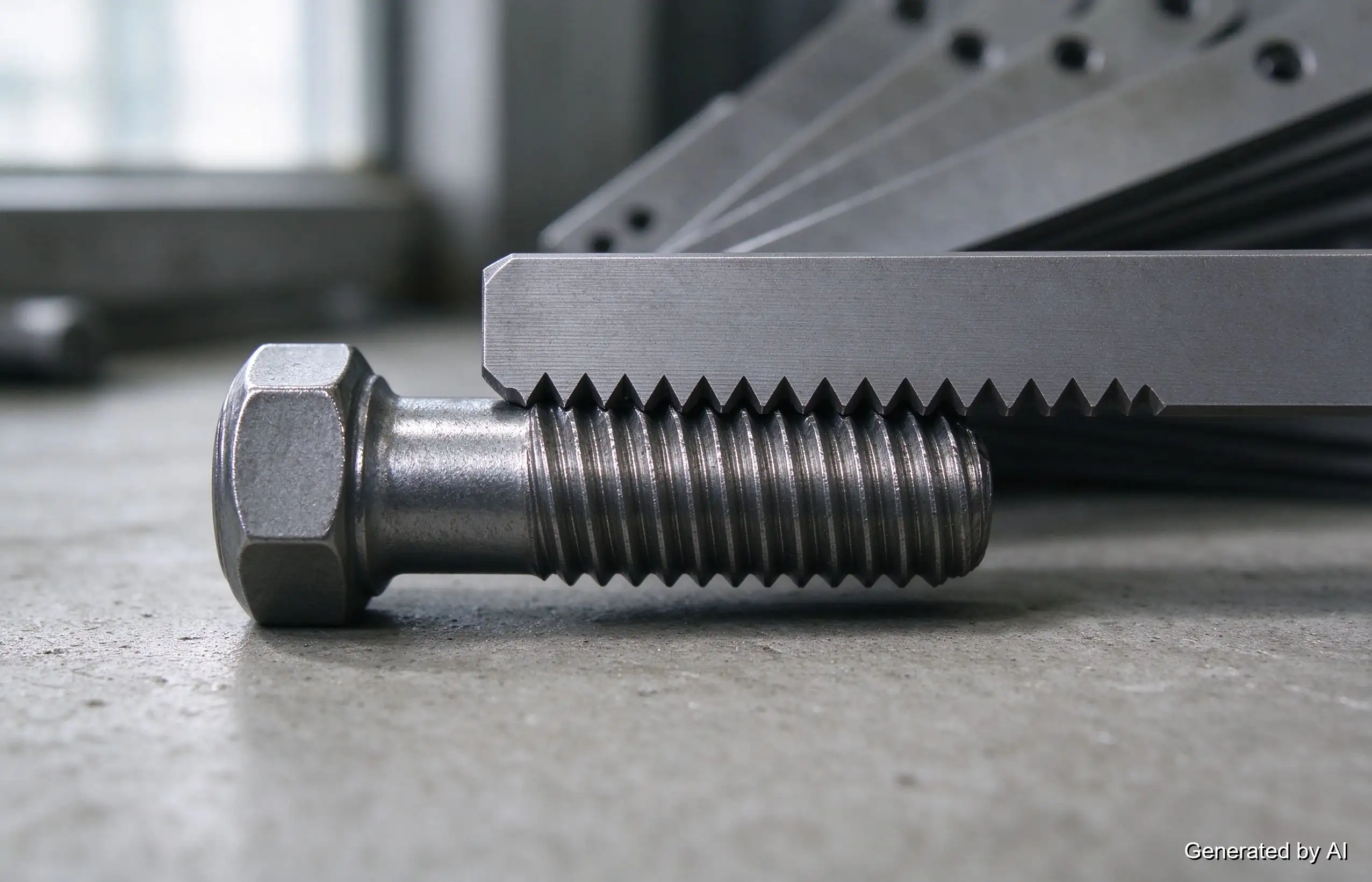
Both systems use a 60° thread angle, so the profiles look alike. What separates them is the pitch system: metric pitches run in millimeters (1.0, 1.25, 1.5…), inch pitches in threads per inch (13, 12, 20…), and no callout matches across the two. Although M8 and 5/16-inch fasteners have very similar nominal diameters, their thread pitches belong to different systems: they are not interchangeable, and forcing one into the other can damage the mating threads — the fix is picking one standard for the whole assembly. The inch side runs on a different pitch logic: UNC and UNF series are specified in threads per inch, and their full pitch tables belong to a separate chart.
Choosing Between Coarse and Fine Pitch on a Metric Thread
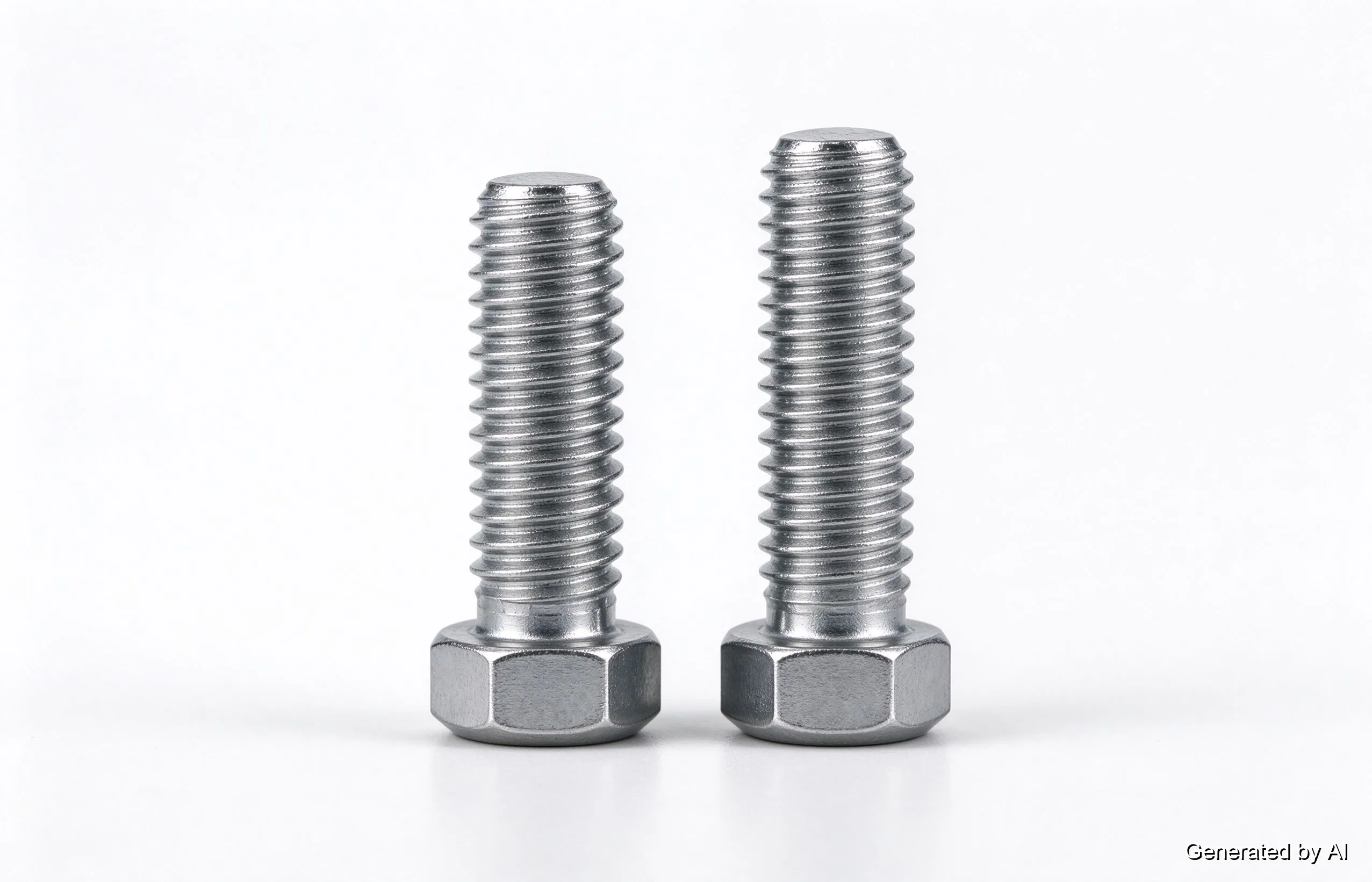
Coarse is the default for good reasons: it assembles faster, tolerates dirt and slight damage better, and taps with less torque. Fine pitch earns its keep in specific conditions rather than universally:
- Thin walls and short engagement — fine pitch packs more load-bearing threads into a length that a coarse thread cannot fill.
- Vibration-prone joints — fine pitch may offer advantages in certain joint designs, but thread pitch alone does not determine resistance to loosening; proper preload and suitable locking methods are essential.
- Fine adjustment — set screws and optical hardware use fine threads because each turn moves the part less.
The practical rule is to follow the drawing: if it says M8, the coarse 1.25 pitch is assumed; if it says M8×1.0, the fine thread is specified deliberately, and substituting coarse because the nut was at hand strips the joint.
FAQ about Metric Screw Size Chart
Q: What does M8 mean on a bolt?
M8 means the bolt's major diameter is 8mm, following the ISO metric thread standard. Without a pitch stated, the standard coarse pitch of 1.25mm is assumed; M8×1.0 would be the fine-pitch variant of the same diameter.
Q: What is the pitch of a standard M8 thread?
The standard coarse pitch for M8 is 1.25mm. The common fine alternative is 1.0mm, and both exist for the same 8mm diameter, so the pitch specification matters as much as the size.
Q: Is M8 the same as 5/16 inch?
No. The diameters are close: M8 measures 8.0mm (0.315 inch) against 5/16 inch at 7.94mm (0.3125 inch), but the thread pitches belong to different systems. The two are not interchangeable; forcing one into the other can damage both threads.
Q: How do I measure a metric thread size?
Measure the major diameter across the thread crests with a caliper, then measure the pitch with a thread pitch gauge or by counting threads per unit length. The diameter identifies the M size; the pitch confirms whether it is the coarse or fine variant.
Q: What is the difference between M8×1.25 and M8×1.0?
The diameter is identical; the pitch differs. M8×1.25 is the ISO coarse thread, the default for general assembly. M8×1.0 is a fine-pitch thread used in thin-wall and vibration-sensitive applications, and it needs its own nut, its own tap drill, and its own callout.
Q: Are metric and imperial threads interchangeable?
No. Metric and inch thread systems use different pitch sequences, and their size series only approach each other on diameter. A partially-engaged mixed joint can leak or bind under load. Adapters exist for plumbing transitions, but fastened joints should be built on a single thread standard throughout.
Q: What size drill bit is used for an M8 tap?
A 6.8mm drill is the common starting reference for an M8×1.25 coarse thread. Confirm the final size against the tap manufacturer's data and the thread engagement your joint needs — material and tapping method both shift the number.
Q: Does a fine-pitch thread always give a stronger or more secure joint?
No. Fine pitch can help in specific designs, but joint performance depends on fastener grade, preload, engagement length, material, friction, and the locking method used. Pitch alone decides nothing.
About This Metric Screw Size Chart
A metric screw size chart does its job with two numbers per thread: the diameter that names it and the pitch that completes it. The tables above assemble the ISO coarse series M1–M24, the common fine-pitch options, and the size-by-size picture for the everyday M3–M12 range, so a drawing callout can be matched to hardware — and an unmarked bolt can be sorted before it reaches the wrong nut.
Values here are standard reference figures, and the tap manufacturer's chart decides for production tapping. For the threads that pair with these sizes, the tap drill chart covers the drill side, and matched metric screws and nuts are what keep an assembly on one standard from first hole to final torque.
Keep Learning
Metric Screw Size Chart: M1–M24, Pitch & Tap Drill
Key Takeaways The M in an M8 bolt is the major diameter in millimeters: M8×1.25 reads as an 8mm outer diameter with a 1.25mm thread pitch, and coarse pitch is assumed when the pitch is not written. The metric screw size chart below covers the ISO coarse series M1–M24 with pitch, inch equivalents, and the common tap drill for each size. M8 and 5/16 inch sit only 0.06mm apart on diameter, but their thread pitches come from different systems; the two look-alikes must not be mixed in one assembly. Fine pi......
Drill Bit Size Chart: Number, Letter, Fractional & Metric
Key Takeaways A drill bit size chart has to cover four systems — fractional (inches), number (#1–#80), letter (A–Z), and metric (mm) — because the same physical diameter can carry three different callouts. Number sizes provide intermediate diameters between standard fractional-inch drill sizes, allowing finer selection where 1/64-inch increments are too coarse — which is why a 1/4-20 tap takes a #7 drill (0.201 inch). Convert decimal inches to millimeters by multiplying by 25.4; the charts below give ......
2-Bolt vs. 4-Bolt Flange Bearing Units: Selection Differences That Matter
Key Takeaways Housing geometry and space: A two-bolt flange bearing unit normally uses an oval or diamond-shaped housing, making it ideal when the mounting face is narrow or access is limited. Bolt count vs. capacity: A four-bolt flange bearing unit normally uses a square housing suited for wider interfaces, but bolt count alone does not establish the unit's load capacity. Machine interface priority: Choose the housing pattern based on the machine interface first. Then verify shaft size, published loa......
NPT Thread Guide: Charts, Tap Drill Sizes, and Fitting Identification
Key Takeaways NPT (National Pipe Taper) is a U.S. standard tapered pipe thread defined by ASME B1.20.1: a 60° thread angle and a 1:16 taper on diameter, sealing through thread interference plus sealant. NPT tap drill sizes do not follow the diameter-minus-pitch formula used for straight machine threads — ASME B1.20.1 Appendix B provides guidance, and the tap manufacturer's data decides. The everyday sizes: 1/8 NPT (27 TPI, 0.405 inch major diameter), 1/4 NPT (18 TPI, 0.540 inch), 1/2 NPT (14 TPI, 0.84......
Tap Drill Chart: UNC, UNF, Metric & NPT Drill Sizes
Key Takeaways A tap drill creates the hole a tap cuts internal threads into; the drill diameter controls how much full thread the finished hole has. For Unified inch threads, drill size = major diameter − 1/TPI (rounded to the nearest standard drill) is a commonly used starting point for approximately 75 percent thread engagement; the actual percentage depends on thread geometry and the specified hole tolerance. For metric threads, the quick formula is drill = thread diameter − pitch in millimeters, r......
Comparing Brushless Motors and Stepper Motors: Principles, Structures & Applications
We have many machines around us that have electric motors to operate, including simple tools and complex robots. Brushless DC (BLDC) motors and stepper motors are two popular options for high precision and performance. They are both electrically commutated motors and have no physical brushes, but operate in different ways and are appropriate for different applications. Key Takeaways The advantages of BLDC motors are high-speed, smooth, continuous operation, and high efficiency. Stepper motors can be u......