NPT Thread Guide: Charts, Tap Drill Sizes, and Fitting Identification
14 min
- What Is an NPT Thread?
- NPT Thread Chart: Sizes 1/16 to 2
- How to Read an NPT Thread Chart and Identify a Fitting
- NPT Tap Drill Sizes for the Most Common Threads
- Why NPT Tap Drills Ignore the Standard Formula
- NPT vs. BSP vs. NPS: Do Not Mix Them
- Sealing and Installing NPT Threads Correctly
- Where NPT Shows Up — and What JLCMC Stocks for It
- FAQ about NPT Thread Chart
Key Takeaways
- NPT (National Pipe Taper) is a U.S. standard tapered pipe thread defined by ASME B1.20.1: a 60° thread angle and a 1:16 taper on diameter, sealing through thread interference plus sealant.
- NPT tap drill sizes do not follow the diameter-minus-pitch formula used for straight machine threads — ASME B1.20.1 Appendix B provides guidance, and the tap manufacturer's data decides.
- The everyday sizes: 1/8 NPT (27 TPI, 0.405 inch major diameter), 1/4 NPT (18 TPI, 0.540 inch), 1/2 NPT (14 TPI, 0.840 inch), and 1 NPT (11.5 TPI, 1.315 inch).
- Identify an unmarked fitting in two steps: a thread pitch gauge narrows the size band by TPI, then a caliper on the major diameter (at the large end) separates same-TPI neighbors — confirm the taper before calling it NPT.
- NPT and BSP threads are not interchangeable — 60° versus 55° thread angles and different thread forms mean a forced joint leaks.
- NPT joints generally need thread sealant (PTFE tape or pipe dope), because a spiral leak path remains between the thread crests and roots.
NPT threads connect most of the pipes, fittings, and gauges sold in North America, and they show up in pneumatics, hydraulics, and instrumentation equipment worldwide. Yet two misconceptions cost people real time on the bench. The first: the number in the name is not the diameter — a 1/2 NPT thread measures 0.840 inch across its outside, not half an inch. The second: NPT is not an ordinary screw thread with a different size — it is tapered on purpose, and that taper is what builds the interference the seal depends on.
This guide collects what an engineer or buyer actually needs in one place: the full NPT thread chart with tap drill sizes, a two-measurement method for identifying an unmarked fitting, the reason NPT tap drills ignore the standard formula, and the sealing practices that keep a joint leak-free. It is the pipe-thread companion to our machine-thread drill chart, which covers UNC, UNF, and metric sizes.
What Is an NPT Thread?
NPT stands for National Pipe Taper — formally the American National Standard Taper Pipe Thread, defined in ANSI/ASME B1.20.1. Two geometric features define it. The thread angle is 60°, the same sharp V-form as unified inch screw threads. And the thread is tapered at 1:16 on diameter — the diameter changes by 1 inch over every 16 inches of length, or 3/4 inch per foot — so an external NPT thread wedges tighter into its internal counterpart as it is screwed in.
The taper's role is to build interference: as the joint is tightened, the wedge action progressively increases the contact pressure between the mating thread flanks, helping form a pressure-tight connection. Even so, the thread form alone does not complete the seal — a spiral leak path remains between the crests and roots, which is why a thread sealant that fills that path (PTFE tape or pipe dope) belongs on every NPT joint covered later in this guide.
NPT is one member of a whole family of American pipe threads, and the family tree matters when you read a fitting label:
| Symbol | Full name | What it does |
|---|---|---|
| NPT | Taper Pipe Thread | Tapered; seals by thread interference, used with sealant |
| NPS | Straight Pipe Thread | Parallel; holds parts together, seals only with a gasket or sealant |
| NPTF | Dryseal Taper Pipe Thread | Tapered with modified crests; designed to seal through thread form and interference, reducing or eliminating the need for conventional sealant when used as specified |
| NPSC | Straight Coupling Thread | Straight internal thread for couplings used with NPT |
| NPSM | Mechanical Joint Thread | Straight; free-fitting mechanical joints, no sealing duty |
| NPSL | Locknut Thread | Straight; locknut and loose-fitting mechanical joints |
For general fluid connections, NPT is the default; the others exist for dry-sealing fuel systems (NPTF) or pure mechanical roles (NPSM, NPSL). The pipe sizes in everyday use run from 1/16 up through 6 inch nominal, with 1/8 through 2 covering the vast majority of bench work.
NPT Thread Chart: Sizes 1/16 to 2
The chart below lists the sizes most shops and design desks touch, with the major diameter of the external thread at its large end, threads per inch, and the common tap drill for the internal thread.
| NPT Size | TPI | Major Dia., Large End (in) | Major Dia., Large End (mm) | Common Tap Drill | Decimal (in) |
|---|---|---|---|---|---|
| 1/16 | 27 | 0.3125 | 7.9 | D | 0.246 |
| 1/8 | 27 | 0.405 | 10.3 | R or 11/32 | 0.339–0.344 |
| 1/4 | 18 | 0.540 | 13.7 | 7/16 | 0.438 |
| 3/8 | 18 | 0.675 | 17.1 | 37/64 | 0.578 |
| 1/2 | 14 | 0.840 | 21.3 | 45/64 | 0.703 |
| 3/4 | 14 | 1.050 | 26.7 | 29/32 | 0.906 |
| 1 | 11.5 | 1.315 | 33.4 | 1-5/32 | 1.156 |
| 1-1/4 | 11.5 | 1.660 | 42.2 | 1-1/2 | 1.500 |
| 1-1/2 | 11.5 | 1.900 | 48.3 | 1-47/64 | 1.734 |
| 2 | 11.5 | 2.375 | 60.3 | 2-7/64 | 2.109 |
Tap-drill sizes are common reference values and may vary depending on tap design, workpiece material, tapping method, and required thread engagement — always verify the tap manufacturer's recommendation for production work.
Larger sizes follow the same standard at 8 TPI:
| NPT Size | TPI | Major Dia., Large End (in) | Common Tap Drill (approx.) |
|---|---|---|---|
| 2-1/2 | 8 | 2.875 | 2-5/8 |
| 3 | 8 | 3.500 | 3-1/4 |
| 3-1/2 | 8 | 4.000 | 3-3/4 |
| 4 | 8 | 4.500 | 4-1/4 |
| 5 | 8 | 5.563 | 5-1/4 |
| 6 | 8 | 6.625 | 6-5/16 |
Three notes on reading these numbers. First, the nominal size is close to the bore of the pipe the thread was designed for, not any dimension of the thread itself — the major-diameter column is what your caliper sees when you measure the largest end of the male thread. Second, the tap drills are common shop references rather than a single mandated value: ASME B1.20.1 lists guidance sizes in its nonmandatory Appendix B, and tap manufacturers publish their own charts. Where the two differ (some list 23/32 for 1/2 NPT or 59/64 for 3/4 NPT as alternates), the tap maker's chart for your specific tap decides. A slightly larger drill trades thread depth for lower tapping torque, and for tapered pipe threads that trade is often acceptable — verify against the manufacturer's data for critical work.
How to Read an NPT Thread Chart and Identify a Fitting
For an unmarked male fitting, measuring TPI and major diameter can quickly narrow down the possible thread size. Confirm the thread form and taper before identifying the fitting as NPT — the two-step method below sorts sizes, not standards.
Step 1: Count threads per inch. A thread pitch gauge (or a count against a known ruler length) sorts the fitting into a size band, because NPT sizes share TPI in groups:
| TPI | Possible sizes |
|---|---|
| 27 | 1/16, 1/8 |
| 18 | 1/4, 3/8 |
| 14 | 1/2, 3/4 |
| 11.5 | 1 through 2 |
| 8 | 2-1/2 and larger |
Step 2: Measure the major diameter at the large end. Within the 27-TPI band, 1/16 NPT measures 0.3125 inch and 1/8 NPT measures 0.405 inch — the caliper settles it in seconds. The same logic separates 1/4 from 3/8 (0.540 versus 0.675) and 1/2 from 3/4 (0.840 versus 1.050).
One caution: measure the major diameter at the large end of the male thread, and confirm the taper and thread form before trusting the reading — a straight thread with a similar pitch is probably BSP or NPS, not NPT, and the two families must not be mixed.
NPT Tap Drill Sizes for the Most Common Threads
Most tapping work concentrates on six sizes, and per-size answers are what the search history of every machinist looks like.
1/8 NPT tap drill: R (0.339 inch, about 8.6mm). The workhorse of instrumentation and pneumatic lines. An 11/32 (0.344 inch) drill is the common substitute when the exact letter drill is not on hand.
1/4 NPT tap drill: 7/16 (0.438 inch, about 11.1mm). Hydraulics, coolant lines, and sensor fittings live at this size.
3/8 NPT tap drill: 37/64 (0.578 inch, about 14.7mm). Medium-flow piping and gas lines.
1/2 NPT tap drill: 45/64 (0.703 inch, about 17.9mm). One of the most-used pipe taps in general assembly. Some tap charts list 23/32 (0.719 inch) instead — the difference is thread depth versus tapping torque, and the tap manufacturer's recommendation settles it.
3/4 NPT tap drill: 29/32 (0.906 inch, about 23.0mm). The 59/64 (0.922 inch) alternate appears on some charts for the same reason as above.
1 NPT tap drill: 1-5/32 (1.156 inch, about 29.4mm). Large manifold and pipe connections.
In every case the drill is sized to the internal thread's minor diameter at the working depth, with the taper cut in by the pipe tap itself — which is why these numbers look nothing like the straight-thread formula.
Why NPT Tap Drills Ignore the Standard Formula
For a straight machine thread, the shop shortcut is drill = major diameter minus pitch (or minus 1/TPI in inch sizes). Apply that to NPT and it fails quietly, because it answers a different question.
An NPT internal thread is tapered, so there is no single major diameter to subtract from — the thread grows along its length, and the hole that matters is the one at the depth where the joint actually seats. The drill is chosen near the minor diameter at the hand-tight engagement point, with the tap cutting the taper and the thread engagement deepening as the fitting winds in. That is also why NPT tap drills come from reference tables rather than a single formula: ASME B1.20.1 provides guidance in its nonmandatory Appendix B (Tap Drill Sizes), but the recommended drill size may still vary depending on tap design, material, tapping method, and required thread engagement — always verify the manufacturer's recommendation for production work. For the straight-thread side of the shelf, the tap drill chart covers UNC, UNF, and metric sizes with the formulas that do apply.
NPT vs. BSP vs. NPS: Do Not Mix Them
The most expensive mistake in pipe threading is assuming the standards interlock. They do not.
| Standard | Thread angle | Form | Sealing method | Where it dominates |
|---|---|---|---|---|
| NPT | 60° | Tapered | Interference plus sealant | North America |
| BSPT (R) | 55° | Tapered | Interference plus sealant | Europe, Asia |
| BSPP (G) | 55° | Parallel | Gasket, O-ring, or seat seal | Europe, Asia |
| NPS | 60° | Straight | Gasket or sealant only | Mechanical joints |
An NPT male will thread a few turns into a BSPT female and then bind — the pitch is close enough to start but the angles and forms differ, and the partly-engaged joint leaks under pressure. The fix is an adapter or, better, sourcing to one standard across the assembly. Our brass tube fittings guide covers the same trap from the plumbing side, including how BSP straight and NPT tapered threads get confused at the counter.
Sealing and Installing NPT Threads Correctly
Because the tapered flanks seal by interference but do not close the crest-to-root gaps, a sealant belongs on the thread. PTFE tape is the default: wrapped in the same direction as the thread so tightening rolls it into the joint rather than peeling it off, with the first thread left bare so the tape cannot shred into the line. Pipe dope performs the same duty as a paste and stays put on joints that get re-made. How many wraps is a matter of tape thickness and fitting size — follow the tape manufacturer's guidance rather than a fixed number.
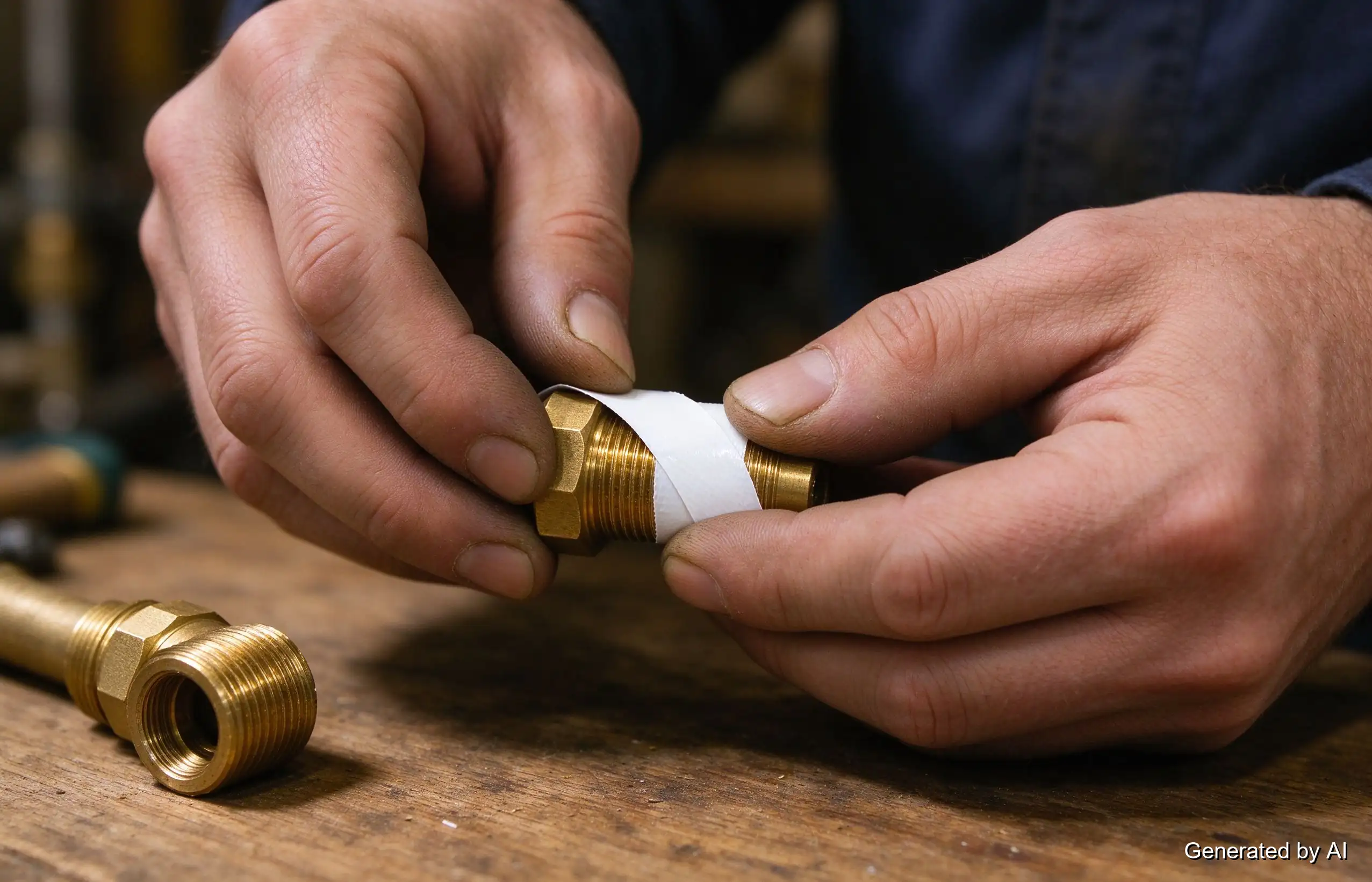
Beyond sealant, three installation habits decide whether the joint holds. Under-tightening leaves the interference short and the joint weeps. Over-tightening — the more common failure with brass fittings — cracks the female part across the thread. And repeated assembly can damage the threads, so a fitting that keeps leaking after several re-makes should be inspected for thread damage — a damaged fitting needs replacement, not more tape. On stainless steel, an anti-seize or lubricant helps prevent galling, which can weld the threads together permanently. For instrument and pneumatic work, 1/4 and 1/2 NPT are the sizes this practice is built around.
Where NPT Shows Up — and What JLCMC Stocks for It
In a mechatronic build, NPT threads appear wherever a line or a gauge meets a housing: pneumatic fittings on air preparation units, hydraulic ports on valves and cylinders, pressure sensor mounts, and general plumbing in machines. The pneumatic fittings overview covers the connector types that carry NPT ends, and the quick connector guide walks through where push-to-connect beats threaded fittings.
For building those lines directly, JLCMC stocks air hose fittings and pneumatic pipe fittings in NPT-threaded configurations, plus manifolds that distribute one supply across several NPT ports — the usual starting point for a bench or machine pneumatic layout.
FAQ about NPT Thread Chart
Q: What drill size do I need for a 1/8 NPT tap?
An R drill (0.339 inch, about 8.6 mm) is a commonly specified tap-drill size for 1/8-27 NPT. An 11/32-inch drill (0.344 inch) may also be used depending on the tap manufacturer's recommendations.
Q: Is NPT the same as NPTF?
No. NPTF is the dryseal variant: its modified crest and root forms are designed to achieve sealing through controlled interference, reducing or eliminating the need for thread sealant when used as specified. NPTF appears mainly in fuel and fluid systems specified for it; general plumbing and pneumatics run on standard NPT with sealant.
Q: Are NPT and BSP threads interchangeable?
No. The thread angle (60° versus 55°), the thread form, and the size systems all differ. An NPT fitting can be screwed partway into a BSP thread and will leak under pressure — use an adapter or match the standard across the whole assembly.
Q: Do NPT threads need thread sealant or PTFE tape?
Yes. NPT joints generally require a suitable thread sealant for a pressure-tight connection. The tapered threads provide mechanical interference, while the sealant helps fill the leakage paths between the mating threads. NPTF dryseal threads are designed to achieve sealing through controlled interference at the thread crests and roots and do not rely on sealant for the primary sealing function.
Q: How do I identify an NPT fitting size?
Use a thread pitch gauge to determine the TPI, then measure the external thread's major diameter at a consistent reference location to distinguish sizes with the same TPI. For example, 1/4 NPT has a basic major diameter of about 0.540 inch, while 3/8 NPT is about 0.675 inch.
Q: Why is my NPT connection still leaking?
Check the four usual suspects in order: no sealant or shredded tape, under-tightening, damaged or dirty threads, and a mixed standard (NPT into BSP). If the joint continues to leak after reassembly, inspect the threads and fitting for damage, galling, contamination, or insufficient engagement. Repeated assembly can damage the threads, so a damaged fitting should be replaced rather than simply adding more sealant.
Conclusion: NPT Thread Chart
NPT is a tapered 60° pipe thread that seals through interference plus sealant and demands three things from the people who use it: the right numbers (a 1/2 NPT thread measures 0.840 inch at the large end, not half an inch), the right drill (from the tap maker's tapered-thread chart, not the straight-thread formula), and the right partner (sealant on the thread, no BSP substitutes). The charts and two-step identification method above cover the bench work; JLCMC stocks the NPT-threaded side of the build — air hose fittings, pneumatic pipe fittings, and manifolds for the bench and the machine.
Keep Learning
Drill Bit Size Chart: Number, Letter, Fractional & Metric
Key Takeaways A drill bit size chart has to cover four systems — fractional (inches), number (#1–#80), letter (A–Z), and metric (mm) — because the same physical diameter can carry three different callouts. Number sizes provide intermediate diameters between standard fractional-inch drill sizes, allowing finer selection where 1/64-inch increments are too coarse — which is why a 1/4-20 tap takes a #7 drill (0.201 inch). Convert decimal inches to millimeters by multiplying by 25.4; the charts below give ......
2-Bolt vs. 4-Bolt Flange Bearing Units: Selection Differences That Matter
Key Takeaways Housing geometry and space: A two-bolt flange bearing unit normally uses an oval or diamond-shaped housing, making it ideal when the mounting face is narrow or access is limited. Bolt count vs. capacity: A four-bolt flange bearing unit normally uses a square housing suited for wider interfaces, but bolt count alone does not establish the unit's load capacity. Machine interface priority: Choose the housing pattern based on the machine interface first. Then verify shaft size, published loa......
NPT Thread Guide: Charts, Tap Drill Sizes, and Fitting Identification
Key Takeaways NPT (National Pipe Taper) is a U.S. standard tapered pipe thread defined by ASME B1.20.1: a 60° thread angle and a 1:16 taper on diameter, sealing through thread interference plus sealant. NPT tap drill sizes do not follow the diameter-minus-pitch formula used for straight machine threads — ASME B1.20.1 Appendix B provides guidance, and the tap manufacturer's data decides. The everyday sizes: 1/8 NPT (27 TPI, 0.405 inch major diameter), 1/4 NPT (18 TPI, 0.540 inch), 1/2 NPT (14 TPI, 0.84......
Tap Drill Chart: UNC, UNF, Metric & NPT Drill Sizes
Key Takeaways A tap drill creates the hole a tap cuts internal threads into; the drill diameter controls how much full thread the finished hole has. For Unified inch threads, drill size = major diameter − 1/TPI (rounded to the nearest standard drill) is a commonly used starting point for approximately 75 percent thread engagement; the actual percentage depends on thread geometry and the specified hole tolerance. For metric threads, the quick formula is drill = thread diameter − pitch in millimeters, r......
Comparing Brushless Motors and Stepper Motors: Principles, Structures & Applications
We have many machines around us that have electric motors to operate, including simple tools and complex robots. Brushless DC (BLDC) motors and stepper motors are two popular options for high precision and performance. They are both electrically commutated motors and have no physical brushes, but operate in different ways and are appropriate for different applications. Key Takeaways The advantages of BLDC motors are high-speed, smooth, continuous operation, and high efficiency. Stepper motors can be u......
DC Motor vs. Stepper Motor: What Are They and How Do They Differ?
To clearly distinguish between DC motors and stepper motors, this article uses brushed DC motors as the primary reference for comparison. A brushed DC motor is typically well suited for continuous rotation, high-speed operation, and variable-speed control, while a stepper motor is commonly used for low-speed positioning, indexing, and holding torque at standstill. When combined with an encoder and an appropriate controller, a brushed DC motor can also be used for closed-loop positioning. The right cho......