What Are Pillow Block Bearings? Definition, Working Principle & Applications
15 min
- Key Takeaways
- What Is a Pillow Block Bearing?
- How Does a Pillow Block Bearing Work?
- Key Components of a Pillow Block Bearing
- Different Types of Pillow Block Bearings
- What Are Pillow Block Bearings Used For?
- Pillow Block Bearing Advantages and Disadvantages
- Pillow Block Bearings vs. Plummer Blocks vs. Standard Bearings
- How to Choose a Pillow Block Bearing
- How to Install and Maintain a Pillow Block Bearing?
- Pillow Block Bearing Failure Signs
- Frequently Asked Questions
- Conclusion
Key Takeaways
- A pillow block bearing is a self-contained bearing unit that combines a rolling-element bearing insert with a rigid housing, designed for shaft support on a flat mounting surface with the shaft axis parallel to the mounting plane.
- The housing provides structural alignment and load distribution, while the bearing insert handles radial and limited axial loads.
- Common locking mechanisms include set screws, eccentric collars, and adapter sleeves; each suits different shaft tolerances, vibration levels, and maintenance requirements.
- Pillow block bearings are widely used in conveyor systems, agricultural machinery, pumps, fans, and material-handling equipment where shafts require stable, accessible support.
- Selection depends on load magnitude and direction, shaft diameter, operating speed, environmental exposure, lubrication access, and the required locking method.
What Is a Pillow Block Bearing?
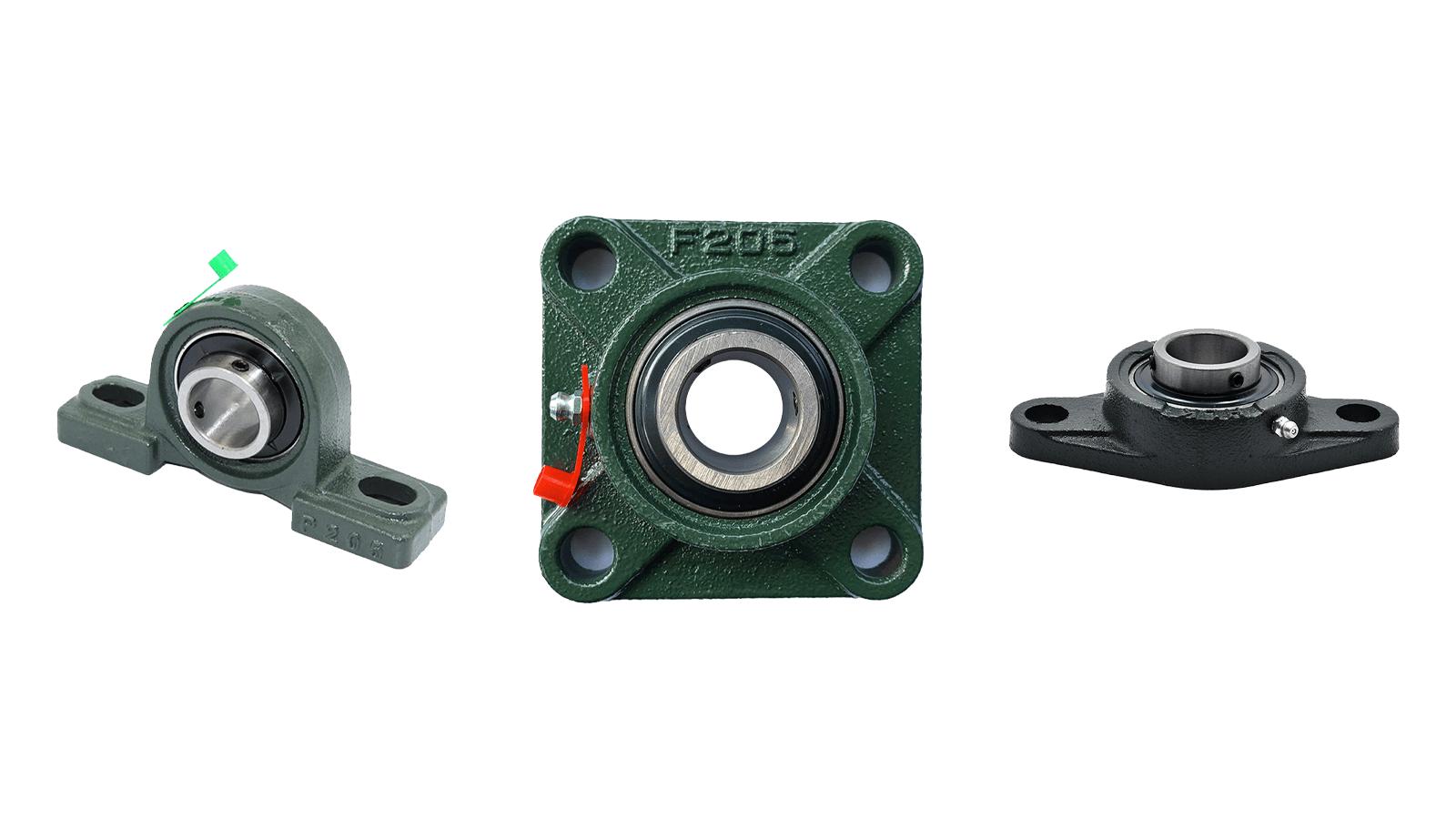
A pillow block bearing is a mounted bearing unit consisting of a rolling-element bearing insert pre-installed in a rigid housing with a flat base and bolt holes for anchoring to a machine frame. The bearing insert features an extended inner ring that clamps to the shaft. Many inserts also incorporate a spherical outer surface that allows limited angular misalignment compensation within the matching housing bore. This configuration provides shaft support on a flat mounting surface with the shaft axis parallel to the mounting plane, without requiring a precision-machined bearing seat in the machine structure itself.
How Does a Pillow Block Bearing Work?
The shaft passes through the bearing insert's inner ring, where the specific locking mechanism secures the shaft against relative rotation, in some designs by creating an interference fit. Radial loads transmit through the rolling elements into the outer ring and then distribute through the housing into the machine frame via mounting bolts. In units with a spherical outer-surface insert and a matching concave housing bore, the insert can tilt slightly to compensate for limited angular misalignment within the manufacturer's specified range. Seals or shields retain lubricant and exclude contaminants.
Key Components of a Pillow Block Bearing
A pillow block bearing is an assembly of distinct parts, each serving a specific mechanical function. Understanding these components clarifies maintenance requirements, failure modes, and specification logic.
| Component | Function | Key Characteristics | Common Pairings |
| Housing | Provides structural support, load distribution, and mounting interface | Cast iron offers stiffness and vibration damping; stamped steel reduces weight and cost at the expense of rigidity; stainless or polymer housings resist corrosion | Cast iron with heavy-duty inserts; pressed steel with light-duty inserts; stainless housings with food-grade seals |
| Bearing Insert | Handles radial and axial loads through rolling elements | Ball-type inserts suit moderate combined loads and higher speeds; roller-type inserts accommodate higher radial loads, shock, and misalignment at moderate speeds | Ball inserts with set screw or eccentric collar locking; roller inserts with adapter sleeves in heavy-duty units |
| Locking Mechanism | Secures the inner ring to the shaft and prevents axial displacement | Set screws for economy and quick installation; eccentric collars for vibration resistance; adapter sleeves for high-speed or heavily loaded applications | Set screws with commercial shafts; adapter sleeves with ground shafts |
| Seals / Shields | Retains lubricant and excludes contaminants | Rubber contact seals for dusty/wet environments; metal shields for low-drag, clean environments; labyrinth seals for abrasive conditions | Triple-lip seals in agriculture; metal shields in indoor fans |
| Lubrication System | Reduces friction and dissipates heat | Sealed-for-life grease fill in small units; grease fittings with relief ports in larger or high-duty units | Grease nipples with cast-iron housings; sealed inserts in stamped-steel units Each component must be matched to the application. A heavy-duty bearing insert in a lightweight stamped housing will distort the mounting base; a high-speed application with set screw locking will suffer from imbalance and loosening. Specification requires treating the unit as a system rather than an isolated bearing. |
Different Types of Pillow Block Bearings
Pillow block bearings are manufactured in multiple configurations to address load capacity, environmental exposure, and shaft attachment requirements. The most useful classification separates them by housing material, bearing insert design, and shaft-locking method.
By Housing Material
Cast-Iron Housings. Gray or ductile cast iron provides high stiffness, vibration damping, and thermal stability. These housings dominate industrial applications where structural rigidity and load capacity are priorities. The trade-off is weight and susceptibility to impact cracking.
Stamped-Steel Housings. Pressed from sheet steel, these housings are lightweight and economical. They suit light-duty applications with minimal shock loading and are common in agricultural and food-processing equipment where lower mass or frequent washdown is advantageous. Rigidity is significantly lower than cast iron.
Stainless-Steel and Polymer Housings. These resist corrosion and chemical exposure. They are used in food-grade, marine, or chemically aggressive environments where standard iron or steel housings would degrade. Load capacity and temperature range are generally reduced compared to metal alternatives.
By Bearing Insert Design
Ball Bearing Inserts: These use deep-groove or angular-contact ball configurations and suit moderate radial loads with some axial capacity. They run at higher speeds than roller alternatives and generate less friction. Ball inserts are the default choice for fans, pumps, and light-to-medium conveyors.
Roller Bearing Inserts: Spherical roller or cylindrical roller inserts handle significantly higher radial loads and tolerate greater misalignment. They are preferred in vibrating screens, heavy conveyors, crushers, and agricultural equipment where shock loading and frame flexure are present. Speed capability and efficiency are lower than ball equivalents.
Tapered Roller Inserts (Specialty): Less common in standard pillow blocks, these accommodate combined radial and axial loads in a single unit. They appear in specialized heavy-duty units where thrust components are significant.
By Shaft-Locking Method
Set Screw Locking: Two set screws tighten against the shaft at an angle to each other. This is the most economical and widely used method, suitable for standard commercial shaft tolerances and moderate speeds. The set screws can score the shaft surface and may loosen under reversing loads or severe vibration.
Eccentric Collar Locking: A collar with an offset bore rotates relative to the inner ring, creating a wedge fit through cam action. This provides superior resistance to vibration and shock loading because the tightening force increases with rotational torque. Installation requires correct rotation direction relative to shaft rotation; incorrect orientation will cause loosening.
Adapter Sleeve Locking: A tapered sleeve between the shaft and bearing bore is drawn into place by a lock nut, creating a uniform radial interference fit. Preferred for high-speed or heavily loaded applications. Allows use of standard tolerance shafts and permits easier removal than set screw units, but costs more and requires more involved installation.
The optimal configuration depends on the interaction of these three dimensions: a cast-iron housing with a roller insert and adapter sleeve locking suits a high-load industrial vibrating screen, while a stamped-steel unit with a ball insert and set screw locking fits a light agricultural conveyor.
What Are Pillow Block Bearings Used For?
Conveyor Systems
Belt and roller conveyors use pillow blocks to support drive and idler shafts. Take-up units maintain proper belt tension as the belt stretches or wears. The ability to grease bearings without disassembly is critical in dusty material-handling environments.
Agricultural Machinery
Harvesters, balers, and grain-handling equipment use pillow blocks because these applications tolerate moderate misalignment from frame flexing and are easy to service in the field. Where spherical-outer-surface inserts are specified, limited angular misalignment compensation addresses minor frame distortion.
Pumps and Fans
Centrifugal pumps and industrial fans mount pillow blocks on bearing pedestals to support the overhung impeller shaft. Units with spherical-outer-surface inserts and matching housing bores can accommodate limited angular misalignment from minor assembly errors. Thermal expansion must be evaluated separately based on the specific bearing arrangement.
Food and Packaging Equipment
Stainless-steel or polymer-housed pillow blocks with food-grade lubricants support washdown requirements. The open housing design allows thorough cleaning compared to enclosed gearbox bearings.
Mining and Aggregate Processing
Heavy-duty spherical roller pillow blocks handle high radial loads from crushers, screens, and vibrating equipment. Cast-iron housings with labyrinth seals survive abrasive environments.
Pillow Block Bearing Advantages and Disadvantages
Advantages
- Eliminates the need for a precision-machined bearing seat in the machine frame; the housing provides a standardized mounting interface.
- For units with spherical-outer-surface inserts, limited angular misalignment compensation accommodates minor frame distortion and assembly tolerances, reducing base alignment requirements.
- Bearing insert replacement does not require shaft removal or disturbance of adjacent components, shortening maintenance downtime.
- External mounting positions the bearing away from process heat or contamination when the frame design permits, extending service life in harsh environments.
- Available in a wide range of sizes, materials, and locking configurations to match diverse industrial requirements.
Disadvantages
- Increases overall machine envelope; the housing may interfere with guards, covers, or adjacent equipment in compact designs.
- Set screw locking can score shafts, creating stress concentrations and making future removal difficult.
- Generally unsuitable for precision spindle applications; self-alignment introduces compliance that limits rotational accuracy and stiffness.
- Sensitive to mounting surface quality; warped bases or loose bolts distort the housing bore and accelerate wear.
- Eccentric collar and adapter sleeve configurations cost more than set screw units and require more careful installation.
Pillow Block Bearings vs. Plummer Blocks vs. Standard Bearings
Pillow block bearings, plummer blocks, and standard bearings are not interchangeable categories on the same dimensional axis. The fundamental distinction lies in whether the bearing is delivered as a self-contained mounted unit, a split housing designed for separate bearing insertion, or a standalone bearing element requiring custom installation.
Core Comparison
| Type | Structure / Characteristics | Installation Method | Typical Applications | Advantages | Limitations |
| Pillow Block Bearing | Bearing insert pre-mounted in a non-split housing with a flat base and bolt holes | Bolt housing directly to machine frame; slide shaft through insert and lock | Conveyor shafts, fans, pumps, agricultural machinery, light-to-medium industrial drives | Quick installation; self-aligning; no precision housing bore required; easy insert replacement | Moderate load capacity; increased machine envelope; limited precision |
| Plummer Block | Split housing (cap + base) with spherical bore; bearing purchased and installed separately | Assemble housing halves around shaft; shim for bearing clearance; precision mounting surface required | Steel mills, paper machines, large gearboxes, heavy crushers, marine propulsion shafts | Very high load capacity; serviceable without shaft removal; accommodates large shaft diameters | Heavy; requires precise base machining and shimming; higher installation complexity |
| Standard Bearing | Bare rolling-element bearing without housing or locking mechanism | Press or shrink-fit into precision-machined housing bore; requires shoulders, snap rings, or nuts for axial location; external sealing needed | Electric motors, precision spindles, gearboxes, automotive, high-speed rotating equipment | Highest precision and stiffness; most compact envelope; broadest speed and load range | Requires precision machining of mating parts; no self-alignment; installation and sealing are design responsibilities |
Selecting among these three types depends on the structural, load, and maintenance requirements of each shaft location. In practice, many machines use all three types simultaneously: standard bearings inside a motor or gearbox, a pillow block on an intermediate conveyor shaft, and plummer blocks on a heavy agitator or crusher drive. The correct selection depends on matching the capabilities of the bearing system to the constraints of each application.
How to Choose a Pillow Block Bearing
Step 1: Analyze the Load
Determine the radial load magnitude and any axial load component. Verify the dynamic load rating and static load rating against actual loads with an appropriate safety factor. For pure radial loads above ball insert capacity, or when greater angular misalignment capacity is required, specify an insert designed for the required misalignment range—such as an appropriate spherical roller configuration.
Step 2: Match Shaft Diameter and Speed
Confirm the bearing bore matches the shaft diameter. Check the manufacturer's speed rating, which depends on bearing type, lubrication, and seal design. Set screw units are generally speed-limited due to imbalance from the screw interface; adapter sleeve units allow higher speeds.
Step 3: Select the Locking Method
For commercial-grade shafts and moderate speed with minimal vibration, set screw locking is cost-effective. For vibration, shock loads, or reversing torque, specify eccentric collar or adapter sleeve locking. For frequent bearing replacement on the same shaft, avoid set screws to prevent cumulative shaft damage.
Step 4: Define Environmental Requirements
In wet or dusty environments, specify contact seals or labyrinth seals. For food processing, specify stainless-steel or thermoplastic housings with FDA-approved lubricants. In high-temperature applications, verify seal material compatibility and grease operating temperature range.
Step 5: Verify Housing and Mounting
Cast iron is the default for industrial applications; choose ductile iron or steel for higher strength. For corrosive environments, consider composite or stainless housings. Verify that the mounting bolt pattern and base dimensions fit the available machine structure, and ensure the mounting surface is sufficiently rigid.
Step 6: Establish a Lubrication Strategy
Sealed-for-life units reduce maintenance but cannot be relubricated once factory grease degrades. For continuous-duty or dirty environments, specify units with grease fittings and establish a relubrication interval based on operating hours and conditions.
How to Install and Maintain a Pillow Block Bearing?
Installation
- Prepare the shaft: ensure it is clean, straight, and within the manufacturer's recommended tolerance. Remove burrs and nicks that could prevent uniform seating of the inner ring.
- Verify the mounting surface: it must be flat and rigid. A warped base will distort the housing and preload the bearing unevenly.
- Mount the housing: torque the mounting bolts to the manufacturer's specification in a cross pattern for uniform seating. Use hardened washers under bolt heads to prevent embedding in soft housing material.
- Install the bearing insert: slide it onto the shaft at the designated location. Tighten set screws, eccentric collars, or adapter sleeve lock nuts to the manufacturer's specified torque using a calibrated wrench. For eccentric collars, rotate in the direction of shaft rotation while tightening.
- Align the assembly: minimize initial misalignment using a straightedge or laser tool. Ensure multiple pillow blocks on the same shaft are coaxial within the manufacturer's allowable limit.
Maintenance
- Establish a relubrication schedule for units that are not sealed for life, following the manufacturer's guidelines.
- Add grease slowly to avoid overfilling; excess grease increases temperature and seal drag. If the unit includes a relief port, ensure displaced old grease can exit during service.
- Periodically inspect for seal damage, housing cracks, mounting bolt looseness, and abnormal noise or vibration.
- Compare housing surface temperature to baseline readings or identical units on the same machine to detect overheating early.
Pillow Block Bearing Failure Signs
Excessive Noise or Vibration
A healthy pillow block runs quietly with minimal vibration. Grinding, squealing, or irregular rumbling indicates damaged rolling elements, raceway spalling, or lubrication breakdown. Vibration analysis can detect defects before they become audible.
Elevated Operating Temperature
A sudden temperature rise suggests inadequate lubrication, over-lubrication, seal drag, or internal damage. Compare housing surface temperature to baseline readings or to identical units on the same machine.
Grease Discoloration or Contamination
When relubricating, inspect the purged grease. Metallic particles indicate wear. Water contamination appears as emulsified, milky grease. Hardened or oxidized grease indicates thermal degradation or extended service intervals.
Shaft Movement or Looseness
If the shaft can be moved axially or radially relative to the housing beyond normal bearing clearance, the locking mechanism has failed or the bearing insert is worn. Check set screw torque and inspect the shaft for scoring.
Housing Cracks or Bolt Loosening
Cracks in the housing feet or repeated loosening of mounting bolts signal excessive dynamic loads, resonance, or housing fatigue. This may require upgrading to a heavier-duty housing series or redesigning the mounting structure.
Frequently Asked Questions
What is the difference between a pillow block and a flange bearing?
A pillow block mounts to a horizontal surface with bolts through a flat base, positioning the shaft parallel to the mounting plane. A flange bearing mounts via a circular or square flange to a vertical surface, positioning the shaft perpendicular to the mounting plane. The bearing inserts are often interchangeable.
Can pillow block bearings handle axial loads?
Ball bearing inserts accommodate moderate axial loads in both directions, but their primary design intent is radial load support. For significant or sustained axial loads, verify the specific bearing's axial load rating or consider angular contact alternatives.
How tight should pillow block bearing set screws be?
Tighten to the manufacturer's specified torque using a calibrated wrench. Overtightening deforms the inner ring and reduces bearing life; undertightening allows shaft slippage and fretting corrosion.
Are pillow block bearings self-aligning?
Yes, to a limited degree. The spherical outer surface of the bearing insert allows angular misalignment compensation within the manufacturer's specified range. This compensates for minor frame distortion but does not correct for significant shaft deflection.
Can I replace just the bearing insert without replacing the housing?
Yes. In most pillow block designs, the bearing insert can be removed from the housing and replaced independently, provided the housing is undamaged. This is one of the primary maintenance advantages of the configuration.
Conclusion
A pillow block bearing integrates a bearing insert, shaft locking, sealing, and structural mounting into a single, field-replaceable unit. Its value lies in simplifying machine design, enabling rapid maintenance without shaft removal, and—on units with appropriate spherical-outer-surface inserts—accommodating limited angular assembly misalignment. The correct specification requires matching the housing material, insert type, and locking method to the actual load, speed, and environment.
For engineers needing shafts, JLCMC offers shaft purchasing, customization, and additional machining services to meet specific application needs. Standard pillow block bearings are also available for reliable, ready-to-use solutions. Explore JLCMC's shaft and bearing options to find the right fit for your application.
Keep Learning
How to Choose a Shaft Coupling: Rigid vs Beam vs Jaw vs Universal Joint
Key Takeaways Shaft Coupling Basics: A shaft coupling transmits torque between driving and driven shafts while accommodating misalignment, vibration, and thermal expansion. The core choice is between rigid (zero flexibility, maximum torque density) and flexible (misalignment-tolerant, vibration-damping) designs. Four Primary Types: Rigid couplings offer zero backlash but require perfect alignment; helical beam couplings provide precision motion for light-duty drives; jaw couplings deliver versatile vi......
Roller Chain Size Chart: ANSI and BS Sizes in mm and Inches
Key Takeaways Identify the chain series first: ANSI and BS-series size codes belong to different dimensional families; changing the units does not change the chain type. Check four details together: Pitch, roller diameter, inner width and number of rows. Matching pitch alone is not enough to choose a replacement. Use the millimeter columns for comparison: Inch equivalents appear beside them, so there is no need to interpret two units in one cell. Count the gaps when measuring pitch: Six consecutive pi......
How to Choose Between Closed-Loop and Open-Loop Stepper Motors
People need the right motor for machine projects. Picking between a closed-loop and open-loop stepper motor shapes machine accuracy and total cost. You can build simple 3D printers with open-loop drives. You can run fast industrial equipment with closed-loop systems. This guide helps you pick the correct motor for your build. Key Takeaways Open-loop stepper systems operate without position feedback, while closed-loop systems use an encoder to monitor actual shaft position. Open-loop systems cannot det......
What Are Pillow Block Bearings? Definition, Working Principle & Applications
Key Takeaways A pillow block bearing is a self-contained bearing unit that combines a rolling-element bearing insert with a rigid housing, designed for shaft support on a flat mounting surface with the shaft axis parallel to the mounting plane. The housing provides structural alignment and load distribution, while the bearing insert handles radial and limited axial loads. Common locking mechanisms include set screws, eccentric collars, and adapter sleeves; each suits different shaft tolerances, vibrat......
Main Types of Servo Motors: AC, DC, and Everything in Between
1. Introduction By leveraging closed-loop feedback to precisely control position, velocity, and torque, servo motors serve as the backbone of modern automation. Yet, application success hinges on matching the right architecture to your load requirements—a task made challenging by the sheer variety of servo motor types available today. In this article, we map motor technology to application requirements through a practical taxonomy covering electrical topology, mechanical construction, performance spec......
Quiet Servo Motors: How to Select Low-Noise Servo Motors for Precision Automation
Noise has quietly become a specification. Medical device makers, semiconductor equipment builders, and packaging OEMs now arrive at the design review with a dB(A) target alongside torque and settling time — and the motion axis is usually the first thing they point at. This guide is written for engineers and buyers specifying industrial AC and brushless servo systems, covering small to medium power ranges commonly used in precision automation equipment. It is not about RC hobby servos: the plastic-gear......