Threaded Inserts for Plastic: Types, Design Tips, 3D Printing Uses, and Mechatronic Applications
16 min
- 1. Why Plastic Parts Need Threaded Inserts
- 2. What Are Threaded Inserts for Plastic?
- 3. Common Types of Threaded Inserts for Plastic
- 4. Material Matters: Thermoplastics vs Thermosets
- 5. Design Tips for Threaded Inserts in Plastic Parts
- 6. Threaded Inserts in 3D Printed Parts
- 7. Threaded Inserts in Mechatronic Assemblies
- 8. Choosing the Right Insert for Plastic
- 9. Common Sizes for Plastic Threaded Inserts
- 10. Installation Tips for Threaded Inserts in Plastic
- 11. Common Mistakes to Avoid
- 12. Threaded Inserts vs Screws Directly Into Plastic
- 13. FAQ: Threaded Inserts for Plastic
- 14. Conclusion
1. Why Plastic Parts Need Threaded Inserts
Plastic is lightweight, easy to shape, corrosion resistant, and widely used in housings, covers, brackets, fixtures, and 3D printed prototypes. It is an excellent material for many mechanical and mechatronic designs.
But plastic has one obvious weakness: it does not love repeated screw assembly.
A screw driven directly into plastic may work for a simple one-time connection. However, after repeated tightening, removal, vibration, or thermal cycling, the plastic thread can wear, deform, crack, or lose clamping force. This is especially common in serviceable products, prototype parts, and machine components that need regular maintenance.
That is where threaded inserts for plastic become useful.
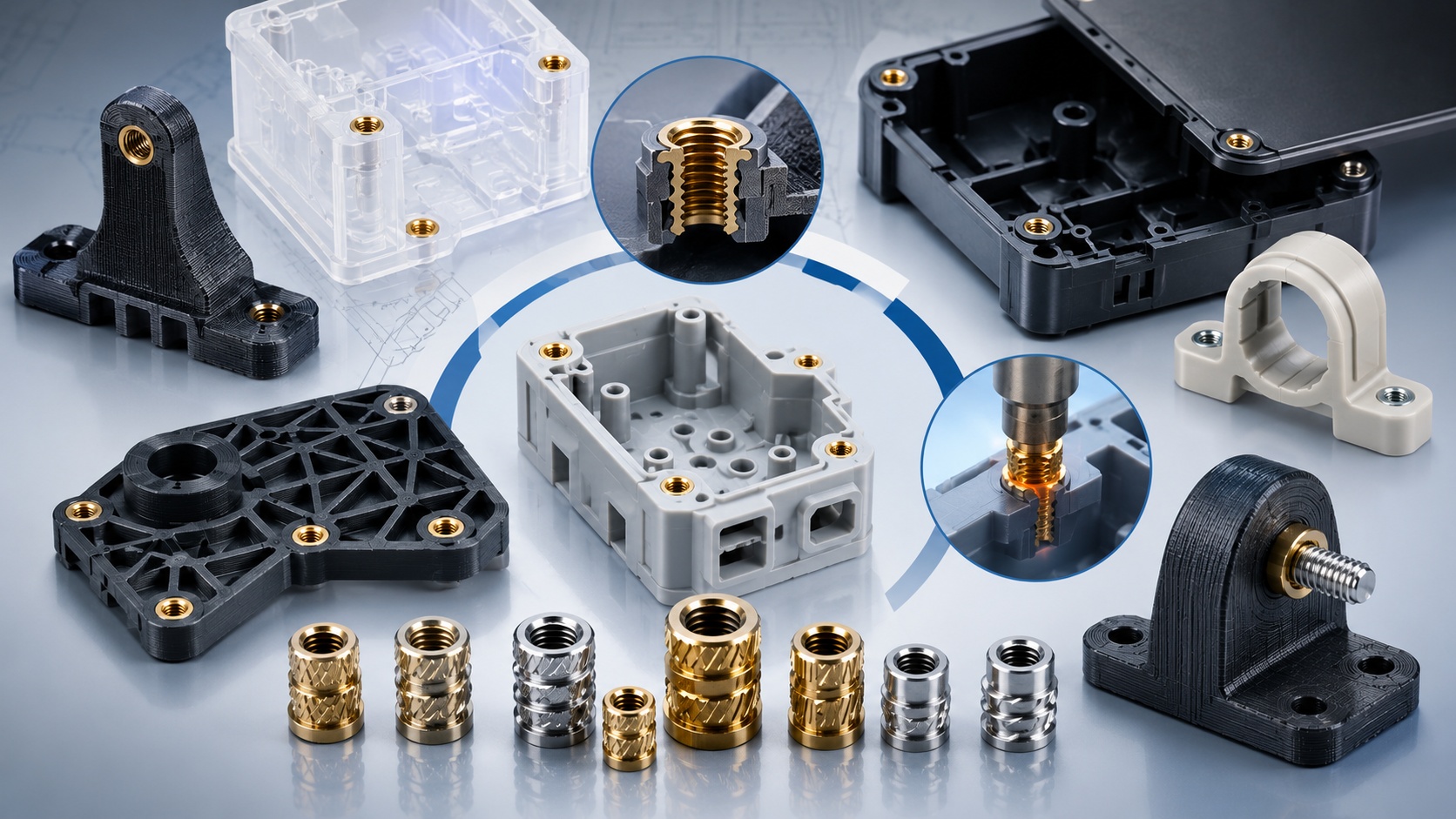
A threaded insert is a metal component installed into a plastic part to create a strong, reusable internal thread. Instead of depending on the plastic itself to hold the screw, the insert provides a durable metal thread for a machine screw, socket head cap screw, or small hex bolt.
If you are new to the broader topic, start with our complete guide to threaded inserts, which explains common insert types, installation principles, material differences, and general selection logic. This article focuses specifically on plastic parts, including thermoplastic housings, 3D printed components, press-fit designs, heat-set inserts, and mechatronic applications.
In simple terms: plastic provides the shape, insulation, weight reduction, and design flexibility; The insert provides durable metal threads while the surrounding plastic structure carries the applied loads.
Threaded inserts are especially valuable when a plastic part needs to be opened, adjusted, repaired, tested, or reassembled. In mechatronic equipment, this can include covers, sensor mounts, cable-management parts, control housings, lightweight brackets, and 3D printed fixtures.
A small insert may not look dramatic, but it can prevent a very common failure: the screw hole that worked perfectly yesterday and spins helplessly today.
2. What Are Threaded Inserts for Plastic?
Threaded inserts for plastic are metal inserts designed to be fixed inside a plastic hole or boss. They usually include an internal machine thread and an engineered outer surface.
The internal thread accepts the screw. The outer surface locks into the plastic.
Depending on the insert type, the outside may include:
· Knurls
· Grooves
· Barbs
· Undercuts
· Tapered surfaces
· Straight walls
· External threads
Once installed, the insert improves the threaded connection by providing better thread durability, better resistance to repeated assembly, and cleaner maintenance compared with screws driven directly into plastic.
However, the insert does not make the whole plastic part as strong as metal. The surrounding boss, wall thickness, plastic material, installation method, and load direction still matter.
A good threaded insert design should always consider the full joint:
· Insert type
· Plastic material
· Boss design
· Hole diameter
· Installation method
· Screw size
· Load direction
· Assembly frequency
The insert is only one part of the fastening system.
3. Common Types of Threaded Inserts for Plastic
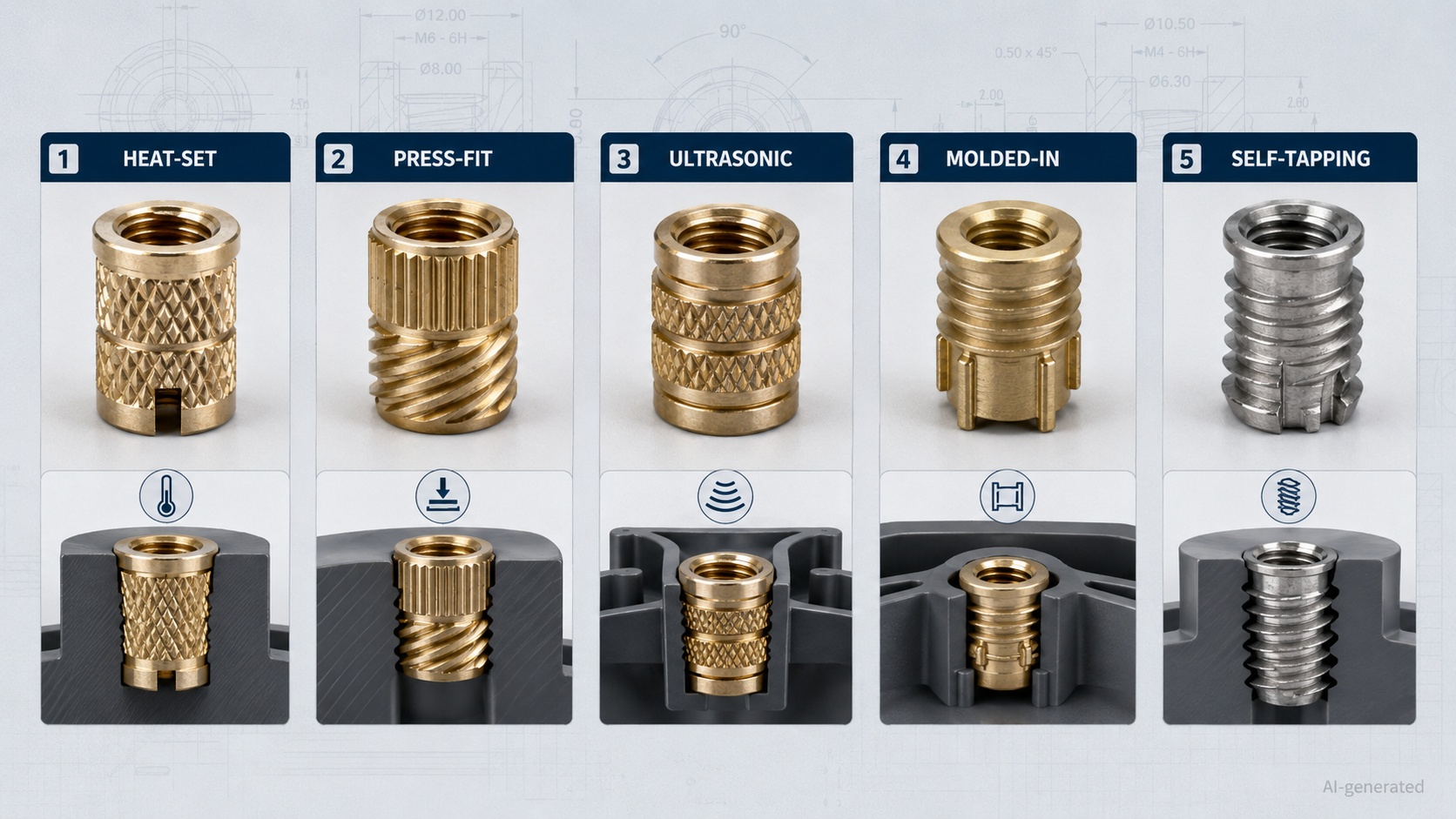
Different plastic parts require different insert styles. The best choice depends on whether the part is 3D printed, injection molded, machined, or used in a low-volume assembly.
Heat-Set Threaded Inserts
Heat-set threaded inserts are commonly used in thermoplastic parts and 3D printed components. The insert is heated and pressed into a prepared hole. The surrounding plastic softens, flows around the insert geometry, and locks it in place after cooling.
This type is popular because it is simple, effective, and suitable for many prototype and production plastic parts.
Heat-set inserts are commonly used for:
· 3D printed brackets and housings
· Plastic covers that need repeated removal
· Compact control boxes
· Lightweight mechanical fixtures
· Serviceable plastic components
Brass is commonly used for heat-set inserts because it transfers heat well, machines cleanly, and performs well in many indoor applications.
Press-Fit Threaded Inserts
Press-fit inserts are mechanically pressed into a prepared hole using an interference fit. They normally do not require thermal installation. They rely on interference fit, ribs, barbs, or knurled geometry to grip the plastic.
They are useful when heat is not suitable or when the design can support a controlled press-in process.
Press-fit inserts require accurate hole sizing. If the hole is too small, the plastic boss may crack. If the hole is too large, the insert may spin or pull out.
Ultrasonic Threaded Inserts
Ultrasonic inserts are installed using high-frequency vibration. The vibration creates localized heat at the insert-plastic interface, allowing the insert to be pressed into place.
This method is often used in production environments where speed and repeatability matter. It is suitable for many molded thermoplastic parts, especially when consistent installation quality is required.
Molded-In Inserts
Molded-in inserts are placed into the mold before plastic is injected around them. After molding, the insert becomes permanently embedded in the plastic part.
This method can provide strong performance and accurate insert location, but it requires planning during mold design and production. It is usually more suitable for higher-volume molded parts rather than quick prototypes.
Self-Tapping Inserts for Plastic
Self-tapping inserts either cut or form their mating thread in the surrounding plastic during installation, depending on their design. They can be useful in certain engineering plastics, low-volume fixtures, and retrofit applications.
They do not require heat or ultrasonic equipment, but pilot hole size and installation torque must be carefully controlled. Too much torque can crack the boss or damage the surrounding plastic.
4. Material Matters: Thermoplastics vs Thermosets
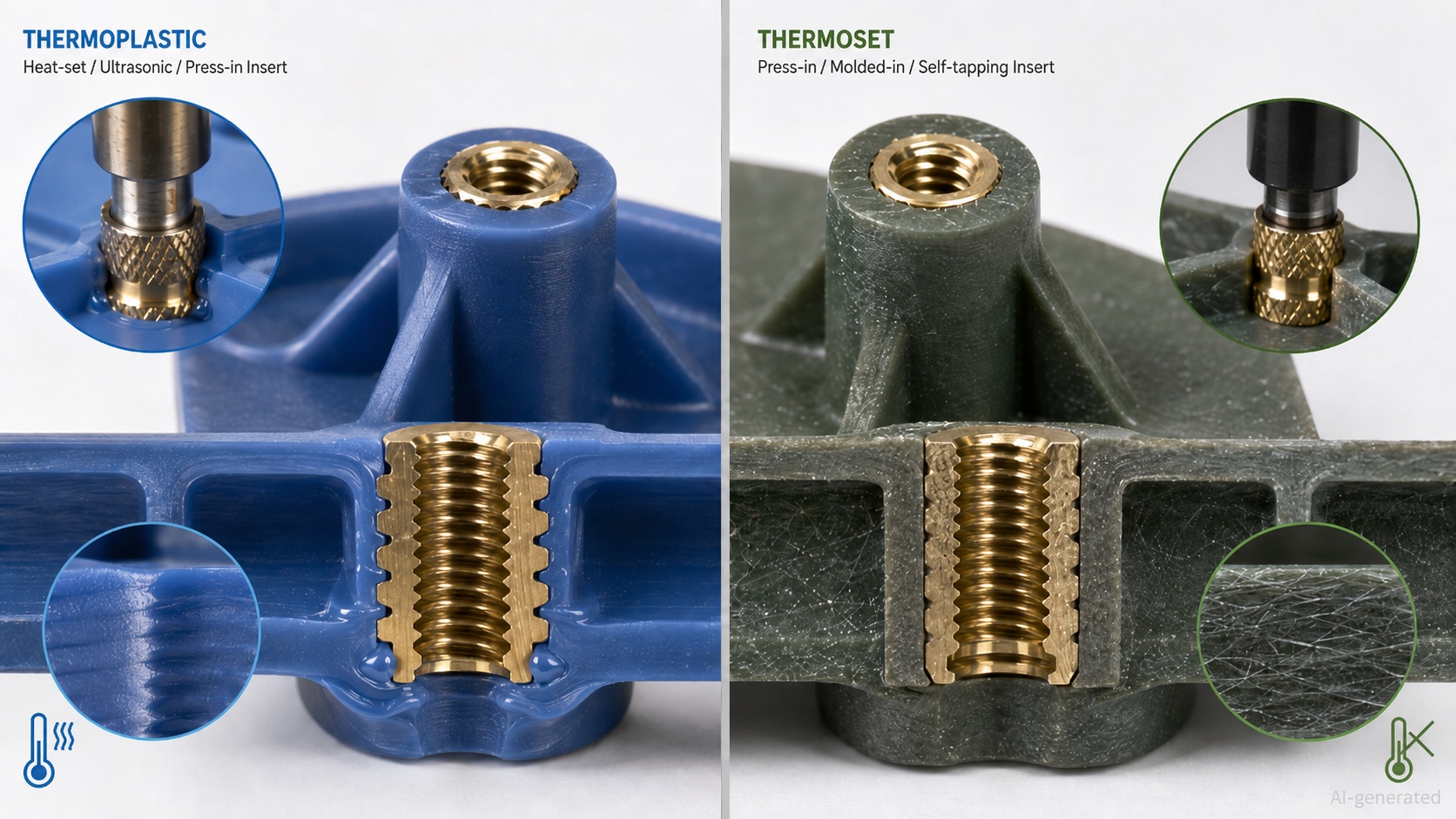
Before choosing threaded inserts for plastic, it is important to understand what kind of plastic is being used.
Thermoplastics
Thermoplastics soften when heated and harden again when cooled. This makes them suitable for heat-set and ultrasonic inserts.
Common thermoplastics include:
· ABS
· PLA
· PETG
· Nylon
· Polycarbonate
· Polypropylene
· PEEK
Thermoplastics are common in 3D printed parts, injection-molded housings, machine covers, brackets, and industrial accessories.
For thermoplastic parts, heat-set, ultrasonic, press-fit, molded-in, and self-tapping inserts may all be possible depending on the design.
Thermosets
Thermoset plastics do not re-melt in the same way after curing. Because they do not soften like thermoplastics, heat-set installation is usually not the best choice.
For thermoset parts, press-in, molded-in, or self-tapping inserts may be more suitable, depending on the material and structure.
The key point is simple: choose the insert according to the plastic, not only according to the screw size.
5. Design Tips for Threaded Inserts in Plastic Parts
Good insert performance starts in the design stage. Many insert failures are caused not by the insert itself, but by weak boss geometry, poor hole sizing, or incorrect installation conditions.
Use a Proper Boss
A boss is the raised cylindrical structure that holds the insert. For most plastic insert designs, a well-designed boss is better than placing the insert directly into a thin wall.
A proper boss improves:
· Pull-out resistance
· Torque resistance
· Screw alignment
· Local stiffness
· Installation stability
If the boss is too thin or unsupported, the insert may crack the plastic or fail under load.
Leave Enough Wall Thickness
There should be enough plastic around the insert to support installation and use. Small inserts such as M2.5 and M3 still require careful boss design, especially in compact housings.
For larger inserts such as M5 or M6, the boss must be strong enough to handle both installation force and screw tightening force.
Control Hole Diameter
Hole diameter is one of the most important details.
If the hole is too small, the insert may crack the plastic or require excessive installation force. If the hole is too large, the insert may have poor pull-out resistance or rotate during screw tightening.
For 3D printed parts, this is especially important because printed holes often differ from CAD dimensions due to extrusion behavior, shrinkage, and printer calibration.
Control Installation Depth
The insert should sit at the intended depth. It may be flush, slightly below the surface, or positioned inside a blind hole depending on the design.
If the insert sits too high, it may interfere with assembly. If it sinks too deep, the screw may not engage properly or the boss may lose strength.
Avoid Sharp Stress Concentrations
Plastic bosses should avoid sharp internal corners where possible. Ribs, fillets, and proper wall transitions can help reduce stress concentration and improve durability.
The goal is not only to hold the insert, but to help the whole plastic structure survive assembly and use.
6. Threaded Inserts in 3D Printed Parts
One of the most common modern uses of threaded inserts for plastic is in 3D printed parts.
Printed plastic threads can work for light-duty prototypes, but they are often not ideal for repeated assembly. Layer lines, print orientation, hole accuracy, and material behavior can all reduce thread strength.
Heat-set inserts solve this problem by adding a metal internal thread to the printed part.
They are especially useful in 3D printed:
· Enclosures
· Robot parts
· Cable clamp bases
· Test fixtures
· Prototype actuator accessories
· Control panel components
In mechatronic prototyping, 3D printed parts are often adjusted many times. A sensor bracket may need to move. A cable guide may need redesign. A motor cover may need to be removed several times during testing. Without inserts, the screw holes can wear quickly.
With properly installed inserts, the same printed part can survive repeated assembly and modification.
That is why many engineers use heat-set inserts in functional prototypes: they make printed parts feel much closer to real mechanical components.
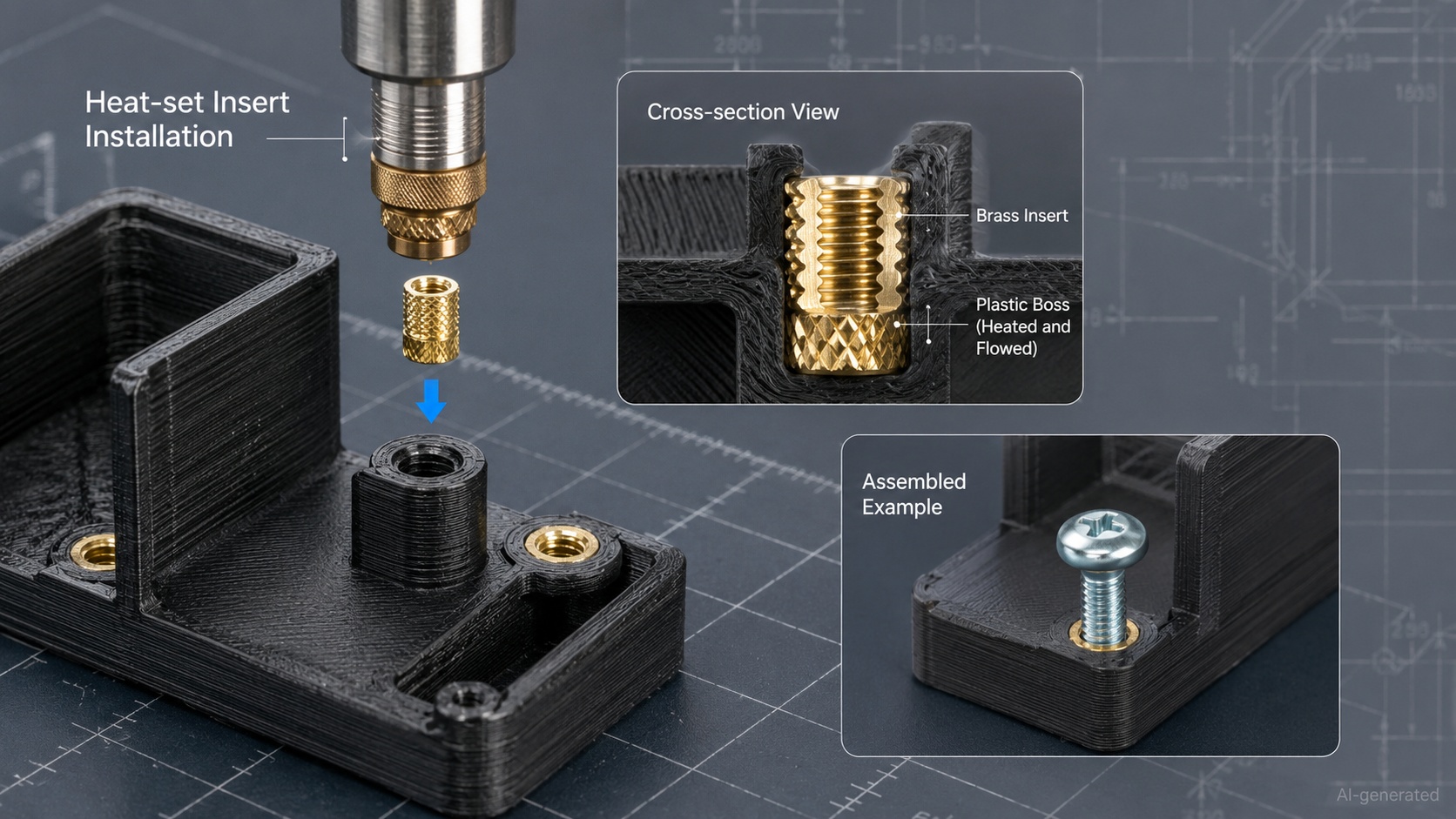
3D Printing Design Tips
For 3D printed parts with threaded inserts:
· Add enough wall thickness around the insert.
· Use a proper boss instead of a thin wall.
· Make the hole slightly deeper than the insert length.
· Test hole size with the actual printer and filament.
· Use enough infill or local reinforcement near the boss.
· Install the insert straight.
· Avoid overheating the plastic.
Print orientation also matters. If the insert is loaded in a direction that separates layer lines, the boss may fail even if the insert itself is installed correctly.
7. Threaded Inserts in Mechatronic Assemblies
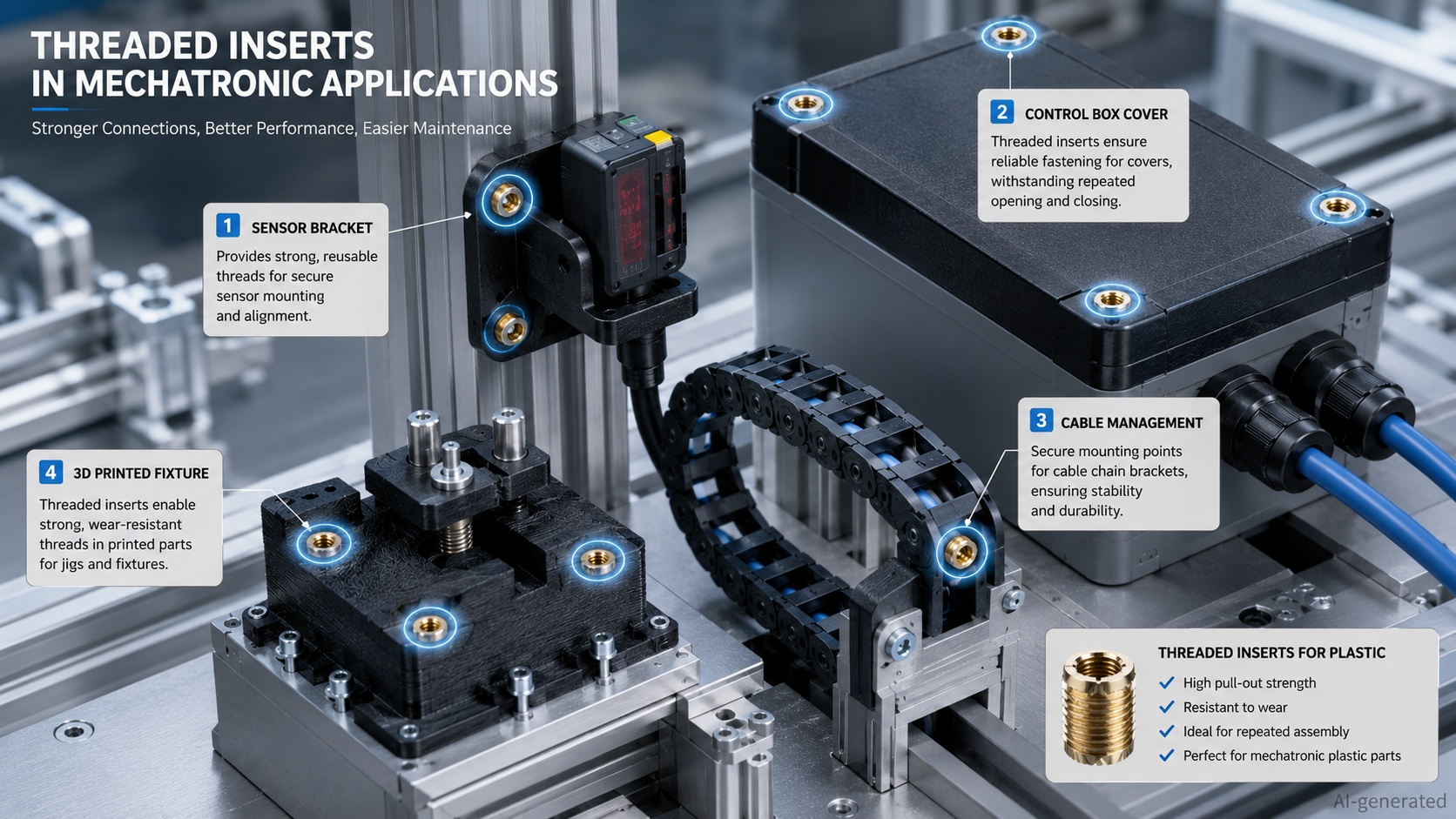
Threaded inserts for plastic are not limited to consumer products or simple enclosures. They are also useful in mechatronic assemblies, where plastic parts often work together with metal frames, sensors, PCBs, motors, cables, and motion components.
In these systems, plastic parts are often used for three main purposes:
Protective Structures
Plastic covers and housings protect electronics, wiring, sensors, and moving mechanisms. Threaded inserts allow these covers to be removed during inspection or maintenance without damaging the plastic threads.
Mounting and Positioning Parts
Plastic brackets, sensor holders, and lightweight fixtures may need screws for adjustment or replacement. Inserts improve the durability of these fastening points, especially when the part is adjusted during commissioning.
Prototype and Test Fixtures
3D printed plastic fixtures are common in early-stage machine design. Threaded inserts make these parts easier to assemble, disassemble, and reuse during testing.
For example, an M3 heat-set insert may be used in a printed sensor bracket, while an M4 insert may be used in a plastic control box cover. A larger M5 insert may be used in a cable clamp base or lightweight fixture.
JLCMC offers threaded inserts and related fastening components for mechanical and mechatronic assemblies, including screws, washers, brackets, and other supporting hardware. When choosing parts for plastic housings or 3D printed prototypes, the insert should be selected according to material, installation method, screw size, and load direction rather than thread size alone.
8. Choosing the Right Insert for Plastic
Choosing the right insert starts with the material and production method.
Ask these questions before selection:
1.Is the plastic thermoplastic or thermoset?
2.Is the part 3D printed, machined, or injection molded?
3.Will the screw be removed repeatedly?
4.What screw size will be used?
5.Is the main load pull-out, torque, shear, or vibration?
6..Is the hole blind or through?
7.What installation method is available?
8.How much wall thickness is available around the insert?
9.Does the insert need to sit flush or below the surface?
10.Is the part a prototype, production part, or serviceable component?
A practical selection guide:
| Application Condition | Common Insert Choice | Notes |
| FDM 3D printed thermoplastic part | Heat-set insert | Good for prototypes and repeated assembly |
| Injection-molded thermoplastic housing | Heat-set, ultrasonic, or molded-in insert | Depends on volume and production process |
| Thermoset plastic part | Press-in, molded-in, or self-tapping insert | Heat-set installation is usually unsuitable |
| Low-volume plastic fixture | Self-tapping or press-fit insert | Pilot hole control is critical |
| Serviceable plastic cover | Heat-set or ultrasonic insert | Useful for repeated opening and closing |
| Lightweight bracket or holder | Heat-set or press-fit insert | Check pull-out and torque requirements |
The right insert is not simply the one that matches the screw size. It must match the plastic material, geometry, installation process, and service life.
9. Common Sizes for Plastic Threaded Inserts
Threaded inserts for plastic are available in many sizes. In compact mechanical, electronic, and mechatronic assemblies, the most common metric sizes are M2.5, M3, M4, M5, and M6.
| Insert Size | Typical Use in Plastic Parts |
| M2.5 | Small electronics, lightweight covers, compact PCB housings |
| M3 | 3D printed brackets, sensor mounts, small enclosures |
| M4 | Control boxes, medium covers, cable clamp bases |
| M5 | Larger plastic brackets, fixture accessories, handles |
| M6 | Stronger plastic mounts, machine covers, medium-duty accessories |
For 3D printed parts, M3 and M4 are especially common because they offer a good balance between compact size and practical strength.
M5 and M6 inserts can work well, but the printed or molded part must have enough boss diameter, wall thickness, and local reinforcement.
10. Installation Tips for Threaded Inserts in Plastic
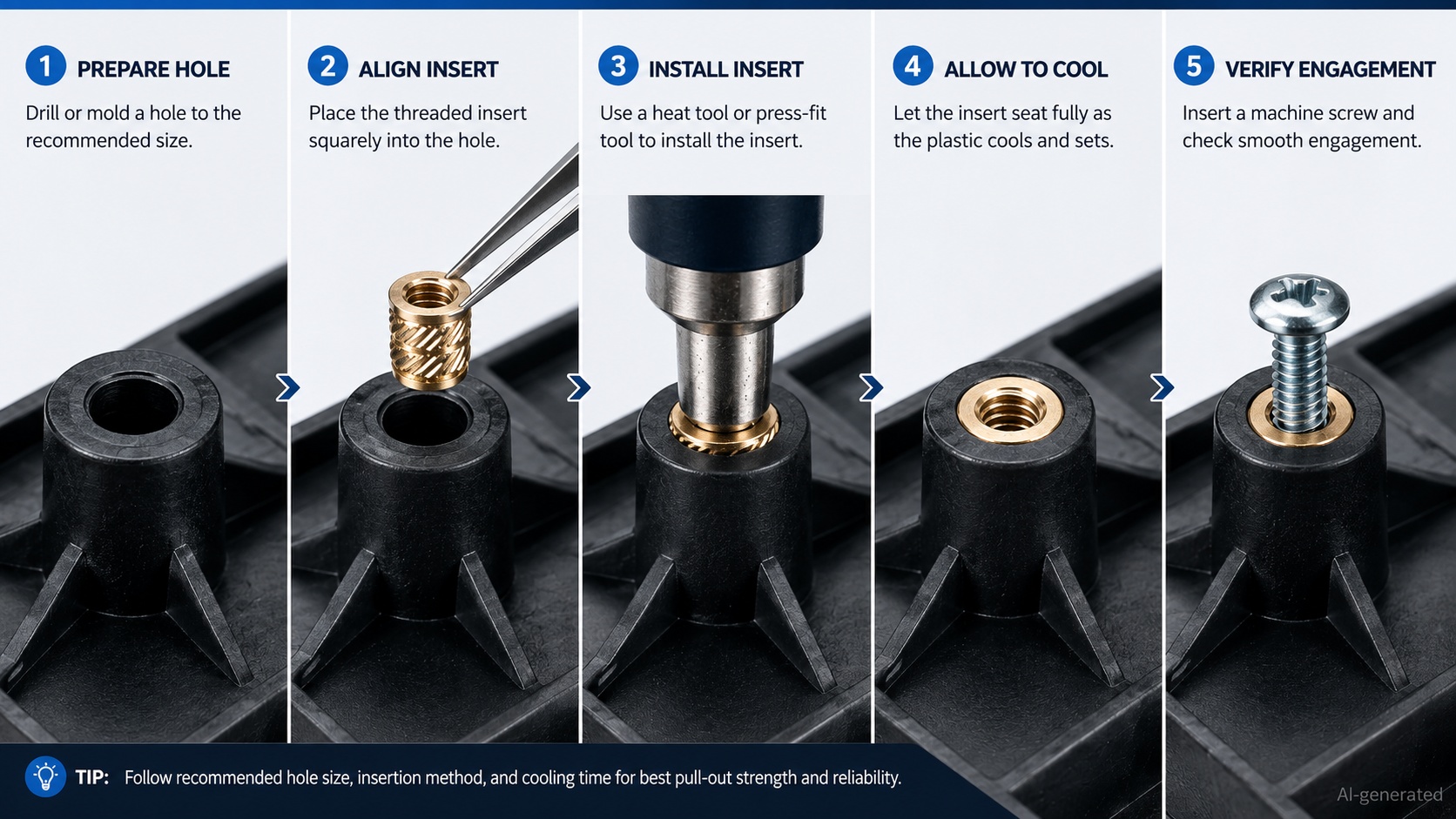
A good insert design still needs proper installation.
Prepare the Hole Correctly
Follow the insert manufacturer’s recommended hole diameter. Do not guess. Hole size affects installation force, pull-out strength, torque resistance, and final alignment.
Keep the Insert Straight
A tilted insert creates screw alignment problems. This is especially noticeable when several screws must align across one cover or bracket.
Control Heat
For heat-set inserts, use enough heat to soften the plastic around the insert, but not so much that the boss collapses or the insert sinks too far.
Let the Plastic Cool
After installing a heat-set insert, allow the plastic to cool before tightening the screw. Tightening too early may disturb the softened material around the insert.
Avoid Over-Tightening
The insert is metal, but the surrounding plastic is still plastic. Excessive screw torque can crack the boss or damage the part.
Test Before Production
Test the insert in the actual material and geometry. A flat test coupon is useful, but the real boss shape, wall thickness, and load direction matter more.
11. Common Mistakes to Avoid
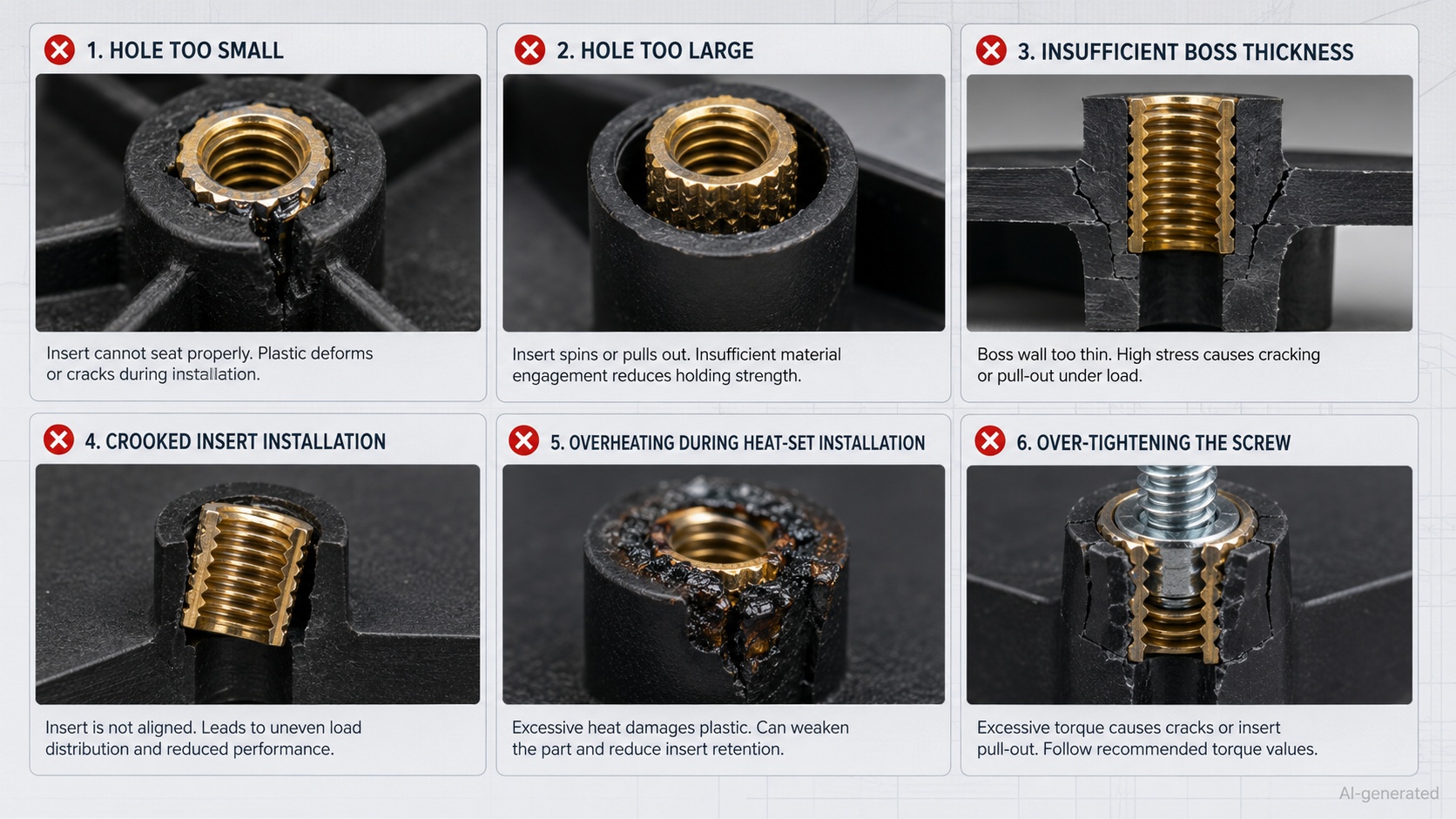
Threaded inserts for plastic often fail for predictable reasons.
Choosing the Wrong Insert Type
A heat-set insert may work well in thermoplastic but not in thermoset material. A press-fit insert may fail in a thin unsupported boss. A self-tapping insert may crack brittle plastic.
Poor Boss Design
Thin walls, weak ribs, sharp corners, and insufficient material around the insert can all reduce strength.
Incorrect Hole Size
This is one of the most common causes of failure. Hole size affects installation force, torque resistance, pull-out strength, and final alignment.
Overheating the Insert
Too much heat can deform the part. In 3D printed parts, excessive heat can also weaken the material around the boss.
Ignoring Load Direction
Pull-out load, torque load, shear load, and vibration affect the insert differently. The boss and insert location should be designed around the real load path.
Treating Plastic Like Metal
A metal insert improves the thread, but it does not make the surrounding plastic behave like aluminum or steel. The plastic structure still sets the real strength limit.
12. Threaded Inserts vs Screws Directly Into Plastic
Sometimes a screw driven directly into plastic is enough. For simple, low-load, one-time assembly products, thread-forming screws for plastic may be practical.
Threaded inserts are usually better when:
· The screw will be removed repeatedly.
· The part needs professional serviceability.
· The joint must hold higher torque.
· The plastic part is expensive or difficult to replace.
· The assembly uses machine screws.
· The component is part of a fixture, prototype, or automation system.
· Long-term reliability matters.
A simple rule is useful:
For low-load, non-serviceable plastic assemblies, a direct thread-forming screw may be sufficient.
If the screw needs to come out and go back in, use a threaded insert.
13. FAQ: Threaded Inserts for Plastic
What are threaded inserts for plastic?
Threaded inserts for plastic are metal inserts installed into plastic parts to create strong, reusable internal threads for screws or bolts.
What is the best threaded insert for 3D printed parts?
Heat-set threaded inserts are commonly used for FDM 3D printed thermoplastic parts because they are easy to install and provide durable metal threads.
Can threaded inserts be used in all plastics?
No. Insert selection depends on whether the material is thermoplastic or thermoset, as well as the part geometry, installation method, and load requirements.
Are heat-set inserts good for plastic?
Heat-set inserts are suitable for many thermoplastics. They are especially common in 3D printed parts and molded thermoplastic housings.
What is the difference between heat-set and press-fit inserts?
Heat-set inserts use heat to soften the plastic and embed the insert. Press-fit inserts are pushed into a prepared hole and rely on mechanical interference or external features to stay in place.
Can I use threaded inserts in PLA, PETG, or ABS?
Yes, heat-set inserts are commonly used in PLA, PETG, ABS, nylon, and other thermoplastic 3D printing materials. The correct temperature, hole size, and boss geometry should be tested for each material.
Do threaded inserts make plastic parts stronger?
They make the threaded connection stronger and more durable, but the surrounding plastic still limits the overall joint strength.
What screw sizes are common for plastic threaded inserts?
M2.5, M3, M4, M5, and M6 are common in electronics, 3D printed parts, plastic housings, and compact mechatronic assemblies.
14. Conclusion
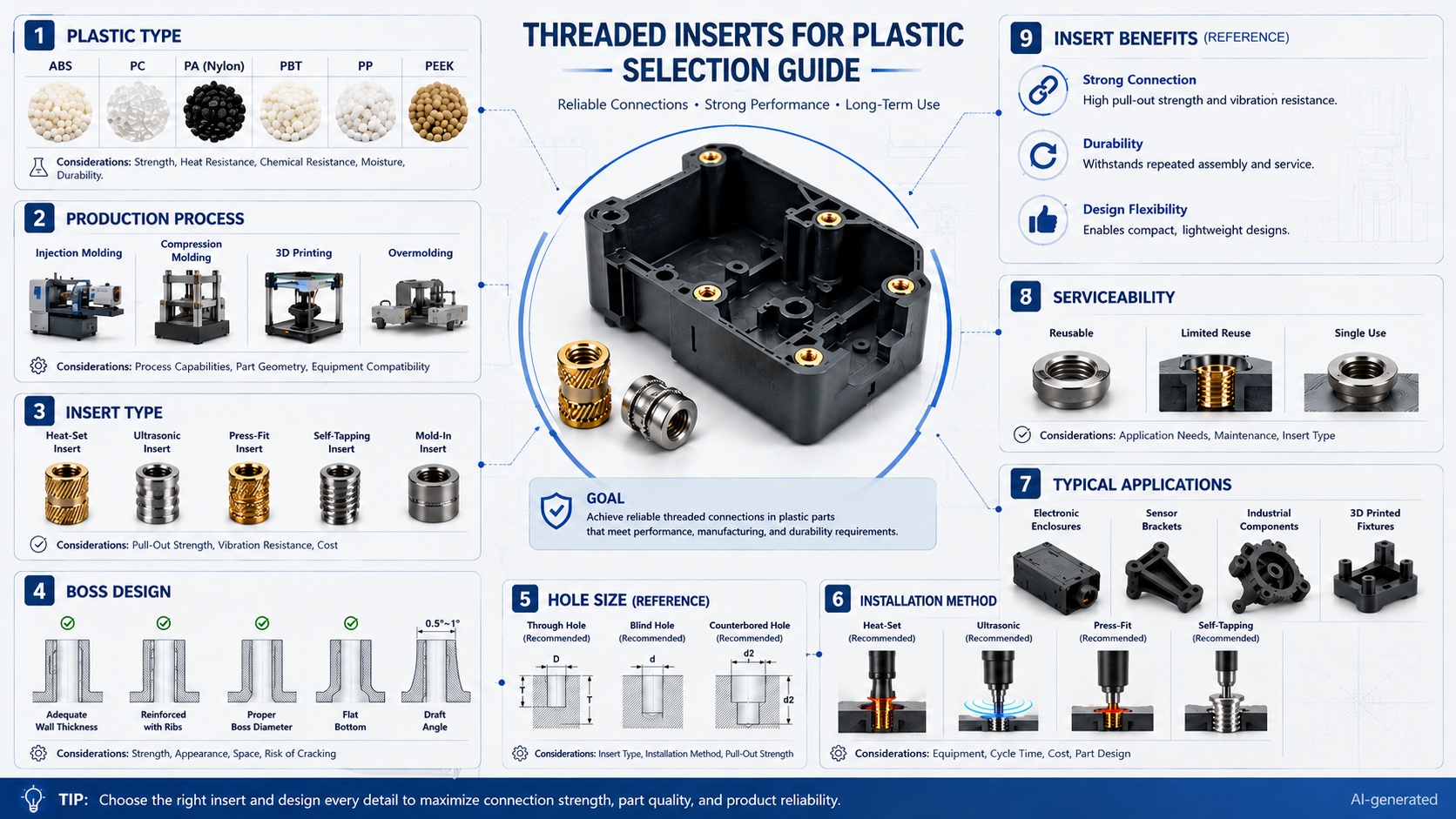
Threaded inserts for plastic solve a common design problem: plastic is excellent for lightweight structures, housings, covers, brackets, and prototypes, but it is not always reliable as a reusable thread material.
By adding a metal threaded insert, designers can create stronger, cleaner, and more serviceable plastic assemblies. Heat-set inserts are a practical choice for many thermoplastic and 3D printed parts. Press-fit inserts are useful when mechanical installation is preferred. Ultrasonic inserts work well in production environments. Molded-in inserts can provide strong performance in injection-molded parts. Self-tapping inserts may be suitable for certain engineering plastics and low-volume applications.
For mechatronic assemblies, threaded inserts help plastic parts survive real use: covers are removed, brackets are adjusted, cables are clamped, and prototypes are revised. The best insert is not simply the one that matches the screw size. It is the one that matches the plastic material, boss design, installation method, load direction, and service life.
Design the boss carefully. Choose the insert wisely. Install it straight. Then let the little metal thread quietly do its job.
Popular Articles
Keep Learning
Threaded Standoff vs Spacer: What Is the Difference?
Key Takeaways Threaded standoffs provide both spacing and threaded attachment points, making them ideal for modular assemblies and PCBs. Spacers are unthreaded sleeves that work with through-bolts to maintain gaps in clamped assemblies, offering a simpler and more economical solution. The right choice depends on the load path, assembly sequence, material, and service environment - not just appearance or catalog naming. A threaded standoff and a spacer can look almost identical on a workbench. Both cre......
How to Choose a Threaded Standoff for PCB and Mechatronic Assemblies
Key Takeaways Select the right configuration: Choose male-female, female-female, or male-male thread configurations based on the two mating interfaces and the intended assembly sequence. Treat height as a tolerance stack: Standoff body length must satisfy clearance, electrical, thermal, and connector requirements across the full tolerance range, not just the nominal dimension. Verify thread engagement: Check male thread length against tapped-hole depth and upper screw length against usable female thre......
Threaded Standoff Guide: Types, Sizes, Materials and Applications
Key Takeaways Thread configuration first: Choose female-female, male-female or male-male based on how both sides of the assembly attach — thread config is the most practical way to classify a threaded standoff. Body length is the critical dimension: Standoff length refers to the distance between supporting faces, not total physical length. Reading the wrong length causes incorrect mounting height or screw bottoming. Material affects more than strength: Brass, stainless steel, carbon steel, aluminum an......
Ball Nose End Mill Stepover: Scallop Height and Effective Diameter
Key Takeaways Geometric Control: Stepover directly controls geometric scallop height, but it does not automatically guarantee a measured Ra value. Cusp Height Formula: For a ball radius $R$ and pass spacing $s$ on a flat surface, the ideal cusp height is $h = R - \sqrt{R^2 - \frac{s^2}{4}}$. Tool Radius Advantage: A larger ball can use wider spacing for the same ideal cusp, provided it can reach the required geometry without gouging. Effective Diameter: The active cutting diameter near the tool tip ca......
Manual SMT Stencil Printer Sizing: Print Area, PCB Support and Frame Fit
Key Takeaways Different dimensions: Worktable size, effective print area, board envelope, and stencil frame size are different dimensions. Check the full pattern: Check the whole aperture pattern in its intended orientation, including clearance for the printing stroke. Thickness is not enough: A compatible board thickness does not prove that a populated underside or a support fixture will fit. Support and contact: Stable support and close stencil-to-board contact are necessary for a repeatable printin......
Blind Rivet Guide: Types, Sizes, Uses, Installation and Removal
A blind rivet may be small, but choosing one correctly involves more than matching a rivet to the nearest drill bit. The diameter, grip range, hole size, body material, mandrel material, head style and installation tool all influence the finished joint. A rivet that looks perfectly acceptable before installation can still spin, loosen, pull through the sheet or form incorrectly on the blind side if one of these factors is overlooked. Blind rivets are widely used in sheet-metal fabrication, electrical ......