Snap Rings in Mechatronics: Types, Uses, Comparisons, and Removal Tips
11 min
- 1. What Are Snap Rings?
- 2. Why Snap Rings Matter in Mechatronics
- 3. Common Types of Snap Rings
- 4. Snap Ring Materials
- 5. Snap Rings vs. Other Retaining Products
- 6. Snap Rings vs. Shaft Collars
- 7. Snap Rings vs. Locknuts and Set Screws
- 8. Where Snap Rings Are Used in JLCMC-Type Applications
- 9. How to Choose the Right Snap Ring
- 10. How to Remove Snap Rings Safely
- 11. Common Snap Ring Problems
- 12. FAQ About Snap Rings
- Conclusion
In mechatronic assemblies, small parts often carry big responsibilities. Motors drive motion, sensors provide feedback, and controllers make decisions, but something still has to keep bearings, pulleys, gears, rollers, and spacers from moving out of place.
That small but important part is often a snap ring.
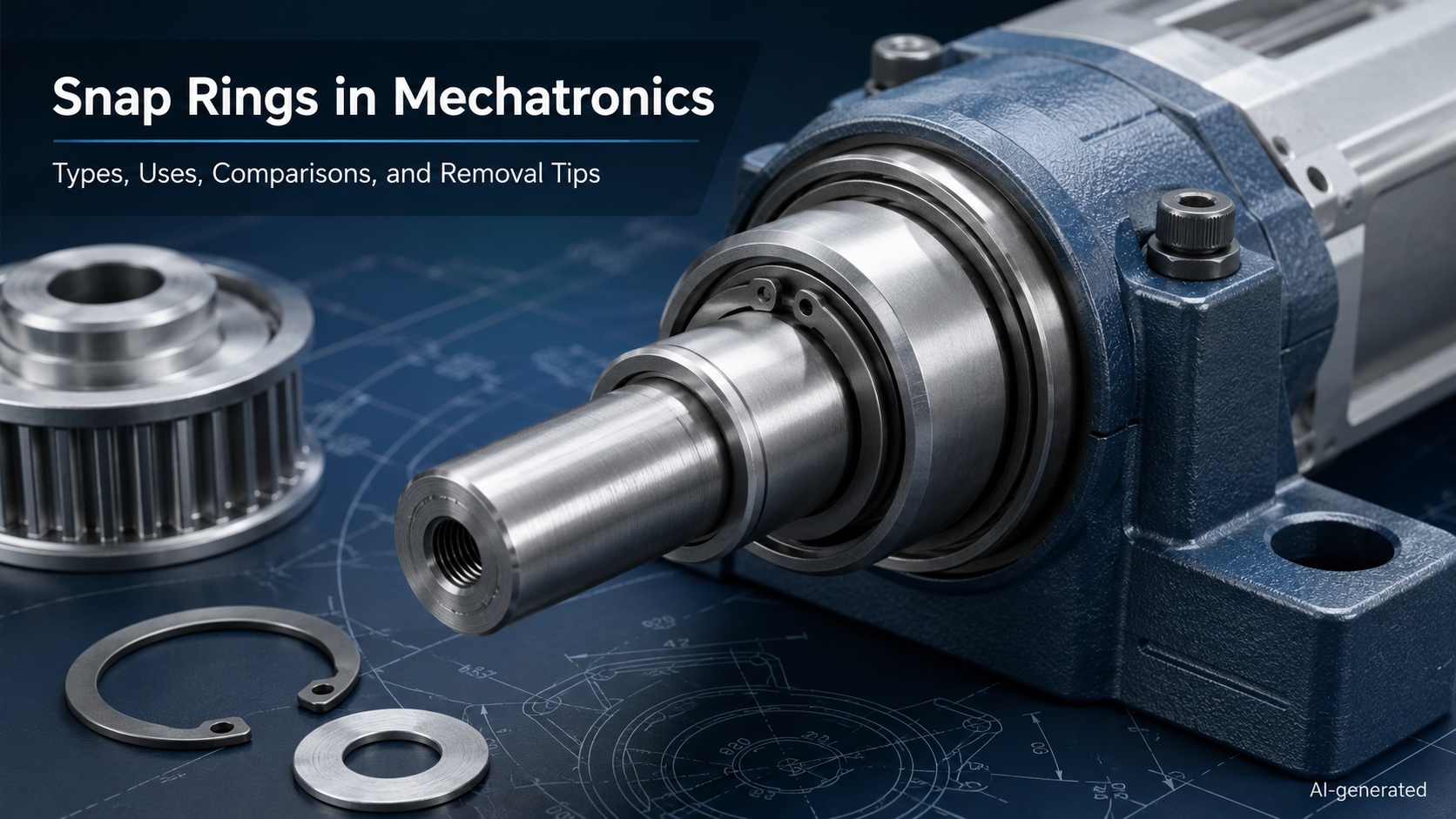
Snap rings, also called retaining rings or circlips, are compact fastening components used to control axial movement on shafts or inside bores. They fit into grooves and act as mechanical stops, helping parts stay exactly where they should.
For automation equipment builders, mechanical engineers, maintenance teams, and sourcing specialists, snap rings are practical, low-profile components that support reliable machine design without adding unnecessary bulk.
1. What Are Snap Rings?
A snap ring is a circular spring-like retaining part installed in a groove. Once seated, it prevents another component from sliding along a shaft or moving out of a housing.
There are two main types:
External snap rings are installed on shafts. They retain parts such as bearings, gears, pulleys, rollers, and spacers.
Internal snap rings are installed inside bores or housings. They are commonly used to hold bearings, bushings, sleeves, and seals in place.
In simple terms, a snap ring tells nearby parts: “You may rotate, but you may not escape.”
Snap rings are widely used because they are compact, lightweight, affordable, and suitable for many standardized mechanical designs.
2. Why Snap Rings Matter in Mechatronics
Mechatronic systems combine mechanical structure, motion control, electronics, sensors, and automation. Even if the control system is accurate, poor mechanical retention can still cause vibration, misalignment, noise, or premature wear.
Snap rings are commonly used in:
· Servo motor shaft assemblies
· Stepper motor structures
· Bearing housings
· Gearboxes
· Conveyor rollers
· Timing pulley systems
· Linear actuators
· Ball screw support assemblies
· Robotic joints
· Pneumatic mechanisms
For JLCMC’s typical users, snap rings are often selected together with linear shafts, bearings, couplings, timing pulleys, screws, washers, spacers, bushings, and other mechanical components.
3. Common Types of Snap Rings
External Snap Rings
External snap rings are used on shafts. They fit into an external groove and prevent parts from moving outward.
Typical uses include retaining bearings, pulleys, gears, spacers, and conveyor rollers.
A common standard is DIN 471, which refers to external retaining rings for shafts.
Internal Snap Rings
Internal snap rings are used inside bores. They fit into an internal groove and prevent bearings, sleeves, or bushings from moving out of the housing.
A common standard is DIN 472, which refers to internal retaining rings for bores.
E-Type Snap Rings
E-type snap rings, also known as E-clips, are installed from the side of a shaft. They are useful when shaft-end access is limited.
They are often used in small linkages, sensor brackets, compact actuator mechanisms, pin retention, and light-duty pivot joints.
C-Type Snap Rings
C-type snap rings are among the most common retaining rings. They usually have lug holes for snap ring pliers and are available for both shaft and bore applications.
They are practical for general machinery, automation systems, bearing supports, and transmission assemblies.
4. Snap Ring Materials
Snap rings are usually made from materials with good elasticity and strength.
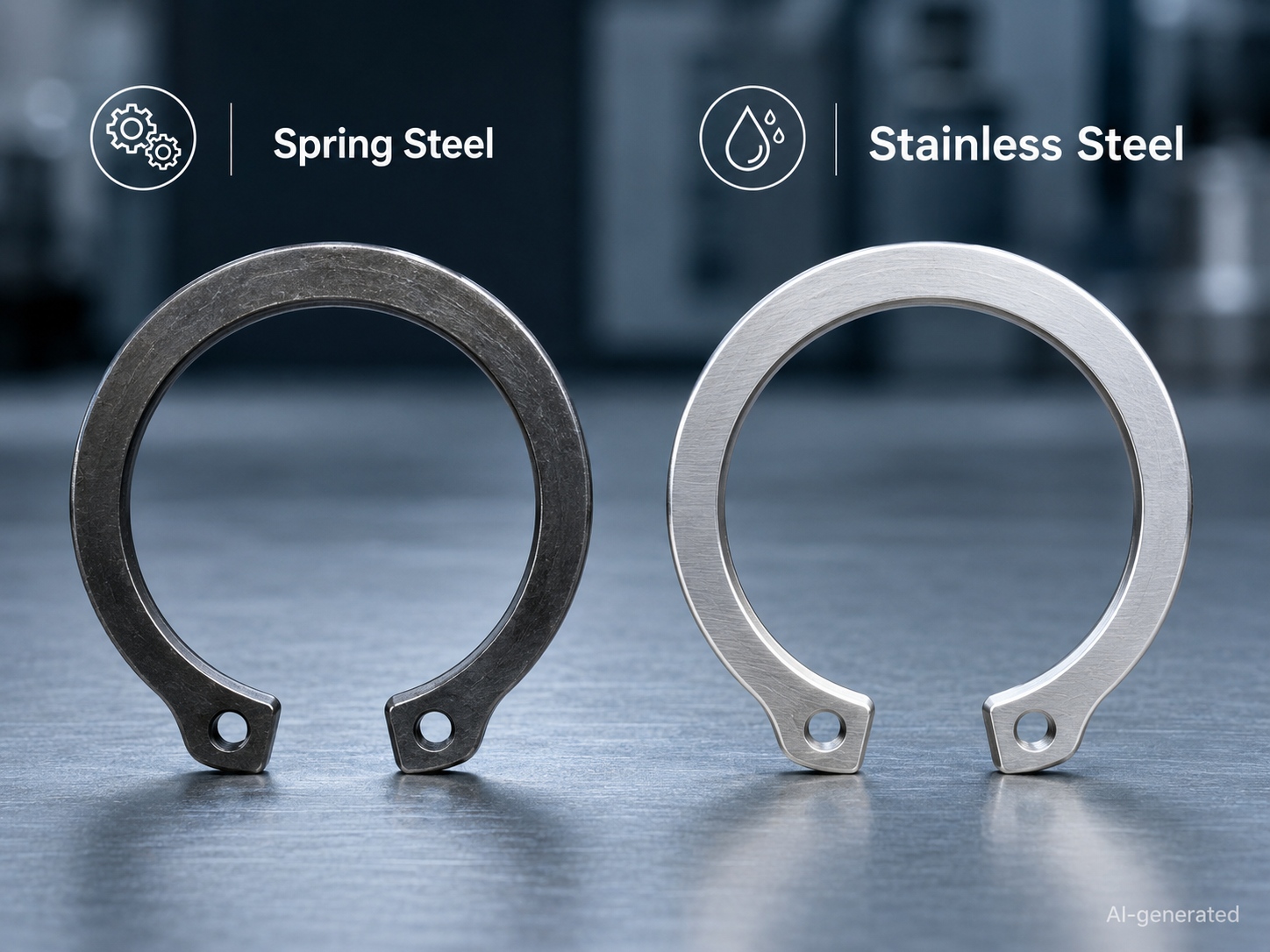
Spring steel is common for general industrial use. It offers good holding force and cost efficiency, making it suitable for automation equipment, fixtures, conveyors, and mechanical transmission systems.
Stainless steel is preferred when corrosion resistance is important. It is suitable for humid environments, outdoor equipment, laboratory devices, and machines exposed to cleaning processes.
Surface treatments such as blackening or phosphate coating may also be used to improve corrosion resistance or appearance.
When choosing material, consider operating environment, load, humidity, maintenance frequency, and cost.
5. Snap Rings vs. Other Retaining Products
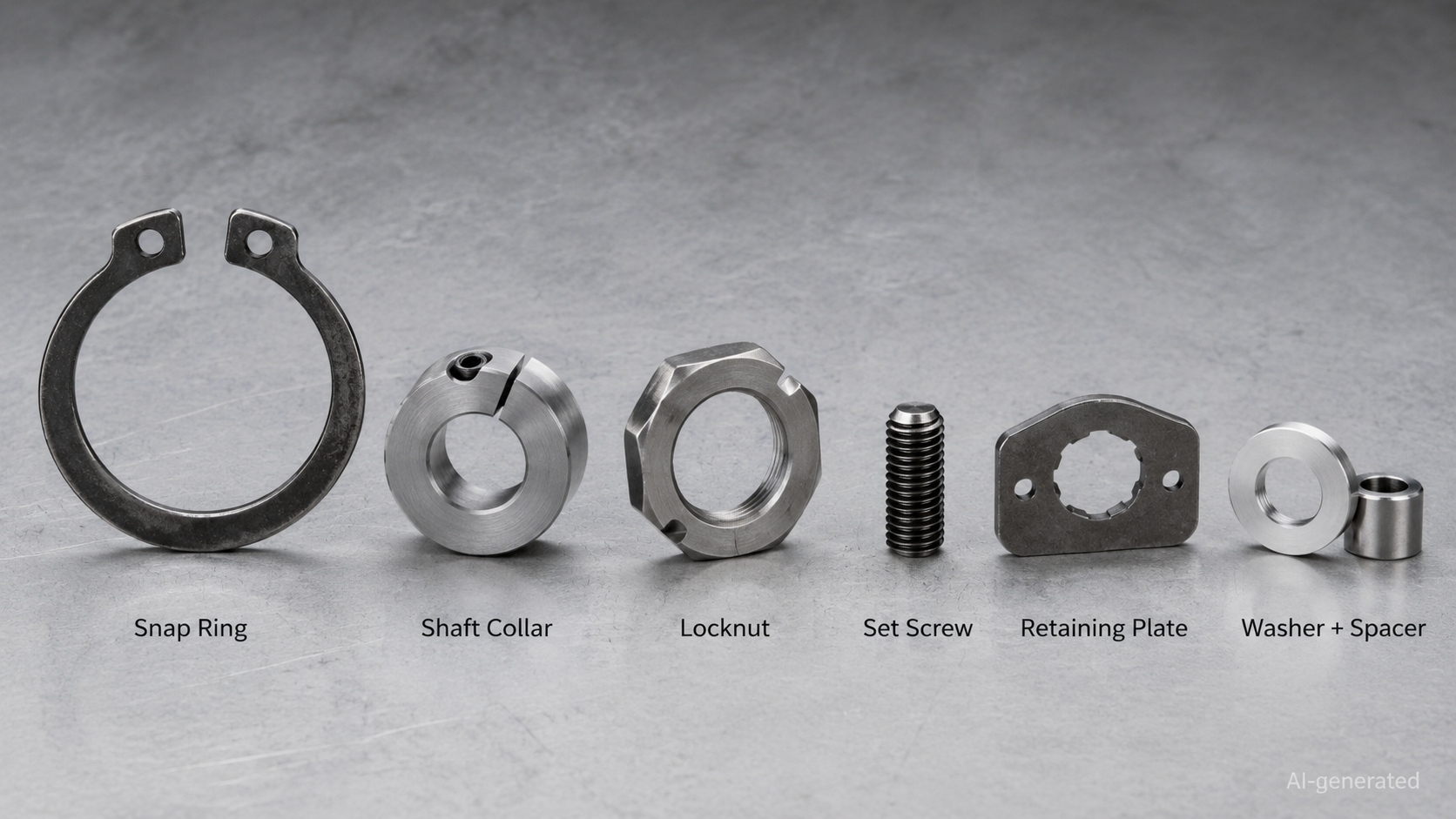
Snap rings are useful, but they are not the only option. Engineers often compare them with shaft collars, locknuts, set screws, retaining plates, cotter pins, washers, and spacers.
| Product | Best For | Advantages | Limitations |
| Snap Rings | Compact axial retention | Small, lightweight, cost-effective | Requires groove machining |
| Shaft Collars | Adjustable shaft positioning | Easy to adjust, no groove needed | Larger than snap rings |
| Locknuts | Bearing preload, high axial force | Strong clamping | Requires threaded shaft |
| Set Screws | Locking hubs or pulleys rotationally | Simple and low cost | May damage shaft surface |
| Retaining Plates | Heavy-duty housing retention | Strong and stable | Requires screws and more space |
| Cotter Pins / R-Clips | Removable pin retention | Easy to remove | Less precise axial control |
| Washers / Spacers | Clearance and spacing control | Simple and useful | Need another retaining method |
6. Snap Rings vs. Shaft Collars
Snap rings and shaft collars both help control axial movement, but they are used differently.
A snap ring is better when the position is fixed and space is limited. It sits inside a groove and creates a compact axial stop.
A shaft collar is better when the position may need adjustment. It clamps onto the shaft and can be moved during setup or maintenance.
Choose snap rings when you need compactness, repeatability, and production consistency. Choose shaft collars when you need adjustability and easier repositioning.
For example, a conveyor roller may use snap rings to save space, while a prototype test fixture may use shaft collars for quick adjustment.
7. Snap Rings vs. Locknuts and Set Screws
A locknut is often used when strong axial clamping or bearing preload is required. It is common in ball screw support assemblies, bearing supports, and threaded shaft structures.
A snap ring is simpler and more compact, but it does not provide the same preload control as a locknut.
A set screw is used to lock a component rotationally onto a shaft, such as a pulley or hub. However, set screws can leave marks on the shaft surface.
Snap rings are better for axial retention. Set screws are better for rotational locking. In many assemblies, both may be used together.
For example, a timing pulley may use a set screw to prevent rotation, while a snap ring or shaft shoulder controls axial movement.
8. Where Snap Rings Are Used in JLCMC-Type Applications
Snap rings are especially useful in automation and mechanical assemblies where compact structure and stable positioning are important.
Linear Motion Systems
In linear shafts, ball screws, linear actuators, and bearing support structures, snap rings may help retain bearings or spacers. If a bearing shifts, the system may lose alignment and generate extra friction or noise.
Transmission Components
In shaft couplings, timing pulleys, gears, and conveyor rollers, snap rings help keep rotating parts aligned. This improves belt tracking, reduces vibration, and supports stable motion.
Bearing Assemblies
Snap rings are often used to secure bearings inside housings or on shafts. Common compact bearing models used in small automation assemblies include 608ZZ, 6000ZZ, 6001ZZ, 6002ZZ, 6200ZZ, 6201ZZ, 6900ZZ, 6901ZZ, and 6902ZZ.
Pneumatic and Robotic Mechanisms
Small snap rings and E-clips are often used in robotic joints, grippers, pneumatic linkages, and compact pivot structures. They provide simple retention without adding bulky hardware.
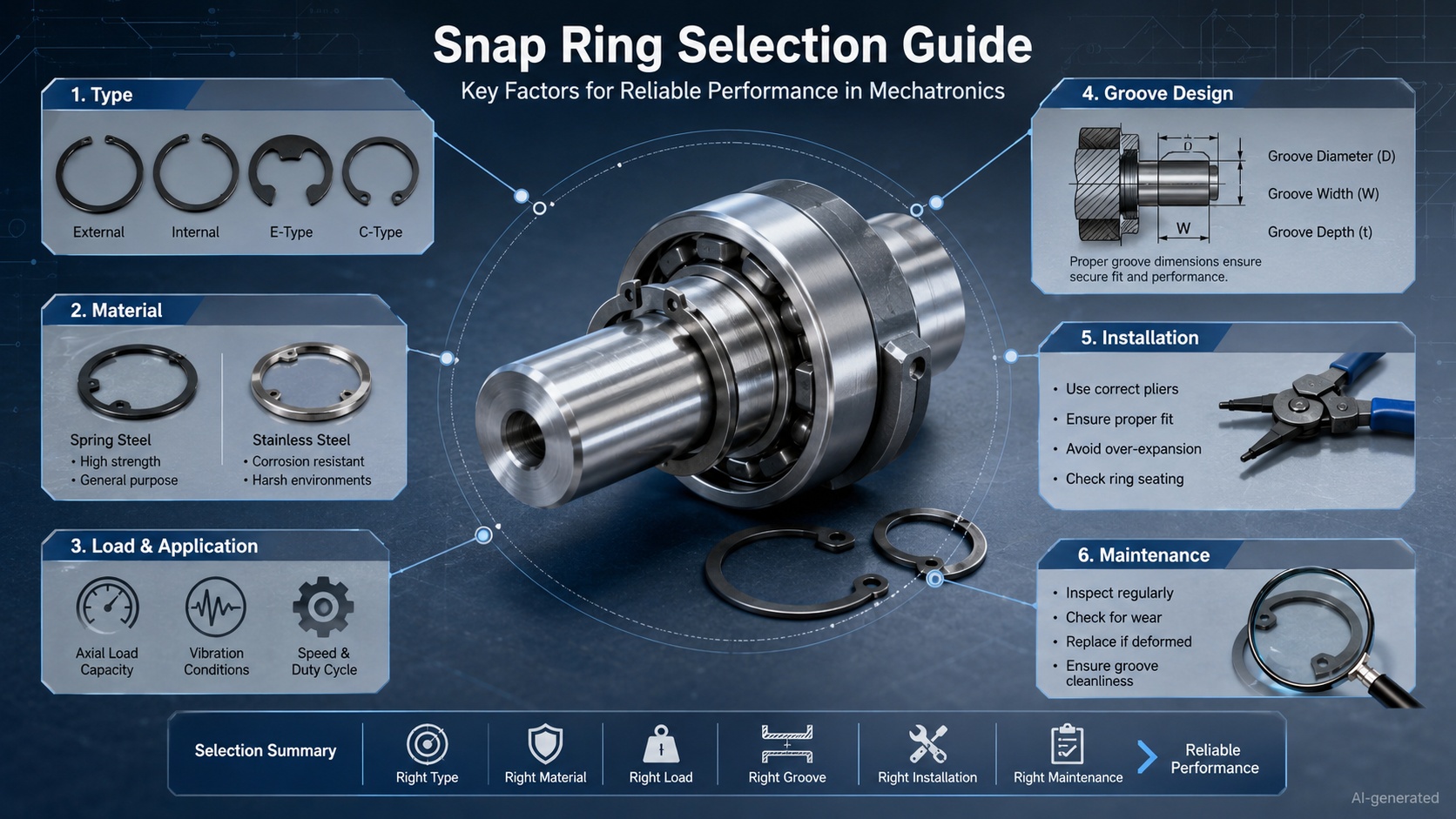
9. How to Choose the Right Snap Ring
Choosing a snap ring is not just about matching the shaft size. A reliable selection should consider the whole assembly.
First, decide whether you need an external snap ring for a shaft or an internal snap ring for a bore.
Next, check the standard. For many metric applications, DIN 471 is used for external shaft retaining rings, while DIN 472 is used for internal bore retaining rings.
Then confirm the groove dimensions. Groove width, depth, and diameter must match the retaining ring. A ring may fit the shaft but still fail if the groove is incorrect.
Also consider axial load. Snap rings are suitable for many compact retaining tasks, but high-load structures may need a locknut, retaining plate, shaft shoulder, or combined retaining method.
Finally, choose the right material. Spring steel is practical for general machinery, while stainless steel is better for humid or corrosion-prone environments.
10. How to Remove Snap Rings Safely
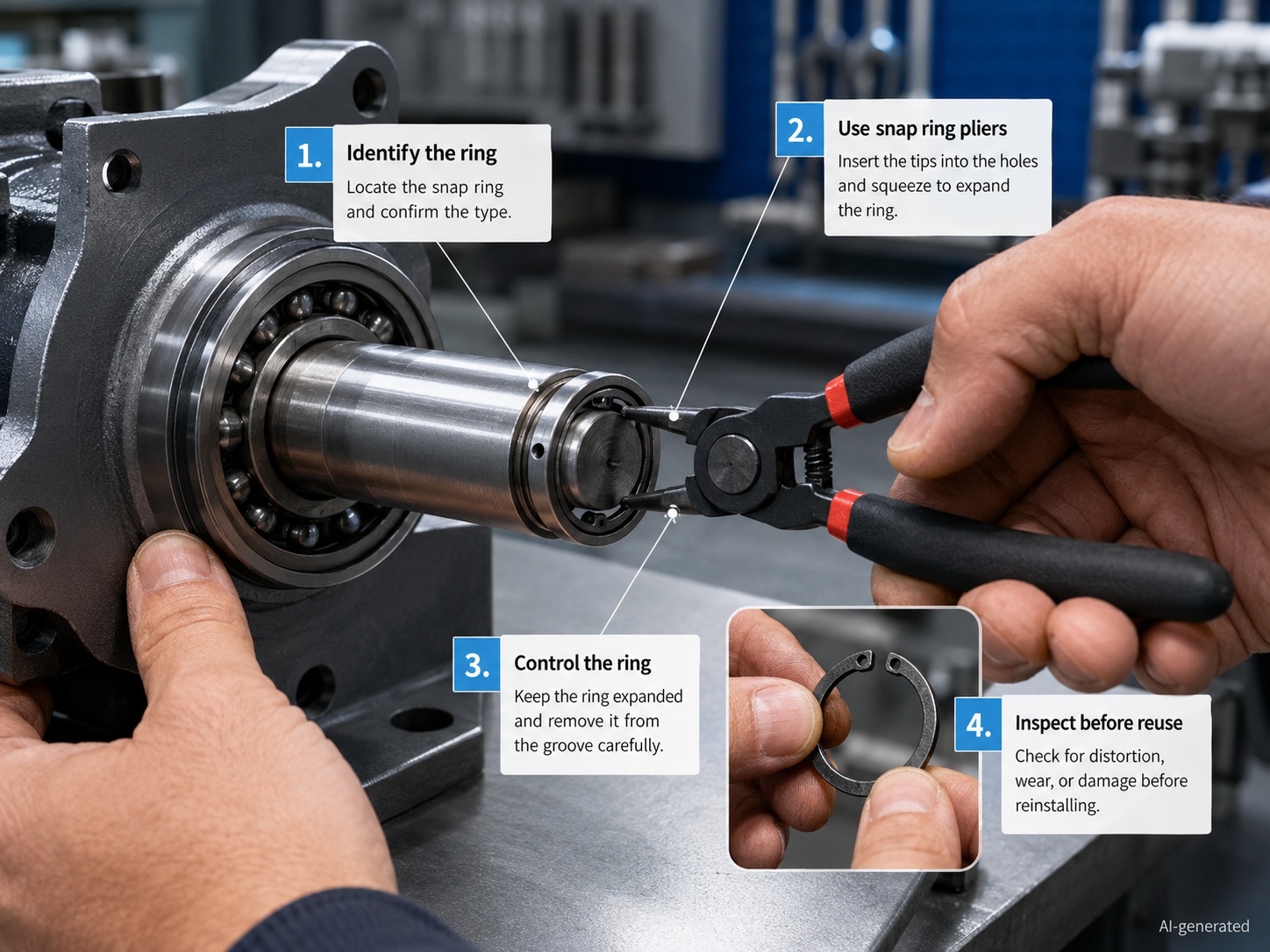
Removing snap rings is simple when the right tool is used, but careless removal can damage the ring, shaft, groove, or surrounding parts.
Step 1: Identify the Ring Type
Check whether the snap ring is external or internal.
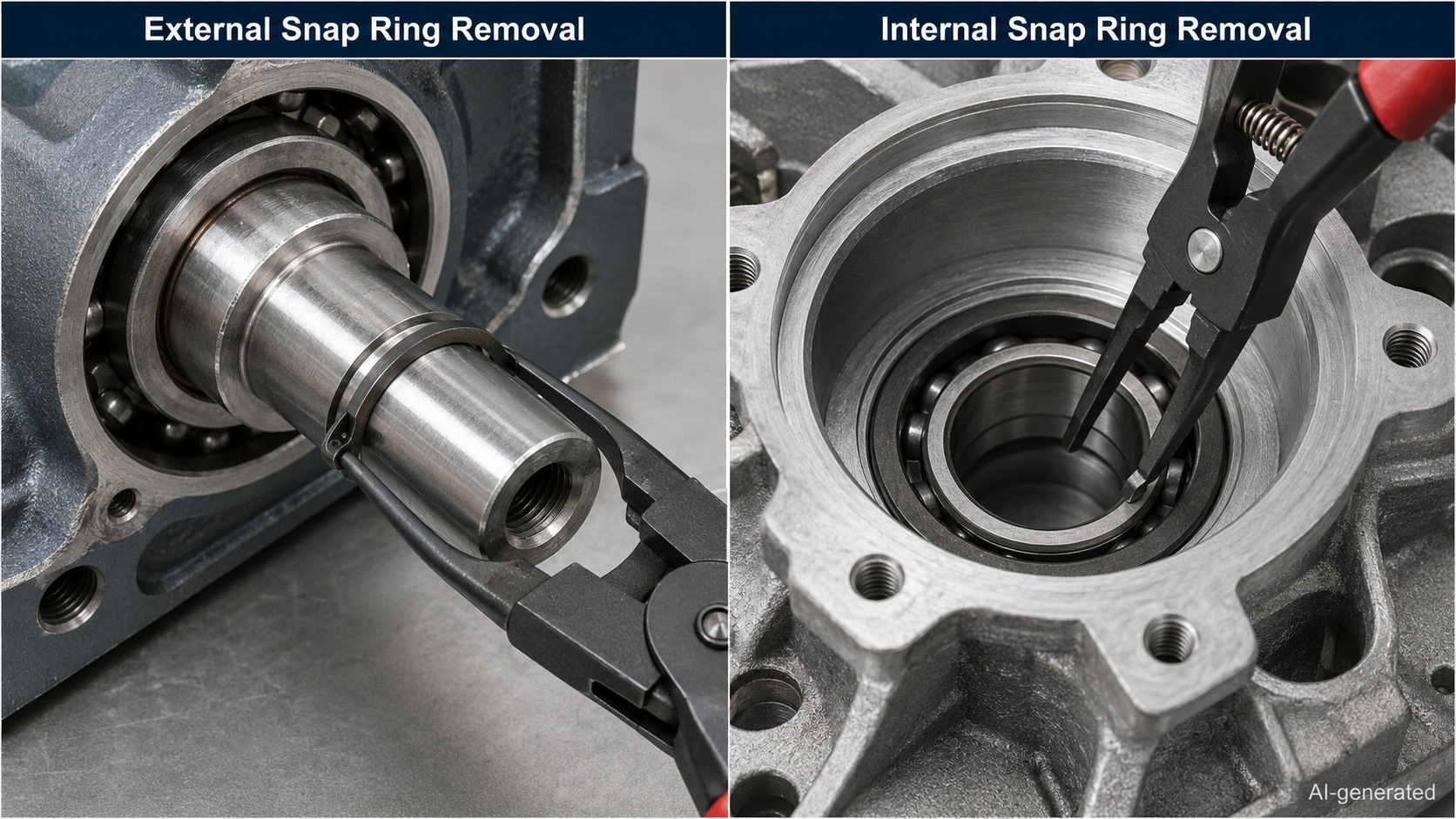
An external snap ring sits on a shaft and usually needs to be expanded for removal.
An internal snap ring sits inside a bore and usually needs to be compressed for removal.
Step 2: Use Proper Snap Ring Pliers
Use dedicated snap ring pliers with tips that fit the ring holes.
For external rings, use pliers that expand the ring.
For internal rings, use pliers that compress the ring.
Avoid using screwdrivers unless there is no better option. A screwdriver may slip, scratch the shaft, deform the ring, or send the ring flying across the workshop. Snap rings are small, but they have dramatic personalities.
Step 3: Control the Ring During Removal
Do not overexpand or overcompress the ring. Move it only enough to clear the groove.
Keep one hand or a protective cover near the ring to prevent it from springing away. Eye protection is strongly recommended, especially for small E-clips and spring steel rings.
Step 4: Remove the Retained Part Carefully
After removing the snap ring, slide out the retained component slowly. Check whether there are washers, spacers, bearings, or sleeves behind it.
Taking a quick photo before disassembly can help during reassembly.
Step 5: Inspect the Ring and Groove
Before reuse, inspect the snap ring. Replace it if it is bent, overstretched, corroded, worn, or no longer springs back properly.
Also inspect the groove. If the groove is damaged, dirty, or burred, clean or repair it before installing a new ring.
11. Common Snap Ring Problems
The Ring Pops Out
This usually happens because the groove is too shallow, the wrong ring was selected, the axial load is too high, or the ring was not fully seated.
The Ring Deforms
This may happen if the ring is overstretched during installation or overloaded during operation.
The Groove Wears Out
Vibration, impact, or repeated axial movement can wear the groove shoulder.
Corrosion Appears
Moisture, chemicals, or unsuitable materials can cause corrosion and reduce ring strength.
The Wrong Retaining Method Was Used
Sometimes a snap ring is not the best solution. High-load applications may need locknuts or retaining plates. Adjustable positions may need shaft collars. Removable pin joints may need cotter pins or R-clips.
Good design means choosing the right retaining method, not forcing one product to solve every problem.
12. FAQ About Snap Rings
What is the difference between a snap ring and a retaining ring?
The terms are often used interchangeably. “Snap ring” is common in assembly language, while “retaining ring” is common in catalogs and engineering documentation. “Circlip” is another common term.
What is the difference between DIN 471 and DIN 472?
DIN 471 is used for external retaining rings on shafts. DIN 472 is used for internal retaining rings in bores.
Are snap rings better than shaft collars?
Snap rings are better for compact fixed retention. Shaft collars are better when the position needs to be adjustable.
Can snap rings replace locknuts?
Not always. Snap rings are compact and simple, but locknuts are better for high axial loads and bearing preload control.
Can snap rings be reused?
Sometimes, but only if they are not bent, worn, corroded, or overstretched. For important assemblies, replacement is usually safer.
What tools are needed to remove snap rings?
Snap ring pliers are recommended. External and internal snap rings require different plier actions.
Conclusion
Snap rings may be small, but they play an important role in mechatronic assemblies. They help retain bearings, pulleys, gears, rollers, spacers, pins, and other mechanical components in the correct axial position.
Compared with shaft collars, snap rings are more compact. Compared with locknuts, they are faster and simpler to install. Compared with retaining plates, they save space. Compared with set screws, they avoid direct point pressure on the shaft. Compared with cotter pins, they provide more precise axial retention for shaft and bore applications.
However, snap rings are not suitable for every retaining task. High-load bearing assemblies may need locknuts. Adjustable setups may need shaft collars. Heavy housings may need retaining plates. Serviceable pin joints may need cotter pins or R-clips.
For automation equipment builders, mechanical engineers, maintenance teams, and industrial sourcing specialists, understanding snap rings helps improve compactness, reliability, assembly efficiency, and maintenance convenience.
In short, do not underestimate the snap ring. It may be thin, quiet, and easy to overlook, but in a well-designed mechatronic system, it often keeps everything exactly where it belongs.
Popular Articles
Keep Learning
Threaded Standoff Guide: Types, Sizes, Materials and Applications
Key Takeaways Thread configuration first: Choose female-female, male-female or male-male based on how both sides of the assembly attach — thread config is the most practical way to classify a threaded standoff. Body length is the critical dimension: Standoff length refers to the distance between supporting faces, not total physical length. Reading the wrong length causes incorrect mounting height or screw bottoming. Material affects more than strength: Brass, stainless steel, carbon steel, aluminum an......
How to Choose a Threaded Standoff for PCB and Mechatronic Assemblies
Key Takeaways Select the right configuration: Choose male-female, female-female, or male-male thread configurations based on the two mating interfaces and the intended assembly sequence. Treat height as a tolerance stack: Standoff body length must satisfy clearance, electrical, thermal, and connector requirements across the full tolerance range, not just the nominal dimension. Verify thread engagement: Check male thread length against tapped-hole depth and upper screw length against usable female thre......
Drawer Slide Selection Guide for Equipment Trays: Sizing, Load Calculation & Locking
Key Takeaways Gross Load First: Calculate the moving assembly's gross load, including the tray, brackets, equipment and attached accessories. Travel, Not Rail Length: Specify the actual travel needed for service access; nominal rail length alone does not establish that travel. Know Your Lock: Distinguish a positive lock, a detent, a soft-close feature and a disconnect mechanism. Three Independent Checks: Treat slide capacity, mounting-bracket strength and cabinet tipping resistance as separate checks.......
Threaded Standoff vs Spacer: What Is the Difference?
Key Takeaways Threaded standoffs provide both spacing and threaded attachment points, making them ideal for modular assemblies and PCBs. Spacers are unthreaded sleeves that work with through-bolts to maintain gaps in clamped assemblies, offering a simpler and more economical solution. The right choice depends on the load path, assembly sequence, material, and service environment - not just appearance or catalog naming. A threaded standoff and a spacer can look almost identical on a workbench. Both cre......
Ball Nose End Mill Stepover: Scallop Height and Effective Diameter
Key Takeaways Geometric Control: Stepover directly controls geometric scallop height, but it does not automatically guarantee a measured Ra value. Cusp Height Formula: For a ball radius $R$ and pass spacing $s$ on a flat surface, the ideal cusp height is $h = R - \sqrt{R^2 - \frac{s^2}{4}}$. Tool Radius Advantage: A larger ball can use wider spacing for the same ideal cusp, provided it can reach the required geometry without gouging. Effective Diameter: The active cutting diameter near the tool tip ca......
Manual SMT Stencil Printer Sizing: Print Area, PCB Support and Frame Fit
Key Takeaways Different dimensions: Worktable size, effective print area, board envelope, and stencil frame size are different dimensions. Check the full pattern: Check the whole aperture pattern in its intended orientation, including clearance for the printing stroke. Thickness is not enough: A compatible board thickness does not prove that a populated underside or a support fixture will fit. Support and contact: Stable support and close stencil-to-board contact are necessary for a repeatable printin......