Lock Washer Guide: Types, Placement & Uses in Mechatronics
23 min
- Quick Answer Box
- Introduction
- 1. What Is a Lock Washer?
- 2. How Does a Lock Washer Work?
- 3. Lock Washer Types
- 4. Lock Washer Placement: Where Should It Go?
- 5. How to Use a Lock Washer
- 6. Popular Lock Washer Sizes, Materials, and Finishes
- 7. Lock Washer Applications in Mechatronic Components
- 8. Lock Washer Selection Guide
- 9. Common Mistakes When Using Lock Washers
- 10. Practical FAQ About Lock Washers and Final Takeaway
Quick Answer Box
What is a lock washer?
A lock washer is a washer used with screws, bolts, or nuts to help reduce loosening caused by vibration, repeated motion, thermal expansion, or joint movement.
How does a lock washer work?
A lock washer works by adding spring tension, friction, surface bite, wedge action, or mechanical resistance to the fastened joint.
Where does a lock washer go?
In most cases, a lock washer is placed directly under the nut or bolt head, depending on which side of the fastener is tightened.
How do you use a lock washer?
Choose the correct size and type, place it under the tightening side of the fastener, tighten the joint properly, and inspect it during maintenance.
Common lock washer sizes in mechatronics:
M3, M4, M5, M6, M8, M10, and M12.
Introduction
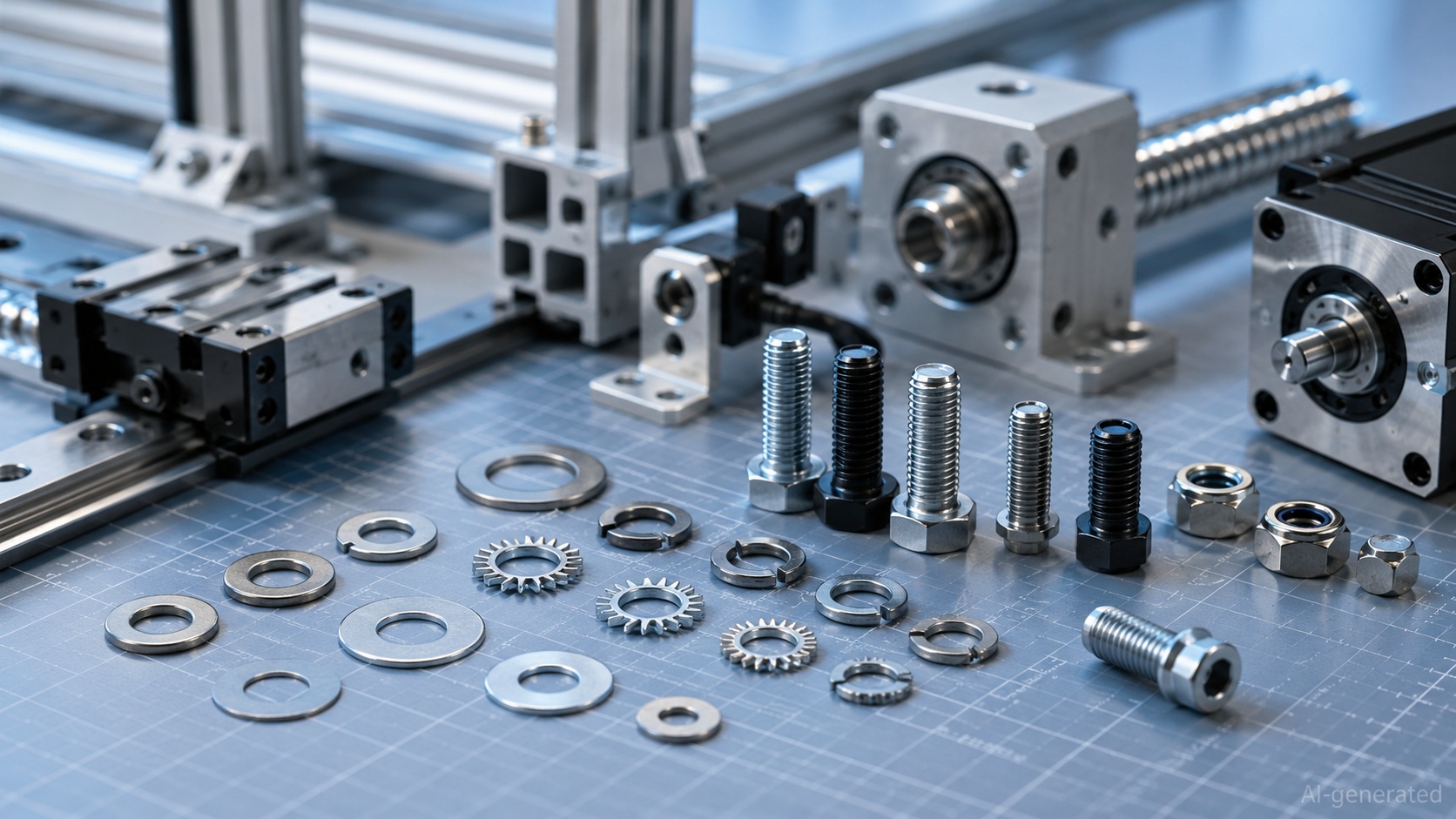
A lock washer is small enough to be overlooked, but important enough to decide whether an assembly stays tight or slowly turns into a rattling maintenance problem. In mechatronics, where mechanical motion, electronics, sensors, motors, and structural components all work together, fastening reliability is not a minor detail. It is part of the system’s performance.
A servo motor may deliver precise torque. A linear guide may keep motion smooth. A ball screw may provide accurate positioning. But if the bolts holding the mounting plate loosen under vibration, the whole system can lose accuracy, generate noise, or fail earlier than expected. That is where lock washers become useful.
This guide explains how lock washers work, common lock washer types, correct lock washer placement, how to use a lock washer, popular metric sizes, material choices, and practical applications in mechatronic assemblies. It also includes selection tables and practical FAQ questions based on common real-world fastening problems.
JLCMC provides washer options for mechatronic assemblies, including lock washers, spring washers, flat washers, tap washers, and double-stack self-locking washers. These parts can be selected together with screws, bolts, nuts, aluminum extrusion accessories, linear motion components, sensor brackets, and motor mounting hardware.
A good lock washer does not make the machine faster. It does not add horsepower. It does not look heroic. It simply helps the fastener stay where it belongs. In engineering, that is already a pretty respectable job.
1. What Is a Lock Washer?
A lock washer is a fastening component designed to help prevent screws, bolts, or nuts from loosening after installation. It is usually installed under the bolt head, screw head, or nut, depending on the joint structure.
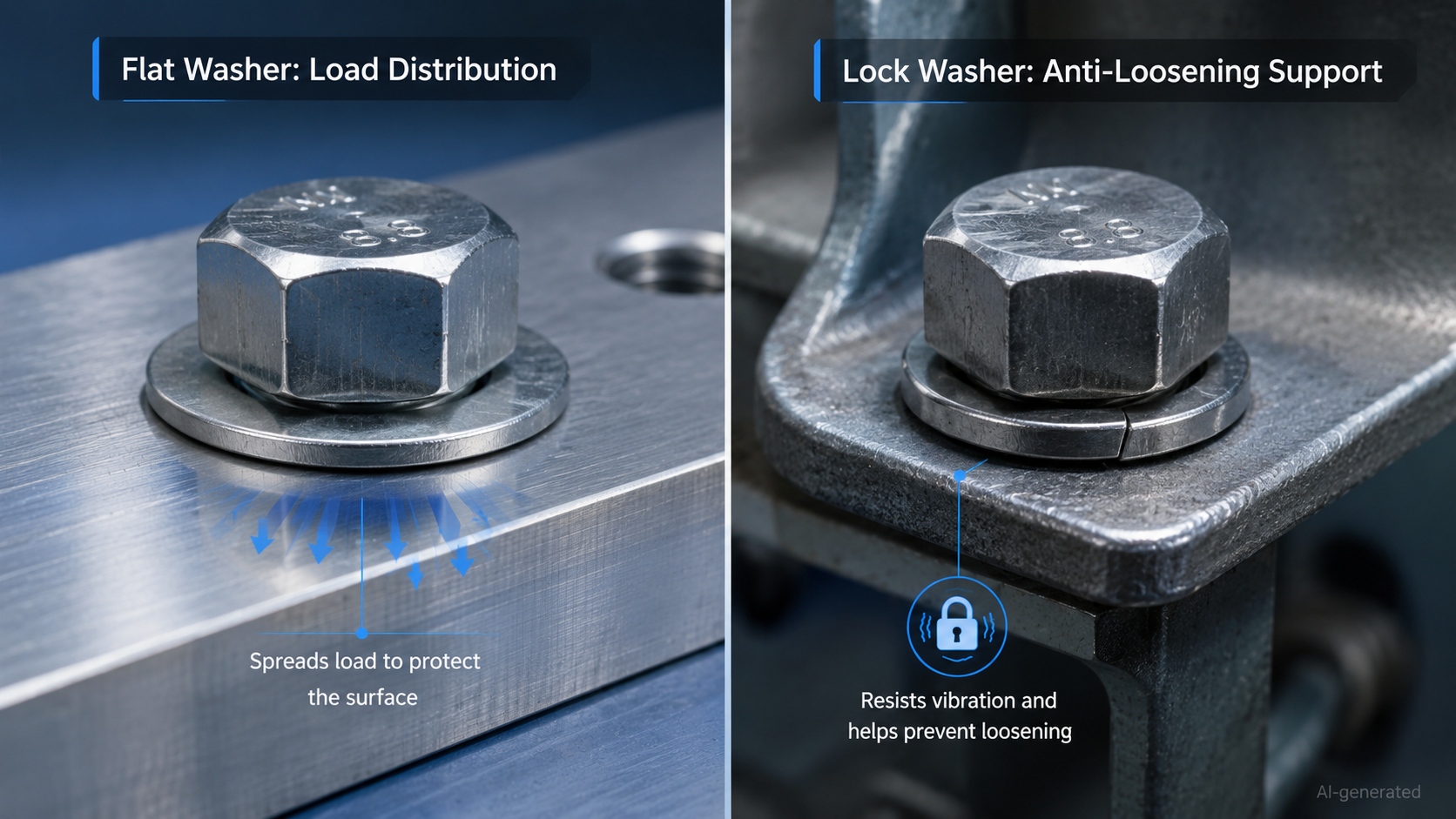
A standard flat washer mainly spreads load and protects the mating surface. A lock washer has an additional function: it helps resist loosening caused by vibration, repeated loading, rotation, thermal expansion, or small movements between joint surfaces.
In mechatronic assemblies, this matters because many components are not static. They move, stop, accelerate, reverse, vibrate, and operate for long periods. These working conditions can gradually reduce clamping force in a bolted joint.
Lock Washer vs. Flat Washer
| Washer Type | Main Function | Typical Use |
| Flat washer | Distributes load and protects the surface | General fastening, soft surfaces, slotted holes |
| Spring washer | Adds elastic force to the joint | Light vibration, general machinery |
| Lock washer | Helps resist fastener loosening | Vibration-prone or motion-related assemblies |
| Tooth washer | Bites into the surface to resist rotation | Electrical panels, grounding points, compact brackets |
| Double-stack self-locking washer | Uses wedge action to resist loosening | Higher-vibration mechanical structures |
Lock washers are commonly used in:
| Application Area | Typical Use |
| Linear motion systems | Linear guide brackets, ball screw supports, actuator plates |
| Motor mounting | Servo motor bases, stepper motor brackets, adapter plates |
| Sensor assemblies | Proximity sensor brackets, photoelectric sensor mounts |
| Aluminum frame systems | T-slot brackets, connecting plates, machine guards |
| Conveyor modules | Roller supports, side plates, motor brackets |
| Cable carrier systems | Moving-axis support brackets |
| Control panels | Electrical enclosures, grounding points, panel covers |
| Robotic fixtures | End-effectors, support frames, adjustable tooling |
A lock washer is not a cure for poor design. It cannot fix weak thread engagement, incorrect torque, an undersized bolt, or a badly supported joint. But when selected and installed correctly, it can improve fastening stability and reduce maintenance problems.
Think of it as a small mechanical bodyguard: quiet, compact, and usually ignored until the vibration starts.
2. How Does a Lock Washer Work?
One of the most common questions is: how does a lock washer work?
A lock washer works by making it harder for a fastener to rotate loose. Different lock washer types achieve this in different ways. Some add spring tension. Some increase friction. Some bite into the mating surface. Some use wedge-shaped geometry to resist reverse rotation.
Main Working Principles
| Working Principle | How It Works | Common Washer Types |
| Spring tension | The washer deforms during tightening and pushes back against the fastener | Split lock washer, spring washer, conical spring washer |
| Friction | The washer increases resistance between the fastener and contact surface | Split washer, serrated washer |
| Surface bite | Teeth or edges grip the fastener or mating surface | Internal tooth washer, external tooth washer |
| Wedge locking | Paired washers use wedge-shaped cams to resist loosening | Double-stack self-locking washer |
| Mechanical blocking | A tab or bent feature physically stops rotation | Tab washer |
Simple Explanation
When a fastener is tightened, it creates clamping force. That clamping force holds the parts together. However, vibration, repeated motion, load changes, and temperature changes can reduce the clamping force over time.
A lock washer adds resistance inside the joint. It helps keep tension, increases friction, or creates a mechanical obstacle that makes loosening more difficult.
For example:
· A split lock washer flattens under pressure and applies spring force.
· A tooth lock washer bites into the surface to resist rotation.
· A conical spring washer maintains elastic force in a compact space.
· A double-stack self-locking washer uses wedge action to resist loosening under vibration.
· A tab washer physically blocks rotation after installation.
In mechatronics, these effects are useful because systems often include vibration-producing or motion-related components such as motors, actuators, conveyors, ball screws, linear guides, cable carriers, and robotic fixtures.
3. Lock Washer Types
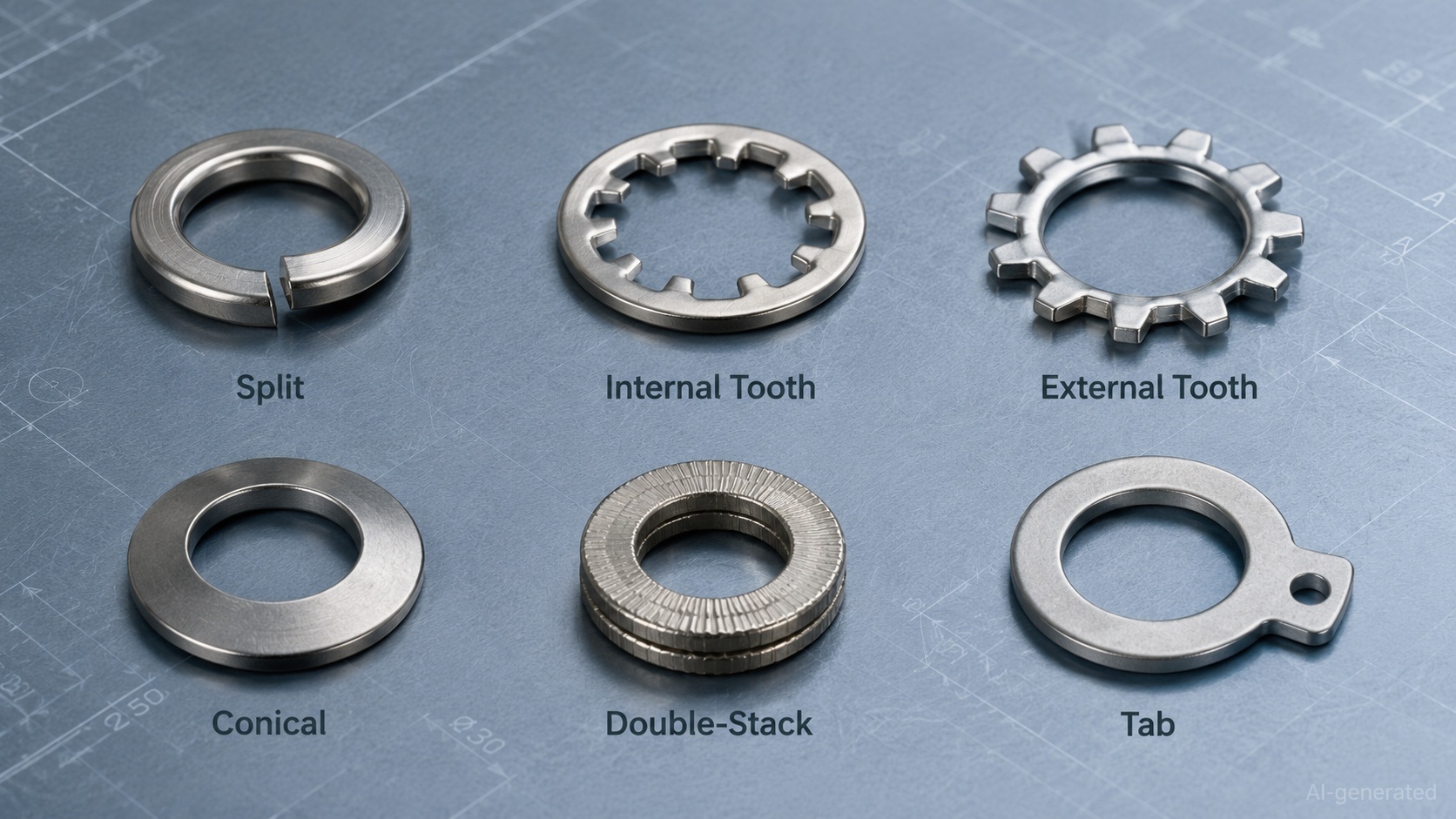
There are several common lock washer types, and each type has its own structure, advantage, and best-use scenario. Choosing the right one depends on vibration level, fastener size, material, installation space, and whether the joint needs to be removed during maintenance.
Lock Washer Type Comparison
| Lock Washer Type | Main Feature | Best For | Common Sizes |
| Split lock washer | Cut and twisted ring shape | General fastening, light to medium vibration | M3–M12 |
| Internal tooth lock washer | Teeth on the inner edge | Small screws, electrical assemblies, compact brackets | M3–M6 |
| External tooth lock washer | Teeth on the outer edge | Sheet metal, grounding points, panel covers | M3–M8 |
| Conical spring washer | Cone-shaped spring washer | Higher preload and elastic compensation | M4–M16 |
| Double-stack self-locking washer | Paired wedge-locking structure | Higher-vibration assemblies | M6–M20 |
| Tab washer | Bendable tab blocks rotation | Shafts, locknuts, bearing assemblies | Application-specific |
Split Lock Washer
A split lock washer is one of the most common types. It looks like a ring that has been cut and slightly twisted. When tightened, it flattens and creates spring tension.
Typical uses:
· Sensor brackets
· Small motor plates
· Aluminum frame accessories
· General machine covers
· Light-duty mounting plates
Split lock washers are affordable and widely used, but they may not be the best solution for severe vibration or critical joints.
Internal Tooth Lock Washer
An internal tooth lock washer has teeth on the inside edge. These teeth grip the fastener or contact surface.
Typical uses:
· Small screws
· Electrical panels
· Control boxes
· Sensor mounts
· Grounding connections
This type is useful when the outer washer diameter needs to remain clean and compact.
External Tooth Lock Washer
An external tooth lock washer has teeth around the outside edge. It provides more gripping points than an internal tooth washer.
Typical uses:
· Sheet metal covers
· Enclosure panels
· Grounding points
· Light-duty brackets
· Electrical assemblies
External tooth washers can mark the surface, so they should be used carefully on anodized aluminum, painted panels, or visible parts.
Conical Spring Washer
A conical spring washer has a cone-like shape. It acts like a compact spring disc and helps maintain preload in a bolted joint.
Typical uses:
· Motor mounting plates
· Ball screw support brackets
· Linear actuator structures
· Machine frame connections
· High-preload bolted joints
This type is useful when the joint needs elastic compensation in a limited space.
Double-Stack Self-Locking Washer
A double-stack self-locking washer is used as a pair. The pair uses wedge-shaped cam surfaces to resist loosening. When the fastener tries to rotate loose, the wedge action increases tension instead of allowing easy rotation.
Typical uses:
· Servo motor bases
· Robotic structures
· Heavy linear modules
· Machine frames
· High-vibration mounting points
For mechatronic equipment with frequent movement or vibration, double-stack self-locking washers are often a stronger choice than basic split lock washers.
4. Lock Washer Placement: Where Should It Go?
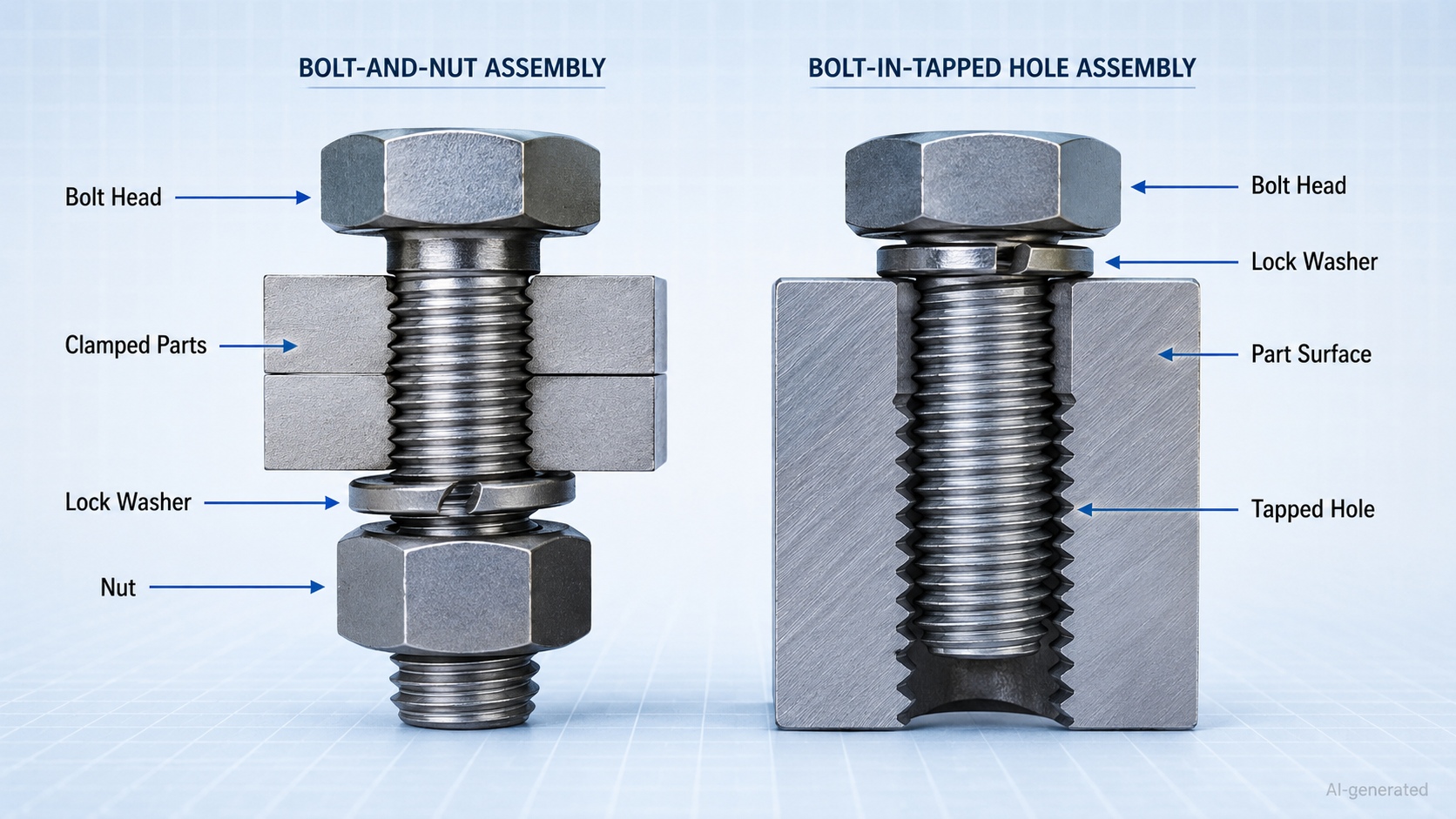
Correct lock washer placement is important because a lock washer only works properly when it contacts the right part of the joint. A good washer in the wrong position may look useful, but its locking effect can be reduced.
Basic Placement Rule
Place the lock washer directly under the fastener side that is tightened.
This usually means:
· Under the nut, when the nut is tightened
· Under the bolt head, when the bolt threads into a tapped hole
· Under the screw head, when the screw threads into a plate or component
Placement Diagram 1: Bolt and Nut Assembly
Correct order:
Bolt head
↓
Parts being clamped
↓
Lock washer
↓
This arrangement allows the lock washer to work under the nut as the nut is tightened.
Placement Diagram 2: Bolt Into Tapped Hole
Correct order:
Bolt head
↓
Lock washer
↓
Part surface
↓
Tapped hole
This arrangement allows the lock washer to work under the bolt head.
Placement With a Flat Washer
Sometimes a flat washer is used together with a lock washer. The flat washer spreads load and protects the surface, while the lock washer helps resist loosening.
A common arrangement is:
Nut or bolt head
↓
Lock washer
↓
Flat washer
↓
Part surface
However, this order depends on the washer type and joint design. For serrated washers, direct contact with the surface may be required for the teeth to bite properly. If a flat washer blocks the serrated washer from contacting the mating surface, the locking effect may be reduced.
Practical Placement Table
| Fastening Situation | Recommended Lock Washer Placement |
| Bolt and nut assembly | Between the nut and clamped surface |
| Bolt into tapped hole | Under the bolt head |
| Screw into threaded plate | Under the screw head |
| Grounding point with tooth washer | Directly against the conductive surface |
| Soft aluminum surface | Check whether a flat washer is needed to reduce surface damage |
| High-vibration joint | Use the placement required for the selected locking washer design |
Important Note
Do not randomly stack washers without a clear reason. More washers do not automatically mean more security. Sometimes they create more contact surfaces that can settle, shift, or loosen.
Good fastening is not about using more parts. It is about using the right part in the right place.
5. How to Use a Lock Washer
Another common search question is: how to use a lock washer or how do you use a lock washer?
The basic process is simple, but the details matter.
Step-by-Step Guide
| Step | Action | Why It Matters |
| 1 | Select the correct size | The washer must match the screw or bolt size |
| 2 | Select the correct type | Different washer types suit different vibration and load conditions |
| 3 | Check the material | Material affects strength and corrosion resistance |
| 4 | Place the washer correctly | Proper placement ensures locking action |
| 5 | Tighten to correct torque | Lock washers need proper clamping force |
| 6 | Inspect after installation | Early inspection helps catch settling or loosening |
| 7 | Replace damaged washers | Flattened or cracked washers may lose effectiveness |
How Do You Use a Lock Washer With a Nut?
Use this order:
Bolt head
↓
Parts being clamped
↓
Lock washer
↓
Nut
Then tighten the nut so the lock washer compresses properly.
How Do You Use a Lock Washer With a Bolt?
If the bolt threads into a tapped hole, use this order:
Bolt head
↓
Lock washer
↓
Part surface
↓
Tapped hole
Then tighten the bolt to the required torque.
Quick Installation Checklist
Before tightening, check:
· The washer size matches the fastener size.
· The washer type matches the vibration level.
· The material suits the working environment.
· The washer is not cracked, flattened, or corroded.
· The contact surface is clean.
· The washer is placed under the tightening side.
· The fastener is tightened to the correct torque.
A lock washer is small, but it still deserves correct installation. Tiny parts have responsibilities too, especially when a motor starts shaking the whole assembly.
6. Popular Lock Washer Sizes, Materials, and Finishes
Metric sizes are commonly used in mechatronic assemblies. The most frequently used lock washer sizes are related to common screw and bolt sizes in automation equipment.
Common Size Selection Table
| Lock Washer Size | Matching Fastener | Typical Mechatronic Applications |
| M3 | M3 screw | Sensors, PCB brackets, compact covers, small electrical modules |
| M4 | M4 screw | Photoelectric sensor brackets, small motor brackets, control panels |
| M5 | M5 screw | Aluminum frame accessories, cable carrier brackets, light machine guards |
| M6 | M6 bolt | Linear guide supports, actuator brackets, servo motor plates |
| M8 | M8 bolt | Machine frames, conveyor brackets, larger motor bases |
| M10 | M10 bolt | Structural plates, heavy-duty brackets, machine supports |
| M12 | M12 bolt | Larger equipment frames, heavy linear modules, industrial bases |
| M16 and above | M16+ bolt | Heavy machinery, large structural supports, industrial equipment bases |
Most Popular Sizes in Mechatronics
For many mechatronic components, the most practical and frequently used sizes are:
M3, M4, M5, M6, M8, M10, and M12
These sizes cover a wide range of applications, from small sensor brackets to larger machine frames.
Size Selection by Application
| Application | Common Sizes |
| Sensor brackets | M3, M4 |
| Control panels | M3, M4, M5 |
| Aluminum extrusion accessories | M5, M6, M8 |
| Linear motion structures | M5, M6, M8 |
| Servo motor mounting | M4, M5, M6, M8 |
| Conveyor modules | M6, M8, M10 |
| Machine frames | M8, M10, M12 |
| Heavy equipment bases | M12, M16 and above |
Material Comparison Table
| Material | Main Advantage | Suitable Applications |
| Carbon steel | Good strength and cost efficiency | General machinery, indoor automation, aluminum frames |
| SUS304 stainless steel | Better corrosion resistance | Humid environments, clean equipment, stainless structures |
| Spring steel | Strong elastic performance | Spring washers, high-preload joints |
| Surface-treated steel | Improved corrosion resistance or appearance | Industrial equipment, machine frames, outdoor-related structures |
Surface Finish Options
| Surface Finish | Purpose |
| Black oxide / blackened | Appearance and mild surface protection |
| Zinc plating | General corrosion resistance |
| Dacromet | Higher corrosion resistance in selected industrial environments |
| Plain stainless | Corrosion resistance without additional coating |
| Nickel plating | Appearance and corrosion resistance in selected applications |
Selection Tip
Do not choose a lock washer only because it looks good. A shiny washer that performs poorly is still a shiny problem. For mechatronic assemblies, material compatibility, torque behavior, corrosion resistance, surface hardness, and vibration level matter more than appearance alone.
7. Lock Washer Applications in Mechatronic Components
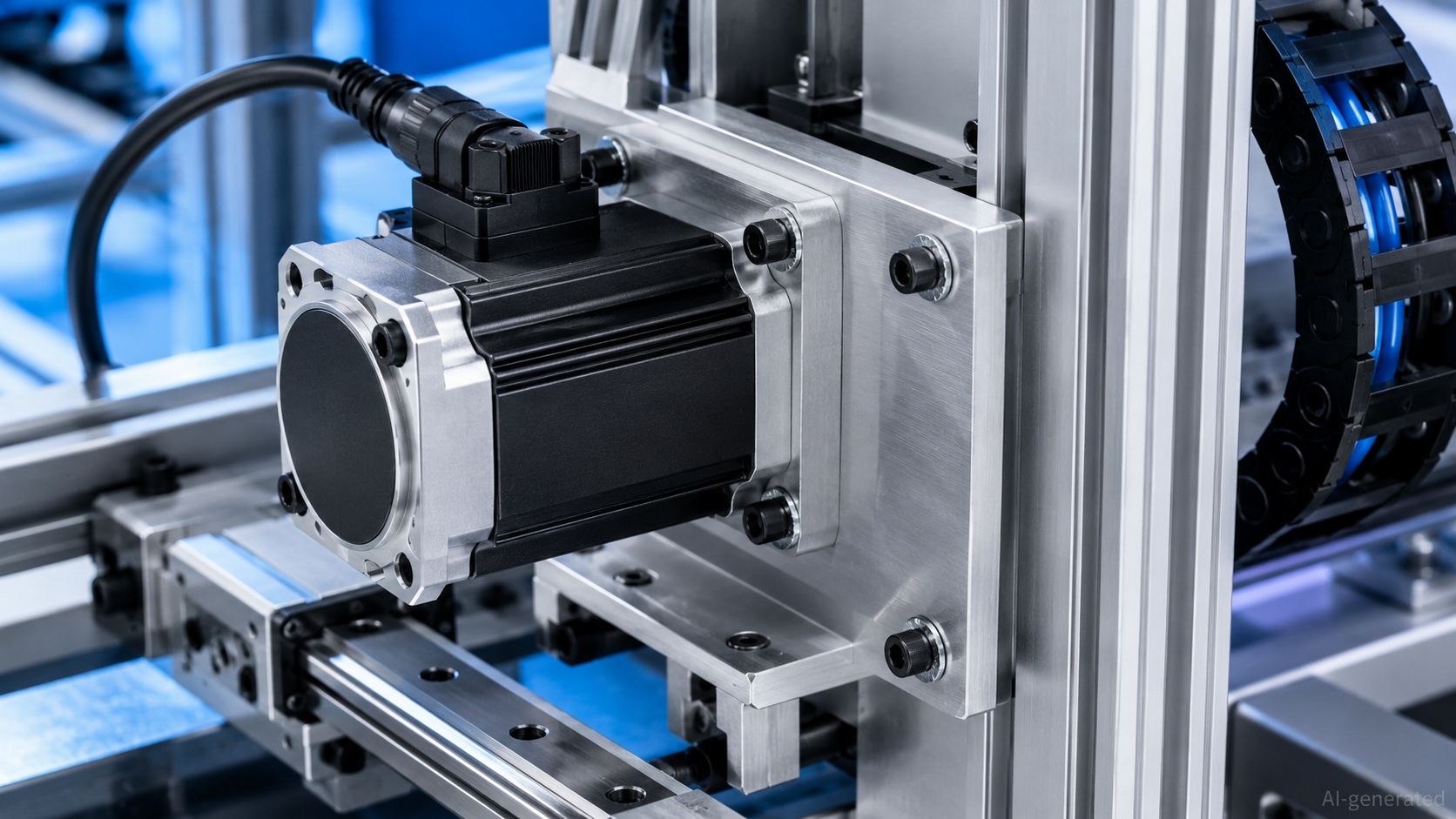
Lock washers are widely used in mechatronics because these systems combine mechanical structure, motion, sensing, and control. Many assemblies experience vibration, repeated movement, torque reaction, or maintenance cycles.
Application Map
| Mechatronic Component | Why Lock Washers Are Used | Common Sizes |
| Linear guides | Support brackets and auxiliary plates may experience repeated motion | M5, M6, M8 |
| Ball screw supports | Mounting plates need stable fastening | M6, M8, M10 |
| Servo motor mounts | Motors create vibration and torque reaction | M4, M5, M6, M8 |
| Stepper motor brackets | Repeated start-stop motion may loosen fasteners | M3, M4, M5 |
| Sensor brackets | Sensor position must remain stable | M3, M4 |
| Aluminum extrusion frames | Frame joints and plates need stable connections | M5, M6, M8 |
| Conveyor modules | Continuous motion creates vibration | M6, M8, M10 |
| Cable carrier brackets | Repeated cable carrier movement affects mounting points | M4, M5, M6 |
| Control enclosures | Panels and grounding points require secure fastening | M3, M4, M5 |
| Robotic fixtures | Dynamic motion requires stable joints | M5, M6, M8, M10 |
Linear Motion Systems
Linear guides, ball screws, linear actuators, and support units often operate under repeated motion. Lock washers may be used on auxiliary mounting plates, support brackets, covers, and frame connections.
For precision linear guide rail mounting, always follow the component’s installation and torque requirements. Lock washers are usually more suitable for surrounding brackets and support structures rather than changing the precision mounting condition of the rail itself.
Motor Mounting
Servo motors and stepper motors generate vibration and torque reaction. M4, M5, M6, and M8 lock washers are often used with motor plates, adapter brackets, and machine frames.
For higher-vibration motor bases, double-stack self-locking washers may be a better option than simple split lock washers.
Sensor Brackets
A loose sensor bracket can cause misalignment, false detection, and unstable machine behavior. M3 and M4 lock washers are commonly used for proximity sensors, photoelectric sensors, and safety light curtain brackets.
This is a small fastening point, but it affects the machine’s “eyes.” And a machine with shaky eyesight is never fun.
Aluminum Extrusion Frames
Aluminum extrusion frames are widely used in automation equipment. M5, M6, and M8 lock washers are commonly used with brackets, plates, and frame accessories.
Since aluminum is softer than steel, washer type and contact pressure should be selected carefully to avoid unnecessary surface damage.
JLCMC Product Note
JLCMC washer options can be used with related mechatronic parts such as screws, bolts, nuts, aluminum extrusion accessories, linear motion components, sensor brackets, and motor mounting hardware. When selecting from JLCMC, it is useful to compare washer type, material, surface finish, nominal diameter, and application environment rather than choosing only by product name.
8. Lock Washer Selection Guide
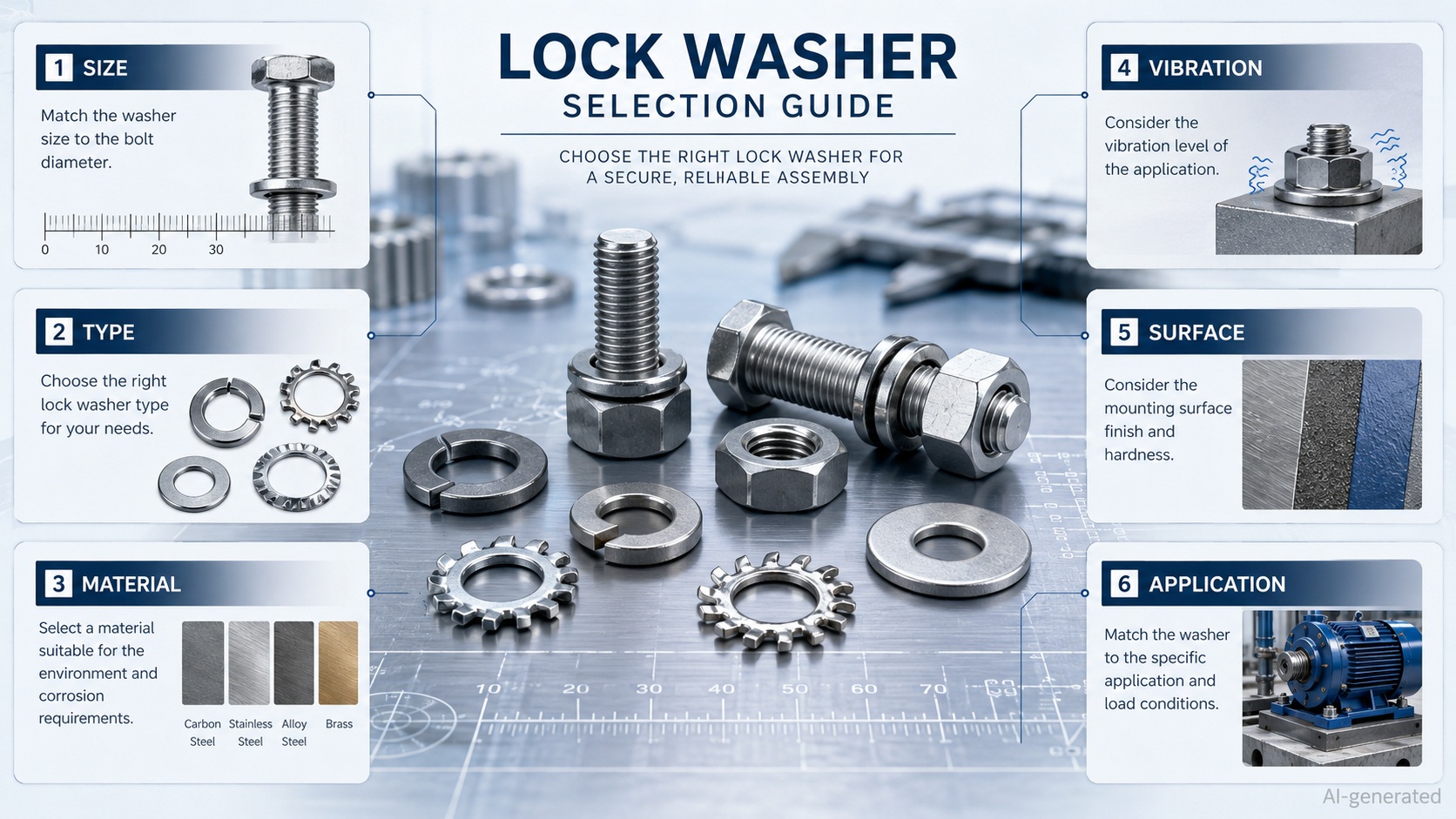
A good lock washer selection process should start with the joint, not the washer. Before choosing a washer type, ask what the fastened connection needs to survive.
Key Selection Questions
| Question | Why It Matters |
| What fastener size is used? | The washer must match the screw or bolt size |
| How much vibration is present? | Higher vibration may require stronger locking methods |
| What material is being clamped? | Aluminum, steel, stainless steel, and plastic behave differently |
| Is the surface visible or coated? | Serrated washers may leave marks |
| Is the joint frequently disassembled? | Reusable fastening methods may be preferred |
| Is the joint precision-critical? | Extra washer layers may affect seating or alignment |
| Is corrosion resistance required? | SUS304 stainless steel may be preferred in humid environments |
| Is installation space limited? | Some lock washers are thicker than others |
Lock Washer Selection Summary
| Application | Suggested Lock Washer Type | Common Sizes |
| Sensor brackets | Split lock washer or internal tooth washer | M3, M4 |
| Aluminum extrusion frames | Spring washer or suitable lock washer with flat washer | M5, M6, M8 |
| Servo motor mounts | Conical spring washer or double-stack self-locking washer | M5, M6, M8 |
| Conveyor modules | Conical spring washer or self-locking washer | M6, M8, M10 |
| Robotic fixtures | Double-stack self-locking washer or wedge-locking method | M6, M8, M10 |
| Control panels | Tooth lock washer or spring washer | M3, M4, M5 |
| Heavy machine frames | Double-stack self-locking washer or verified locking method | M8, M10, M12 |
Lock Washer Selection Checklist
Before choosing a lock washer, confirm the following:
☐ Fastener size: M3, M4, M5, M6, M8, M10, M12, or larger
☐ Washer type: split, tooth, conical, double-stack, or tab washer
☐ Material: carbon steel, SUS304 stainless steel, or spring steel
☐ Surface finish: blackened, zinc-plated, Dacromet, stainless, or other finish
☐ Vibration level: low, medium, or high
☐ Contact surface: steel, aluminum, stainless steel, coated surface, or plastic
☐ Installation space: enough height for the washer type
☐ Torque requirement: correct tightening torque available
☐ Maintenance plan: replace if damaged or reused too many times
☐ Application: sensor bracket, motor mount, linear guide support, frame, conveyor, or robotic fixture
The goal is not to use the strongest-looking washer everywhere. The goal is to match the washer to the joint. Overdesign can waste space and cost. Underdesign can create maintenance trouble. The sweet spot is boringly reliable, which is exactly what most machine builders want.
9. Common Mistakes When Using Lock Washers
Lock washers are useful, but they are often misused. A small mistake in placement, material selection, or torque can reduce their effectiveness.
Mistake Comparison Table
| Mistake | Why It Is a Problem | Better Practice |
| Using a lock washer as a universal fix | It cannot correct poor joint design or weak thread engagement | Start with proper screw size, thread depth, and torque |
| Choosing the wrong type | Different washer types suit different vibration levels | Match washer type to load and vibration |
| Incorrect placement | The washer may not create locking action | Place it under the nut or bolt head being tightened |
| Over-tightening | The washer may flatten or deform | Use correct torque |
| Reusing damaged washers | Damaged washers may lose locking effect | Replace cracked, flattened, or corroded washers |
| Ignoring surface material | Serrated washers may damage soft or coated surfaces | Check surface hardness and finish |
| Random washer stacking | Extra interfaces can reduce stability | Use only washers required by the design |
| Choosing only by price | Low-cost parts may not suit critical joints | Consider downtime, vibration, and maintenance cost |
Practical Reminder
A lock washer is part of a fastening system. It should be considered together with:
· Fastener type
· Thread engagement
· Torque control
· Material hardness
· Surface finish
· Joint design
· Load direction
· Vibration level
· Maintenance plan
If the joint is critical, do not rely on a basic washer alone. Consider thread-locking adhesive, lock nuts, double-stack self-locking washers, wedge-locking methods, or mechanical locking features where appropriate.
For precision motion components, such as linear guide rails or ball screw support units, correct torque, clean mounting surfaces, proper alignment, and stable preload are often more important than simply adding extra washer layers.
Engineering is not seasoning. More parts do not always improve the recipe.
10. Practical FAQ About Lock Washers and Final Takeaway
1. Why does my bolt still loosen even with a lock washer?
A bolt can still loosen even with a lock washer if the joint itself is not properly designed or installed. Common causes include insufficient tightening torque, poor thread engagement, high vibration, soft material settlement, dirty contact surfaces, or using the wrong washer type.
In mechatronic assemblies, this often happens around motor mounts, actuator brackets, conveyor modules, and moving-axis structures where repeated motion gradually reduces clamping force.
Practical tip:
If the same bolt keeps loosening, do not just replace the washer again. Check the full fastening system, including torque, thread depth, contact surface, vibration level, and whether a stronger locking method is needed.
2. Are split lock washers enough for high-vibration applications?
Usually, split lock washers are not the best choice for high-vibration applications. They may be acceptable for light-duty brackets, covers, panels, and general machine structures, but demanding joints often need stronger anti-loosening solutions.
For high-vibration points such as servo motor bases, robotic fixtures, actuator supports, and conveyor drive units, consider double-stack self-locking washers, wedge-lock washers, lock nuts, thread-locking adhesive, or better preload control.
| Application Condition | Suggested Approach |
| Light vibration | Split lock washer or spring washer |
| Medium vibration | Conical spring washer, lock nut, or threadlocker |
| High vibration | Double-stack self-locking washer or wedge-lock washer |
| Critical joint | Verified fastening design and torque control |
3. Can lock washers damage aluminum or anodized surfaces?
Yes. Some lock washers can scratch, bite into, or deform aluminum and anodized surfaces, especially tooth lock washers or aggressive serrated washers.
This may improve grip, but it can also damage appearance, reduce surface protection, or create marks on visible machine panels. In aluminum extrusion frames, sensor brackets, actuator plates, and lightweight machine guards, surface protection should be considered before choosing the washer type.
Practical tip:
For soft or visible surfaces, consider using a flat washer for load distribution, a less aggressive spring washer, or another locking method that does not rely on sharp teeth biting into the surface.
4. Should I use a lock washer or threadlocker?
It depends on whether the joint needs easy disassembly, how much vibration it faces, and whether liquid adhesive is suitable for the working environment.
A lock washer is mechanical, simple to install, and easier to remove during maintenance. Threadlocker is useful for threaded holes, compact spaces, and vibration-prone joints where a washer may not provide enough locking performance.
| Option | Better For |
| Lock washer | Reusable brackets, covers, frame accessories, general mechanical joints |
| Threadlocker | Vibration-prone threaded holes, compact assemblies, motor mounts |
| Lock nut | Bolt-and-nut assemblies with repeated vibration |
| Double-stack self-locking washer | Higher-vibration mechanical structures |
For mechatronic assemblies, light brackets may only need a lock washer, while motor mounts, actuator bases, and high-speed moving structures may require threadlocker or a stronger mechanical locking method.
5. Can I reuse a lock washer?
Sometimes, but replacing it is usually the safer choice, especially during machine maintenance.
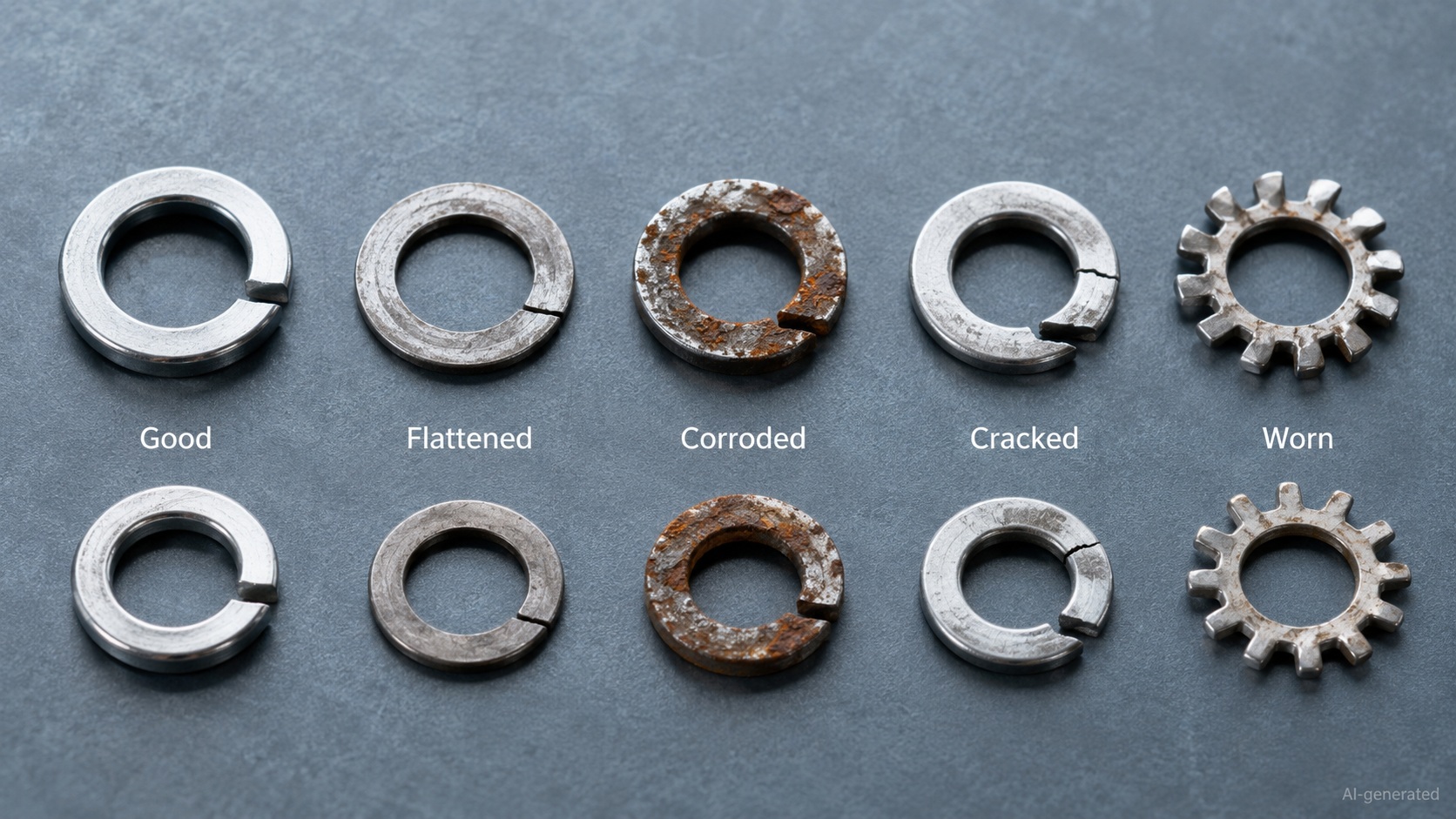
A lock washer should not be reused if it is flattened, cracked, corroded, deformed, worn, or no longer provides spring tension or proper biting action. Reusing a damaged washer can reduce fastening reliability and increase the chance of loosening.
| Condition | Why It Matters |
| Flattened | It may have lost spring force |
| Cracked | It may fail under load |
| Corroded | Strength and contact quality may be reduced |
| Deformed | It may not seat correctly |
| Worn teeth or edges | Locking action may be weakened |
For common mechatronic sizes such as M3, M4, M5, M6, and M8, replacing the washer is usually much cheaper than dealing with downtime caused by a loose fastener.
Final Takeaway
Lock washers may be small, but they play an important role in fastening reliability. In mechatronic systems, where vibration, motor torque, repeated motion, and structural loads are common, the right lock washer can help reduce loosening and improve long-term assembly stability.
The key is not simply asking, “Do I need a lock washer?” A better question is:
What type of joint am I designing, what vibration or load will it face, and which locking method fits best?
For light-duty brackets, split or tooth lock washers may be enough. For motor mounts, conveyor modules, machine frames, and higher-vibration assemblies, conical spring washers or double-stack self-locking washers may be more suitable.
Popular metric sizes such as M3, M4, M5, M6, M8, M10, and M12 cover many common mechatronic applications, from small sensor brackets to larger machine frames.
JLCMC provides washer options for mechatronic component assemblies, including lock washers, spring washers, flat washers, tap washers, and double-stack self-locking washers. Used together with suitable screws, bolts, nuts, linear motion parts, sensor brackets, and aluminum structures, lock washers help create assemblies that are more stable, serviceable, and ready for real machine operation.
A good lock washer does not make noise, demand attention, or brag about its job. It simply helps the fastener stay where it belongs. In engineering, that is usually the best kind of performance.
Popular Articles
Keep Learning
Threaded Standoff vs Spacer: What Is the Difference?
Key Takeaways Threaded standoffs provide both spacing and threaded attachment points, making them ideal for modular assemblies and PCBs. Spacers are unthreaded sleeves that work with through-bolts to maintain gaps in clamped assemblies, offering a simpler and more economical solution. The right choice depends on the load path, assembly sequence, material, and service environment - not just appearance or catalog naming. A threaded standoff and a spacer can look almost identical on a workbench. Both cre......
How to Choose a Threaded Standoff for PCB and Mechatronic Assemblies
Key Takeaways Select the right configuration: Choose male-female, female-female, or male-male thread configurations based on the two mating interfaces and the intended assembly sequence. Treat height as a tolerance stack: Standoff body length must satisfy clearance, electrical, thermal, and connector requirements across the full tolerance range, not just the nominal dimension. Verify thread engagement: Check male thread length against tapped-hole depth and upper screw length against usable female thre......
Threaded Standoff Guide: Types, Sizes, Materials and Applications
Key Takeaways Thread configuration first: Choose female-female, male-female or male-male based on how both sides of the assembly attach — thread config is the most practical way to classify a threaded standoff. Body length is the critical dimension: Standoff length refers to the distance between supporting faces, not total physical length. Reading the wrong length causes incorrect mounting height or screw bottoming. Material affects more than strength: Brass, stainless steel, carbon steel, aluminum an......
Ball Nose End Mill Stepover: Scallop Height and Effective Diameter
Key Takeaways Geometric Control: Stepover directly controls geometric scallop height, but it does not automatically guarantee a measured Ra value. Cusp Height Formula: For a ball radius $R$ and pass spacing $s$ on a flat surface, the ideal cusp height is $h = R - \sqrt{R^2 - \frac{s^2}{4}}$. Tool Radius Advantage: A larger ball can use wider spacing for the same ideal cusp, provided it can reach the required geometry without gouging. Effective Diameter: The active cutting diameter near the tool tip ca......
Manual SMT Stencil Printer Sizing: Print Area, PCB Support and Frame Fit
Key Takeaways Different dimensions: Worktable size, effective print area, board envelope, and stencil frame size are different dimensions. Check the full pattern: Check the whole aperture pattern in its intended orientation, including clearance for the printing stroke. Thickness is not enough: A compatible board thickness does not prove that a populated underside or a support fixture will fit. Support and contact: Stable support and close stencil-to-board contact are necessary for a repeatable printin......
Blind Rivet Guide: Types, Sizes, Uses, Installation and Removal
A blind rivet may be small, but choosing one correctly involves more than matching a rivet to the nearest drill bit. The diameter, grip range, hole size, body material, mandrel material, head style and installation tool all influence the finished joint. A rivet that looks perfectly acceptable before installation can still spin, loosen, pull through the sheet or form incorrectly on the blind side if one of these factors is overlooked. Blind rivets are widely used in sheet-metal fabrication, electrical ......