Threaded Inserts Guide: Types, Uses, Installation Tips, and Mechatronic Applications
25 min
- 1. What Are Threaded Inserts?
- 2. How Threaded Inserts Work
- 3. Common Types of Threaded Inserts
- 4. Threaded Insert Materials
- 5. Where Threaded Inserts Are Used
- 6. How to Install Threaded Inserts
- 7. Installation Notes by Material
- 8. 3D Prints That Use Threaded Inserts
- 9. Threaded Inserts, Fasteners, and Installation Data
- 10. Threaded Inserts vs Tapped Holes
- 11. How to Choose the Right Threaded Insert
- 12. Common Installation Mistakes
- 13. FAQ About Threaded Inserts
- 14. Conclusion
1. What Are Threaded Inserts?
Threaded inserts are mechanical fastening components used to create strong, reusable internal threads in a base material. Instead of relying only on threads cut directly into aluminum, plastic, wood, cast metal, or a 3D printed part, a threaded insert is installed into a prepared hole. The insert then provides a durable female thread for a screw, socket head cap screw, or hex bolt.
In practical terms, threaded inserts help materials hold screws more reliably, especially when the material is soft, thin, frequently serviced, or easy to strip.
They are commonly used in:
· Automation equipment
· 3D printed prototypes
· Plastic housings
· Aluminum mounting plates
· Wooden jigs and fixtures
· Machine covers
· Control enclosures
· Robot prototypes
· Test benches and production fixtures
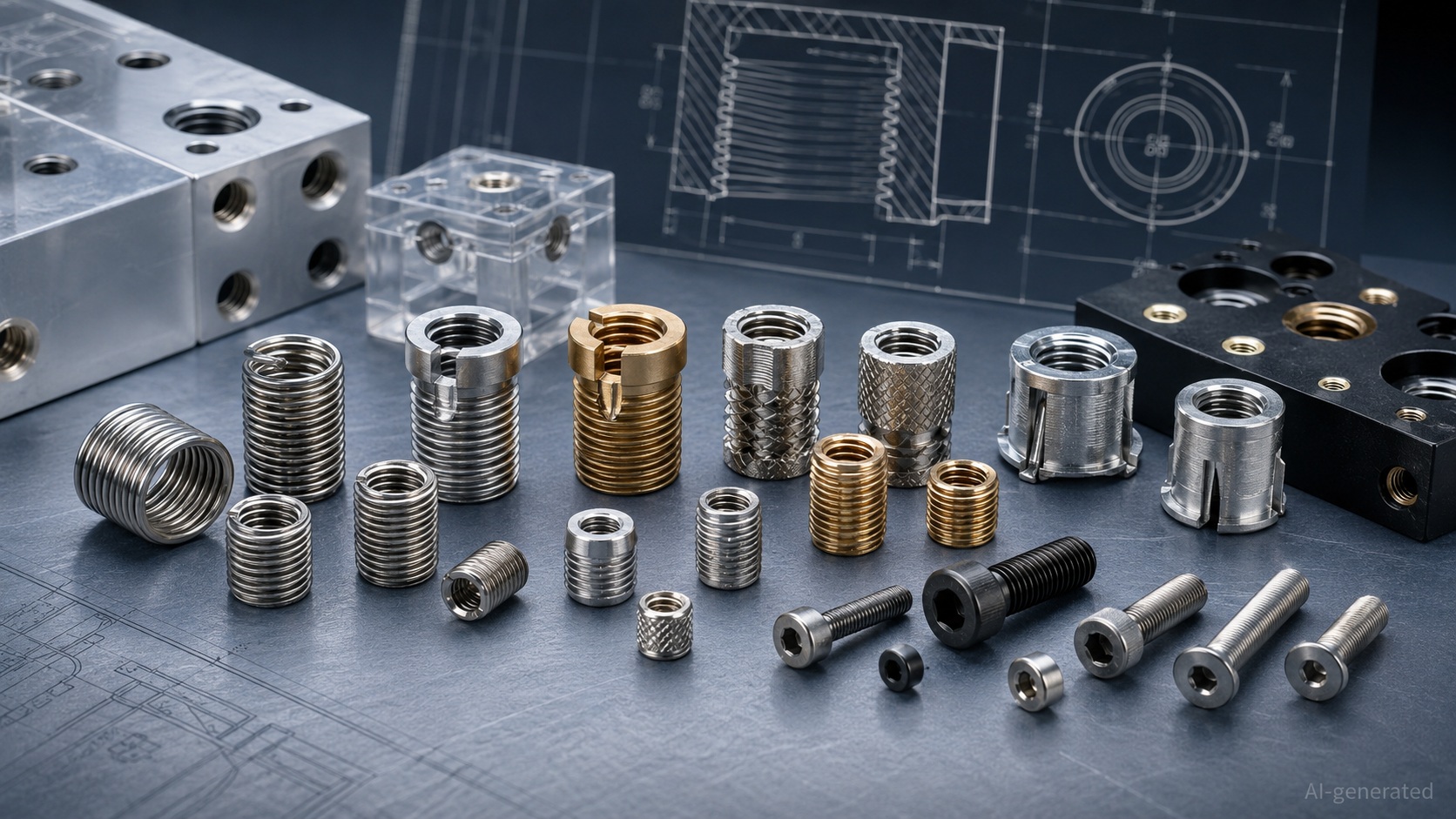
A threaded insert may look like a small background part, but it often determines whether a product can be assembled and serviced repeatedly. A screw driven directly into plastic or wood may work once. A tapped hole in soft aluminum may survive the first few builds. But after repeated removal, vibration, or adjustment, the thread may loosen, strip, or fail.
That is where threaded inserts become useful. They create a more reliable fastening point without requiring the entire part to be made from a stronger material.
In mechatronic systems, this is especially important. Machines are rarely assembled once and never touched again. Covers are removed, brackets are adjusted, sensors are repositioned, and prototypes are rebuilt. A durable threaded connection helps keep the system serviceable, stable, and easier to maintain.
2. How Threaded Inserts Work
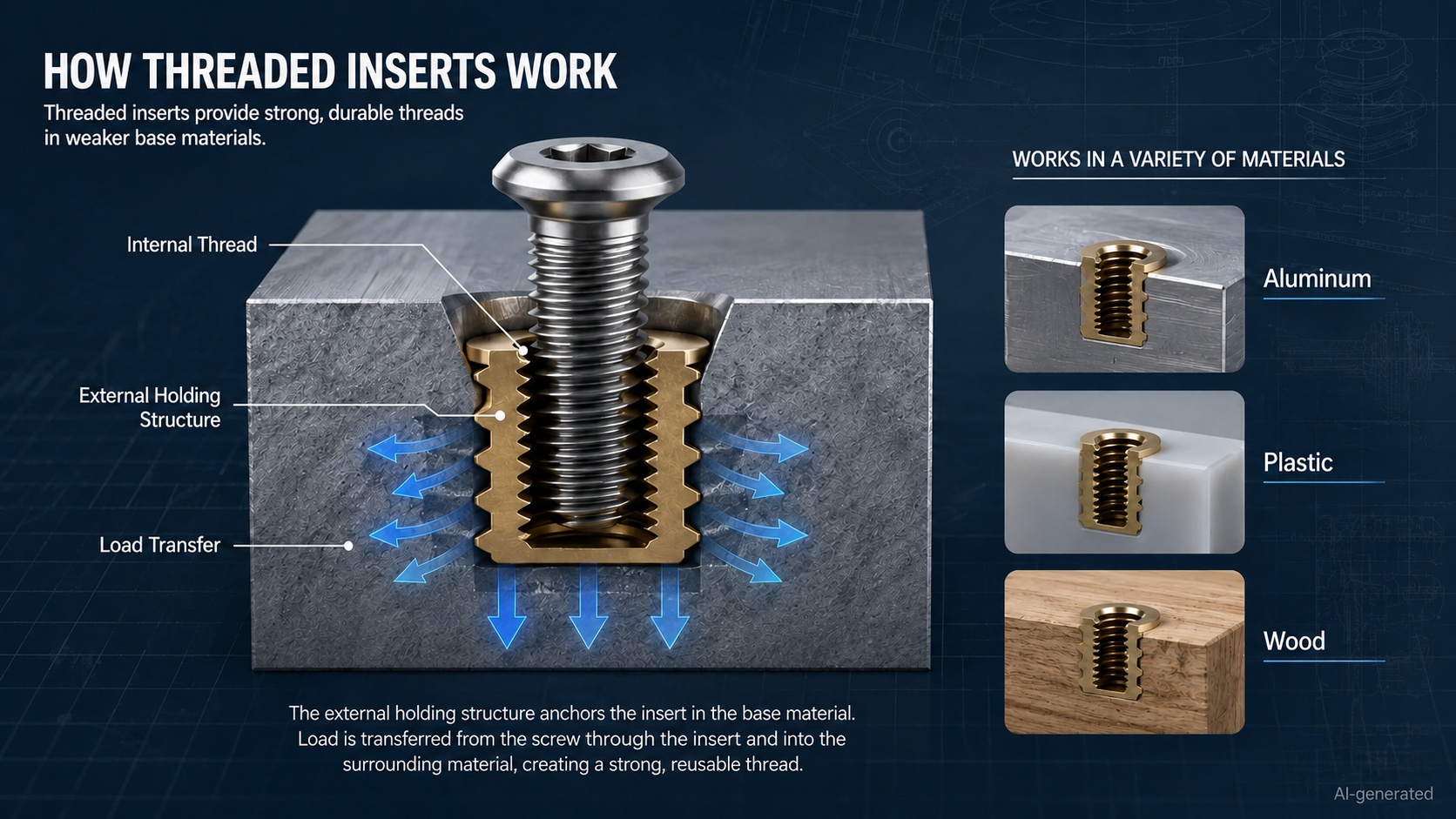
A threaded insert has two main functional areas.
The first is the internal thread, which accepts the mating screw, bolt, or stud. Common metric sizes include M2.5, M3, M4, M5, M6, M8, M10, and M12.
The second is the external holding structure, which secures the insert into the parent material. Depending on the insert design, this external structure may include:
· Wire coil geometry
· External threads
· Cutting slots
· Cutting bores
· Knurled surfaces
· Barbs
· Locking keys
· Heat-set features
· Press-fit geometry
Once installed, the insert distributes load into the surrounding material and provides a stronger internal thread for the mating fastener. This can improve thread wear resistance, pull-out strength, torque resistance, repairability, assembly repeatability, and service life.
However, a threaded insert is not magic. The surrounding material still matters. A metal insert installed into a very thin plastic wall can still fail if the plastic boss is poorly designed. A wood insert placed too close to the edge can still split the wood. A self-tapping insert installed into the wrong pilot hole size can still loosen or damage the base material.
The best results come from treating the insert, screw, base material, pilot hole, and installation method as one complete fastening system.
3. Common Types of Threaded Inserts
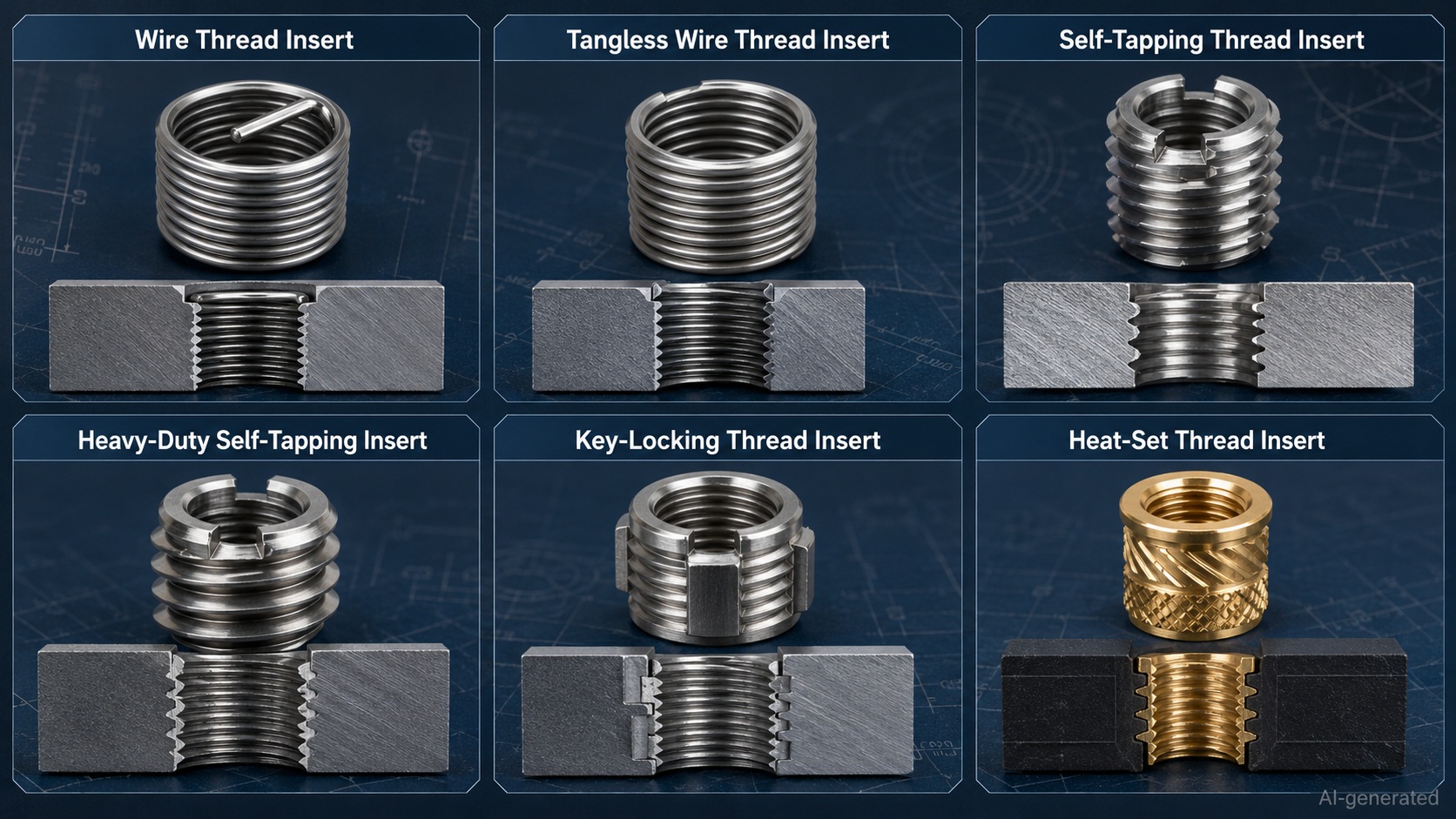
Threaded inserts come in several designs. The right choice depends on the base material, required strength, installation method, and service conditions.
Wire Thread Inserts
Wire thread inserts, also known as helical thread inserts or coil thread inserts, are made from precision-formed wire and are used to create or repair internal threads in metal parts.
Unlike a solid threaded insert, a wire thread insert is not installed into an ordinary tapped hole of the same nominal size. The damaged or prepared hole must first be drilled to the correct diameter and then tapped with a special STI tap. STI stands for Screw Thread Insert, and the STI thread is larger than the final internal thread that the screw will use.
For example, if the final screw size is M6 × 1.0, the receiving thread is not a standard M6 × 1.0 tapped hole. The hole must be prepared with the correct drill size and tapped with an M6 × 1.0 STI tap. After the wire insert is installed, the internal thread becomes the intended M6 × 1.0 thread for the mating screw.
This detail is important because using a normal metric tap instead of an STI tap will make the installation fail. The insert will not seat correctly, and the final thread will not have the proper geometry or strength.
Wire thread inserts are commonly used for:
· Repairing stripped internal threads
· Reinforcing threads in aluminum and other soft metals
· Improving wear resistance in frequently assembled joints
· Restoring damaged machine parts without replacing the entire component
· Creating durable threads in lightweight metal housings, brackets, and fixture plates
In mechatronic assemblies, wire thread inserts are especially useful for aluminum mounting plates, motor housings, sensor brackets, actuator components, and maintenance points where screws may be removed and reinstalled many times. They help preserve the nominal screw size while strengthening the threaded connection inside the parent material.
Tangless Wire Thread Inserts
Tangless wire thread inserts are similar to traditional wire thread inserts, but they do not use an installation tang. Traditional wire inserts often require a small tang to drive the insert into place, and that tang must be broken off after installation. Tangless inserts avoid that extra step.
This is useful in precision assemblies, enclosed mechanisms, electronics-related equipment, and clean mechanical systems where loose metal fragments should be avoided.
Tangless inserts are especially helpful when working with blind holes, compact housings, or maintenance-sensitive assemblies.
Self-Tapping Thread Inserts
Self-tapping thread inserts are solid inserts with external cutting features. During installation, they cut or form their own thread in the receiving hole. This reduces or eliminates the need to pre-tap the base material.
They are commonly used in aluminum, soft metals, engineering plastics, and repair applications where a stronger or more durable internal thread is needed. Some self-tapping insert designs can also be used in cast or low-ductility materials, but these applications require careful pilot-hole preparation, proper alignment, and controlled installation torque.
Self-tapping inserts are often used for:
· Aluminum plates
·Cast metal parts
· Plastic housings
· Repair of worn threads
· Fixture plates
· Prototype machine components
· General mechanical assemblies
Some self-tapping inserts use cutting slots, while others use cutting bores or other external cutting structures. The goal is the same: to create a secure external thread in the base material while providing a reliable internal thread for the mating screw.
Heavy-Duty Self-Tapping Inserts
Heavy-duty self-tapping inserts are used when the connection requires higher pull-out strength, better torque resistance, or stronger wall structure. They are suitable for more demanding applications such as machine frames, fixture plates, actuator supports, repair points, and medium-duty brackets.
The insert itself may be stronger, but the surrounding material must also be strong enough to support the load. A heavy-duty insert installed into weak or thin material will not automatically create a heavy-duty joint.
Key-Locking Thread Inserts
Key-locking thread inserts are solid inserts with locking keys that are driven into the parent material after installation. These keys help prevent the insert from rotating under torque or vibration.
They are often used in metal thread repair, high-strength reinforcement, and vibration-prone mechanical assemblies.
Common applications include:
· Repairing stripped metal threads
· Reinforcing aluminum or cast components
· Machine bases
· Fixture plates
· Maintenance-heavy machinery
· High-load fastening points
Key-locking inserts usually require more careful hole preparation than simple self-tapping inserts. They are best used where the added installation effort is justified by the strength and anti-rotation benefits.
Heat-Set Threaded Inserts
Heat-set threaded inserts are commonly used in thermoplastic parts and 3D printed components. The insert is heated and pressed into a prepared hole. The surrounding plastic softens and flows around the insert. After cooling, the insert becomes locked in place.
Heat-set inserts are especially popular in 3D printed parts because they provide reusable metal threads in plastic structures that would otherwise wear out quickly.
They are commonly used in:
· 3D printed sensor brackets
· Electronics housings
· Robot prototypes
· Cable clamp bases
· Control panel parts
· Small actuator covers
· Plastic mechanical enclosures
· Printed test fixtures
For functional prototypes, heat-set threaded inserts are often one of the easiest ways to make a 3D printed part feel less like a prototype and more like a real assembly component.
4. Threaded Insert Materials
Threaded inserts are commonly made from stainless steel, carbon steel, brass, and other engineering materials. The best choice depends on the base material, environment, load, and installation method.
Stainless Steel
Stainless steel inserts are used when corrosion resistance, cleanliness, or long service life matters. They are suitable for humid environments, outdoor equipment, laboratory machinery, food-related equipment, and frequently serviced automation systems.
Carbon Steel
Carbon steel inserts are often selected for mechanical reinforcement and thread repair where strength and cost efficiency are important. They are commonly used in metal components, fixture plates, cast parts, and industrial equipment.
Surface treatment may be used when corrosion resistance is required.
Brass
Brass inserts are widely used in plastic, 3D printed parts, electronics enclosures, and many wood applications. Brass is easy to process, performs well in heat-set insert designs, and provides good corrosion resistance in many indoor environments.
For 3D printed parts and plastic housings, brass heat-set inserts are one of the most common choices.
Material Selection Tips
A stronger insert material is not always the better choice. The insert must work with the parent material.
For example, stainless steel may be suitable for harsh environments, but brass may be better for heat-set installation in plastic. Carbon steel may be cost-effective for many mechanical repairs, but it may not be ideal in humid or corrosive conditions. Wood inserts need external geometry that can grip wood fibers, while plastic inserts need a structure suitable for heat-setting, pressing, ultrasonic installation, or molding.
The insert material should be selected together with the screw material, load direction, surrounding wall thickness, and expected service life.
5. Where Threaded Inserts Are Used
Threaded inserts are used anywhere a stronger, cleaner, or more reusable threaded connection is needed.
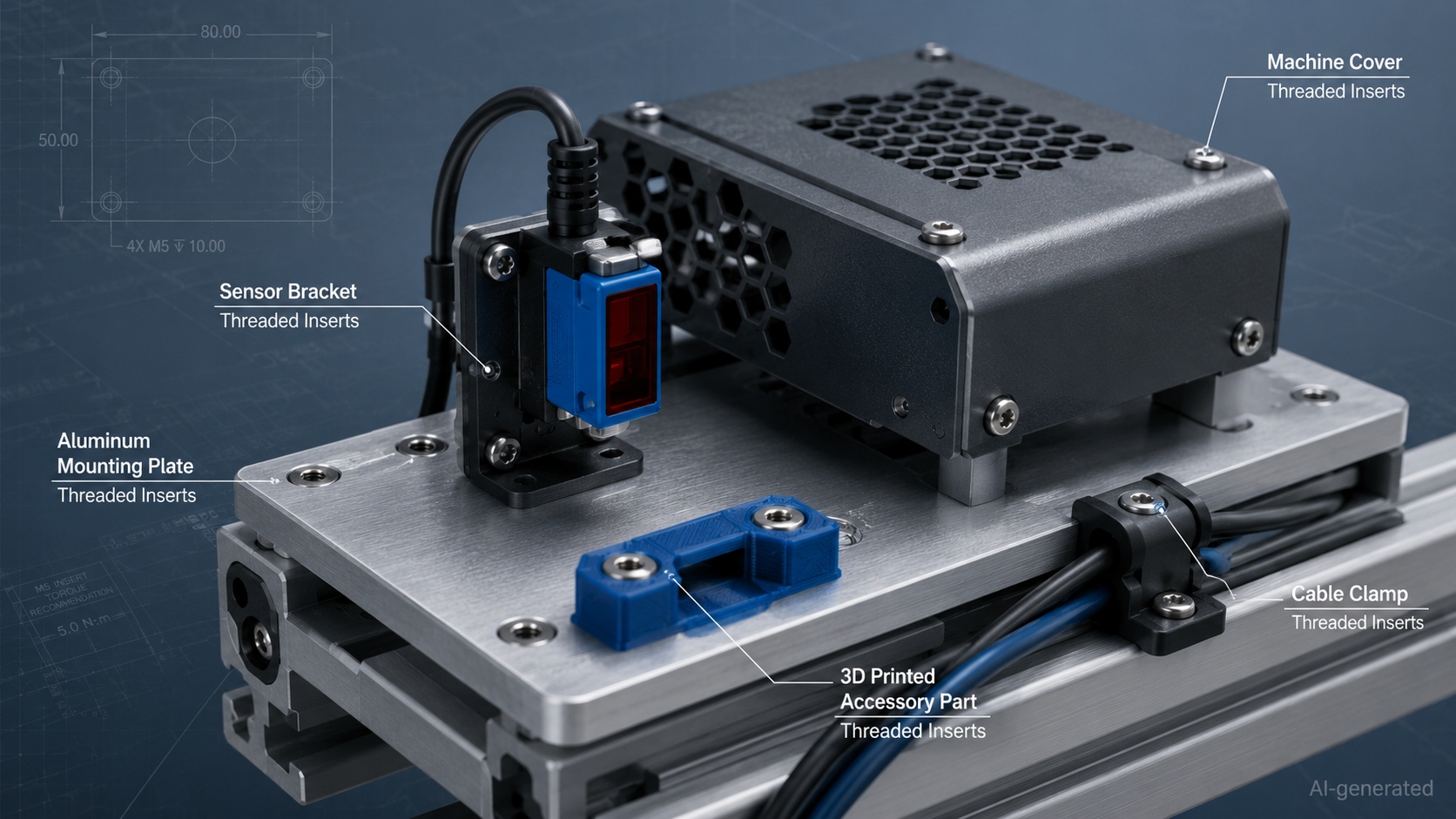
In mechatronic assemblies, they are especially useful because mechanical parts, electrical hardware, sensors, and motion components often need to be assembled, adjusted, and serviced.
Typical applications include:
· Sensor bracket mounting
· Motor cover installation
· Linear guide accessory plates
· Aluminum extrusion accessories
· Cable clamp fixing points
· Control box covers
· Robot arm prototypes
· 3D printed test fixtures
· Machine guard panels
· Adjustable stops
· Handles and knobs
· Positioning blocks
· Locating fixtures
Popular insert sizes in compact mechanical assemblies include M3, M4, M5, and M6. Larger structures, fixture plates, and machine frames may use M8, M10, or M12.
| Insert Size | Typical Application |
| M2.5 | Small electronics and compact printed parts |
| M3 | Sensor brackets, 3D printed housings, small covers |
| M4 | Machine covers, compact brackets, control panels |
| M5 | General automation accessories and mounting plates |
| M6 | Medium-duty brackets, handles, fixture plates |
| M8 | Machine bases, stronger brackets, aluminum frames |
| M10–M12 | Heavy fixtures, repair work, larger mechanical assemblies |
JLCMC offers threaded inserts and related fastening components for automation equipment, fixtures, 3D printed prototypes, and general mechanical assemblies. These inserts can be used together with hex socket screws, hex bolts, washers, aluminum extrusion accessories, sensor brackets, linear motion components, and CNC machined plates.
The important point is serviceability. A reliable threaded connection keeps covers secure, brackets adjustable, sensors aligned, and prototypes easier to improve.
6. How to Install Threaded Inserts
The exact installation method depends on the insert type and base material, but the general process follows the same logic.
First, identify the base material. Threaded inserts for metal, threaded inserts for wood, and threaded inserts for plastic are not designed the same way. Metal may need drilling, tapping, chamfering, or a self-tapping insert. Wood needs a pilot hole that allows the external thread to bite without splitting the material. Plastic may require heat, pressure, ultrasonic installation, or a molded-in design.
Second, choose the correct internal thread size. The insert must match the mating screw or bolt. In compact automation equipment, M3, M4, M5, and M6 are common. For stronger machine structures, M8 or larger sizes may be used.
Third, prepare the hole correctly. This is one of the most important steps. A hole that is too small can crack the material or damage the insert. A hole that is too large can cause the insert to spin, loosen, or pull out. Always follow the recommended pilot hole diameter and drilling depth.
Fourth, keep the insert straight. A crooked insert creates a crooked screw path. In precision equipment, that can affect sensor alignment, cover fit, bracket position, or fixture repeatability.
Fifth, install with controlled force. Do not rush the process. Self-tapping inserts should be driven steadily. Heat-set inserts should be heated carefully. Wood inserts should be turned slowly to avoid splitting or stripping the fibers.
Finally, test the screw engagement. After installation, the mating screw, socket head cap screw, or hex bolt should thread smoothly without wobble, binding, or cross-threading.
Good installation is not complicated, but it does require control. Threaded inserts are mechanical components, not nails. They deserve better treatment than “just force it in and hope.”
7. Installation Notes by Material
Different materials require different installation thinking. This is where many threaded insert failures begin.
Metal
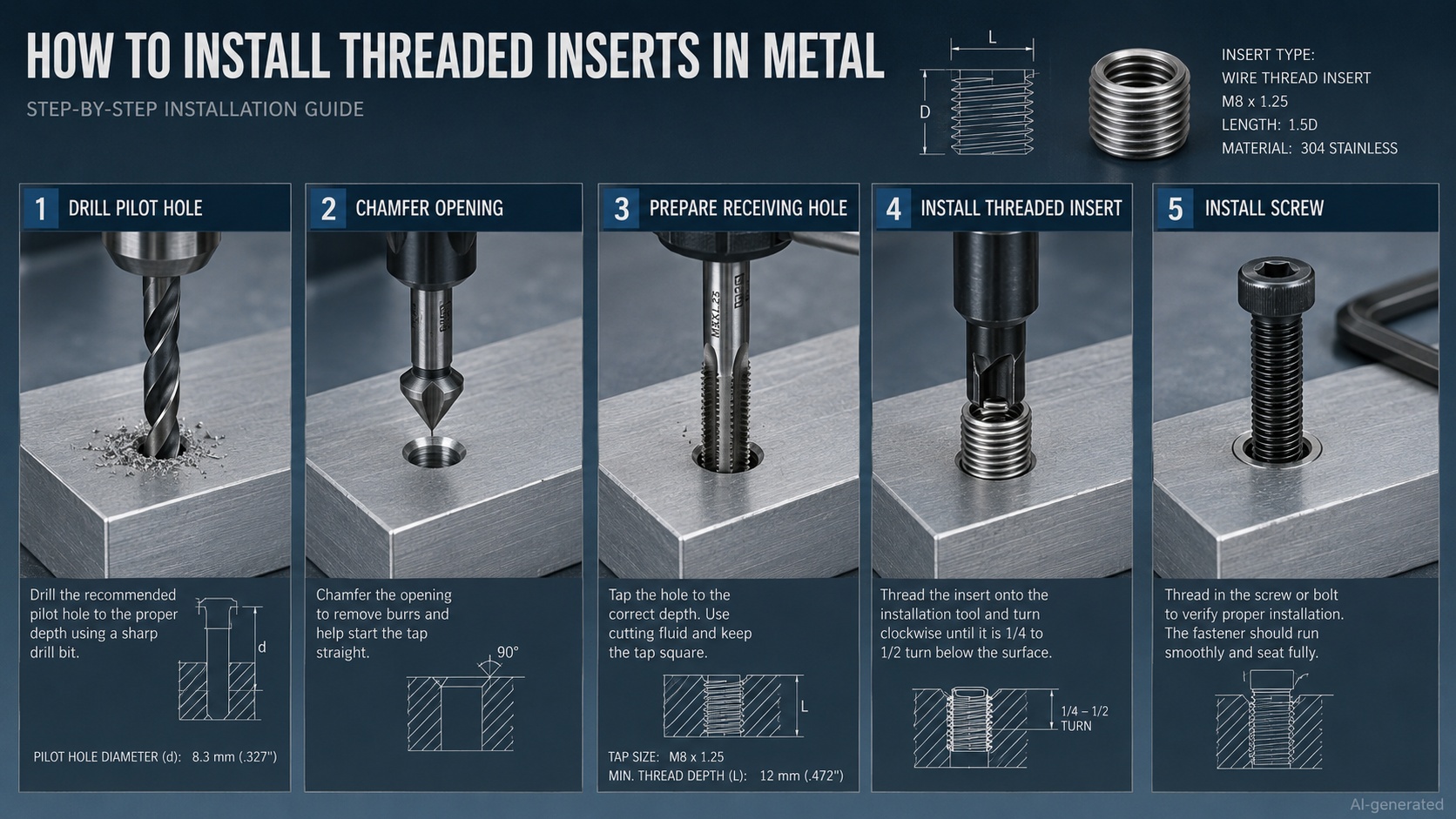
When installing threaded inserts in metal, the most important factors are hole size, thread preparation, chip removal, and alignment.
Threaded inserts for metal are commonly used in aluminum plates, cast metal housings, machine bases, fixture tooling, motor mounting plates, automation brackets, and stripped thread repair.
For metal applications:
· Use the correct drill size.
· Chamfer the hole opening when needed.
· Remove burrs and chips.
· Use the proper installation tool.
· Keep the insert perpendicular.
· Check the final thread with the mating screw or bolt.
In aluminum parts, inserts are especially useful because repeated screw removal can wear or strip the original threads. In repair work, a threaded insert can restore a damaged hole without replacing the entire part.
Wood
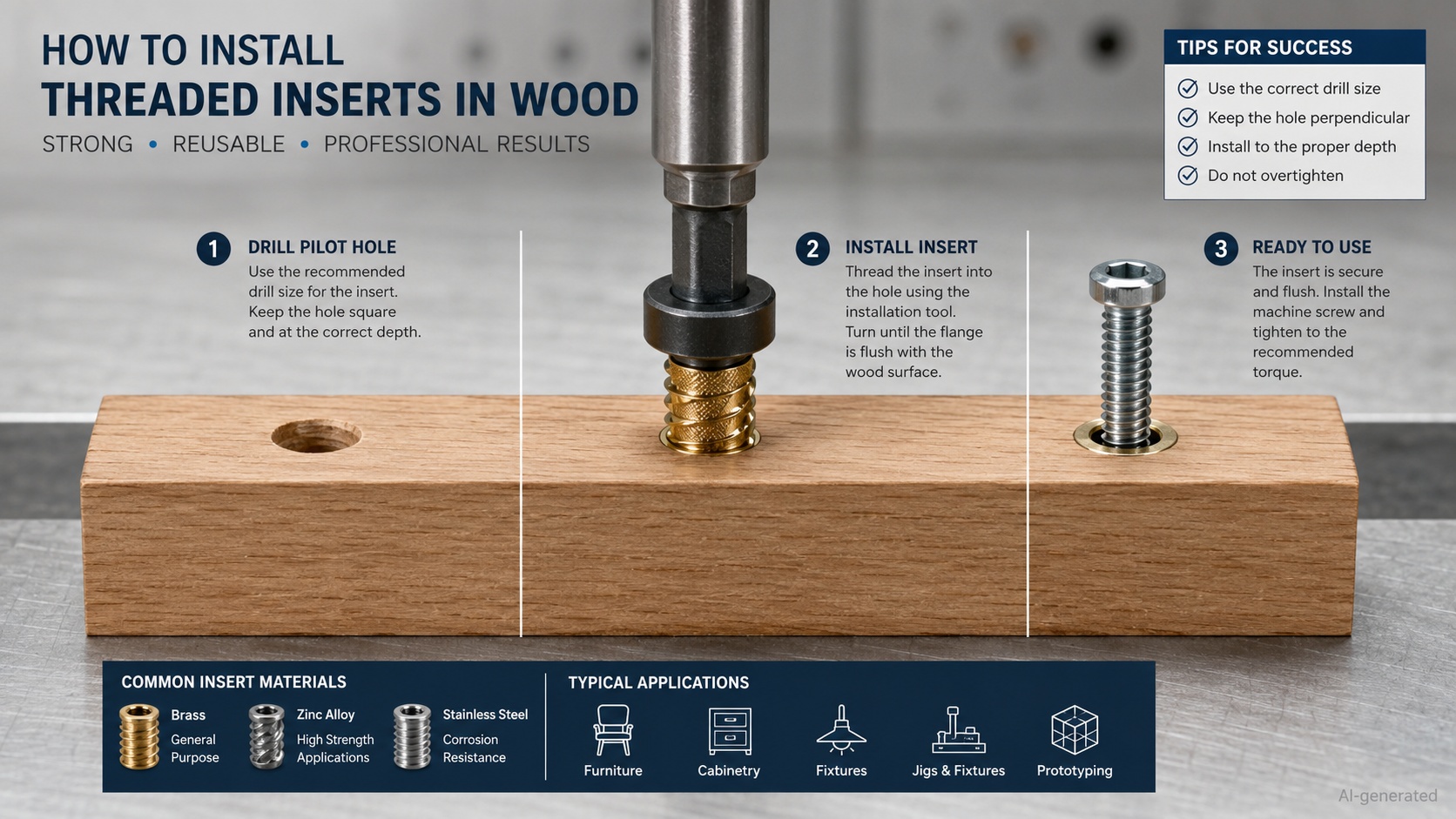
Threaded inserts for wood are used to create reusable machine threads in wood, plywood, MDF, and engineered wood. They are common in wooden jigs, test benches, furniture-style mechanical structures, fixture plates, handles, removable panels, and workshop automation aids.
For wood applications:
· Use inserts designed for wood.
· Drill the correct pilot hole.
· Avoid placing the insert too close to an edge.
· Keep the insert straight.
· Drive it slowly.
· Stop when the insert sits flush.
· Test on scrap material when working with unfamiliar wood.
Wood insert performance depends on wood type, grain direction, insert length, and load direction. A threaded insert can improve the joint, but it cannot make weak wood behave like steel.
Plastic
Threaded inserts for plastic are used when plastic parts need more durable threads than the plastic itself can provide. They are common in electronics enclosures, plastic covers, sensor housings, control panels, cable management parts, robot prototypes, and small automation accessories.
For plastic applications:
· Choose the insert type based on the plastic and production method.
· Use proper boss diameter and wall thickness.
· Avoid thin unsupported walls.
· Control heat during heat-set installation.
· Keep the insert straight.
· Validate torque and pull-out strength with the actual material.
Heat-set inserts are common in thermoplastic parts and 3D printed components. Press-fit, ultrasonic, molded-in, and self-tapping inserts may also be used depending on the design and manufacturing process.
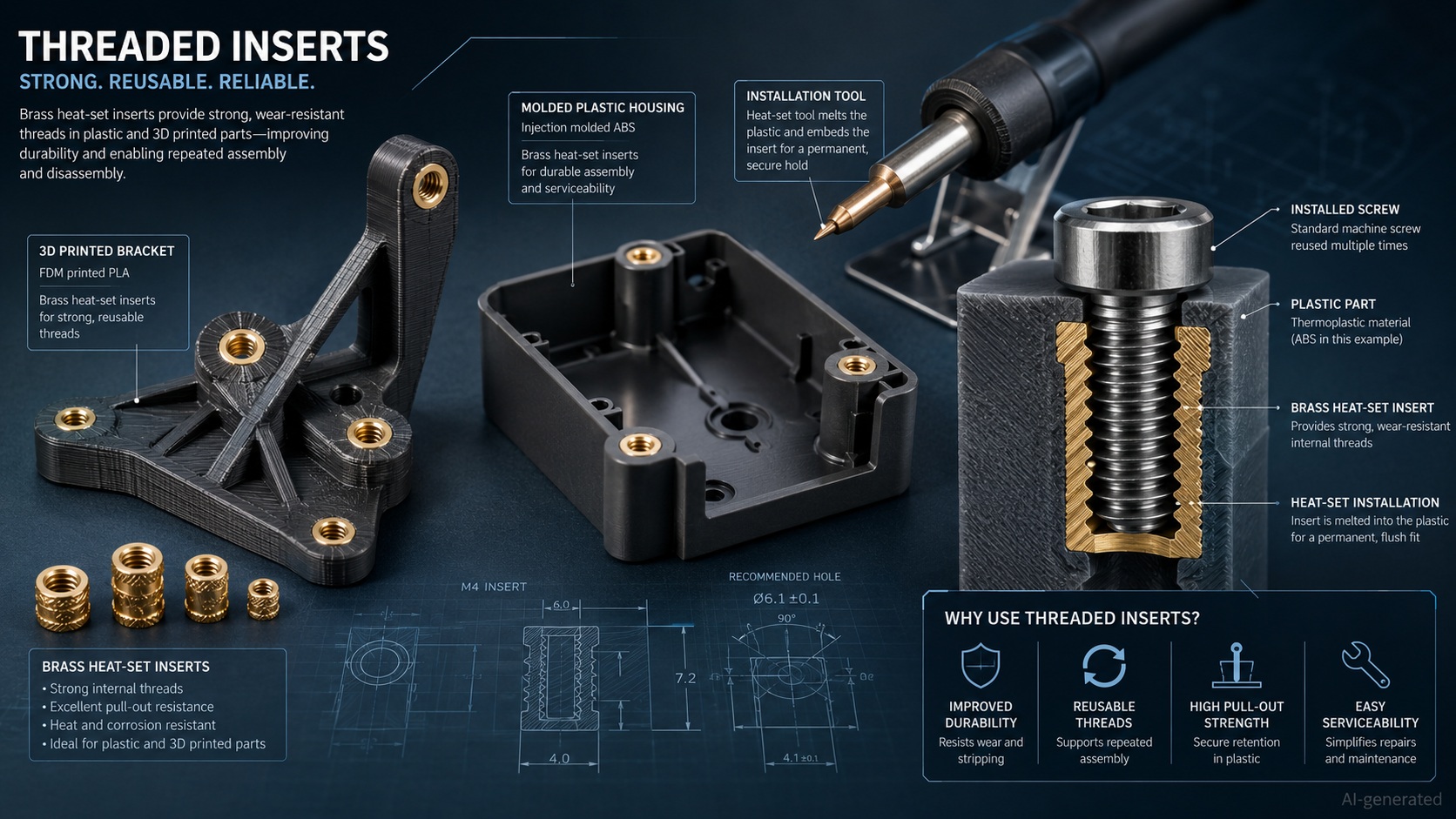
8. 3D Prints That Use Threaded Inserts
3D prints that use threaded inserts are usually more durable and more serviceable than parts that rely only on printed plastic threads. This is especially useful for functional prototypes, small automation fixtures, robot parts, sensor brackets, and electronic housings.
Common 3D printed parts that use threaded inserts include:
· Electronics housings
· Robotics brackets
· Camera mounts
· Sensor holders
· Motor covers
· Cable clamp bases
· Test fixtures
· Prototype actuator brackets
· Control panel parts
· Modular machine accessories
Heat-set inserts are one of the most common solutions for FDM printed thermoplastic parts. The insert is heated and pressed into a designed hole. The surrounding plastic softens, flows around the insert geometry, and locks the insert after cooling.
Good design is important. The printed part should have enough wall thickness around the insert. A proper boss is usually better than placing the insert into a thin wall. The hole should be deep enough, the insert should be installed straight, and the print should have enough local strength to support the load.
For 3D printed prototypes, threaded inserts are useful because prototypes change. A bracket may need to be removed, adjusted, reprinted, or tested several times. Without inserts, the plastic thread can wear out quickly. With a properly installed insert, the same part can survive multiple assembly cycles.
That may not sound exciting, but anyone who has printed version 17 of the same bracket will understand the joy of a screw hole that still works.
9. Threaded Inserts, Fasteners, and Installation Data
Threaded inserts are often used together with hex bolts, hex socket screws, and socket head cap screws. However, simply matching an M5 insert with an M5 screw is not the difficult part. That is already expected.
The more important question is whether the insert can be installed correctly and whether the surrounding material can support the fastening load. In real assemblies, the reliability of a threaded insert depends on several practical factors:
· Insert outside diameter
· Recommended pilot hole diameter
· Minimum hole depth
· Parent material strength
· Installation torque
· Screw engagement length
· Wall thickness around the insert
· Whether the joint is exposed to vibration or repeated servicing
A threaded insert should not be selected only by internal thread size. Two inserts with the same M6 internal thread may have different outside diameters, lengths, cutting features, installation torque limits, and pull-out performance.
For example, a compact M6 insert for a light cover plate is not the same design choice as an M6 insert used in a fixture plate, actuator bracket, or repaired machine base.
Reference Table: Self-Tapping Threaded Insert Installation Data
The table below gives a practical reference for self-tapping threaded inserts. Values can vary by insert series, manufacturer, material, surface treatment, and installation method, so always check the product drawing or datasheet before production use.
| Internal Thread | Typical Insert OD | Typical Insert Length | Reference Pilot Hole Ø | Reference Pilot Hole Depth | Installation Torque Note |
| M3 | 5.0 mm | 6 mm | 4.6–4.8 mm | 8 mm | Use low, controlled torque; suitable for compact brackets and small housings |
| M4 | 6.5 mm | 8 mm | 6.0–6.2 mm | 10 mm | Good for small covers, light-duty mounts, and compact automation parts |
| M5 | 8.0 mm | 10 mm | 7.3–7.6 mm | 12 mm | Common for medium covers, fixture accessories, and mounting plates |
| M6 | 10.0 mm | 14 mm | 8.9–9.4 mm | 16 mm | Useful for medium-duty brackets, handles, and frequently serviced joints |
| M8 | 12.0 mm | 15 mm | 10.9–11.4 mm | 17 mm | Suitable for stronger brackets, machine guards, and aluminum frame accessories |
| M10 | 14.0 mm | 18 mm | 12.9–13.4 mm | 20 mm | Used for heavier fixtures, machine bases, and stronger mechanical interfaces |
| M12 | 16.0 mm | 22 mm | 14.9–15.4 mm | 24 mm | Used for larger repair points, load-bearing structures, and heavy-duty assemblies |
These values should be treated as engineering starting points, not universal rules. Softer materials may require the lower end of the pilot hole range to improve grip. Harder materials may require the upper end to reduce driving torque and avoid galling, cracking, or insert damage.
For plastics and 3D printed parts, the situation is different. A heat-set insert does not use the same pilot hole logic as a self-tapping metal insert. The hole size, boss diameter, wall thickness, installation temperature, and material flow around the insert are all critical.
For wood, the pilot hole is also material-dependent. Softwood, hardwood, plywood, and MDF may require different preparation. A hole that works well in hardwood may split softwood or give poor holding force in MDF.
Why Pilot Hole Size Matters
The pilot hole is one of the most important details in threaded insert installation.
If the pilot hole is too small, the insert may:
· Require excessive installation torque
· Crack plastic or wood
· Deform the insert
· Damage the external cutting thread
· Cause poor seating depth
If the pilot hole is too large, the insert may:
· Spin during screw tightening
· Lose pull-out strength
· Sit loosely in the parent material
· Fail under vibration
· Become unreliable after repeated assembly
A correct pilot hole allows the insert to cut, form, press, or embed into the base material without overstressing it.
Installation Torque Should Not Be Ignored
Installation torque is another practical detail that is often overlooked. For self-tapping metal inserts, excessive driving torque can damage the insert, the installation tool, or the surrounding material. For plastic and wood, too much torque can crack, split, or strip the base material.
The correct installation torque depends on the insert design, parent material, lubrication, hole diameter, and installation equipment. In production, torque-controlled tools are preferred because they reduce variation between operators.
A useful rule is simple: if the insert suddenly becomes difficult to drive, do not force it. Stop and check the pilot hole, material hardness, chip removal, and alignment.
Screw Engagement Still Matters
After the insert is installed, the mating fastener must also be selected correctly. The screw should fully engage the insert thread without bottoming out in a blind hole.
For most threaded insert applications:
· The screw should engage enough internal thread to develop clamping force.
· The screw should not be so long that it bottoms out before clamping the parts.
· Washers may be needed when clamping soft surfaces.
· Threadlocker or locking hardware may be needed in vibration-prone assemblies.
· Over-tightening should be avoided, especially in plastic, wood, and thin-wall structures.
The threaded insert, screw, washer, and parent material should be treated as one fastening system. A strong insert cannot compensate for a poor pilot hole, weak surrounding material, or incorrect screw length.
In mechatronic assemblies, this system-level thinking is especially important. Sensor brackets, covers, motor plates, cable clamps, and fixture blocks are often adjusted or removed during commissioning and maintenance. A well-installed threaded insert helps the joint stay serviceable instead of becoming a repair problem later.
10. Threaded Inserts vs Tapped Holes
Tapped holes are simple and effective in many metal parts. Drill a hole, cut the thread, and install the screw. For thick steel or strong aluminum parts, this may be enough.
Threaded inserts become more valuable when the base material is soft, thin, worn, frequently serviced, or already damaged.
Use a tapped hole when:
· The material is strong enough.
· The part has enough thickness.
· The screw will not be removed often.
· The load is moderate.
· Cost and speed are the main priorities.
Use a threaded insert when:
· The material is plastic, wood, or soft metal.
· The thread will be used repeatedly.
· The connection needs better service life.
· A stripped thread must be repaired.
· Pull-out resistance matters.
· The assembly is exposed to vibration.
· Maintenance access is frequent.
In mechatronic assemblies, threaded inserts are often chosen not because a tapped hole cannot work, but because the insert gives the design better long-term reliability.
11. How to Choose the Right Threaded Insert
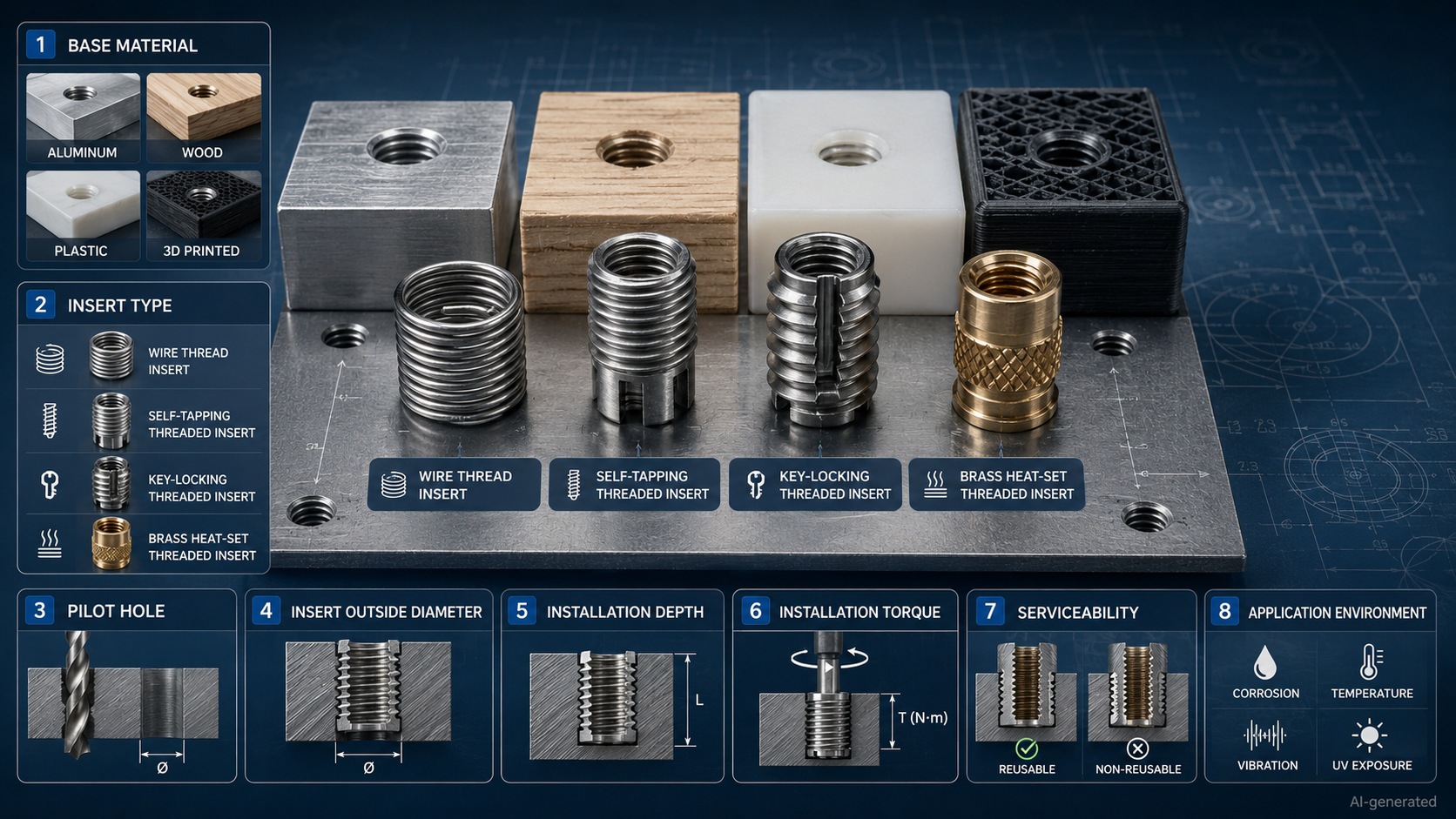
Choosing threaded inserts is not difficult, but it requires a clear understanding of the application.
Before selecting an insert, ask:
1. What is the base material—metal, wood, plastic, or a 3D printed part?
2.What screw or hex bolt size will be used?
3.Will the screw be removed repeatedly?
4.Is the main load pull-out, torque, shear, or vibration?
5.Is corrosion resistance required?
6.How much wall thickness is available?
7.Is the hole blind or through?
8.What installation tools are available?
Does the insert need to sit flush or below the surface?
A practical selection path may look like this:
| Application | Common Insert Choice |
| Stripped thread repair in metal | Wire thread insert or key-locking insert |
| Soft metal thread reinforcement | Wire thread insert or self-tapping insert |
| Plastic enclosure assembly | Heat-set, press-fit, or self-tapping insert |
| 3D printed prototype | Heat-set threaded insert |
| Wooden jig or fixture | Wood threaded insert |
| High-torque metal repair | Key-locking thread insert |
| Frequently removed machine cover | Wire thread insert or self-tapping insert |
| Medium-duty automation bracket | Self-tapping or heavy-duty insert |
The right insert should match the whole fastening system, not just the nominal thread size. Material, load direction, assembly frequency, installation method, and available wall thickness all affect the final result.
12. Common Installation Mistakes
Threaded inserts usually fail for predictable reasons. Most failures come from poor hole preparation, wrong insert selection, bad alignment, or excessive installation force.
Wrong Pilot Hole Size
This is the most common problem. A hole that is too small can crack the material or deform the insert. A hole that is too large can cause spinning, loosening, or poor pull-out strength.
Crooked Installation
A crooked insert creates a crooked screw path. In precision equipment, this can affect bracket alignment, cover fit, or sensor position.
Poor Material Support
If the wall around the insert is too thin, the insert may pull out or crack the surrounding material. This is especially important for plastic and 3D printed parts.
Overheating Heat-Set Inserts
Too much heat can deform the boss or damage the part. Too little heat can prevent the insert from seating correctly.
Over-Tightening the Screw
The insert may be metal, but the parent material still has strength limits. Excessive torque can damage plastic, crush wood, or weaken soft metal.
Ignoring Vibration
Threaded inserts improve thread durability, but they do not automatically lock the screw. In vibration-prone assemblies, use proper preload, washers, threadlocker, or locking features when needed.
13. FAQ About Threaded Inserts
What are threaded inserts used for?
Threaded inserts are used to create strong, reusable internal threads in metal, wood, plastic, and 3D printed parts. They are common in automation equipment, enclosures, brackets, fixtures, furniture, and machine repair.
How do threaded inserts work?
A threaded insert locks into the base material using wire coil geometry, external threads, cutting features, locking keys, knurls, heat-set geometry, or press-fit structure. Its internal thread then accepts a screw or bolt.
How do you install threaded inserts?
To install threaded inserts, choose the correct insert type, drill the proper pilot hole, keep the insert straight, install it with controlled force, and test the final thread with the mating screw or bolt. The exact method depends on whether the insert is used in metal, wood, plastic, or a 3D printed part.
Are threaded inserts good for 3D printed parts?
Yes. 3D prints that use threaded inserts are usually more durable than parts that rely only on plastic threads. Heat-set threaded inserts are especially common in FDM printed thermoplastic parts.
Can threaded inserts be used with hex bolts?
Yes. Threaded inserts can be used with hex bolts, hex socket screws, and socket head cap screws. The insert provides the internal thread, while the bolt provides the clamping force.
What are threaded inserts for wood used for?
Threaded inserts for wood are used to create reusable machine threads in wooden parts, jigs, fixtures, furniture-style structures, and test benches.
What are threaded inserts for metal used for?
Threaded inserts for metal are used to reinforce threads, repair stripped holes, and improve durability in aluminum, cast parts, fixture plates, and mechanical assemblies.
What are threaded inserts for plastic used for?
Threaded inserts for plastic provide durable metal threads inside plastic parts. They are common in molded housings, 3D printed parts, electronics enclosures, and automation accessories.
What is the difference between wire thread inserts and self-tapping thread inserts?
Wire thread inserts are coil-style inserts used to create or repair internal threads, often in metal parts. Self-tapping thread inserts are solid inserts with external cutting features that form their own thread in the parent material during installation.
Do threaded inserts stop screws from loosening?
Not by themselves. Threaded inserts strengthen the threaded connection, but vibration resistance still depends on screw preload, washer choice, threadlocker, locking features, and the overall fastening design.
14. Conclusion
Threaded inserts are small components with a serious job. They create stronger, reusable threads in materials that may not hold screws well on their own. Whether the material is metal, wood, plastic, or a 3D printed thermoplastic, the right insert can improve assembly strength, serviceability, and long-term reliability.
For mechatronic systems, threaded inserts are especially useful because machines are often adjusted, repaired, upgraded, and reassembled. A reliable threaded connection keeps brackets stable, covers secure, sensors aligned, and prototypes serviceable.
The best approach is to treat threaded inserts as part of a complete fastening system. Choose the right insert type, match it with the correct screw or hex bolt, prepare the hole accurately, and install it with control. Do that, and this tiny component will quietly do what good engineering parts should do: work reliably without asking for attention.
Popular Articles
Keep Learning
Threaded Standoff Guide: Types, Sizes, Materials and Applications
Key Takeaways Thread configuration first: Choose female-female, male-female or male-male based on how both sides of the assembly attach — thread config is the most practical way to classify a threaded standoff. Body length is the critical dimension: Standoff length refers to the distance between supporting faces, not total physical length. Reading the wrong length causes incorrect mounting height or screw bottoming. Material affects more than strength: Brass, stainless steel, carbon steel, aluminum an......
How to Choose a Threaded Standoff for PCB and Mechatronic Assemblies
Key Takeaways Select the right configuration: Choose male-female, female-female, or male-male thread configurations based on the two mating interfaces and the intended assembly sequence. Treat height as a tolerance stack: Standoff body length must satisfy clearance, electrical, thermal, and connector requirements across the full tolerance range, not just the nominal dimension. Verify thread engagement: Check male thread length against tapped-hole depth and upper screw length against usable female thre......
Drawer Slide Selection Guide for Equipment Trays: Sizing, Load Calculation & Locking
Key Takeaways Gross Load First: Calculate the moving assembly's gross load, including the tray, brackets, equipment and attached accessories. Travel, Not Rail Length: Specify the actual travel needed for service access; nominal rail length alone does not establish that travel. Know Your Lock: Distinguish a positive lock, a detent, a soft-close feature and a disconnect mechanism. Three Independent Checks: Treat slide capacity, mounting-bracket strength and cabinet tipping resistance as separate checks.......
Threaded Standoff vs Spacer: What Is the Difference?
Key Takeaways Threaded standoffs provide both spacing and threaded attachment points, making them ideal for modular assemblies and PCBs. Spacers are unthreaded sleeves that work with through-bolts to maintain gaps in clamped assemblies, offering a simpler and more economical solution. The right choice depends on the load path, assembly sequence, material, and service environment - not just appearance or catalog naming. A threaded standoff and a spacer can look almost identical on a workbench. Both cre......
Ball Nose End Mill Stepover: Scallop Height and Effective Diameter
Key Takeaways Geometric Control: Stepover directly controls geometric scallop height, but it does not automatically guarantee a measured Ra value. Cusp Height Formula: For a ball radius $R$ and pass spacing $s$ on a flat surface, the ideal cusp height is $h = R - \sqrt{R^2 - \frac{s^2}{4}}$. Tool Radius Advantage: A larger ball can use wider spacing for the same ideal cusp, provided it can reach the required geometry without gouging. Effective Diameter: The active cutting diameter near the tool tip ca......
Manual SMT Stencil Printer Sizing: Print Area, PCB Support and Frame Fit
Key Takeaways Different dimensions: Worktable size, effective print area, board envelope, and stencil frame size are different dimensions. Check the full pattern: Check the whole aperture pattern in its intended orientation, including clearance for the printing stroke. Thickness is not enough: A compatible board thickness does not prove that a populated underside or a support fixture will fit. Support and contact: Stable support and close stencil-to-board contact are necessary for a repeatable printin......