Blind Rivet vs Solid Rivet: Differences, Strength and Applications
19 min
- 1. What Is the Difference Between a Blind Rivet and a Solid Rivet?
- 2. How Does a Blind Rivet Work?
- 3. How Does a Solid Rivet Work?
- 4. Installation Access and Tooling
- 5. Blind Rivet vs Solid Rivet Strength
- 6. Vibration, Fatigue and Joint Integrity
- 7. Materials and Head Styles
- 8. Installation Quality and Inspection
- 9. Installation Speed, Automation and Cost
- 10. Typical Applications
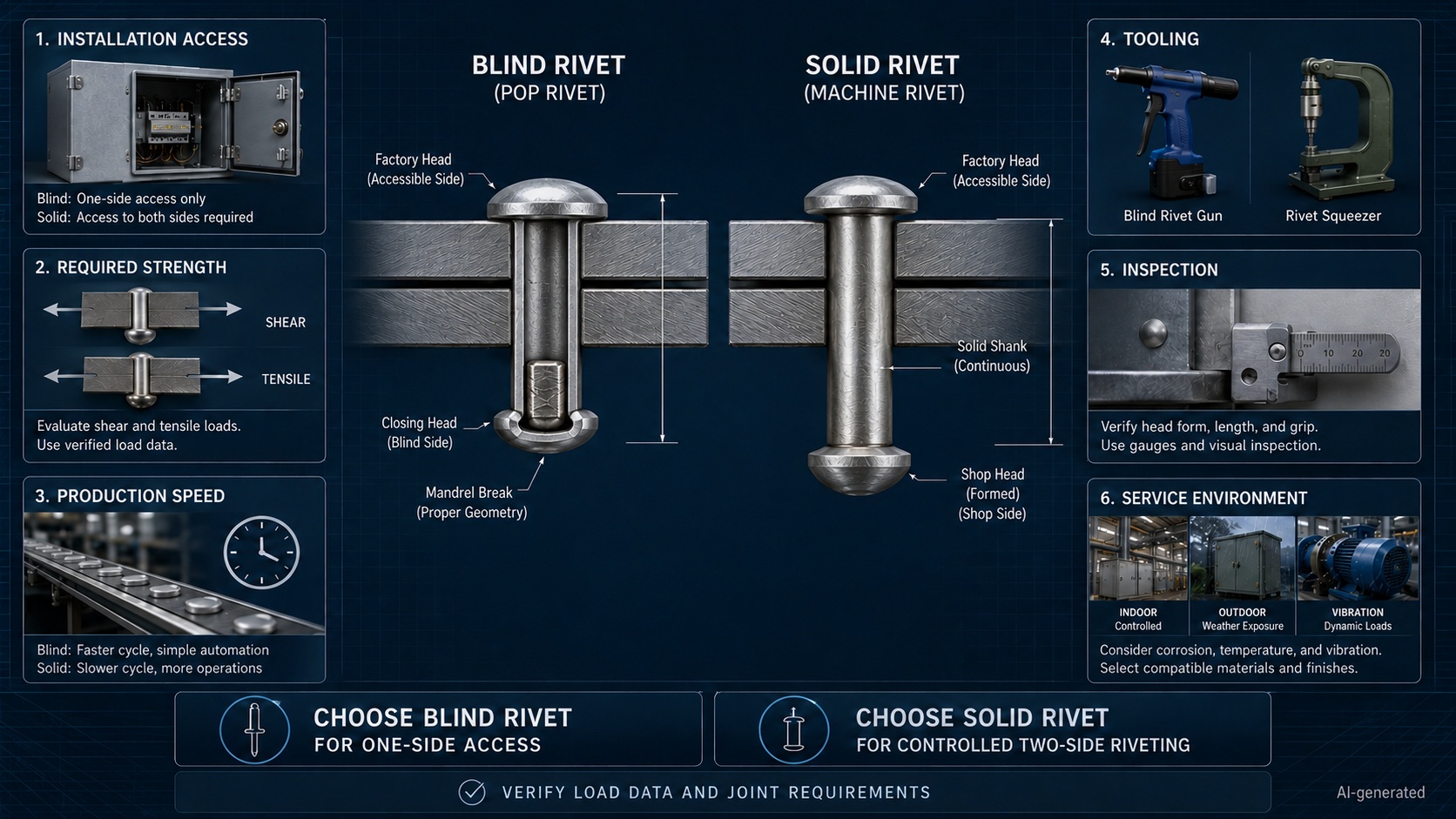
- 11. How to Choose Between a Blind Rivet and a Solid Rivet
- 12. Frequently Asked Questions
- Conclusion
Choosing between a blind rivet and a solid rivet is not simply a matter of deciding which fastener is stronger.
The correct choice depends on how the joint is assembled, whether both sides are accessible, how loads enter the structure, how quickly the rivet must be installed, what inspection is possible, and whether the connection is part of a machine cover or a highly loaded structural assembly.
A blind rivet is installed from one side by pulling a mandrel through a hollow rivet body. A solid rivet usually requires access to both sides so that its tail can be deformed against a supporting tool. Both create permanent joints, but their installation methods, available designs, tooling requirements, and typical applications differ considerably.
This blind rivet vs solid rivet guide compares their construction, strength, vibration performance, installation speed, cost, inspection requirements, and use in sheet-metal and mechatronic equipment.
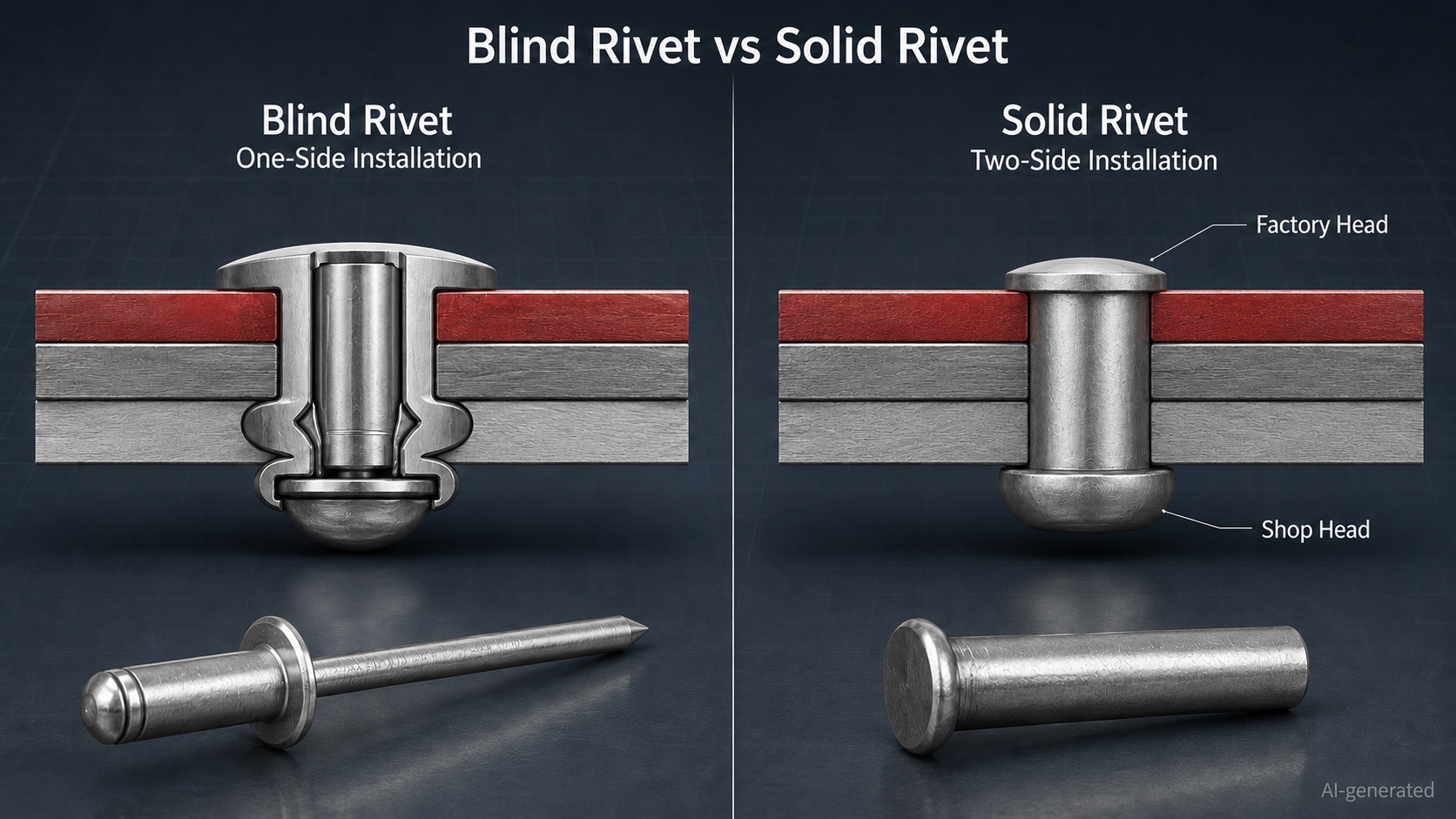
1. What Is the Difference Between a Blind Rivet and a Solid Rivet?
The main difference is installation access.
A blind rivet can be installed when only one side of the assembly is accessible. The fastener contains a hollow rivet body and a mandrel. Pulling the mandrel deforms the body behind the workpiece and forms the blind-side closing head.
A solid rivet is a one-piece fastener with a solid shank and a factory-formed head. During installation, the plain tail is mechanically deformed to create a second head. This process normally requires access to both ends of the rivet.
The basic distinction can be summarized as follows:
| Feature | Blind Rivet | Solid Rivet |
| Rivet construction | Hollow body with mandrel | One-piece solid shank |
| Installation access | One side | Usually both sides |
| Setting method | Mandrel is pulled through the body | Tail is hammered, squeezed, or pressed |
| Typical tool | Hand, battery, pneumatic, or hydraulic riveter | Rivet gun and bucking bar, rivet squeezer, or press |
| Installation speed | Generally fast | Depends heavily on access and process |
| Rear-side operator or tool | Not required | Usually required |
| Joint removal | Normally drilled out | Normally drilled out |
| Common applications | Enclosures, panels, covers, hollow sections | Aircraft structures, heavy sheet assemblies, traditional metalwork |
| Internal thread | No | No |
| Joint type | Permanent | Permanent |
JLCMC classifies blind rivets and solid rivets as separate types of permanent mechanical fasteners. The platform also lists related products such as threaded, hollow, grooved, flush, and split rivets.
2. How Does a Blind Rivet Work?
A blind rivet consists primarily of:
· A hollow rivet body
· A mandrel
· A factory-formed head
· A deformable blind end
The rivet body is inserted through aligned holes in the materials being joined. A rivet tool grips the projecting mandrel and pulls it toward the accessible side.
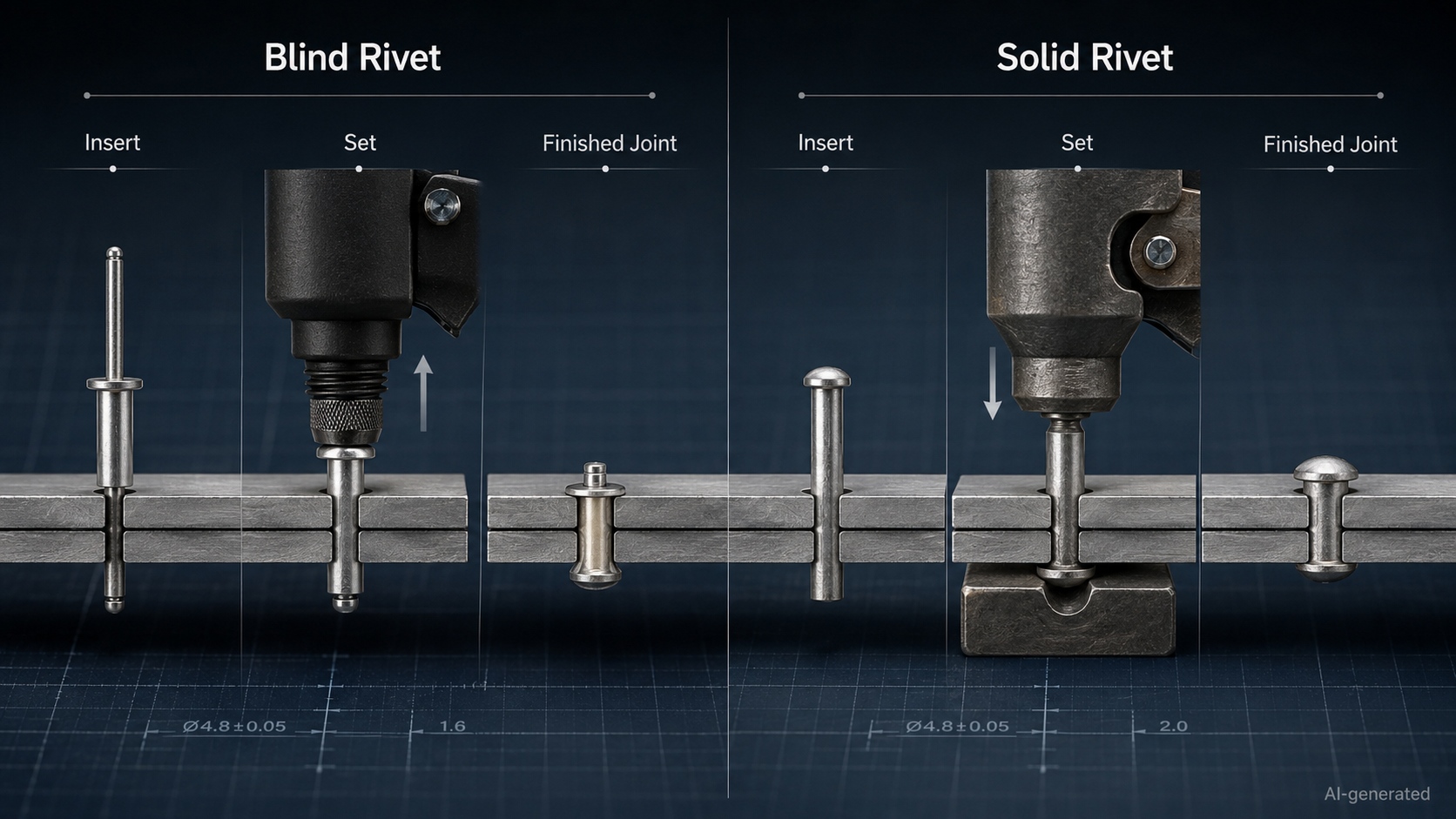
As the mandrel moves, its enlarged head forces the blind end of the rivet body to expand and shorten. This creates a closing head behind the workpiece and clamps the materials between the two rivet heads.
The installation sequence is:
Insert → Pull → Expand → Break
Once the required setting load is reached, the mandrel breaks at a designed point. The rivet body remains in the joint.
This installation method is valuable for:
· Enclosed structures
· Hollow profiles
· Folded sheet-metal parts
· Equipment housings
· Assemblies with internal components
· Locations where a backing tool cannot reach
The term “blind” refers to the installer not needing access to the rear side. A blind rivet is therefore useful when a conventional solid-riveting process would be impossible or unnecessarily difficult.
Blind rivets are also commonly called pop rivets. Strictly speaking, blind rivet is the generic fastener category, while POP® originated as a brand name associated with blind riveting systems.
For a complete explanation of blind rivet types, materials, grip ranges, installation, and removal, see the main Blind Rivet Guide.
3. How Does a Solid Rivet Work?
A solid rivet is manufactured from one continuous piece of material.
It normally includes:
· A factory-formed head
· A solid cylindrical shank
· A plain tail
The rivet is placed through aligned holes, and its factory head is supported on one side. Force is then applied to the exposed tail from the opposite side.
The tail shortens and expands until it forms a second head, often called the shop head or driven head. The materials are clamped between the factory head and the newly formed head.
Common solid-rivet installation methods include:
Rivet Gun and Bucking Bar
A pneumatic rivet gun fitted with a rivet set applies impact force to the protruding tail, while a bucking bar supports the factory head on the opposite side. The repeated impact upsets and expands the tail to form a shop head.
Rivet Squeezer
A manual, pneumatic, or hydraulic squeezer applies controlled compressive force from both sides.
Squeezing often provides a more controlled result than impact riveting, but the tool jaws must reach both sides of the joint.
Press Riveting
A mechanical or hydraulic press deforms the rivet in a controlled production process.
This is useful for repeatable factory assembly where part geometry allows access to both sides.
NASA installation guidance for solid rivets treats their installation as a controlled process requiring correct rivet dimensions, hole preparation, tooling, and final shop-head geometry. Solid riveting therefore involves more than simply striking the tail until it looks approximately round.
4. Installation Access and Tooling
Access is often the deciding factor before strength, price, or material is even considered.
Blind Rivet Access
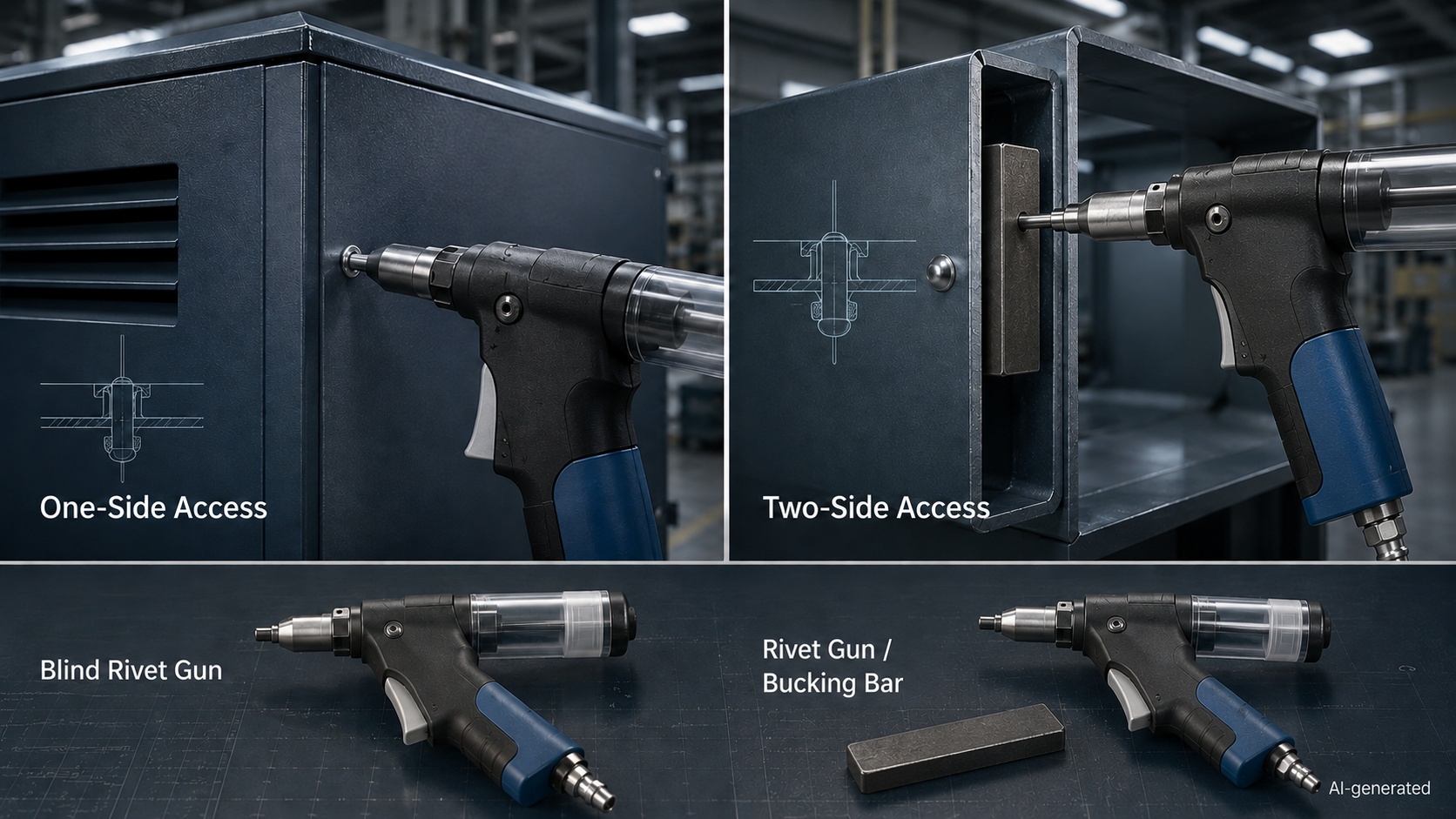
A blind rivet requires access to only the visible side.
This makes it suitable for:
· A closed electrical enclosure
· A folded machine cover
· A hollow tube
· A ventilation duct
· A panel mounted over internal components
· A structure assembled before riveting
The riveting tool must reach the mandrel, but no backing tool is required behind the joint.
Solid Rivet Access
A solid rivet normally requires:
· Access to the factory head
· Access to the tail
· Space for a bucking bar, squeezer, or press
· Sufficient room to hold both tools in alignment
NASA technical material notes that conventional solid-rivet installation requires both ends to be accessible for the driving tool and bucking bar.
This can be straightforward on an open frame or flat sheet before final assembly. It becomes much more difficult inside a narrow housing or behind an already installed panel.
Tooling Comparison
Blind rivet tools include:
· Manual hand riveters
· Lever riveters
· Battery-powered tools
· Pneumatic-hydraulic tools
· Automated feeding and setting systems
Solid rivet tools include:
· Hammers
· Pneumatic rivet guns
· Bucking bars
· Manual squeezers
· Pneumatic or hydraulic squeezers
· Mechanical presses
· Dedicated riveting machines
Blind riveting is usually easier for field repairs, small workshops, and one-person assembly. Solid riveting may require more training, access planning, noise control, and coordination between operators.
5. Blind Rivet vs Solid Rivet Strength
A common question is:
Is a solid rivet stronger than a blind rivet?
The accurate answer is: often, but not automatically.
A conventional solid rivet has a continuous metal shank without a mandrel or hollow body, which can provide efficient load transfer when properly installed.In comparable materials and diameters, this can provide efficient load transfer and predictable structural performance.
However, the final joint strength depends on more than whether the rivet is solid or blind.
Important factors include:
· Rivet material
· Rivet design
· Hole diameter
· Hole quality
· Material thickness
· Grip condition
· Edge distance
· Rivet spacing
· Head style
· Installation quality
· Load direction
· Number of rivets
· Workpiece material
Shear Strength
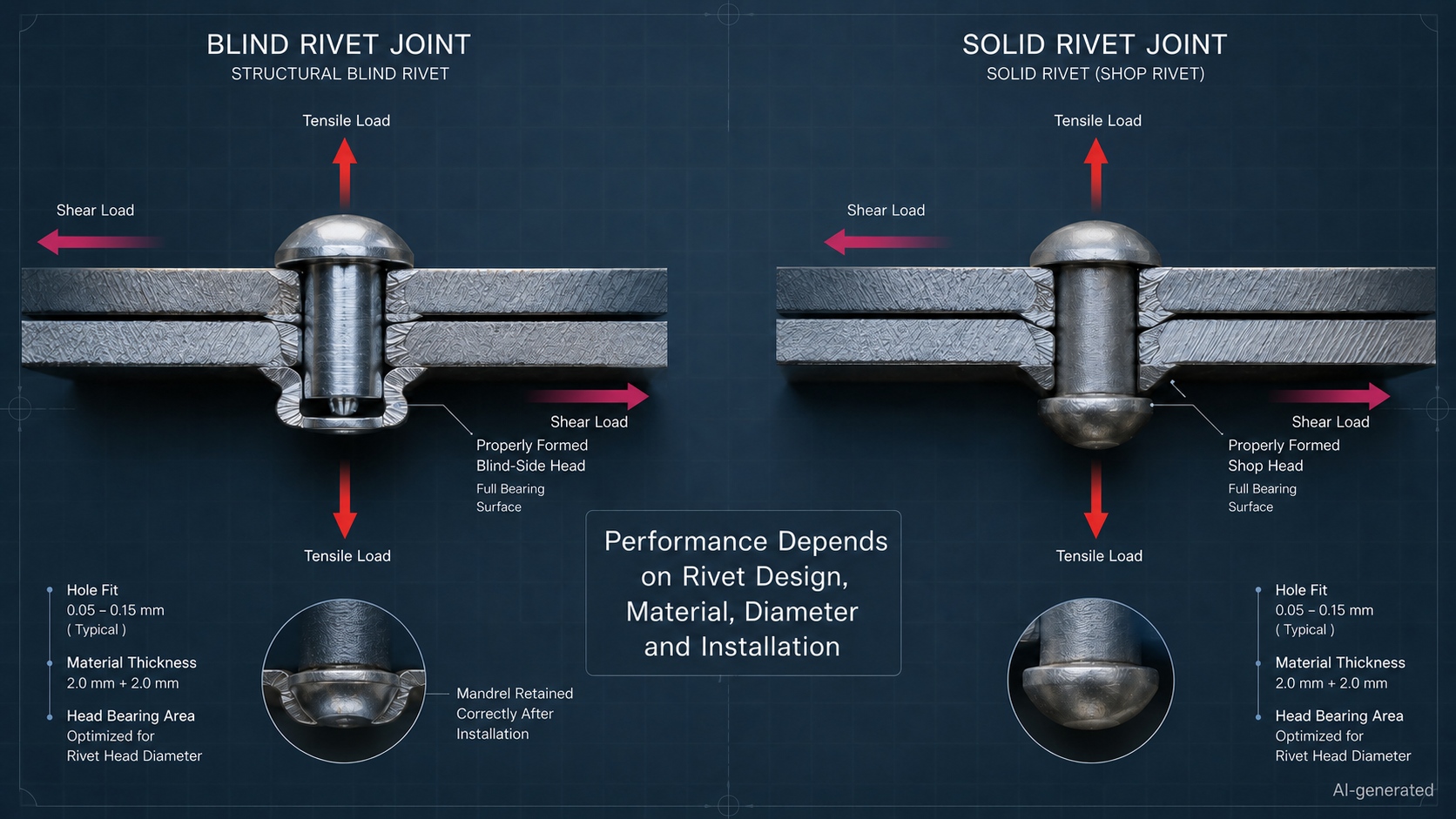
Shear load acts across the rivet shank and tries to slide the joined materials relative to each other.
A solid shank can provide a substantial load-bearing cross-section. This is one reason solid rivets are used in many traditional structural applications.
A standard open-end blind rivet has a hollow body and may provide lower shear capacity than a comparable solid rivet. However, structural blind rivets may use larger bodies, improved hole filling, retained mandrels, or specialized locking systems to provide much higher performance than ordinary blind rivets.
Tensile Strength
Tensile load acts along the rivet axis and tries to pull the joined materials apart.
Performance depends on:
· Factory-head diameter
· Blind-side head formation
· Material strength
· Sheet bearing strength
· Hole size
· Rivet grip
· Rivet construction
Blind-rivet manufacturers specify individual tensile and shear ratings because rivets with the same nominal diameter can have very different capacities. Joint strength also depends on rivet spacing, material, and diameter.
Avoiding an Oversimplified Comparison
The following statement is too broad:
Solid rivets are always stronger than blind rivets.
A better engineering conclusion is:
A conventional solid rivet often offers greater structural efficiency than a standard open-end blind rivet of similar material and diameter, but actual performance must be compared using product-specific tensile, shear, fatigue, and joint data.
A structural blind rivet can outperform a smaller, softer, or incorrectly installed solid rivet. The label alone does not carry the load.
6. Vibration, Fatigue and Joint Integrity
Strength values from a static test are important, but many machines rarely experience perfectly static loads.
Equipment may be exposed to:
· Motor vibration
· Repeated acceleration
· Impact
· Thermal expansion
· Transport shock
· Pressure cycling
· Opening and closing loads
· Long-term fatigue
Solid Rivet Performance
A properly installed solid rivet expands within the hole during setting. This can create good hole filling and a stable load path.
Solid riveted joints have a long history in structures exposed to cyclic loading, particularly where the design, installation, and inspection process is tightly controlled.
Their performance depends on correct:
· Rivet length
· Hole fit
· Shop-head formation
· Material compatibility
· Rivet spacing
· Edge distance
· Surface condition
An under-driven rivet may not clamp the materials properly. An over-driven rivet may damage the sheet or produce an unacceptable shop head.
Blind Rivet Performance
The vibration performance of a blind rivet depends heavily on its construction.
A basic non-structural open-end rivet may be suitable for:
· Covers
· Guards
· Ducts
· Light brackets
· Noncritical enclosures
More demanding joints may require a structural blind rivet with:
· Positive mandrel retention
· Higher clamp load
· Greater blind-side expansion
· Better hole filling
· Higher tensile and shear strength
· Improved resistance to rattling
Some structural blind-rivet designs specifically use retained mandrels and larger blind-side expansion to improve vibration resistance and joint integrity.
Neither rivet type should be selected for fatigue-sensitive or safety-critical equipment without proper joint testing and documented engineering data.
7. Materials and Head Styles
Blind rivets and solid rivets are available in several materials, including:
· Aluminum
· Carbon steel
· Stainless steel
· Copper
· Brass
· Specialized alloys
The best material depends on:
· Required strength
· Weight
· Corrosion resistance
· Installation force
· Temperature
· Base-material compatibility
· Electrical conductivity
· Appearance
· Service environment
Aluminum
Aluminum rivets are lightweight and corrosion-resistant in many ordinary environments.
They are often used in:
· Aluminum panels
· Enclosures
· Appliances
· Transport components
· Lightweight structures
Aluminum is generally easier to deform during installation than steel or stainless steel.
Carbon Steel
Carbon steel provides relatively high strength at a practical cost.
Protective coatings may be needed when the joint is exposed to moisture or corrosive environments.
Stainless Steel
Stainless steel combines strength with good corrosion resistance but requires greater installation force.
Both blind- and solid-riveting equipment must be suitable for the selected alloy and rivet diameter.
Material Compatibility
Dissimilar metals can create galvanic corrosion when they are in electrical contact and exposed to moisture or another electrolyte.
A stainless steel rivet in an aluminum sheet may require:
· Isolation coating
· Sealant
· Protective finish
· Material review
· Environmental testing
The strongest rivet material is not necessarily the most suitable one.
Head Styles
Common head styles include:
· Round or dome head
· Universal head
· Flat head
· Large-flange head
· Countersunk or flush head
Large-flange blind rivets distribute load over a wider area and can help with thin or soft materials.
Countersunk blind and solid rivets require correctly prepared countersunk holes. Their use can create a flush surface, but removing material to form the countersink may reduce the remaining sheet thickness.
8. Installation Quality and Inspection
A good rivet joint depends on process control.
Inspecting a Blind Rivet
After installation, check that:
· The factory head sits flat
· The joined parts have no unwanted gap
· The rivet does not spin
· The mandrel broke normally
· The surrounding sheet is not cracked
· The blind-side head formed correctly, if visible
· The head has not pulled into the surface
· The rivet body is not tilted
Blind-side inspection can be difficult because the rear of the joint may be inaccessible. This is one of the tradeoffs that comes with one-sided installation.
Hole size is especially important. Blind-rivet design guidance recommends selecting the hole according to the rivet specification and keeping it clean and correctly formed.
Inspecting a Solid Rivet
A solid rivet joint can be inspected for:
· Factory-head condition
· Shop-head diameter
· Shop-head height
· Rivet alignment
· Sheet deformation
· Cracks
· Gaps between materials
· Damage from the riveting tool
· Edge distance and spacing
Because both sides are normally accessible during installation, the shop head can usually be examined directly.
However, visual access does not guarantee good workmanship. Incorrect bucking pressure, tool angle, rivet length, or impact force can still produce a defective joint.
Process Consistency
Blind riveting is often easier to standardize using tools that control pull force or stroke.
Solid riveting can also be highly repeatable when performed with a correctly adjusted squeezer or press. Manual impact riveting may depend more heavily on operator technique.
For production work, representative joints should be validated using appropriate mechanical tests rather than appearance alone.
9. Installation Speed, Automation and Cost
Fastener price is only one part of the total assembly cost.
The complete cost includes:
· Hole preparation
· Equipment
· Labor
· Operator training
· Access
· Inspection
· Rework
· Production speed
· Maintenance
· Joint failures
Blind Rivet Installation Speed
Blind rivets are generally fast to install.
A worker can insert the rivet, position the tool, complete the pull cycle, and move to the next joint without accessing the rear side.
This is valuable for:
· Large enclosures
· Long ducts
· Finished assemblies
· Field installation
· Repair work
· High-volume sheet-metal production
Automated blind-riveting equipment can feed and set fasteners rapidly, although the system cost must be justified by production volume.
Solid Rivet Installation Speed
Solid riveting may be fast in a well-designed production cell, particularly when presses or squeezers are used.
It becomes slower when:
· Two workers are required
· Rear access is restricted
· Bucking bars must be repositioned
· Components require complex fixtures
· Noise restrictions apply
· Shop-head inspection is extensive
Fastener Cost vs Process Cost
A solid rivet itself may be simple and inexpensive.
A blind rivet is more complex because it includes both a body and mandrel. It may therefore cost more per piece.
However, a more expensive blind rivet can still reduce total assembly cost if it eliminates:
· A second operator
· Rear-side tooling
· Special fixtures
· Assembly disassembly
· Difficult access
· Additional handling
The cheapest fastener on the purchasing sheet is not always the cheapest joint on the production line.
10. Typical Applications
Blind Rivet Applications
Blind rivets are commonly used in:
· Electrical enclosures
· Control cabinets
· Machine guards
· Equipment covers
· HVAC ducts
· Ventilation panels
· Signs
· Appliances
· Vehicle body panels
· Electronic housings
· Hollow profiles
· Field repairs
They are especially attractive when the rear of the joint is enclosed or blocked.
Solid Rivet Applications
Solid rivets are traditionally used in:
· Aircraft structures
· Bridges and traditional steel structures
· Pressure-related assemblies
· Heavy sheet-metal fabrication
· Cookware
· Braking components
· Leather and decorative products
· High-integrity permanent joints
The appropriate rivet material, process, and standard depend heavily on the industry.
Applications in Mechatronic Equipment
In mechatronic equipment, blind rivets are well suited to:
· Control-cabinet ventilation plates
· Motor covers
· Fan guards
· Cable-management brackets
· Sensor housings
· Sheet-metal guards
· Inspection covers that do not require routine removal
Solid rivets may be considered where:
· Both sides remain accessible
· Higher structural performance is required
· Production tooling is available
· The joint is designed around a controlled riveting process
· Permanent, high-integrity fastening is the priority
JLCMC supplies rivets alongside fasteners, linear-motion components, transmission parts, sensor brackets, motors, and other components used in automation equipment. Its Rivets category includes blind rivets, solid rivets, and related permanent fasteners in several materials.
Where a component must be removed repeatedly, neither a blind rivet nor a solid rivet may be ideal. A screw, nut, threaded insert, or blind rivet nut may provide better serviceability.
11. How to Choose Between a Blind Rivet and a Solid Rivet
Use the following questions to guide the decision.
Can Both Sides of the Joint Be Reached?
Choose a blind rivet when only one side is accessible.
A solid rivet is practical only when the tail can be supported and formed correctly.
Is the Joint Structural or Safety-Critical?
Do not select a fastener solely by category.
Compare:
· Tensile rating
· Shear rating
· Fatigue data
· Rivet spacing
· Edge distance
· Hole fit
· Installation specification
· Relevant industry standards
A validated solid-rivet joint may be preferable for demanding structural work. A documented structural blind-rivet system may be appropriate where one-sided installation is essential.
How Important Is Installation Speed?
Blind rivets usually offer faster one-person installation.
Solid rivets may still be efficient in high-volume production with dedicated presses or squeezers.
Is Rear-Side Inspection Required?
Solid riveting generally allows direct inspection of the formed shop head.
The blind-side head of a blind rivet may be difficult or impossible to inspect after installation.
Will the Assembly Be Exposed to Vibration?
For a light cover, a standard blind rivet may be sufficient.
For more demanding vibration, evaluate structural blind rivets, retained mandrels, hole filling, clamp load, and fatigue performance.
A properly specified solid rivet may also provide excellent vibration and fatigue performance.
Does the Joint Need to Be Sealed?
Standard open-end blind rivets are not automatically sealed.
Closed-end or specialized sealed blind rivets may improve leakage resistance. Solid riveted joints may also require sealant depending on the application.
Will the Component Need to Be Removed?
Both fastener types create permanent joints and normally require drilling for removal.
Use a threaded fastening system when routine maintenance is expected.
What Is the Total Installed Cost?
Compare tooling, labor, access, inspection, production rate, and rework—not only the unit price of the rivet.
Quick Selection Summary
Choose a blind rivet when:
· Only one side is accessible
· Installation speed is important
· The assembly is enclosed
· A simple one-person process is preferred
· The application is sheet metal, a housing, cover, or guard
· A suitable structural blind design is available for the required load
Choose a solid rivet when:
· Both sides are accessible
·The joint is designed for solid riveting
· High structural efficiency is required
· Shop-head inspection is important
· Suitable riveting tools and trained operators are available
· The production process can control tail deformation accurately
12. Frequently Asked Questions
Is a Solid Rivet Stronger Than a Blind Rivet?
A solid rivet often provides higher structural efficiency than a standard open-end blind rivet of similar diameter and material.
However, strength depends on the specific rivet design, material, diameter, hole quality, installation, and joint geometry. Structural blind rivets can provide much higher performance than ordinary blind rivets.
Is a Pop Rivet the Same as a Blind Rivet?
In everyday use, yes. Pop rivet is commonly used as an informal name for a mandrel-style blind rivet.
Blind rivet is the generic technical term.
Can a Blind Rivet Replace a Solid Rivet?
Sometimes, but not automatically.
The replacement must meet the joint’s required tensile, shear, fatigue, corrosion, temperature, and vibration performance. Hole size, grip range, head geometry, spacing, and applicable standards must also be reviewed.
Can a Solid Rivet Be Installed From One Side?
A conventional solid rivet normally requires access to both ends.
Special riveting methods and fasteners exist, but they should not be confused with standard solid-rivet installation.
Which Rivet Is Easier to Install?
A blind rivet is generally easier where rear access is limited. It can usually be installed by one operator using a manual or powered riveter.
Solid riveting may require a bucking bar, second operator, squeezer, or press.
Which Rivet Is Faster to Install?
Blind rivets are often faster for enclosed sheet-metal assemblies because no rear-side operation is needed.
Solid rivets can be fast in controlled production environments with dedicated tooling.
Which Rivet Is Better for Aircraft?
Solid rivets are widely used in aircraft structures, but the correct fastener depends on the approved design and maintenance documentation.
Aircraft repairs and modifications must follow the applicable structural repair manual, engineering data, and aviation requirements rather than a general online comparison.
Which Rivet Is Better for a Control Cabinet?
Blind rivets are generally convenient for permanently attaching sheet-metal panels, ventilation parts, labels, and internal brackets when only the front side is accessible.
For removable components, use screws with nuts, threaded inserts, or blind rivet nuts.
Can Blind Rivets Handle Vibration?
Yes, when the correct rivet is selected.
Standard blind rivets may be suitable for light equipment, while demanding vibration applications may require structural blind rivets with higher clamp load and retained mandrels.
Are Blind Rivets More Expensive?
The individual fastener may cost more than a basic solid rivet because it includes a body and mandrel.
However, blind riveting can reduce labor, access, tooling, and assembly costs.
Can Blind and Solid Rivets Be Removed?
Yes, but both are permanent fasteners and are normally removed by drilling.
The removed rivet should not be reused.
Should I Choose a Rivet by Diameter Alone?
No.
Selection should also consider material, grip range, hole diameter, head style, tensile and shear loads, corrosion, edge distance, spacing, access, and installation equipment.
Conclusion
The blind rivet vs solid rivet decision begins with access but should not end there.
A blind rivet is usually the more practical option when only one side of a sheet-metal assembly is accessible. It supports fast installation, compact tooling, and efficient assembly of enclosures, machine guards, equipment covers, ventilation components, and hollow structures.
A solid rivet is often preferred when both sides are accessible and the joint requires a tightly controlled, high-integrity permanent connection. Its continuous shank and directly formed shop head make it valuable in structural applications where the process, tooling, inspection, and joint geometry are designed around solid riveting.
Neither type is universally stronger, cheaper, or better. The correct choice depends on the specific fastener, joint design, material, load, environment, production process, and inspection requirements.
Engineers and purchasing teams can review available blind rivets, solid rivets, materials, head styles, and related fastening components through the JLCMC Rivets category. Select the rivet using documented specifications—not by whichever fastener happens to be closest to the drill press.
Popular Articles
Keep Learning
Threaded Standoff vs Spacer: What Is the Difference?
Key Takeaways Threaded standoffs provide both spacing and threaded attachment points, making them ideal for modular assemblies and PCBs. Spacers are unthreaded sleeves that work with through-bolts to maintain gaps in clamped assemblies, offering a simpler and more economical solution. The right choice depends on the load path, assembly sequence, material, and service environment - not just appearance or catalog naming. A threaded standoff and a spacer can look almost identical on a workbench. Both cre......
How to Choose a Threaded Standoff for PCB and Mechatronic Assemblies
Key Takeaways Select the right configuration: Choose male-female, female-female, or male-male thread configurations based on the two mating interfaces and the intended assembly sequence. Treat height as a tolerance stack: Standoff body length must satisfy clearance, electrical, thermal, and connector requirements across the full tolerance range, not just the nominal dimension. Verify thread engagement: Check male thread length against tapped-hole depth and upper screw length against usable female thre......
Threaded Standoff Guide: Types, Sizes, Materials and Applications
Key Takeaways Thread configuration first: Choose female-female, male-female or male-male based on how both sides of the assembly attach — thread config is the most practical way to classify a threaded standoff. Body length is the critical dimension: Standoff length refers to the distance between supporting faces, not total physical length. Reading the wrong length causes incorrect mounting height or screw bottoming. Material affects more than strength: Brass, stainless steel, carbon steel, aluminum an......
Ball Nose End Mill Stepover: Scallop Height and Effective Diameter
Key Takeaways Geometric Control: Stepover directly controls geometric scallop height, but it does not automatically guarantee a measured Ra value. Cusp Height Formula: For a ball radius $R$ and pass spacing $s$ on a flat surface, the ideal cusp height is $h = R - \sqrt{R^2 - \frac{s^2}{4}}$. Tool Radius Advantage: A larger ball can use wider spacing for the same ideal cusp, provided it can reach the required geometry without gouging. Effective Diameter: The active cutting diameter near the tool tip ca......
Manual SMT Stencil Printer Sizing: Print Area, PCB Support and Frame Fit
Key Takeaways Different dimensions: Worktable size, effective print area, board envelope, and stencil frame size are different dimensions. Check the full pattern: Check the whole aperture pattern in its intended orientation, including clearance for the printing stroke. Thickness is not enough: A compatible board thickness does not prove that a populated underside or a support fixture will fit. Support and contact: Stable support and close stencil-to-board contact are necessary for a repeatable printin......
Blind Rivet Guide: Types, Sizes, Uses, Installation and Removal
A blind rivet may be small, but choosing one correctly involves more than matching a rivet to the nearest drill bit. The diameter, grip range, hole size, body material, mandrel material, head style and installation tool all influence the finished joint. A rivet that looks perfectly acceptable before installation can still spin, loosen, pull through the sheet or form incorrectly on the blind side if one of these factors is overlooked. Blind rivets are widely used in sheet-metal fabrication, electrical ......