Aluminum vs Steel vs Stainless Steel Blind Rivet: How to Choose
18 min
- 1. Why Blind Rivet Material Matters
- 2. Rivet Body Material vs Mandrel Material
- 3. Aluminum Blind Rivet
- 4. Steel Blind Rivet
- 5. Stainless Steel Blind Rivet
- 6. Aluminum vs Steel vs Stainless Steel Blind Rivet
- 7. Matching the Blind Rivet to the Base Material
- 8. Galvanic Corrosion Between Rivets and Panels
- 9. Material Choice and Installation Tools
- 10. Material Selection by Application
- 11. How to Choose the Best Blind Rivet Material
- 12. Frequently Asked Questions
- Conclusion
Choosing a blind rivet material may look like a simple three-way decision: aluminum, steel or stainless steel. Pick the strongest one and move on, right?
Not quite.
The correct blind rivet material depends on the materials being joined, the direction and magnitude of the load, corrosion exposure, weight limits, installation-tool capacity and expected service life. The rivet body and mandrel may also use different materials, which means two apparently similar rivets can behave very differently during installation and service.
An aluminum blind rivet may be ideal for a lightweight electrical enclosure but unsuitable for a heavily loaded steel bracket. A steel blind rivet can deliver higher mechanical strength at a reasonable cost, yet it may need additional corrosion protection. A stainless steel blind rivet often provides higher strength and corrosion resistance than general-purpose aluminum or carbon steel blind rivets, but actual performance depends on rivet design and product specifications. and most corrosion-resistant option of the three, but it requires greater setting force and is not automatically the best match for every aluminum panel.
This guide compares the most common blind rivet materials and explains how to select a practical combination for sheet metal, machine guards, control cabinets, electronic housings and other mechatronic assemblies.
For a wider explanation of rivet types, sizing, installation and removal, refer to the complete Blind Rivet Guide.
1. Why Blind Rivet Material Matters
The material of a blind rivet affects almost every part of the joint.
It influences:
· Tensile and shear performance
· Resistance to corrosion
· Rivet weight
· Required setting force
· Compatibility with the base material
· Resistance to vibration and deformation
· Appearance and surface finish
· Tool wear
· Product cost
· Expected service life
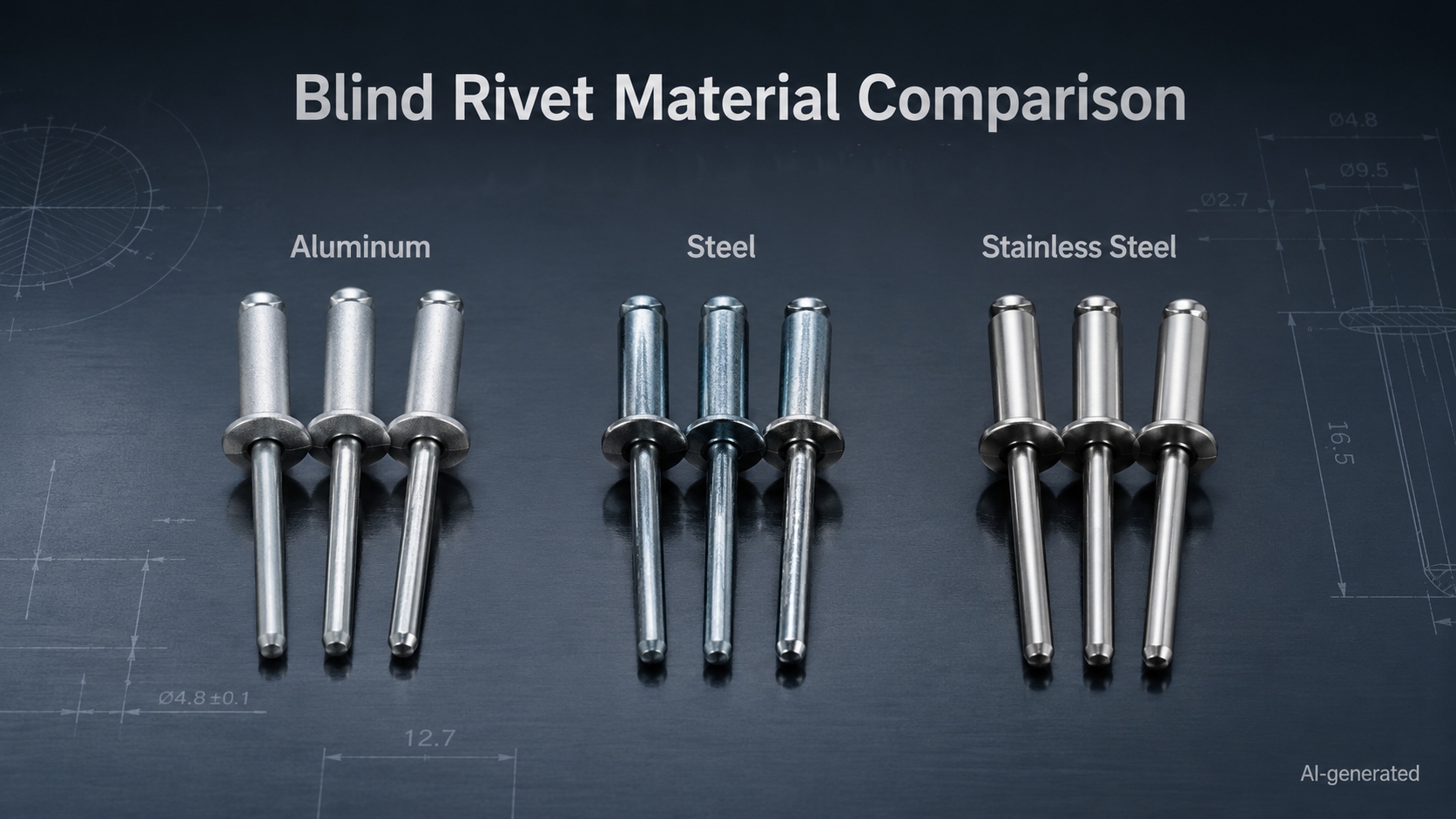
Blind rivets are commonly produced in aluminum, steel, stainless steel, copper and nickel-copper alloys. For most general industrial and sheet-metal applications, however, aluminum, carbon steel and stainless steel are the main options engineers compare.
Material selection should not be based on rivet diameter alone. Two blind rivets with the same nominal diameter and grip range may have very different load ratings because of differences in body material, mandrel material, geometry and manufacturing standard.
JLCMC, for example, lists open-end blind rivets in A5050 aluminum and SUS304 stainless steel, with individual specifications for hole diameter, riveting range, minimum tensile load and minimum shear load.
The practical lesson is straightforward:
Select a blind rivet from documented product data, not simply from its color, diameter or what happens to be left in the workshop drawer.
2. Rivet Body Material vs Mandrel Material
A blind rivet has two principal material components:
· The rivet body
· The mandrel, sometimes called the rivet core or stem
These components do different jobs.
The rivet body passes through the workpiece and deforms to create the blind-side closing head. It remains in the finished joint and directly influences bearing area, clamping behavior, corrosion resistance and mechanical capacity.
The mandrel is pulled by the riveting tool. Its enlarged head deforms the rivet body, and the stem normally breaks at a predetermined point once the rivet is set.
Common material combinations include:
| Rivet body | Mandrel | General characteristic |
| Aluminum | Steel | Lightweight body with higher mandrel strength |
| Aluminum | Aluminum | Lightweight and nonferrous construction |
| Steel | Steel | Strong, economical general-purpose combination |
| Stainless steel | Stainless steel | High strength and corrosion resistance |
| Aluminum | Stainless steel | Lightweight body with corrosion-resistant mandrel |
The combination matters because the mandrel must be strong enough to deform the body correctly. It also affects installation force, retained stem behavior and corrosion inside the installed rivet.
An aluminum-body rivet with a steel mandrel should not be described simply as an “aluminum rivet” without checking the full specification. The exposed body may be aluminum, but the remaining internal mandrel portion may still influence corrosion performance in a wet environment.
Official blind rivet product ranges frequently identify body and mandrel materials separately for this reason.
3. Aluminum Blind Rivet
An aluminum blind rivet is the common choice for lightweight, general-purpose fastening.
Aluminum offers a useful combination of low weight, relatively low setting force and corrosion resistance in many ordinary indoor and moderately exposed environments. It is widely used in sheet-metal covers, signs, electronics, ventilation components, appliances and light mechanical assemblies.
Advantages of Aluminum Blind Rivets
The main advantages include:
· Low weight
· Easy installation
· Lower tool-force requirements
· Good general corrosion resistance
· Compatibility with many aluminum components
· Practical cost for high-volume assembly
Because aluminum deforms more easily than steel or stainless steel, smaller aluminum blind rivets can often be installed with a manual rivet gun. This makes them convenient for maintenance, prototypes and low-volume production.
Professional riveting guidance commonly presents aluminum as the lightweight, corrosion-resistant and cost-effective option for general applications.
Limitations of Aluminum Blind Rivets
Aluminum generally provides lower tensile and shear capacity than comparable steel or stainless steel blind rivets.
It may not be appropriate where the joint experiences:
· High structural load
· Severe vibration
· Repeated impact
· High temperature
· High pull-out force
· Heavy steel components
· Safety-critical loading
Aluminum is also softer than steel. If the installation hole is oversized or the sheet is very thin, the rivet body may deform without developing the required clamping force.
This does not make aluminum a poor material. It simply means that lightweight and easy installation come with mechanical limits.
Typical Applications
Aluminum blind rivets are often suitable for:
· Aluminum enclosures
· Electronic housings
· Light control-box covers
· Labels and identification plates
· HVAC ducts
· Fan guards
· Appliance panels
· Signage
· Light brackets
· Plastic-to-metal assemblies using a suitable head style
A large-flange or load-spreading head may be required when aluminum rivets are used with soft plastic or very thin sheet.
4. Steel Blind Rivet
A steel blind rivet is a practical middle ground between lightweight aluminum and corrosion-resistant stainless steel.
Steel generally provides higher mechanical strength than aluminum at a competitive cost. It is commonly used in industrial cabinets, machine guards, steel brackets, equipment frames and general sheet-metal fabrication.
Advantages of Steel Blind Rivets
Steel blind rivets typically offer:
· Higher shear capacity than general-purpose aluminum rivets
· Higher tensile capacity
· Stronger clamping in demanding assemblies
· Good resistance to mechanical deformation
· Broad availability
· Competitive cost
· Suitability for steel sheet and brackets
Steel is often the sensible choice when mechanical performance matters more than minimum weight.
GESIPA describes steel blind rivets as suitable for higher shear strength and greater mechanical stress.
Limitations of Steel Blind Rivets
The main limitation is corrosion.
Unprotected carbon steel can rust when exposed to moisture, condensation, chemicals or salt. Many steel rivets therefore use zinc plating or another protective surface finish.
A coating helps, but it does not make every steel rivet suitable for every outdoor environment. Rivet installation can scratch the coating, and cut edges or damaged surfaces may become corrosion initiation points.
Steel blind rivets also require more setting force than similar aluminum products. The installation tool must be rated for the selected rivet diameter and material.
Typical Applications
Steel blind rivets are commonly used in:
· Carbon steel cabinets
· Machinery covers
· Mounting brackets
· Storage equipment
· Sheet-metal channels
· Equipment guards
· Industrial ventilation assemblies
· Vehicle interior panels
· Steel frame accessories
· General fabrication
For indoor machinery and dry industrial environments, a coated steel blind rivet can provide a strong and economical connection.
5. Stainless Steel Blind Rivet
A stainless steel blind rivet is selected when corrosion resistance, mechanical strength or both are important.
Common grades include A2-type stainless steel for general corrosion resistance and A4-type stainless steel for more demanding marine or chemical exposure. The exact grade should always be confirmed from the product specification rather than assumed from the phrase “stainless steel.”
JLCMC currently lists SUS304 blind rivet options in open-end and closed-end configurations, including round-head and countersunk-head styles.
Advantages of Stainless Steel Blind Rivets
Stainless steel blind rivets generally provide:
· High tensile strength
· High shear strength
· Good corrosion resistance
· Good performance in humid environments
· Compatibility with stainless steel sheet
· Long service life
· Good temperature resistance
· Clean, professional appearance
They are frequently used in outdoor equipment, food-processing machinery, laboratory equipment, stainless steel cabinets and damp industrial environments.
Manufacturers commonly recommend stainless steel blind rivets for outdoor and moisture-exposed applications because of their corrosion resistance.
Limitations of Stainless Steel Blind Rivets
Stainless steel is not the automatic winner in every comparison.
Potential disadvantages include:
· Higher material cost
· Greater setting force
· Greater tool wear
· More difficult manual installation
· Higher weight than aluminum
· Possible galvanic-corrosion concerns with aluminum
· Risk of galling or surface damage in some tooling conditions
A small hand riveter may struggle to set stainless steel rivets, especially at larger diameters. For repetitive production, a battery-powered, pneumatic or hydro-pneumatic tool may be more practical.
Typical Applications
Stainless steel blind rivets are commonly used in:
· Outdoor automation equipment
· Stainless steel enclosures
· Food-processing machinery
· Marine-adjacent equipment
· Washdown areas
· Chemical-processing covers
· Laboratory devices
· Solar and energy equipment
· Transportation systems
· Humid production facilities
They are especially useful where replacing a corroded fastener would be more expensive than selecting the correct material at the beginning.
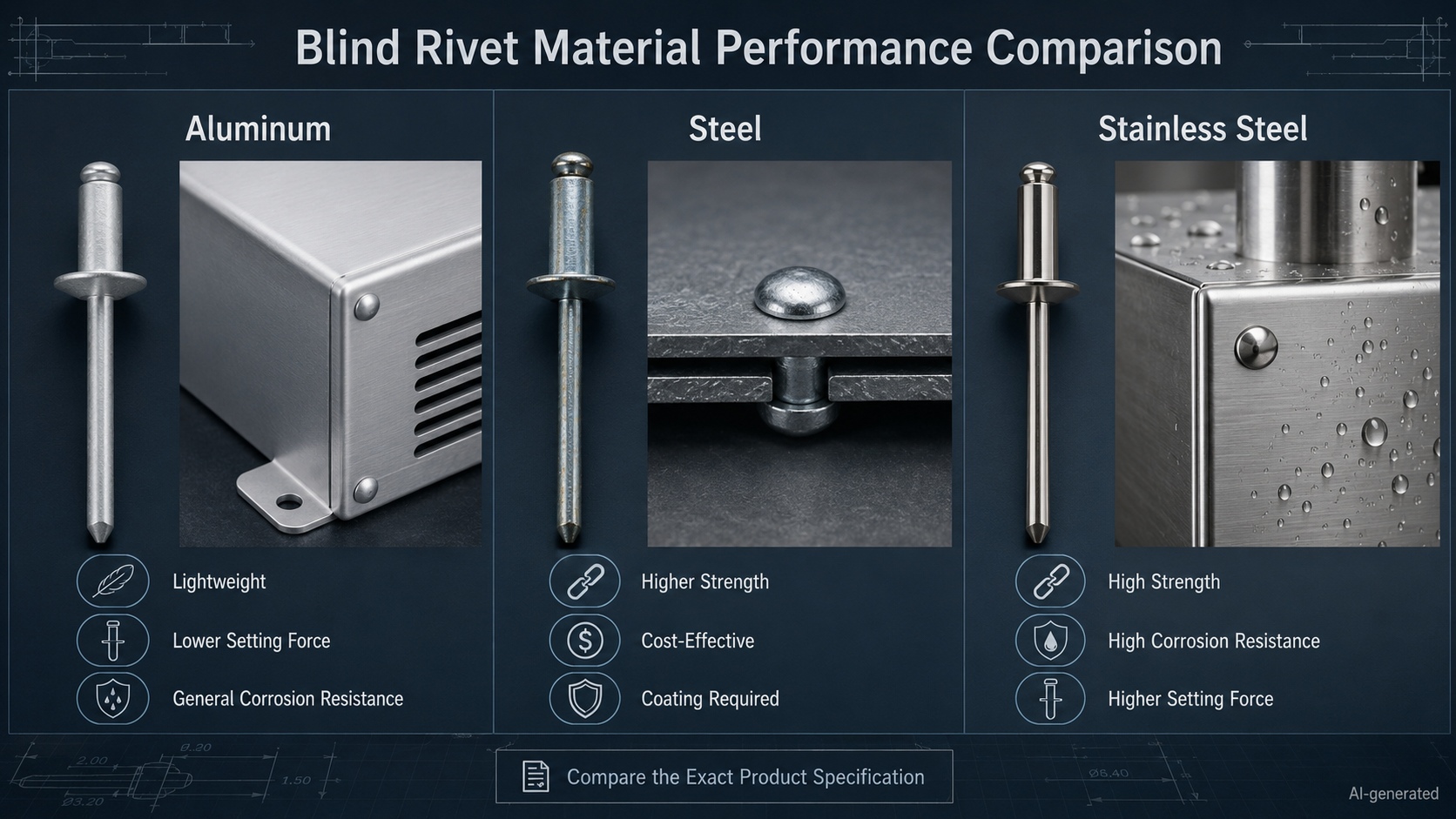
6. Aluminum vs Steel vs Stainless Steel Blind Rivet
The following comparison provides a practical overview.
| Selection factor | Aluminum | Steel | Stainless steel |
| Weight | Lowest | Medium | Medium |
| General strength | Lower | High | High to very high |
| Corrosion resistance | Good in many environments | Depends heavily on coating | Very good |
| Installation force | Lowest | Higher | Highest |
| Typical cost | Low | Low to medium | Highest |
| Tool requirements | Often suitable for manual tools | More demanding | Most demanding |
| Best base-material match | Aluminum and light sheet | Carbon steel | Stainless steel |
| Outdoor suitability | Application-dependent | Limited without protection | Generally strong |
| Magnetic behavior | Nonmagnetic | Magnetic | Grade-dependent |
| Common use | Light enclosures and panels | Industrial steel assemblies | Corrosive or demanding environments |
This table should be treated as a starting point, not a substitute for product data.
Blind rivet geometry, diameter, grip range, mandrel design and manufacturing standard all affect performance. A specialist structural aluminum rivet may outperform a basic steel rivet in a particular joint. Material names alone do not tell the complete story.
A Product-Specific Load Example
JLCMC’s open-end, flat round head catalog illustrates how large the difference can be between material options within one product family.
For the listed 4 mm models:
· The A5050 aluminum-body version specifies a minimum tensile load of 1,200 N and a minimum shear load of 850 N.
· The SUS304 version specifies a minimum tensile load of 3,500 N and a minimum shear load of 2,700 N.
These figures apply to the specific listed products and should not be generalized to every aluminum or stainless steel blind rivet. They do, however, show why the material and load columns in the specification sheet deserve more attention than the product photograph.
7. Matching the Blind Rivet to the Base Material
As a general engineering principle, the rivet should have physical and mechanical properties that are reasonably compatible with the components being joined. Stanley Engineered Fastening similarly advises selecting rivet material with reference to the properties of the joined components.
Riveting Aluminum Sheet
Aluminum blind rivets are often a natural choice for aluminum sheet because they reduce weight and limit dissimilar-metal contact.
Steel or stainless steel rivets may still be selected when greater strength is required, but corrosion isolation should be considered, particularly outdoors or near salt water.
Riveting Carbon Steel Sheet
A steel blind rivet commonly provides a good mechanical and electrochemical match for carbon steel sheet.
Where the equipment is exposed to moisture, the rivet coating and the sheet-metal finish should be assessed together. A galvanized rivet in a painted panel is not automatically protected if drilling and riveting damage both coatings around the hole.
Stainless steel may be selected for improved corrosion resistance, although cost and galvanic behavior still require review.
Riveting Stainless Steel Sheet
A stainless steel blind rivet is usually the logical choice for stainless steel sheet, especially where corrosion resistance is a major reason for selecting the base material.
Installing a plain carbon steel rivet in a stainless steel enclosure can create a weak point in an otherwise corrosion-resistant assembly.
Riveting Plastic or Composite Panels
The main issue is not only rivet material but also load distribution.
Plastic and composite materials may crack, crush or allow a small rivet head to pull through. Aluminum is often attractive because of its lower setting force, but the joint may also require:
· A large-flange head
· A peel-type rivet
· A bulb-type rivet
· A washer
· Controlled installation force
The rivet material, head style and body design should be selected as one system.
8. Galvanic Corrosion Between Rivets and Panels
Galvanic corrosion can occur when dissimilar metals are electrically connected in the presence of an electrolyte such as rainwater, condensation or salt spray.
One metal behaves more anodically and corrodes faster, while the other is protected.
The risk depends on more than the names of the two metals. Important factors include:
· Material combination
· Surface-area ratio
· Moisture exposure
· Salt concentration
· Temperature
· Coatings
· Sealants
· Drainage
· Service duration
An aluminum rivet in a large steel or stainless steel panel can create a real corrosion risk on the rivet itself in a wet environment, because the small aluminum fastener acts as the anode against the much larger panel. The situation may be manageable indoors but problematic on outdoor machinery, transport equipment or marine-adjacent structures.
Ways to reduce galvanic-corrosion risk include:
· Selecting more compatible materials
· Applying protective coatings
· Using sealant around the hole
· Adding an insulating washer or barrier
· Preventing water retention
· Improving drainage
· Protecting drilled edges
· Performing environmental validation
Do not rely on the phrase “corrosion-resistant” without considering the complete joint. A stainless steel rivet can increase the risk of galvanic corrosion of aluminum under wet or salt-exposed conditions if proper isolation measures are not used.
9. Material Choice and Installation Tools
Blind rivet material affects the tool as well as the joint.
Aluminum generally requires the lowest pulling force. Steel requires more, and stainless steel usually requires the most.
Before selecting a rivet, confirm that the tool supports:
· Rivet material
· Nominal diameter
· Mandrel diameter
· Required pulling force
· Suitable nosepiece
· Expected production volume
Using an underpowered tool may lead to:
· Incomplete setting
· Mandrel failure at the wrong point
· Loose joints
· Repeated handle strokes
· Excessive operator fatigue
· Premature jaw wear
· Damage to the rivet or workpiece
Professional tool guidance recommends matching rivet diameter to the appropriate nosepiece and ensuring compatibility among the rivet, tool and accessories.
For occasional small aluminum rivets, a hand riveter may be perfectly adequate.
For regular steel-rivet installation, a long-handle manual tool, battery tool or pneumatic riveter may improve consistency.
For stainless steel, especially at larger diameters or high production volumes, a powered tool with sufficient rated pulling force is usually the more practical choice.
The operator’s forearms should not be part of the official quality-control system.
10. Material Selection by Application
Electrical Enclosures
For lightweight indoor enclosures, aluminum blind rivets may provide sufficient performance with easy installation.
Steel blind rivets can be used for stronger carbon steel cabinets. Stainless steel is appropriate for outdoor, washdown or corrosion-sensitive enclosures.
Machine Guards
Steel blind rivets are often suitable for guards made from painted or galvanized steel.
Stainless steel may be preferred in food-processing, humid or chemical environments. Aluminum can be considered for lightweight covers that carry little structural load.
Sensor and Electronic Housings
Aluminum is attractive for compact electronic housings because of its low weight and easy installation.
Stainless steel may be required where the housing is exposed to moisture, aggressive cleaning or outdoor service.
Material selection should also consider electrical grounding and electromagnetic-compatibility requirements.
Ventilation and Cooling Components
Aluminum rivets are frequently used in light ducting, fan covers and ventilation panels.
Coated steel may be more appropriate for heavier industrial ductwork, while stainless steel is suitable for moisture, food production or corrosive air streams.
Transportation Equipment
Vehicle and transport assemblies can experience vibration, impact, temperature variation and outdoor exposure.
The decision should be based on documented joint performance rather than choosing a material by habit. Structural rivet designs may be required in addition to stronger materials.
Automation and Mechatronic Equipment
Mechatronic systems often combine aluminum frames, steel brackets, stainless steel panels, plastic guards and electronic housings.
A single machine may therefore require more than one blind rivet material.
Engineers and purchasing teams can review the available blind rivet materials, head styles, riveting ranges and load values in the JLCMC Rivets category, rather than forcing one material into every fastening point. JLCMC currently lists open-end and closed-end blind rivets in round-head and countersunk configurations, including A5050 and SUS304 options.
11. How to Choose the Best Blind Rivet Material
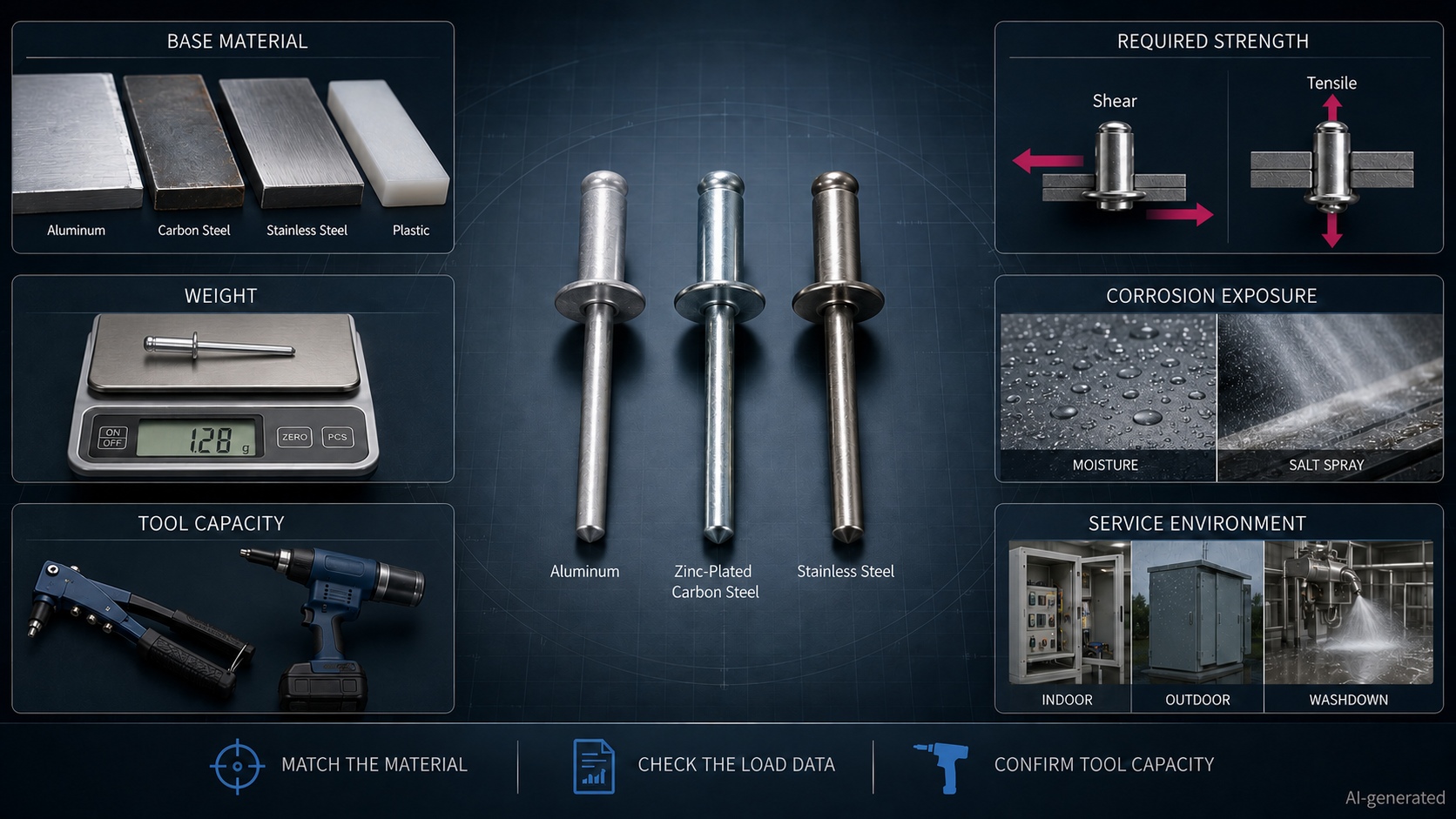
Use the following process before finalizing the material.
Step 1: Identify the Base Materials
Record all materials in the joint, including coatings and surface treatments.
Step 2: Define the Mechanical Load
Determine whether the rivet will experience tension, shear, peel, vibration, fatigue or impact.
Step 3: Review the Environment
Consider:
· Indoor or outdoor use
· Humidity
· Salt exposure
· Chemicals
· Cleaning agents
· Operating temperature
· Condensation
Step 4: Set the Weight Requirement
Aluminum may be valuable in portable equipment, transportation and lightweight assemblies.
In stationary machinery, weight may be less important than strength or durability.
Step 5: Check Galvanic Compatibility
Review whether the rivet and workpiece materials create an unacceptable corrosion pair.
Step 6: Confirm Tool Capacity
Verify that the available riveter can set the selected material and diameter consistently.
Step 7: Review Grip Range and Hole Size
Material selection does not replace correct sizing. The total joint thickness must remain inside the specified grip or riveting range.
For a deeper explanation, refer to the Blind Rivet Size and Grip Range Selection Guide.
Step 8: Compare Product Load Data
Check minimum tensile and shear values for the exact model.
Do not transfer performance data from one rivet family to another.
Step 9: Validate the Joint
For important applications, test the actual combination of:
· Rivet
· Workpiece
· Hole
· Tool
· Operator or automation process
· Environmental exposure
A fastener selected perfectly on paper can still fail if the production hole is oversized or the setting tool is poorly maintained.
12. Frequently Asked Questions
Is a Stainless Steel Blind Rivet Stronger Than an Aluminum Blind Rivet?
In many comparable general-purpose products, stainless steel provides higher tensile and shear capacity. However, performance must be checked using the exact product data because geometry and rivet design also affect strength.
Is a Steel Blind Rivet Better Than an Aluminum Blind Rivet?
Steel is normally better where higher mechanical strength is required. Aluminum is often better where low weight, lower setting force and compatibility with aluminum sheet are more important.
Can I Use a Stainless Steel Blind Rivet in Aluminum?
Yes, but the joint should be evaluated for galvanic corrosion, especially in wet, salty or outdoor environments. Coatings, sealants or isolation methods may be required.
Can I Use an Aluminum Blind Rivet in Steel Sheet?
It may be acceptable for lightly loaded, dry indoor assemblies. In wet or outdoor conditions, however, the aluminum rivet forms a small anode against a much larger steel cathode, and corrosion concentrates on the rivet, so this combination should be avoided or isolated. Mechanical strength should also be checked.
Which Blind Rivet Material Is Best for Outdoor Use?
Stainless steel is often the preferred choice for demanding outdoor environments. Aluminum can also perform well in suitable conditions, while carbon steel generally requires effective protective coatings.
Which Material Is Easiest to Install?
Aluminum usually requires the least setting force. Steel requires more force, and stainless steel generally requires the most.
Does Mandrel Material Matter?
Yes. Mandrel material affects setting behavior, installation force, retained-stem performance and corrosion inside the finished rivet.
Is a Coated Steel Rivet as Corrosion-Resistant as Stainless Steel?
Not necessarily. A coating can significantly improve carbon steel corrosion resistance, but scratches, damaged edges and long-term environmental exposure may reduce protection.
Should the Rivet Match the Panel Material?
Using similar materials is often a good starting point because it can improve mechanical and corrosion compatibility. The final choice must also consider load, environment and tool capacity.
Is Aluminum Always the Lightest Option?
Among aluminum, carbon steel and stainless steel blind rivets of similar geometry, aluminum is generally the lightest.
Conclusion
The best blind rivet material is not simply the strongest material available.
Aluminum is a practical choice for lightweight panels, electronic housings and general low- to medium-load assemblies. Steel provides higher mechanical strength at an economical cost and works well in many carbon steel structures. Stainless steel offers strong mechanical performance and excellent corrosion resistance for outdoor, humid and demanding industrial environments.
The final selection should consider the complete joint:
· Rivet body material
· Mandrel material
· Base material
· Grip range
· Hole diameter
· Tensile and shear requirements
· Corrosion exposure
· Installation-tool capacity
· Maintenance expectations
A strong rivet in the wrong material combination can still create a poor joint. Conversely, a correctly selected aluminum rivet may outperform a stainless steel alternative when weight, base-material compatibility and installation force are the real design priorities.
Review the exact model specification rather than relying on material names alone. JLCMC blind rivet data includes material, hole diameter, riveting range and minimum tensile and shear loads, allowing engineers and purchasing teams to compare options against the actual assembly instead of making an educated guess with a rivet gun in hand.
Popular Articles
Keep Learning
Threaded Standoff Guide: Types, Sizes, Materials and Applications
Key Takeaways Thread configuration first: Choose female-female, male-female or male-male based on how both sides of the assembly attach — thread config is the most practical way to classify a threaded standoff. Body length is the critical dimension: Standoff length refers to the distance between supporting faces, not total physical length. Reading the wrong length causes incorrect mounting height or screw bottoming. Material affects more than strength: Brass, stainless steel, carbon steel, aluminum an......
How to Choose a Threaded Standoff for PCB and Mechatronic Assemblies
Key Takeaways Select the right configuration: Choose male-female, female-female, or male-male thread configurations based on the two mating interfaces and the intended assembly sequence. Treat height as a tolerance stack: Standoff body length must satisfy clearance, electrical, thermal, and connector requirements across the full tolerance range, not just the nominal dimension. Verify thread engagement: Check male thread length against tapped-hole depth and upper screw length against usable female thre......
Drawer Slide Selection Guide for Equipment Trays: Sizing, Load Calculation & Locking
Key Takeaways Gross Load First: Calculate the moving assembly's gross load, including the tray, brackets, equipment and attached accessories. Travel, Not Rail Length: Specify the actual travel needed for service access; nominal rail length alone does not establish that travel. Know Your Lock: Distinguish a positive lock, a detent, a soft-close feature and a disconnect mechanism. Three Independent Checks: Treat slide capacity, mounting-bracket strength and cabinet tipping resistance as separate checks.......
Threaded Standoff vs Spacer: What Is the Difference?
Key Takeaways Threaded standoffs provide both spacing and threaded attachment points, making them ideal for modular assemblies and PCBs. Spacers are unthreaded sleeves that work with through-bolts to maintain gaps in clamped assemblies, offering a simpler and more economical solution. The right choice depends on the load path, assembly sequence, material, and service environment - not just appearance or catalog naming. A threaded standoff and a spacer can look almost identical on a workbench. Both cre......
Ball Nose End Mill Stepover: Scallop Height and Effective Diameter
Key Takeaways Geometric Control: Stepover directly controls geometric scallop height, but it does not automatically guarantee a measured Ra value. Cusp Height Formula: For a ball radius $R$ and pass spacing $s$ on a flat surface, the ideal cusp height is $h = R - \sqrt{R^2 - \frac{s^2}{4}}$. Tool Radius Advantage: A larger ball can use wider spacing for the same ideal cusp, provided it can reach the required geometry without gouging. Effective Diameter: The active cutting diameter near the tool tip ca......
Manual SMT Stencil Printer Sizing: Print Area, PCB Support and Frame Fit
Key Takeaways Different dimensions: Worktable size, effective print area, board envelope, and stencil frame size are different dimensions. Check the full pattern: Check the whole aperture pattern in its intended orientation, including clearance for the printing stroke. Thickness is not enough: A compatible board thickness does not prove that a populated underside or a support fixture will fit. Support and contact: Stable support and close stencil-to-board contact are necessary for a repeatable printin......