Threaded Inserts for Wood: Applications, Installation Tips, and Selection Guide
18 min
- 1. What Are Threaded Inserts for Wood?
- 2. Why Use Threaded Inserts Instead of Wood Screws?
- 3. Common Types of Threaded Inserts Used in Wood
- 4. Where Threaded Inserts Are Used in Wooden Structures
- 5. Threaded Inserts for Wood in Mechatronic Applications
- 6. Choosing the Right Wood for Threaded Inserts
- 7. How to Install Threaded Inserts in Wood
- 8. Recommended Design Rules
- 9. Threaded Inserts vs Tee Nuts vs Wood Screws
- 10. Practical Size Selection
- 11. Common Mistakes When Using Threaded Inserts for Wood
- 12. JLCMC and Related Fastening Components
- 13. FAQ: Threaded Inserts for Wood
- 14. Conclusion
1. What Are Threaded Inserts for Wood?
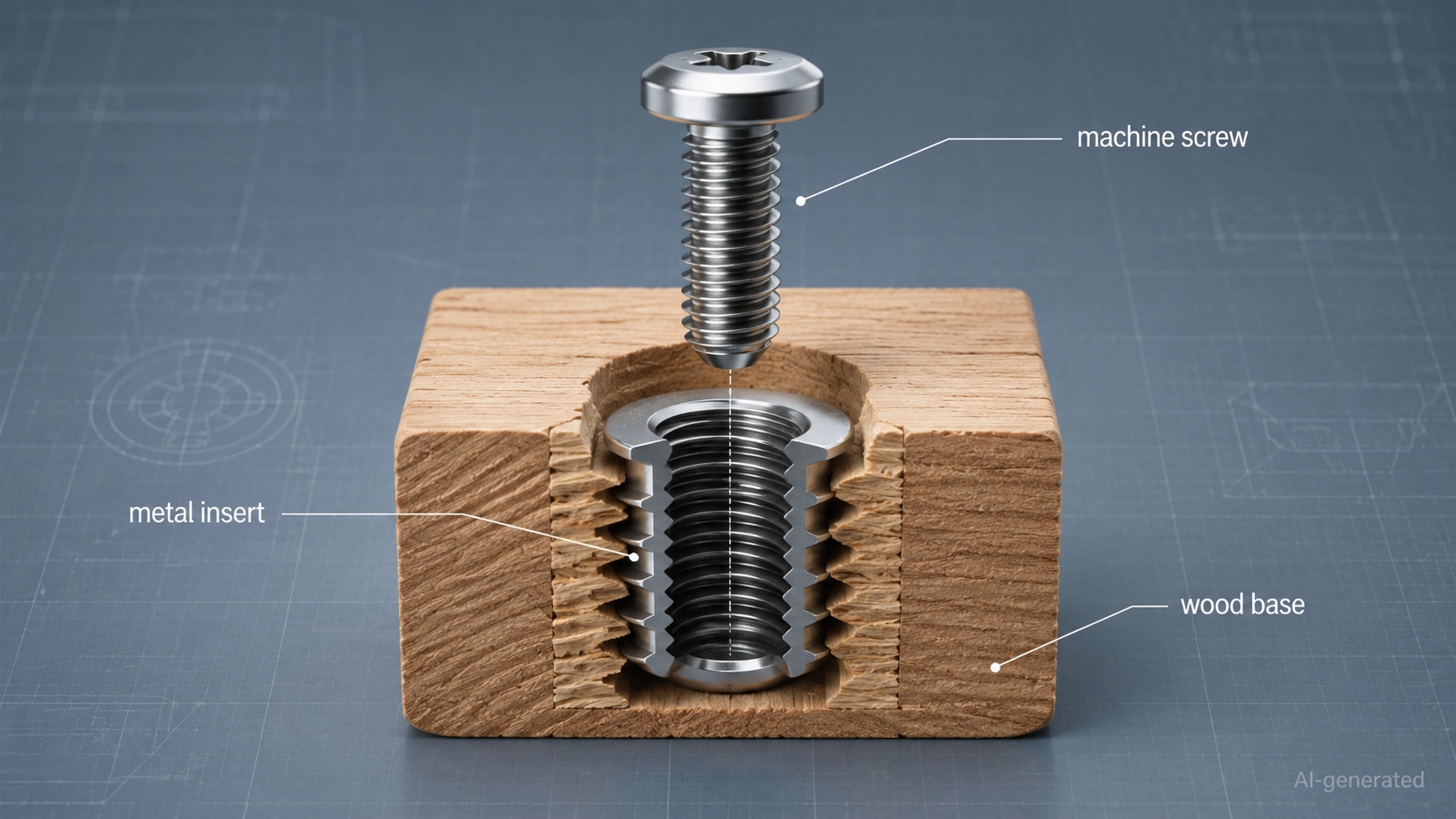
Threaded inserts for wood are metal inserts designed to create reusable machine threads inside wooden parts. Instead of driving a wood screw directly into the material, the insert is installed into a drilled pilot hole. A machine screw, hex socket screw, hex bolt, knob, handle, leveling foot, or adjustable stop can then be fastened into the insert.
In simple terms, threaded inserts allow wood to accept machine screws more like a metal component would. That is useful when the connection needs to be removed, adjusted, tightened, or reassembled multiple times.
A normal wood screw can work well for permanent fastening. But when a part needs repeated assembly and disassembly, wood fibers can wear out, crush, or strip. Threaded inserts solve that problem by placing a durable metal internal thread inside the wood.
They are commonly used in:
· Furniture and cabinet structures
· Wooden jigs and fixtures
· Workbenches and test benches
· Removable panels
· Adjustable stops
· Handles, knobs, and pull hardware
· Display cases and exhibition structures
· Speaker cabinets and equipment boxes
· Packaging fixtures and transport crates
· Prototype frames
· Mechatronic test rigs and wooden machine bases
Threaded inserts for wood may look small, but they can make a wooden structure far more serviceable. In engineering workshops, that can mean the difference between “adjust it and continue testing” and “great, now the screw hole is ruined.”For a broader overview of insert types, materials, and installation methods, see our threaded inserts guide.
2. Why Use Threaded Inserts Instead of Wood Screws?
Wood screws are excellent when you want a fast, strong, mostly permanent connection. They cut into the wood fibers and hold by mechanical grip. For many woodworking tasks, that is enough.
Threaded inserts are different. They are used when the screw connection needs to behave more like a mechanical fastening point.
Use threaded inserts for wood when you need:
· Repeated assembly and disassembly
· A stronger reusable thread
· Better alignment for machine screws
· Adjustable parts
· Replaceable panels
· Removable fixtures
· Cleaner maintenance access
· Compatibility with metric screws or hex bolts
· A more professional mechanical interface
For example, a wooden test fixture may need to hold a sensor bracket today, a small actuator tomorrow, and a different mounting plate next week. If the connection uses ordinary wood screws, the holes may wear out quickly. With threaded inserts, the same fixture can accept repeated changes without destroying the mounting points.
This is why threaded inserts are useful not only in furniture, but also in prototyping, automation testing, machine guarding, and workshop equipment.
3. Common Types of Threaded Inserts Used in Wood
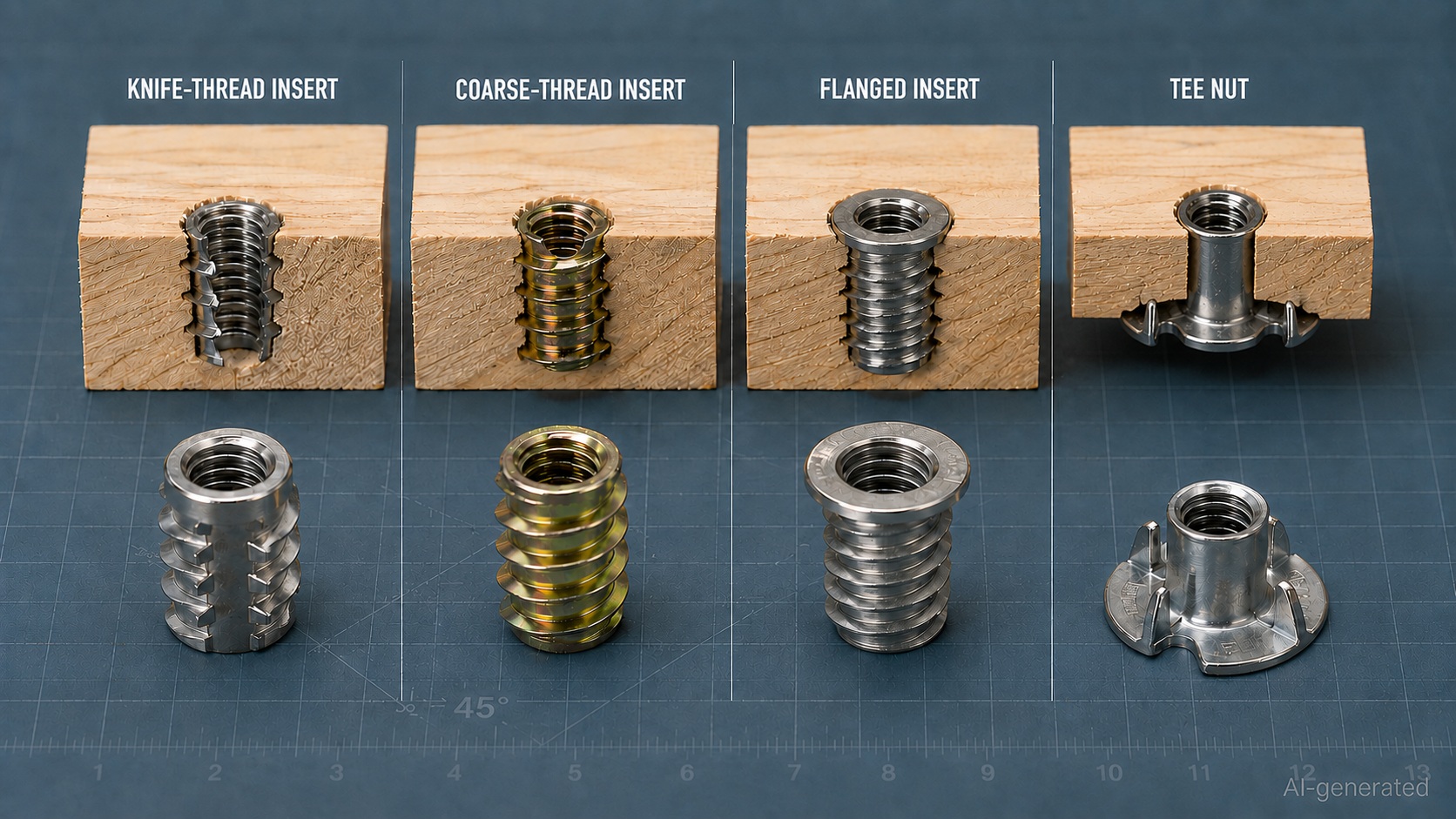
There are several insert designs used in wood. The correct choice depends on the wood type, load direction, installation method, and whether the connection needs to resist pull-out, twisting, or vibration.
Knife-Thread Inserts
Knife-thread inserts have sharp external threads that cut into the wood as they are installed. They are often used in hardwoods such as oak, maple, beech, birch, and walnut.
The sharp external thread creates strong mechanical engagement in dense wood. These inserts are useful for furniture, hardwood jigs, cabinet hardware, and precision wooden fixtures.
Typical applications include:
· Hardwood furniture
· Adjustable woodworking jigs
· Removable table legs
· Cabinet hardware
· Tooling boards
· Test fixtures made from hardwood
Knife-thread inserts are a good choice when the wood is dense enough to support the cutting action without splitting.
Coarse-Thread Inserts
Coarse-thread inserts have larger external threads that can grip softer wood fibers more effectively. They are commonly used in softwood, plywood, particleboard, and MDF, depending on the insert design.
They may be used for:
· Softwood frames
· MDF panels
· Plywood fixtures
· Workbench accessories
· Display stands
· Temporary machine supports
· Packaging fixtures
Soft materials need careful pilot-hole control. If the hole is too large, the insert may spin. If the hole is too small, the material may split or bulge.
Flanged Inserts
Flanged threaded inserts have a shoulder or flange at the top. The flange helps prevent the insert from sinking too deep and can spread load over a larger surface area.
Flanged inserts are useful when:
· The surface is soft
· The insert must sit at a controlled depth
· Pull-through resistance matters
· A flush or neat appearance is needed
· The screw will be removed repeatedly
They are common in furniture, panel assemblies, equipment boxes, and removable covers.
Tee Nuts
Tee nuts are another common threaded insert solution for wood. They are usually installed from the back side of a panel and have prongs or barbs that bite into the wood.
Tee nuts are often used when the backside of the material is accessible. They can provide strong pull-through resistance, especially in through-hole assemblies.
Common applications include:
· Knock-down furniture
· Workbench accessories
· Clamping fixtures
· Speaker cabinets
· Machine guards
· Mounting plates
However, tee nuts may not be suitable when only one side of the part is accessible or when a clean hidden installation is required.
Screw-to-Expand and Press-In Inserts
Some wood inserts expand or grip more tightly when the screw is installed. These are useful in certain panel applications, especially where fast installation is important.
They are often used in production furniture, ready-to-assemble structures, and light-duty wood products.
4. Where Threaded Inserts Are Used in Wooden Structures
Threaded inserts for wood are useful whenever a wooden structure needs a removable, adjustable, or serviceable fastening point.
Furniture and Cabinetry
Furniture is one of the most common applications. Threaded inserts are used in:
· Removable table legs
· Bed frames
· Cabinet handles
· Door pulls
· Adjustable feet
· Shelving systems
· Knock-down furniture
· Drawer hardware
They allow furniture parts to be assembled securely, disassembled for transport, and reassembled without destroying the original screw holes.
For furniture that may be shipped flat-packed or moved multiple times, threaded inserts are a clean and practical solution.
Wooden Jigs and Fixtures
Wooden jigs are often used in workshops because they are easy to cut, drill, modify, and replace. But jigs also need repeatable clamping and adjustment.
Threaded inserts can be used for:
· Adjustable stops
· Toggle clamp mounting
· Guide blocks
· Angle fixtures
· Positioning blocks
· Removable fences
· Workholding accessories
A jig with threaded inserts is easier to modify than one built with permanent screws. It can accept knobs, handles, screws, and locating hardware without wearing out the wood.
Workbenches and Test Benches
Wooden workbenches and test benches often need mounting points for temporary equipment. Threaded inserts can provide reusable attachment points for:
· Small machines
· Test fixtures
· Cable holders
· Sensor brackets
· Measuring devices
· Adjustable supports
· Guard panels
· Lighting brackets
This is especially useful in prototyping environments, where equipment layouts change frequently.
Wooden Equipment Housings and Enclosures
Wood is sometimes used for speaker cabinets, display boxes, instrument cases, control mockups, and prototype enclosures. Threaded inserts allow covers and panels to be removed without stripping screw holes.
Applications include:
· Speaker cabinet hardware
· Removable back panels
· Electronic test boxes
· Display cases
· Prototype control housings
· Wooden covers for temporary equipment
When paired with machine screws, threaded inserts provide cleaner service access than repeated wood-screw installation.
Packaging, Crating, and Transport Fixtures
Industrial packaging sometimes uses wooden crates, support blocks, or transport frames. Threaded inserts can help create reusable attachment points for brackets, clamps, handles, or protection panels.
They are useful when a shipping fixture must be opened and closed repeatedly or when a wooden frame needs replaceable hardware.
5. Threaded Inserts for Wood in Mechatronic Applications
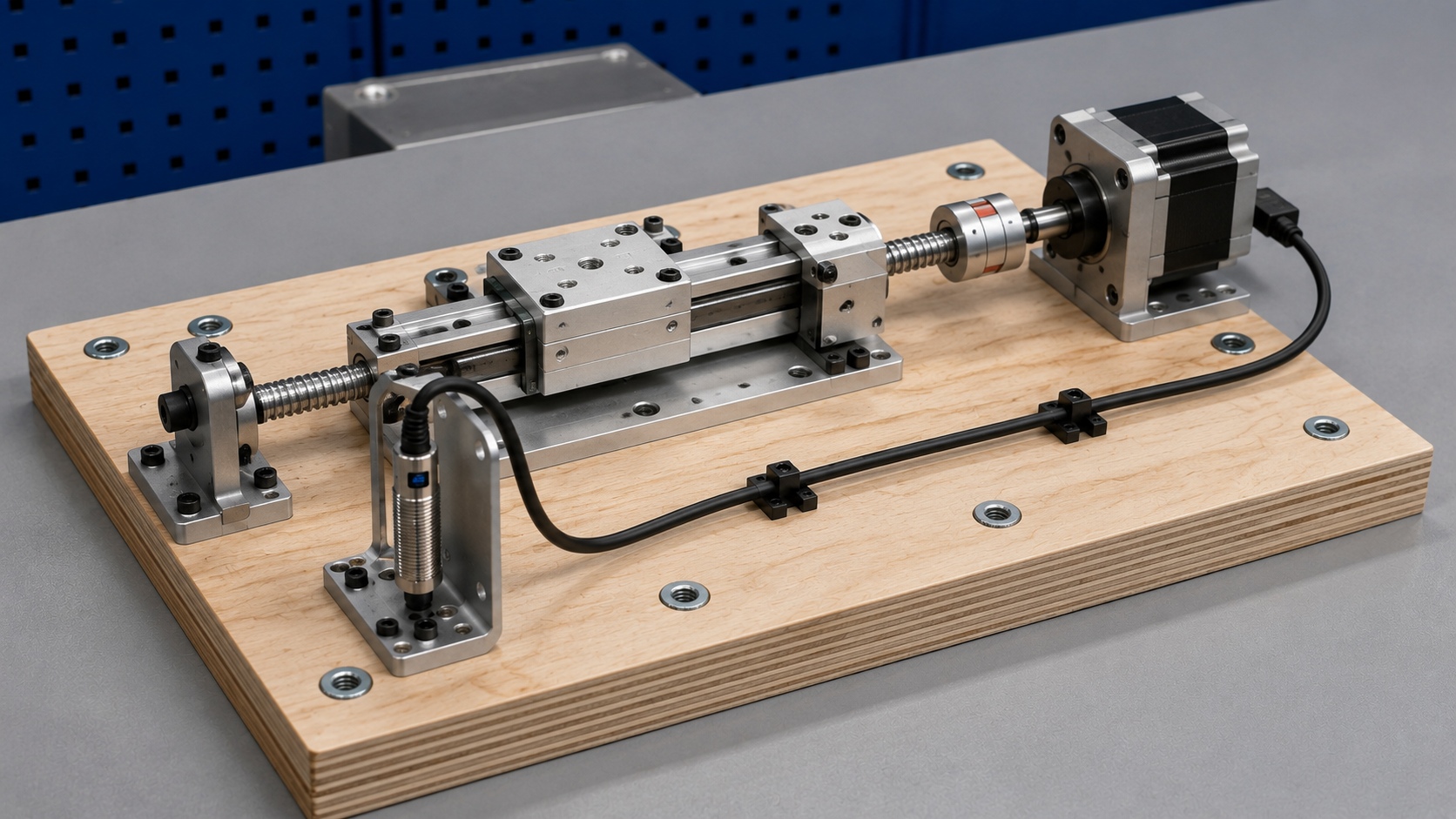
Wood may not be the first material people think of in mechatronics, but it appears more often than expected, especially in prototyping, testing, education, packaging, and workshop automation.
Threaded inserts for wood can be useful in mechatronic projects such as:
· Prototype robot bases
· Temporary sensor test fixtures
· Wooden actuator test stands
· Control panel mockups
· Cable routing boards
· Vision system calibration fixtures
· Lightweight machine guards
· Packaging fixtures for automation parts
· Educational robotics platforms
· Low-volume assembly jigs
A wooden fixture may hold a sensor bracket, a small linear actuator, a camera, a limit switch, or a cable clamp during testing. These parts may need to be repositioned several times. Threaded inserts make that adjustment easier and cleaner.
For example, a prototype automation test bench might use plywood or hardwood as the base. Threaded inserts can be installed at several mounting points so engineers can attach aluminum brackets, sensor holders, pneumatic accessories, or small motor plates with machine screws.
This approach is not meant to replace a final machined aluminum base in high-precision equipment. But for early-stage testing, educational builds, laboratory fixtures, and low-cost prototypes, wood with threaded inserts can be surprisingly practical.
A well-placed insert can turn a simple wooden board into a reusable engineering platform. Not glamorous, but very handy.
6. Choosing the Right Wood for Threaded Inserts
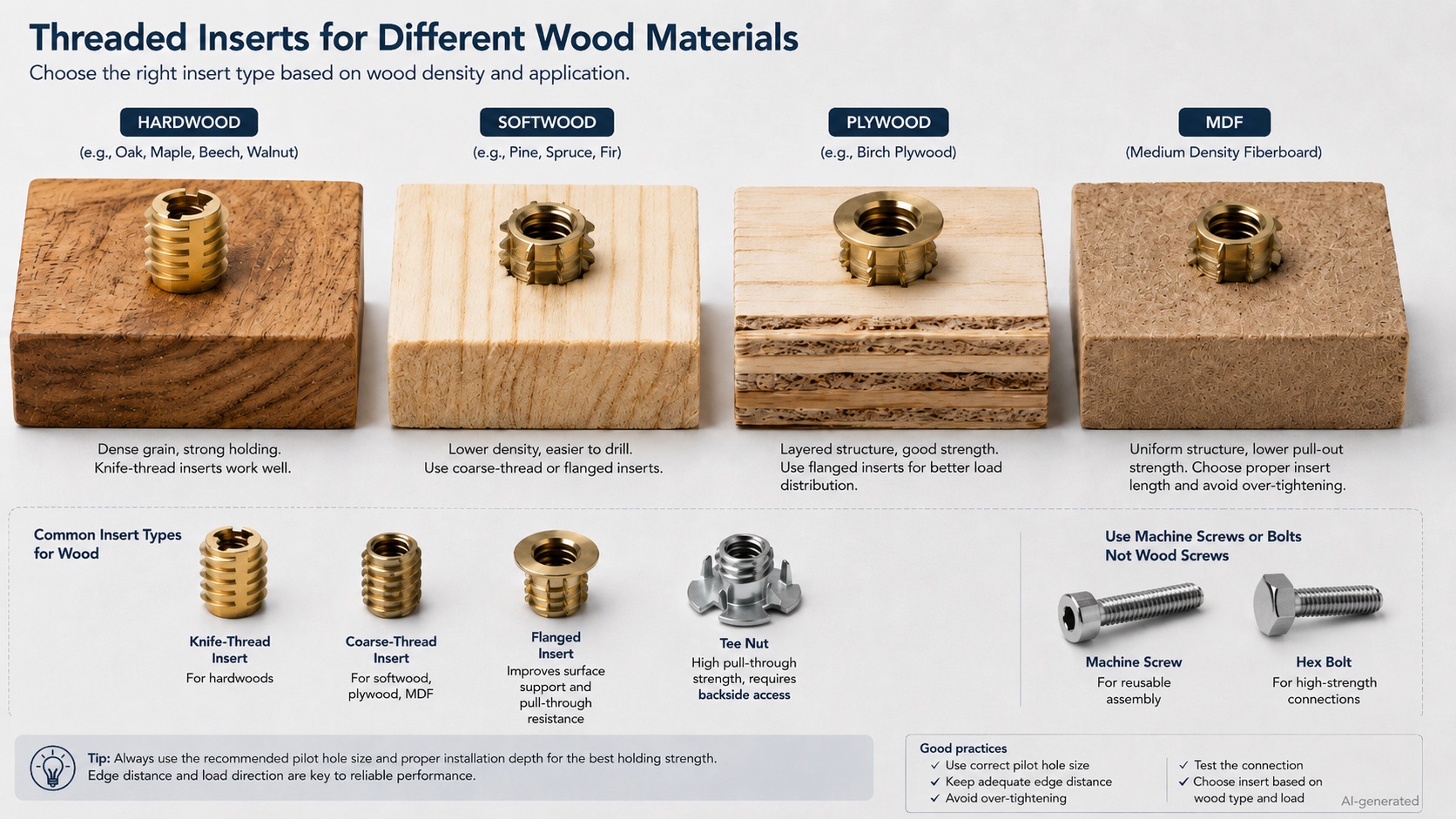
The performance of a threaded insert depends heavily on the wood. The insert is metal, but the surrounding material is still wood. That means density, grain direction, edge distance, moisture, and panel structure all matter.
Hardwood
Hardwoods such as oak, maple, beech, birch, walnut, and ash usually provide better holding strength than softwoods. They are good candidates for knife-thread inserts and precision fixtures.
Hardwood is suitable for:
· Durable furniture joints
· Reusable jigs
· Tooling blocks
· Adjustable stops
· Higher-strength mounting points
However, hardwood can also split if the pilot hole is too small or the insert is forced in too aggressively.
Softwood
Softwoods such as pine, fir, cedar, and spruce are easier to drill and cut but generally have lower holding strength. Inserts used in softwood often need larger external threads, longer bodies, or flanged designs.
Softwood is suitable for:
· Light-duty frames
· Temporary fixtures
· Display structures
· Packaging supports
· Low-load mounting points
For higher loads, test the insert before relying on it in production.
Plywood
Plywood can work well with threaded inserts, especially when the insert is installed perpendicular to the face grain and there is enough thickness. High-quality plywood usually performs better than low-grade construction panels.
Plywood is useful for:
· Test benches
· Machine guards
· Fixture plates
· Prototype frames
· Equipment mounting boards
Avoid placing inserts too close to panel edges, where the layers may separate under load.
MDF and Particleboard
MDF and particleboard can accept threaded inserts, but they are more sensitive to crushing, splitting, and pull-out. Inserts for MDF usually need careful pilot-hole sizing and enough surrounding material.
MDF and particleboard are suitable for:
· Light-duty furniture
· Display structures
· Cabinet hardware
· Low-load panels
They are less suitable for high-vibration or high-pull-out applications unless the design is tested carefully.
7. How to Install Threaded Inserts in Wood
The details vary by insert type, but the general installation process is straightforward.
Step 1: Choose the Correct Insert
Start with the wood type, load requirement, screw size, and installation direction. Do not choose only by internal thread size. An M6 insert for hardwood may have a different external thread and pilot-hole requirement than an M6 insert for softwood.
Step 2: Mark the Hole Location
Mark the center accurately. If the insert will hold a bracket, hinge, or alignment part, poor hole placement can affect the whole assembly.
For multiple inserts, use a template, jig, CNC drilling, or drill press setup when accuracy matters.
Step 3: Drill the Pilot Hole
The pilot hole is one of the most important details. Use the drill size recommended by the insert supplier. Do not guess based only on the internal thread.
A hole that is too small can split the wood or make the insert difficult to drive. A hole that is too large can reduce pull-out strength or cause the insert to spin.
Step 4: Control the Depth
The hole should be deep enough for the insert to seat fully. For blind holes, leave enough clearance so the insert does not bottom out before reaching the correct depth.
Use a drill stop or tape on the drill bit to control depth.
Step 5: Keep the Insert Straight
A crooked insert creates a crooked screw path. This may not matter for a simple furniture foot, but it matters for brackets, panels, jigs, and mechanical fixtures.
Use an installation tool, drill press, guide block, or temporary bolt-and-nut setup to keep the insert aligned.
Step 6: Install Slowly
Drive the insert slowly and steadily. Do not force it. If resistance suddenly increases, stop and check the pilot hole, wood hardness, debris, and alignment.
For hardwood, forcing the insert can split the material. For softwood, overdriving can strip the fibers.
Step 7: Test the Mating Screw
After installation, test the insert with the intended screw, hex socket screw, or bolt. The screw should engage smoothly without wobble, cross-threading, or bottoming out.
8. Recommended Design Rules
Good insert performance starts before installation. The part should be designed with enough material around the insert.
Leave Enough Edge Distance
Avoid placing inserts too close to the edge of the wood. A small edge distance increases the risk of splitting, especially in hardwood or plywood.
As a practical rule, leave generous material around the insert whenever possible. If the insert must be close to an edge, test the design before using it in a load-bearing application.
Consider Load Direction
Threaded inserts perform differently depending on the load direction.
Pull-out loads try to pull the insert straight out of the wood. Torque loads try to rotate the insert. Shear loads act sideways. Vibration can gradually loosen screws or damage weak material around the insert.
For high pull-out loads, use longer inserts, larger external threads, flanged designs, tee nuts, or through-bolted solutions.
Avoid End Grain When Possible
End-grain installation can be weaker than face-grain installation because the insert may not grip the fibers as effectively. If end-grain installation is unavoidable, use a longer insert, test the connection, or consider a different fastening method.
Use Washers on Soft Surfaces
When clamping softwood, plywood, or MDF, a washer can help spread load under the screw head or bolt head. This reduces surface crushing and improves clamping consistency.
Do Not Over-Tighten
The internal thread may be metal, but the surrounding material is still wood. Excessive tightening can crush fibers, pull the insert upward, or damage the connection.
Use controlled torque when the application is important.
9. Threaded Inserts vs Tee Nuts vs Wood Screws
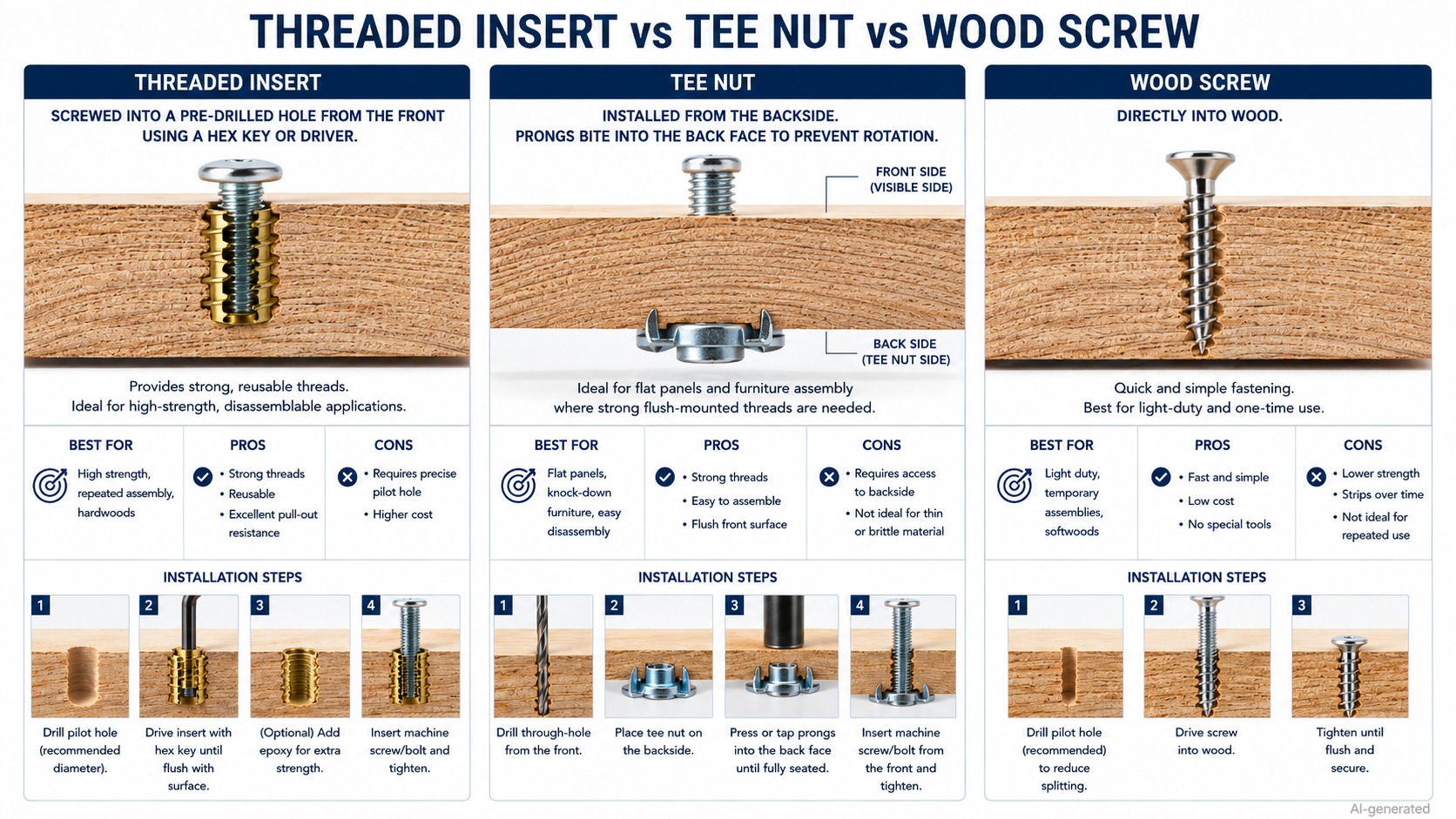
Threaded inserts are not always the only option. The best fastening method depends on the application.
| Fastening Method | Best For | Limitations |
| Wood screws | Quick permanent fastening | Poor for repeated removal |
| Threaded inserts | Reusable machine threads in wood | Requires accurate pilot hole and installation |
| Tee nuts | Strong through-hole fastening from backside | Needs backside access |
| Cross dowels | Strong furniture joints | Requires more complex drilling |
| Through bolts | High-strength clamping | Bolt and nut may be visible |
| Adhesive bonding | Permanent bonding | Not serviceable |
Use threaded inserts when you want a clean, reusable internal thread from one side of the part. Use tee nuts or through bolts when pull-out strength is more important and backside access is available.
In machine fixtures and mechatronic test benches, threaded inserts are useful because they keep the top surface clean while allowing parts to be removed and repositioned.
10. Practical Size Selection
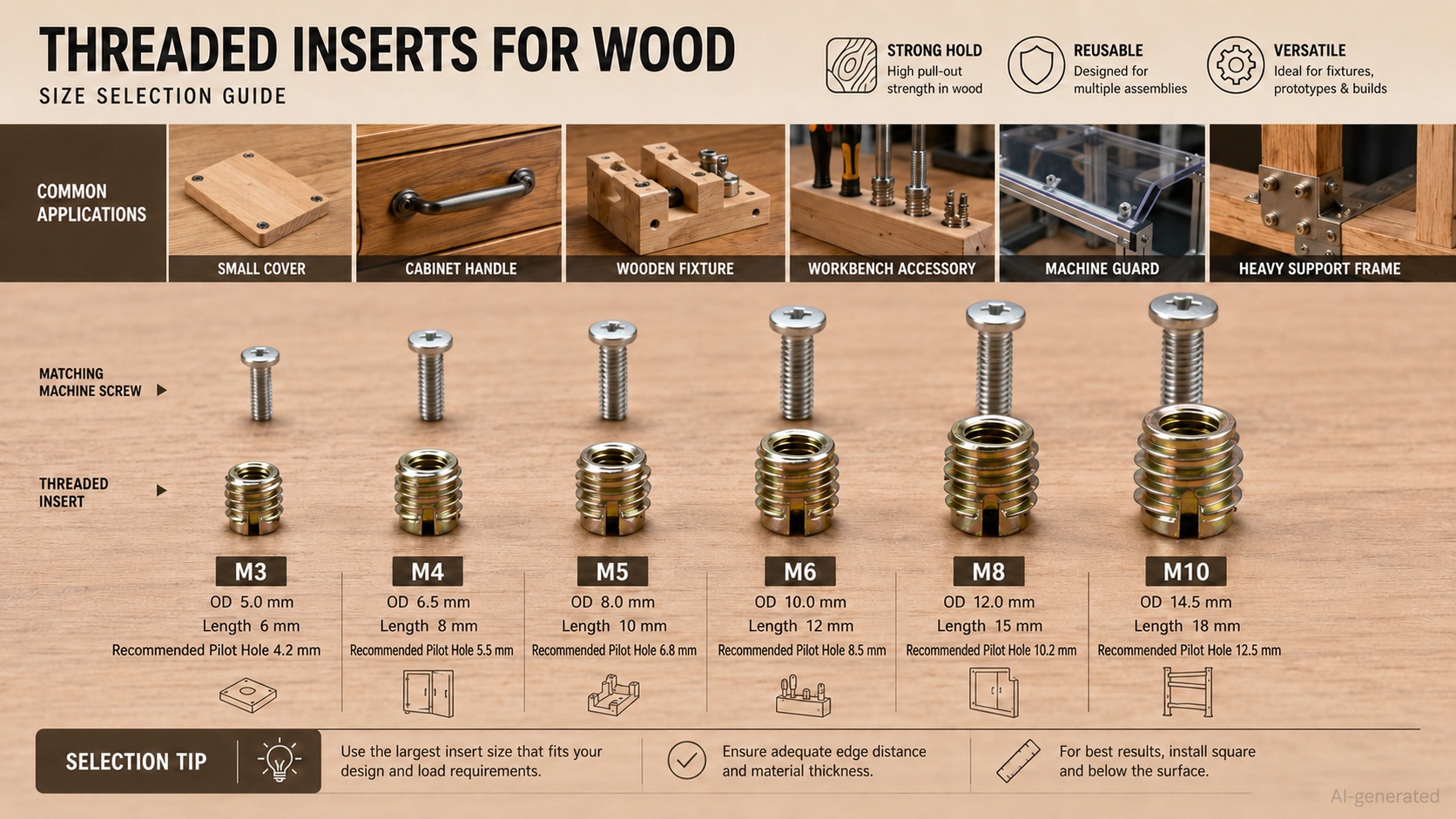
Common threaded insert sizes for wood include M4, M5, M6, M8, and sometimes M10 for heavier structures. Smaller sizes such as M3 may be used in compact parts, but they require careful installation because the insert and surrounding material are small.
| Insert Size | Typical Wood Application |
| M3 | Small covers, light brackets, compact prototype parts |
| M4 | Cabinet hardware, small fixtures, light-duty mounts |
| M5 | General jigs, panels, handles, small equipment mounts |
| M6 | Workbench accessories, adjustable stops, stronger fixtures |
| M8 | Heavy furniture, machine guards, test bench hardware |
| M10 | Large wooden structures with sufficient material thickness, special fixtures |
For mechatronic prototypes, M4, M5, and M6 are often practical because they match many common brackets, handles, machine screws, and small automation accessories.
For heavier loads, do not simply increase the screw size. Check the available wood thickness, insert length, edge distance, and load direction. A larger insert too close to an edge can be worse than a smaller insert placed correctly.
11. Common Mistakes When Using Threaded Inserts for Wood
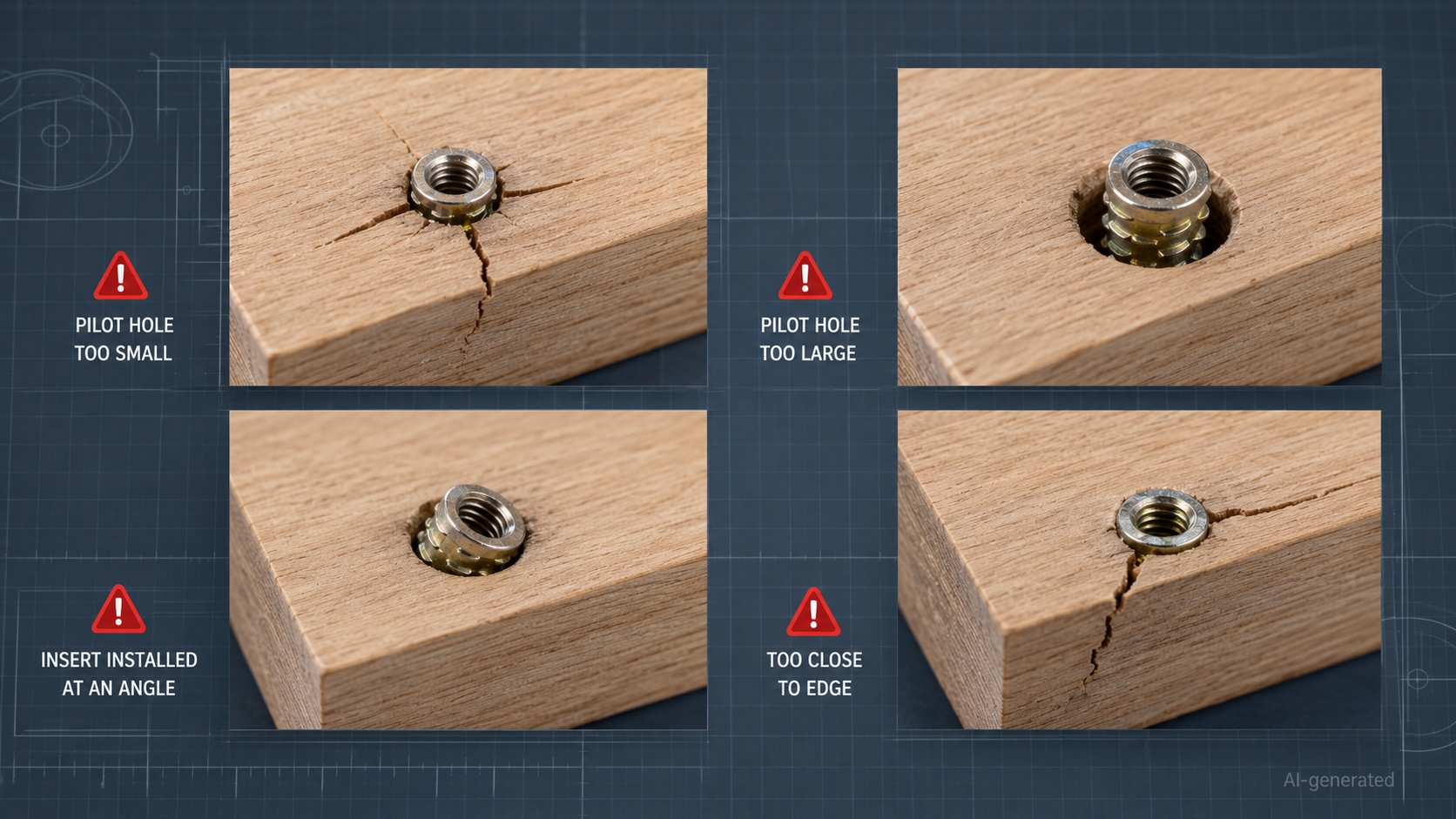
Threaded inserts fail for predictable reasons. Most failures come from poor hole preparation, wrong insert choice, or unrealistic load expectations.
Using the Wrong Pilot Hole
This is the most common problem. The insert may split the wood if the hole is too small, or spin if the hole is too large.
Always follow the recommended pilot-hole size for the insert type and wood material.
Installing Too Close to the Edge
Wood can split when the insert is placed too close to an edge. This is especially true for hardwood and plywood.
Leave enough surrounding material.
Driving the Insert at an Angle
An angled insert creates an angled screw path. This can make panels sit unevenly or cause brackets to misalign.
Use a guide when accuracy matters.
Over-Tightening the Screw
The screw threads into metal, but the insert is held by wood. Excessive torque can pull the insert upward or crush the surrounding fibers.
Using Inserts in Weak MDF Without Testing
MDF and particleboard can work for light-duty applications, but they do not always provide strong pull-out resistance. Test first if the part is structural.
Choosing the Insert Only by Screw Size
The internal thread size is only one part of the decision. Insert length, outside diameter, external thread type, wood density, and load direction all matter.
12. JLCMC and Related Fastening Components
In wood-based mechanical prototypes or test fixtures, threaded inserts rarely work alone. They are usually part of a broader fastening system that may include screws, washers, brackets, aluminum profiles, sensor mounts, handles, knobs, and positioning parts.
JLCMC offers threaded inserts and related mechanical components for automation, prototyping, fixtures, and mechatronic assemblies. When building a wood-based test bench or prototype platform, engineers can combine suitable inserts with hex socket screws, washers, sensor brackets, aluminum extrusion accessories, and other fastening hardware.
For example:
· A plywood test bench may use threaded inserts to mount sensor brackets.
· A wooden robot prototype base may use inserts for removable motor plates.
· A fixture board may use inserts and hex socket screws to reposition stops or guides.
· A wood-and-aluminum hybrid frame may use inserts for temporary mounting points during early design testing.
The best approach is to check the insert specifications, confirm the pilot-hole requirements, and match the insert with the actual wood material and screw size.
13. FAQ: Threaded Inserts for Wood
What are threaded inserts for wood used for?
Threaded inserts for wood are used to create reusable machine threads in wooden parts. They are common in furniture, jigs, fixtures, workbenches, removable panels, prototype frames, and test benches.
Are threaded inserts stronger than wood screws?
Not always in every load direction, but they are much better for repeated assembly and disassembly. Wood screws are often strong for permanent fastening, while threaded inserts are better when the screw must be removed and reinstalled many times.
Can threaded inserts be used in plywood?
Yes, threaded inserts can be used in plywood when there is enough thickness and proper edge distance. High-quality plywood usually performs better than low-grade panels. Pilot-hole size and installation direction are important.
Can threaded inserts be used in MDF?
Yes, but MDF has lower pull-out strength than many hardwoods and plywoods. Use appropriate inserts, avoid high loads, and test the connection before relying on it in structural applications.
How do you install threaded inserts in wood?
Mark the hole, drill the recommended pilot hole, control the depth, keep the insert straight, drive it slowly, and test the mating screw. The correct pilot-hole size is critical.
What size threaded insert should I use for wood?
M4, M5, and M6 are common for general wood fixtures and furniture hardware. M8 may be used for heavier structures. The right size depends on load, wood thickness, edge distance, and screw size.
Do threaded inserts work in softwood?
Yes, but softwood requires the correct insert type and careful installation. Coarse-thread or flanged inserts may work better than fine external threads. Avoid over-tightening.
Can threaded inserts be used in mechatronic projects?
Yes. Threaded inserts for wood are useful in prototype robot bases, sensor test fixtures, wooden test benches, machine guards, cable routing boards, and early-stage automation fixtures.
14. Conclusion
Threaded inserts for wood are a practical solution when wooden parts need reusable, serviceable, and more professional threaded connections. They are useful in furniture, cabinets, workbenches, wooden jigs, test benches, prototype frames, packaging fixtures, and even mechatronic test setups.
The key is to choose the insert based on the actual wood material and application, not just the screw size. Hardwood, softwood, plywood, MDF, and particleboard all behave differently. Pilot-hole size, installation depth, edge distance, load direction, and screw torque all affect performance.
For furniture, threaded inserts make assemblies easier to move and repair. For jigs and fixtures, they make adjustments cleaner and more repeatable. For mechatronic prototypes, they turn simple wooden structures into reusable engineering platforms.
A good threaded insert does not make wood behave exactly like metal. But used correctly, it gives wood a durable machine-thread interface—and that is often exactly what the design needs.
Popular Articles
Keep Learning
Threaded Standoff vs Spacer: What Is the Difference?
Key Takeaways Threaded standoffs provide both spacing and threaded attachment points, making them ideal for modular assemblies and PCBs. Spacers are unthreaded sleeves that work with through-bolts to maintain gaps in clamped assemblies, offering a simpler and more economical solution. The right choice depends on the load path, assembly sequence, material, and service environment - not just appearance or catalog naming. A threaded standoff and a spacer can look almost identical on a workbench. Both cre......
How to Choose a Threaded Standoff for PCB and Mechatronic Assemblies
Key Takeaways Select the right configuration: Choose male-female, female-female, or male-male thread configurations based on the two mating interfaces and the intended assembly sequence. Treat height as a tolerance stack: Standoff body length must satisfy clearance, electrical, thermal, and connector requirements across the full tolerance range, not just the nominal dimension. Verify thread engagement: Check male thread length against tapped-hole depth and upper screw length against usable female thre......
Threaded Standoff Guide: Types, Sizes, Materials and Applications
Key Takeaways Thread configuration first: Choose female-female, male-female or male-male based on how both sides of the assembly attach — thread config is the most practical way to classify a threaded standoff. Body length is the critical dimension: Standoff length refers to the distance between supporting faces, not total physical length. Reading the wrong length causes incorrect mounting height or screw bottoming. Material affects more than strength: Brass, stainless steel, carbon steel, aluminum an......
Ball Nose End Mill Stepover: Scallop Height and Effective Diameter
Key Takeaways Geometric Control: Stepover directly controls geometric scallop height, but it does not automatically guarantee a measured Ra value. Cusp Height Formula: For a ball radius $R$ and pass spacing $s$ on a flat surface, the ideal cusp height is $h = R - \sqrt{R^2 - \frac{s^2}{4}}$. Tool Radius Advantage: A larger ball can use wider spacing for the same ideal cusp, provided it can reach the required geometry without gouging. Effective Diameter: The active cutting diameter near the tool tip ca......
Manual SMT Stencil Printer Sizing: Print Area, PCB Support and Frame Fit
Key Takeaways Different dimensions: Worktable size, effective print area, board envelope, and stencil frame size are different dimensions. Check the full pattern: Check the whole aperture pattern in its intended orientation, including clearance for the printing stroke. Thickness is not enough: A compatible board thickness does not prove that a populated underside or a support fixture will fit. Support and contact: Stable support and close stencil-to-board contact are necessary for a repeatable printin......
Blind Rivet Guide: Types, Sizes, Uses, Installation and Removal
A blind rivet may be small, but choosing one correctly involves more than matching a rivet to the nearest drill bit. The diameter, grip range, hole size, body material, mandrel material, head style and installation tool all influence the finished joint. A rivet that looks perfectly acceptable before installation can still spin, loosen, pull through the sheet or form incorrectly on the blind side if one of these factors is overlooked. Blind rivets are widely used in sheet-metal fabrication, electrical ......