The Engineering Logic Behind the V-Belt Size Chart
7 min
- Standard V-Belt (Vee Belt) Dimensions
- Narrow V-Belts Dimensions
- Wedge V-Belts Dimensions
- Hexagonal / Double V-Belts Dimensions
- Fractional Horsepower (FHP) V-Belts
- Important Notes for Practical Selection
- V-Belt Lengths and Measurement Charts
- Pulley Groove Compatibility
- Formulas Supporting Belt Selection
- Multi-Belt Systems and Load Distribution
- Practical Considerations
- Precision V-Belts for Every Drive — JLCMC
- Frequently Asked Questions
V-belt selection is based on transmission system operating parameters (e.g., power, speed, and transmission ratio) and the geometric relationships between pulley diameters and center distance. In practice, JLCMC engineers emphasize that, beyond standard size charts, relevant design formulas—such as power correction, wrap angle factors, and belt length calculations—must be applied to ensure the selected V-belt type, length, and quantity satisfy performance and service life requirements.
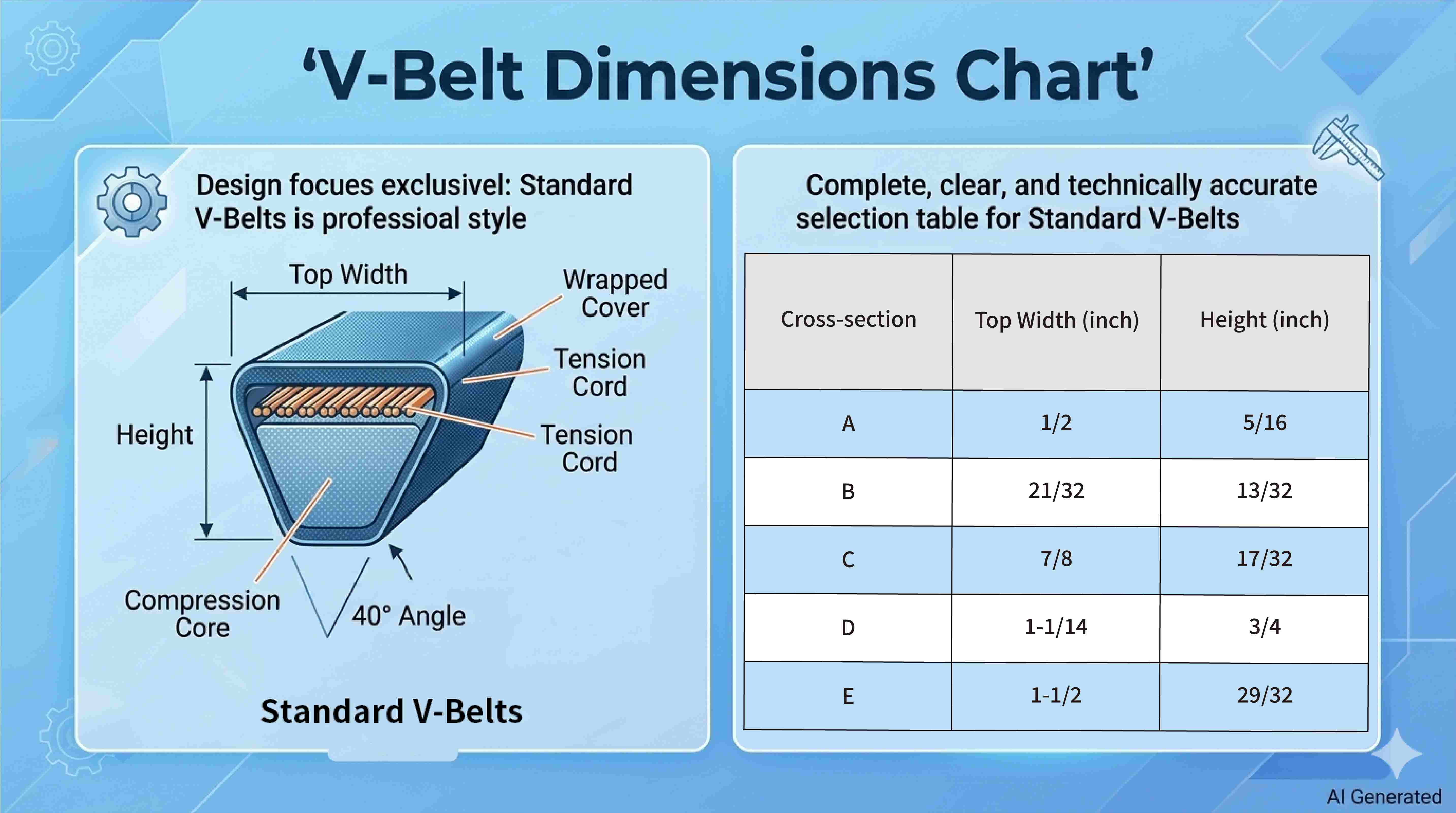
Standard V-Belt (Vee Belt) Dimensions
The cross-section of a V-belt determines its load capacity and suitability for specific applications. Standard profiles follow consistent V-belt dimensions, allowing proper matching to drive requirements.
| Section | Top Width (mm) | Height (mm) | Typical Application |
| A | 13 | 8 | Light-duty drives |
| B | 17 | 11 | General industrial use |
| C | 22 | 14 | Medium to high power |
| D | 32 | 19 | Heavy-duty drives |
| E | 38 | 23 | Very high loads |
The section type identifies the belt profile, while width and height define tensile strength and flexibility. Proper section selection ensures the belt operates within the intended load range.
Narrow V-Belts Dimensions
Designed for higher speed and smaller pulleys. Common in European industrial drives.
| Section | Top Width (mm / in) | Height (mm / in) | Typical Lp Range (mm / in) |
| SPZ | 10 / 0.394 | 8 / 0.315 | 355–4000 / 14–157 |
| SPA | 13 / 0.512 | 8 / 0.315 | 355–6300 / 14–248 |
| SPB | 17 / 0.669 | 14 / 0.551 | 500–10000 / 20–394 |
| SPC | 22 / 0.866 | 18 / 0.709 | 710–16000 / 28–630 |
Wedge V-Belts Dimensions
| Section | Top Width (mm / in) | Height (mm / in) | Lp Range (mm / in) |
| 3V | 9.5 / 0.375 | 8 / 0.315 | 381–3810 / 15–150 |
| 5V | 15.9 / 0.625 | 13 / 0.512 | 381–7620 / 15–300 |
| 8V | 25.4 / 1.00 | 16 / 0.630 | 406–9650 / 16–380 |
Hexagonal / Double V-Belts Dimensions
Used in heavy industrial machinery where two belts are combined in a single profile.
| Type | Width (mm / in) | Height (mm / in) | Lp Range (mm / in) |
| Hexagonal / 2VX | 13 / 0.512 | 8 / 0.315 | 355–6300 / 14–248 |
| Double V / 2V | 17 / 0.669 | 14 / 0.551 | 500–10000 / 20–394 |
Fractional Horsepower (FHP) V-Belts
Designed for low-power, small motors, and compact appliances.
| Section | Top Width (mm / in) | Height (mm / in) | Lp Range (mm / in) |
| 3/8 A | 9.5 / 0.375 | 6 / 0.236 | 305–1016 / 12–40 |
| 1/2 A | 12.7 / 0.500 | 8 / 0.315 | 305–2032 / 12–80 |
| 5/8 A | 15.9 / 0.625 | 10 / 0.394 | 381–2032 / 15–80 |
Important Notes for Practical Selection
- Always verify section and pitch length (Lp) with both pulley geometry and load requirements.
- For multi-belt systems, matched sets are recommended to ensure even load distribution.
- When switching between metric and imperial systems, round cautiously; even small differences affect tension and seating.
- Groove angle, belt profile, and pulley material all influence actual performance beyond charted dimensions.
V-Belt Lengths and Measurement Charts
V-belt length can be expressed in multiple ways. Correct identification prevents common errors in selection and installation.
| Term | Abbreviation | Description |
| Inside Length | Li | Inner surface of the belt |
| Pitch Length | Lp | Neutral axis of the belt (most important) |
| Outside Length | Lo | Outer surface of the belt |
Pitch length (Lp) is typically used in catalogs for proper pulley fit. Approximate conversions from outside to pitch length can be applied as follows:
| Section | Lo → Lp Adjustment (mm) |
| A | −36 |
| B | −43 |
| C | −56 |
For field identification, V-belt measurement charts allow classification based on physical dimensions. Essential steps include:
- Measure top width using calipers.
- Measure outer circumference to estimate pitch length.
- Confirm belt height to verify the section.
| Measured Width (mm) | Likely Section |
| ~13 | A |
| ~17 | B |
| ~22 | C |
Careful measurement is crucial when belts are worn or markings are missing, ensuring proper replacement without relying solely on nominal size.
Pulley Groove Compatibility
Belt performance depends heavily on proper engagement with the pulley. Groove angles typically range from 34° to 40°, but correct seating on the sidewalls is more important than exact numbers. Belts that bottom out in the pulley groove are prone to heat generation, wear, and slippage, even if the size matches.
Formulas Supporting Belt Selection
While dimension charts define potential matches, calculations verify system feasibility.
Belt Length for Two-Pulley Drives
Calculation formula: L = 2*C + (π*(D + d))/2 + ((D - d)^2)/(4*C)
- C = center distance between pulleys
- D = large pulley diameter
- d = small pulley diameter
This formula confirms whether the selected belt length fits the intended pulley arrangement.
Belt Speed
Calculation formula: v = (π * D * n) / 60
- v = belt speed (m/s)
- D = pulley diameter (m)
- n = rotational speed of pulley (rpm)
Belt speed impacts efficiency and wear. Maintaining an appropriate speed range ensures reliable operation.
Power Transmission Concept
Calculation formula: P = (T1 - T2) * v
- P = transmitted power
- T1 = tight side belt tension
- T2 = slack side belt tension
- v = belt speed
Although catalog tables often provide rated power, this formula explains the principles behind the ratings and how tension differences contribute to transmitted power.
Multi-Belt Systems and Load Distribution
In drives with multiple belts, tension is rarely evenly distributed. Correct installation and the use of matched sets help ensure balanced load sharing. Uneven tension can cause premature wear or ineffective transmission.
Practical Considerations
Key factors in belt selection and application include:
- Section size relative to load requirements
- Accurate length measurement and verification of pulley geometry
- Pulley groove design and proper belt seating
- Multi-belt load distribution
Charts, measurement tables, and formulas collectively guide proper selection and installation, ensuring smooth operation and minimizing maintenance issues.
This approach combines V-belt dimensions and measurement methods, providing a structured framework for practical design and maintenance.
Precision V-Belts for Every Drive — JLCMC
When it comes to V-belt dimensions, precision and reliability are non-negotiable. At JLCMC, our V-belts are engineered to fit perfectly, transmit power efficiently, and last longer under demanding industrial conditions.
From standard to narrow and wedge-profile belts, our components are designed to deliver smooth operation, reduce slippage, and maintain consistent tension across a wide range of machinery. Every belt is manufactured to stringent quality standards, ensuring your drives operate at peak performance and your production lines stay running without interruption.
Trust JLCMC V-Belts for durable, high-performance products that keep your equipment working safely and efficiently, while providing the precision fit and reliability your operations demand.
Frequently Asked Questions
What is the difference between standard V-belt sizes and narrow V-belts?
Standard V-belts (sections A, B, C, D, E) are used for general industrial drives and are defined by their top width and height. Narrow V-belts, such as SPZ, SPA, SPB, and SPC, have smaller cross-sections designed for higher-speed drives or smaller pulleys. They transmit similar power with less bulk and are often listed in both metric and imperial units in V-belt size charts.
How can a V-belt measurement chart help identify a worn belt?
A V-belt measurement chart allows identification when markings are missing or worn. By measuring top width, height, and outer circumference, it is possible to determine the belt section (A, B, C, etc.) and estimate pitch length (Lp). This ensures the replacement belt matches the pulley system and avoids issues like slippage or premature wear.
Are fractional horsepower V-belts included in standard size charts?
Yes, fractional horsepower (FHP) belts are a specialized category for low-power motors and small machinery. They have smaller widths and heights compared to standard belts and are usually included in extended V-belt standard sizes charts alongside top width, height, and length ranges in both metric and imperial units.
Why is pulley groove geometry important for selecting the correct V-belt?
Even if a V-belt size matches the catalog, incorrect pulley groove angles or depths can cause the belt to bottom out or slip. Proper groove engagement ensures sidewall contact and uniform tension distribution. Most charts assume standard groove geometry, but verification against actual pulley dimensions is critical for reliable operation.
Keep Learning
Metric Screw Size Chart: M1–M24, Pitch & Tap Drill
Key Takeaways The M in an M8 bolt is the major diameter in millimeters: M8×1.25 reads as an 8mm outer diameter with a 1.25mm thread pitch, and coarse pitch is assumed when the pitch is not written. The metric screw size chart below covers the ISO coarse series M1–M24 with pitch, inch equivalents, and the common tap drill for each size. M8 and 5/16 inch sit only 0.06mm apart on diameter, but their thread pitches come from different systems; the two look-alikes must not be mixed in one assembly. Fine pi......
Drill Bit Size Chart: Number, Letter, Fractional & Metric
Key Takeaways A drill bit size chart has to cover four systems — fractional (inches), number (#1–#80), letter (A–Z), and metric (mm) — because the same physical diameter can carry three different callouts. Number sizes provide intermediate diameters between standard fractional-inch drill sizes, allowing finer selection where 1/64-inch increments are too coarse — which is why a 1/4-20 tap takes a #7 drill (0.201 inch). Convert decimal inches to millimeters by multiplying by 25.4; the charts below give ......
2-Bolt vs. 4-Bolt Flange Bearing Units: Selection Differences That Matter
Key Takeaways Housing geometry and space: A two-bolt flange bearing unit normally uses an oval or diamond-shaped housing, making it ideal when the mounting face is narrow or access is limited. Bolt count vs. capacity: A four-bolt flange bearing unit normally uses a square housing suited for wider interfaces, but bolt count alone does not establish the unit's load capacity. Machine interface priority: Choose the housing pattern based on the machine interface first. Then verify shaft size, published loa......
NPT Thread Guide: Charts, Tap Drill Sizes, and Fitting Identification
Key Takeaways NPT (National Pipe Taper) is a U.S. standard tapered pipe thread defined by ASME B1.20.1: a 60° thread angle and a 1:16 taper on diameter, sealing through thread interference plus sealant. NPT tap drill sizes do not follow the diameter-minus-pitch formula used for straight machine threads — ASME B1.20.1 Appendix B provides guidance, and the tap manufacturer's data decides. The everyday sizes: 1/8 NPT (27 TPI, 0.405 inch major diameter), 1/4 NPT (18 TPI, 0.540 inch), 1/2 NPT (14 TPI, 0.84......
Tap Drill Chart: UNC, UNF, Metric & NPT Drill Sizes
Key Takeaways A tap drill creates the hole a tap cuts internal threads into; the drill diameter controls how much full thread the finished hole has. For Unified inch threads, drill size = major diameter − 1/TPI (rounded to the nearest standard drill) is a commonly used starting point for approximately 75 percent thread engagement; the actual percentage depends on thread geometry and the specified hole tolerance. For metric threads, the quick formula is drill = thread diameter − pitch in millimeters, r......
Comparing Brushless Motors and Stepper Motors: Principles, Structures & Applications
We have many machines around us that have electric motors to operate, including simple tools and complex robots. Brushless DC (BLDC) motors and stepper motors are two popular options for high precision and performance. They are both electrically commutated motors and have no physical brushes, but operate in different ways and are appropriate for different applications. Key Takeaways The advantages of BLDC motors are high-speed, smooth, continuous operation, and high efficiency. Stepper motors can be u......