Comparing Brushless Motors and Stepper Motors: Principles, Structures & Applications
7 min
- Key Takeaways
- How BLDC and Stepper Motors Work
- Major Differences Between BLDC Motor and Stepper Motor
- Advantages and Limitations of BLDC and Stepper Motors
- Which Motor Should You Choose: BLDC or Stepper?
- Applications of BLDC and Stepper Motors
- Frequently Asked Questions
- Conclusion
We have many machines around us that have electric motors to operate, including simple tools and complex robots. Brushless DC (BLDC) motors and stepper motors are two popular options for high precision and performance. They are both electrically commutated motors and have no physical brushes, but operate in different ways and are appropriate for different applications.
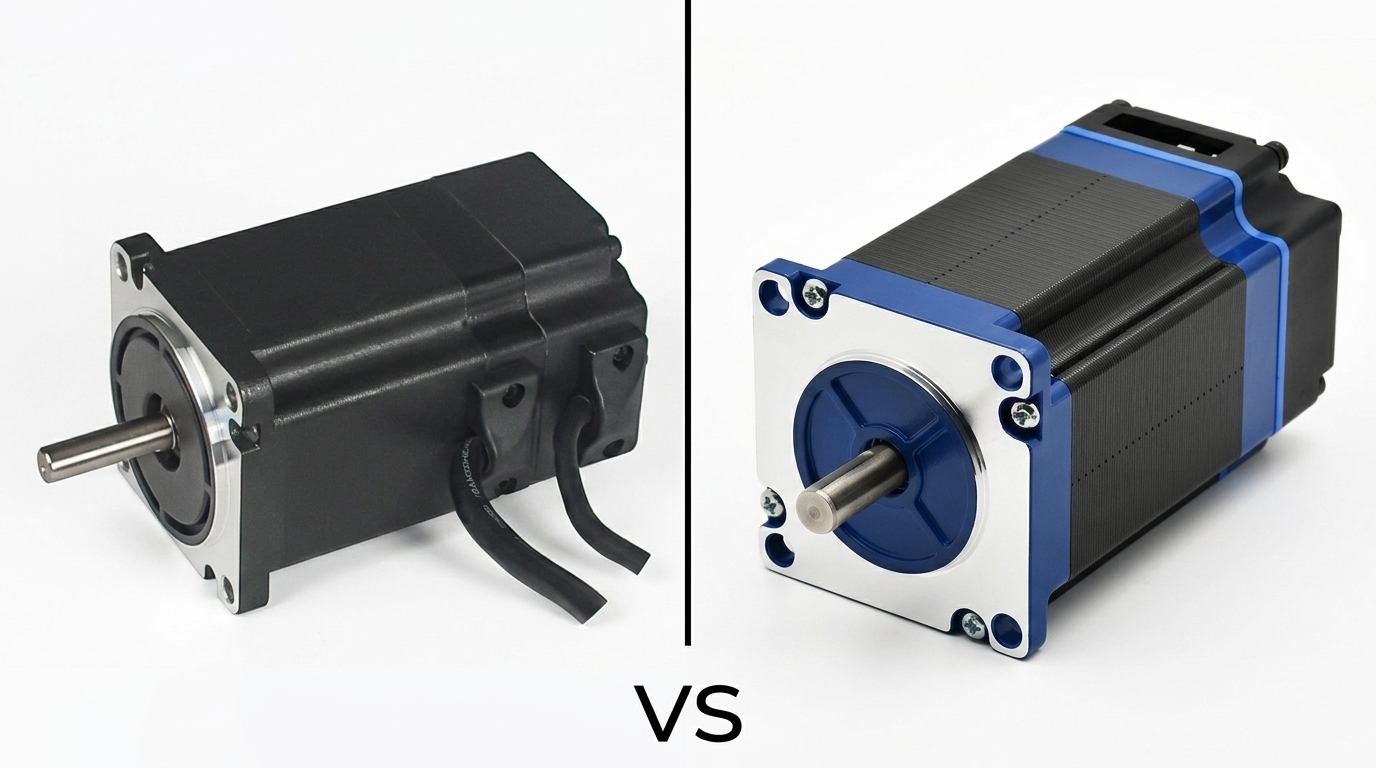
Key Takeaways
- The advantages of BLDC motors are high-speed, smooth, continuous operation, and high efficiency.
- Stepper motors can be used for precise positioning at low speeds when no complex feedback system is required.
- BLDC motors can use closed-loop drivers for dynamic control and position verification, making the overall cost of the driving circuit higher.
- Choices of stepper motor and a BLDC motor will depend on the desired motor speed, the amount of torque desired, the positioning requirements, and budget.
How BLDC and Stepper Motors Work
The magnetic fields are used to create rotation in both types of motor; However, different driving methods are used.
Working Principle of BLDC Motor
A BLDC Motor is one that uses permanent magnets on the rotor and electromagnets on the stator. The current is switched sequentially on and off by an electronic controller that controls the sequence of switching the current through the stator coils.
This switching sequence forms a rotating magnetic field that draws the magnets of the rotor. The rotor position is detected by sensors or estimated through sensorless methods to ensure smooth commutation.
Working Principle of Stepper Motors
A stepper motor segments a full rotation into steps of equal size. It typically has multiple stator windings and a rotor with permanent magnets and/or a toothed magnetic structure, depending on the motor type. The driver activates certain coils, causing the teeth to align with the active magnetic field. The power switching between coils is the basis for precise motor movement, with 1.8 degrees being a common step angle.
Major Differences Between BLDC Motor and Stepper Motor
Comparison Table
| Feature | BLDC Motor | Stepper Motor |
| Speed Range | Typically high, depending on motor design and application | Typically low to medium, depending on motor design and application |
| Low-Speed Torque | Application-dependent | Generally strong holding torque |
| Positioning | Closed-loop control recommended when position verification is required | Open-loop precision is possible |
| Efficiency | Generally high, depending on operating conditions | Often low to moderate, with heat generated during holding |
| System Cost | Due to the inclusion of sensors and controllers, it can be higher. | Lower in many applications |
Structure and Electromagnetic Characteristics of Motors
BLDC motors typically use a permanent-magnet rotor and a wound stator, with the number of poles depending on the motor design. Stepper motors, on the other hand, have multiple stator windings and a toothed rotor. The number of poles and teeth enables fine mechanical steps without external gearing.
Commutation, Control, and Feedback
Experts use continuous electronic commutation for BLDC motors. The controller can determine the position of the rotor by a Hall arrangement, encoder, or sensorless estimation, depending on the system. Stepper motors are typically operated in open-loop control. The controller sends step pulses, and the motor moves without providing position feedback to the controller.
Speed–Torque Characteristics
Stepper motors can provide strong static holding torque when not moving. Their dynamic torque generally decreases as speed increases. BLDC motors can provide useful torque over a broad speed range. Depending on motor design and operating conditions, they can provide high power output at high RPMs.
Positioning Accuracy and Motion Control
Stepper motors move in increments defined by built-in step angles. The controller determines the intended position by counting commanded steps, but open-loop operation does not verify the actual position. Missed steps caused by excessive load or acceleration can therefore produce position errors. To achieve such positioning precision, BLDC motors can use high-resolution encoders and closed-loop algorithms.
Efficiency, Heat, Noise, and Vibration
BLDC motor current generally varies with the mechanical load, speed, and control conditions, while efficiency and heat generation also depend on motor and driver design. They can also produce low noise and vibration. Stepper Motors can consume substantial current while holding position. This continuous current can increase the operating temperature and cause a slight vibration at certain speeds.
Driver Requirements, System Complexity, and Cost
Stepper systems are less expensive to buy and employ simple drive circuits. BLDC systems require more complex inverter drives, while accurate feedback systems and sophisticated tuning may be required for closed-loop positioning. Hence, the total system costs can be higher for full BLDC systems.
Advantages and Limitations of BLDC and Stepper Motors
BLDC Motors
- Pros: High efficiency, long operational life, quiet operation, high top speeds.
- Cons: It's more expensive, has more driver requirements, and may need position feedback for precise positioning.
Stepper Motors
- Pros: Excellent low-speed torque, low cost, simple open-loop control, precise position holding.
- Cons: Available torque decreases at high speed, can lose steps if it is overloaded, and it will run hot and create vibration.
Which Motor Should You Choose: BLDC or Stepper?
Select BLDC for High-Speed, Efficient, Continuous Operation
Use BLDC motors for continuous operation for extended periods. They are ideal for applications that involve high-speed operations where heat management and energy efficiency are critical.
Select Stepper for Simple Open-Loop Positioning
Use stepper motors for simple positioning applications. They are very useful if you want to have tight position control without adding additional position feedback sensors.
Select Closed-Loop Control When Position Accuracy is Important
Closed-loop drive systems are ideal for applications where high speed, position verification, and improved dynamic control are required. Advanced drivers are used in conjunction with BLDC motors or closed-loop steppers to monitor and correct position errors during high-acceleration operation.
Important Factors to Consider
- Minimum speed and torque curve required.
- Position accuracy requirements.
- The budget and complexity of the project.
- Limits of heat dissipation and noise tolerance.
- Required acceleration and load inertia.
Applications of BLDC and Stepper Motors
Common BLDC Motor Applications
- Electric vehicles and drones.
- Hard drives and computer cooling fans.
- Mowers, snow blowers, or other power tools and equipment that do not require cords.
- Industrial pumps and HVAC blowers.
Common Stepper Motor Applications
- 3D printers and CNC routing machines.
- Focus mechanisms for cameras and stage lights.
- Medical liquid dispensers that are automatic.
- Lab automation instruments and specialized hybrid motor stages.
Frequently Asked Questions
Is a BLDC Motor Better Than a Stepper Motor?
Neither motor is generally superior. BLDC motors provide greater speed, power density, and smoother running. Stepper motors provide strong holding torque when stationary, can offer good low-speed torque, and support low-cost positioning.
Are BLDC Motors and Stepper Motors the Same?
They're not the same. Both motors operate without mechanical brushes, but the stepper motor's motion increment is provided by its electromagnetic pole and tooth arrangement. BLDC motors are designed for smooth and continuous high-speed operation.
Are Stepper Motors Brushless?
Yes. In the case of stepper motors, they do not use carbon brushes. The electronic circuits switch current into the stator coils to control movement and do not wear out brushes.
Is It Possible to Replace the Stepper Motor With a Brushless Motor Instead?
A brushless motor can be used in place of a stepper motor in some applications, but the motor, driver, feedback, and control system must be appropriately matched. This replacement can add to system cost and software design requirements.
Conclusion
Selecting between BLDC and stepper motors comes down to speed, torque, precision, and cost. Stepper motors are a cost-effective option for low-speed positioning applications. BLDC motors are highly efficient and fast for high-duty and continuous loads.
Looking for the perfect motor for your automation project? Check out our in-depth technical guides and motor catalog to find the right motor for your design today!
Keep Learning
Drill Bit Size Chart: Number, Letter, Fractional & Metric
Key Takeaways A drill bit size chart has to cover four systems — fractional (inches), number (#1–#80), letter (A–Z), and metric (mm) — because the same physical diameter can carry three different callouts. Number sizes provide intermediate diameters between standard fractional-inch drill sizes, allowing finer selection where 1/64-inch increments are too coarse — which is why a 1/4-20 tap takes a #7 drill (0.201 inch). Convert decimal inches to millimeters by multiplying by 25.4; the charts below give ......
2-Bolt vs. 4-Bolt Flange Bearing Units: Selection Differences That Matter
Key Takeaways Housing geometry and space: A two-bolt flange bearing unit normally uses an oval or diamond-shaped housing, making it ideal when the mounting face is narrow or access is limited. Bolt count vs. capacity: A four-bolt flange bearing unit normally uses a square housing suited for wider interfaces, but bolt count alone does not establish the unit's load capacity. Machine interface priority: Choose the housing pattern based on the machine interface first. Then verify shaft size, published loa......
NPT Thread Guide: Charts, Tap Drill Sizes, and Fitting Identification
Key Takeaways NPT (National Pipe Taper) is a U.S. standard tapered pipe thread defined by ASME B1.20.1: a 60° thread angle and a 1:16 taper on diameter, sealing through thread interference plus sealant. NPT tap drill sizes do not follow the diameter-minus-pitch formula used for straight machine threads — ASME B1.20.1 Appendix B provides guidance, and the tap manufacturer's data decides. The everyday sizes: 1/8 NPT (27 TPI, 0.405 inch major diameter), 1/4 NPT (18 TPI, 0.540 inch), 1/2 NPT (14 TPI, 0.84......
Tap Drill Chart: UNC, UNF, Metric & NPT Drill Sizes
Key Takeaways A tap drill creates the hole a tap cuts internal threads into; the drill diameter controls how much full thread the finished hole has. For Unified inch threads, drill size = major diameter − 1/TPI (rounded to the nearest standard drill) is a commonly used starting point for approximately 75 percent thread engagement; the actual percentage depends on thread geometry and the specified hole tolerance. For metric threads, the quick formula is drill = thread diameter − pitch in millimeters, r......
Comparing Brushless Motors and Stepper Motors: Principles, Structures & Applications
We have many machines around us that have electric motors to operate, including simple tools and complex robots. Brushless DC (BLDC) motors and stepper motors are two popular options for high precision and performance. They are both electrically commutated motors and have no physical brushes, but operate in different ways and are appropriate for different applications. Key Takeaways The advantages of BLDC motors are high-speed, smooth, continuous operation, and high efficiency. Stepper motors can be u......
DC Motor vs. Stepper Motor: What Are They and How Do They Differ?
To clearly distinguish between DC motors and stepper motors, this article uses brushed DC motors as the primary reference for comparison. A brushed DC motor is typically well suited for continuous rotation, high-speed operation, and variable-speed control, while a stepper motor is commonly used for low-speed positioning, indexing, and holding torque at standstill. When combined with an encoder and an appropriate controller, a brushed DC motor can also be used for closed-loop positioning. The right cho......