Wedge Lock Washer Guide: How It Works, Uses, and Selection Tips
25 min
- Quick Answer Box
- Introduction
- 1. What Is a Wedge Lock Washer?
- 2. Why Do Bolts Loosen Under Vibration?
- 3. How a Wedge Lock Washer Works
- 4. Why Wedge Lock Washers Matter in Mechatronics
- 5. Wedge Lock Washer vs Traditional Lock Washers
- 6. Common Applications in Mechatronic Assemblies
- 7. Wedge Lock Washer Sizes, Materials, and Finishes
- 8. Installation Best Practices
- 9. When Not to Use a Wedge Lock Washer
- 10. Wedge Lock Washer Selection Guide
- 11. Practical FAQ About Wedge Lock Washers
- Final Takeaway
Quick Answer Box
What is a wedge lock washer?
A wedge lock washer is a two-piece locking washer system designed to prevent bolt and nut loosening by using wedge geometry, bolt tension, and surface engagement.
How does a wedge lock washer work?
It uses cams on the inner faces and radial teeth on the outer faces. When a fastener tries to loosen, the cam surfaces force the washer pair to expand axially, forcing additional bolt elongation and maintaining clamp load and resisting rotation.
Is a wedge lock washer the same as a split lock washer?
No. A split lock washer mainly relies on spring force and friction. A wedge lock washer uses a paired cam-and-tooth structure to create a geometry-based locking effect.
What test is used to evaluate wedge lock washers?
The Junker vibration test is commonly used to evaluate the self-loosening behavior of bolted joints under transverse vibration.
Where are wedge lock washers used in mechatronics?
They are commonly used around servo motor bases, robotic fixtures, linear motion support structures, actuator brackets, conveyor drive units, CNC frames, battery pack housings, and power electronics assemblies.
Popular metric sizes:
M3, M4, M5, M6, M8, M10, M12, M16, and M20 are common. In mechatronic assemblies, M6, M8, M10, and M12 are especially common for motor mounts, machine frames, and support brackets.
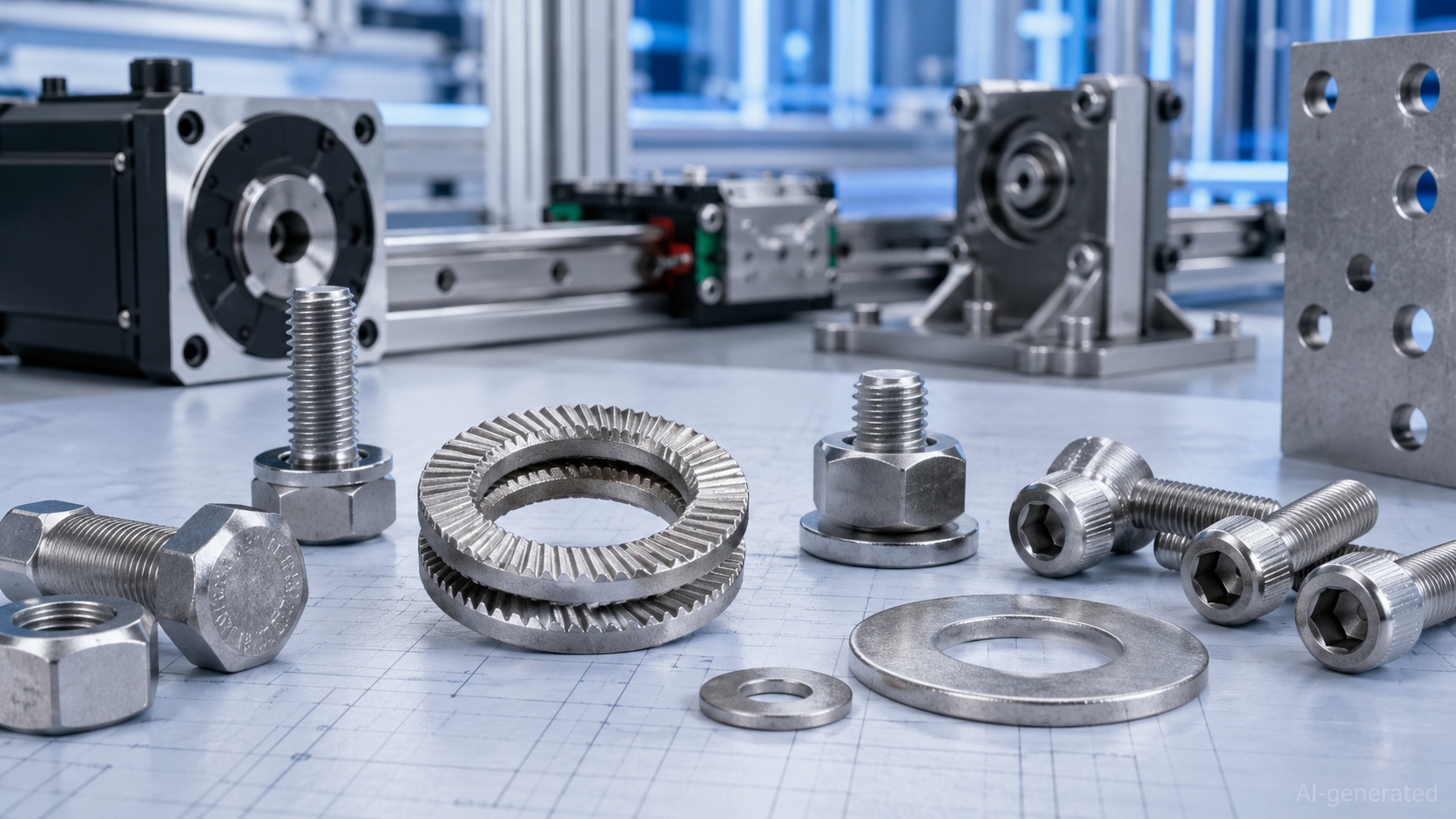
Introduction
Bolts do not loosen because they are careless. They loosen because vibration, transverse movement, dynamic load, thermal cycling, joint settlement, and surface wear are very good at finding weak points in a fastening design.
In many general assemblies, a traditional washer may be enough. A split lock washer adds spring force. A serrated washer bites into the surface. A conical spring washer helps support preload. A flat washer spreads load. Each one has a job.
But in heavy vibration, lubricated fastening, repeated shock, steel structures, or moving mechatronic systems, friction-based locking can become less reliable. Once clamp force drops, the joint can begin to move. Once the joint moves, the fastener can loosen. Once the fastener loosens, the machine may start sending very expensive signals that something was not designed quite well enough.
That is where the wedge lock washer becomes useful.
A wedge lock washer, also called a wedge locking washer or double-stack self-locking washer, is designed to secure bolted joints using geometry and tension. Instead of depending mainly on friction, it uses a two-piece washer pair with cams on the inside and radial teeth on the outside. When the bolt or nut tries to rotate loose, the washer pair creates a wedge effect that increases bolt tension.
In mechatronic assemblies, this matters. Servo motors, stepper motor plates, robotic arms, actuator bases, linear guide support structures, ball screw support brackets, conveyor modules, battery housings, and power electronics enclosures all experience motion, load changes, or vibration. A small washer can become the quiet difference between stable operation and repeat maintenance.
JLCMC provides washer options for mechatronic assemblies, including lock washers, spring washers, flat washers, internal serrated lock washers, and double-stack self-locking washers. These can be selected together with screws, bolts, nuts, aluminum extrusion accessories, sensor brackets, linear motion components, and motor mounting hardware.
This guide explains what a wedge lock washer is, why bolts loosen under vibration, how the wedge locking principle works, how it compares with traditional lock washers, where it is used in mechatronics, how to install it correctly, and how to select the right size, material, and structure for demanding bolted joints.
1. What Is a Wedge Lock Washer?
A wedge lock washer is a paired washer system used to prevent a bolted joint from loosening under vibration or dynamic load. Unlike a flat washer or a split lock washer, it is not designed to work as a single loose washer. It is designed as a matched pair.
Each washer has two functional surfaces:
| Surface | Function |
| Inner cam surface | Creates the wedge locking effect |
| Outer radial teeth | Grip the bolt head, nut, or clamped surface |
The two washers are installed with the cam faces touching each other. The radial teeth face outward, contacting the fastener and the joint surface.
In simple terms:
A wedge lock washer is a two-piece washer pair that uses cam geometry to prevent bolt or nut loosening.
This makes it different from many traditional lock washers. A split lock washer mainly relies on spring force and friction. A tooth washer relies on surface bite. A wedge lock washer uses a more controlled mechanical principle: when loosening starts, the washer pair forces the joint to increase tension.
Common Names
Wedge lock washers may appear under several names in product catalogs and engineering discussions.
| Name | Meaning |
| Wedge lock washer | General name for the wedge locking washer pair |
| Wedge locking washer | Same concept, often used in technical descriptions |
| Double-stack self-locking washer | Describes the paired stacked structure |
| Self-locking washer pair | Emphasizes the two-piece anti-loosening function |
| Cam lock washer | Refers to the cam surfaces inside the pair |
| Anti-vibration washer | Application-based name, less precise |
For JLCMC-style product naming, double-stack self-locking washer is especially useful because it describes the physical structure clearly: two washers stacked together to resist loosening.
Where It Fits in the Lock Washer Family
| Washer Type | Main Locking Principle | Typical Use |
| Split lock washer | Spring tension and friction | Light-duty general fastening |
| Internal or external tooth washer | Surface bite | Sheet metal, grounding points, small brackets |
| Conical spring washer | Elastic preload support | Medium-load joints, preload compensation |
| Wedge lock washer | Cam wedge geometry and bolt tension | High-vibration and dynamic-load joints |
| Tab washer | Mechanical blocking | Shaft nuts, bearing locknuts, positive locking |
A wedge lock washer is not simply a “stronger-looking washer.” It is a different locking mechanism.
2. Why Do Bolts Loosen Under Vibration?
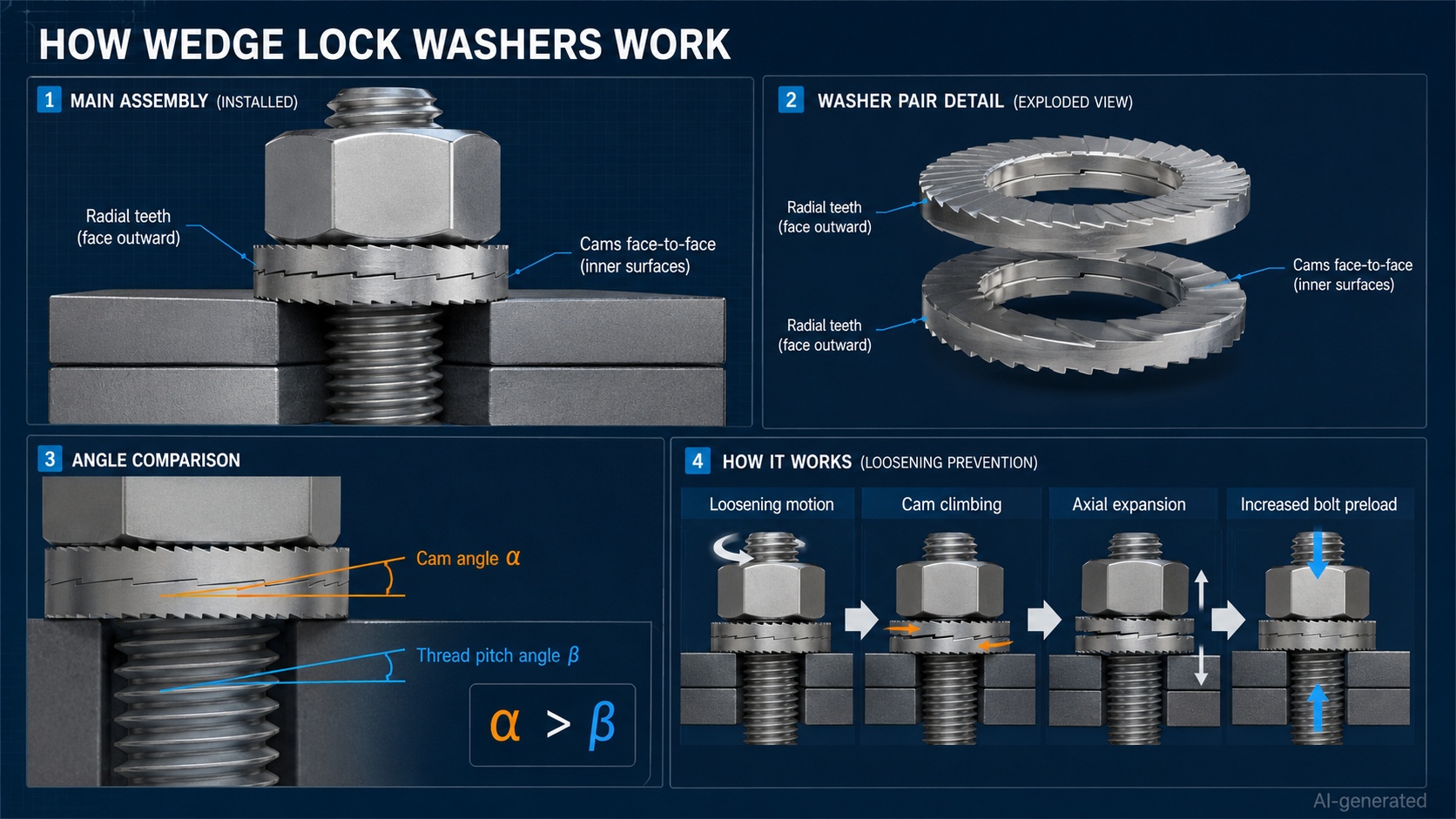
Before discussing how a wedge lock washer works, it helps to understand the problem it is designed to solve: bolt loosening under vibration.
A bolted joint works by clamp force. When a bolt is tightened correctly, it stretches slightly and creates preload. That preload presses the joint surfaces together and keeps the assembly stable. If preload drops, the joint can begin to slip. Once slip begins, the fastener may gradually rotate loose.
Bolted joints often loosen because of:
· Vibration
· Dynamic loading
· Thermal cycling
· Joint settlement
· Side-to-side movement
· Surface wear
· Improper tightening torque
· Insufficient thread engagement
Among these causes, side-to-side movement, also called transverse movement, is especially important. In many bolted joints, the most damaging motion is not pulling directly along the bolt axis. It is repeated movement across the joint interface. This transverse motion can create small slips between the clamped parts and gradually reduce preload.
This process is commonly described as self-loosening of bolted joints. It is one of the main reasons fastener loosening becomes a serious issue in machinery exposed to vibration, shock, repeated motion, or changing loads.
In mechatronic assemblies, this is not just a fastening theory problem. A loose bolt may cause sensor misalignment, motor base movement, linear axis positioning error, conveyor vibration, enclosure noise, or repeated maintenance.
| Cause of Loosening | Possible Effect in Mechatronics |
| Vibration | Gradual preload loss |
| Dynamic loading | Joint slip or movement |
| Thermal cycling | Expansion and contraction of materials |
| Joint settlement | Reduced clamp force after operation |
| Transverse movement | Self-loosening of the fastener |
| Surface wear | Lower friction and unstable contact |
The Junker vibration test is often used to evaluate this type of vibration loosening. In the test, a bolted joint is exposed to repeated transverse movement while preload is monitored. If the locking method is weak, preload can drop quickly. If the locking method is effective, preload remains more stable.
This is where wedge lock washers become relevant. They are designed specifically to resist self-loosening caused by transverse vibration. Instead of relying only on friction, they use geometry to turn loosening movement into increased bolt tension.
That brings us to the key question: how does a washer pair do that?
3. How a Wedge Lock Washer Works
A wedge lock washer works by using a two-piece cam structure. It does not behave like a normal flat washer, and it does not rely mainly on spring force like a split lock washer. Its locking effect comes from the interaction between the inner cam faces, the outer radial teeth, and the bolt’s preload.
A wedge lock washer pair has:
· Cams on the inner faces
· Radial teeth on the outer faces
· Two washers installed cam-face to cam-face
· Teeth facing outward toward the nut, bolt head, and clamped surface
The key engineering principle is:
The wedge angle (α) of the cam surfaces is intentionally greater than the thread lead angle (β) of the fastener.
This means that when the fastener tries to loosen, the washer pair cannot simply rotate freely. The radial teeth grip the outside contact surfaces, while the inner cam faces are forced to climb over each other. Because the cam angle (α) is greater than the thread lead angle (β), the bolt cannot loosen without first overcoming this geometric mismatch, which forces additional bolt elongation and increases tension instead of allowing rotation to proceed freely.
In practical terms, loosening motion stretches the bolt slightly and increases tension. The bolt tries to relax, but the washer pair makes that movement mechanically difficult.
Step-by-Step Working Process
| Step | What Happens |
| 1 | The bolt or nut is tightened over the wedge lock washer pair |
| 2 | The radial teeth bite into the nut, bolt head, or clamped surface |
| 3 | The washer pair becomes fixed against the outside contact surfaces |
| 4 | Vibration or transverse movement tries to rotate the fastener loose |
| 5 | The inner cam faces force the two washers to climb against each other |
| 6 | The washer pair expands axially |
| 7 | The bolt is stretched slightly |
| 8 | Bolt preload increases instead of dropping |
| 9 | The increased tension resists further loosening |
What Is the Junker Test?
The Junker test, also called the Junker vibration test, is a widely used method for evaluating bolt self-loosening under transverse vibration. It is commonly used to compare how different fastening methods perform when a bolted joint is exposed to repeated side-to-side movement.
During the test, a bolted joint is tightened to a specified preload. The joint is then subjected to cyclic transverse displacement while bolt preload is measured continuously. A weak locking method usually shows rapid preload loss. A stronger locking method maintains preload more effectively over repeated cycles.
This test is especially relevant for wedge lock washers because their locking principle directly targets the same failure mode: transverse vibration loosening. Since the cam angle is greater than the thread pitch angle, loosening rotation forces the washer pair to climb over the cams, increasing axial tension instead of allowing the bolt to back off.
That is why wedge lock washers are often used in railway equipment, mining machinery, heavy machinery, steel structures, and industrial automation systems.
For mechatronic assemblies, the same principle applies on a smaller but still important scale. Servo motor mounts, linear guide support plates, actuator bases, conveyor modules, and robotic fixtures often face vibration and side loading that can lead to fastener loosening over time.
Simple Explanation
When the bolt tries to loosen, the washer pair attempts to separate and climb the cam surfaces.
Because the wedge angle of the cams is greater than the thread lead angle, this movement requires additional bolt elongation before significant loosening can occur.
The bolt's inherent elasticity strongly resists this additional stretch, helping prevent self-loosening and maintain clamp load.
Or, in workshop language:
The wedge lock washer uses geometry to create a mechanical roadblock. The bolt cannot back off without first overcoming its own preload, effectively resisting loosening and keeping the joint secure.
4. Why Wedge Lock Washers Matter in Mechatronics
Mechatronic assemblies combine motion, structure, control, and sensing. That combination creates fastening conditions that are much tougher than a static frame.
A moving automation axis may accelerate and stop hundreds or thousands of times. A servo motor may generate torque reaction. A conveyor drive may vibrate continuously. A robotic arm may reverse direction rapidly. A battery housing may experience vibration and temperature changes. A power inverter enclosure may expand and contract under heat.
If a bolted joint loses clamp force in these systems, the result may be more than a loose screw.
It can cause:
· Sensor misalignment
· Motor base movement
· Positioning error
· Extra vibration
· Noise
· Wear
· Downtime
· Reduced repeatability
· Electrical enclosure failure
· Premature component damage
Why Traditional Washers May Not Be Enough
Traditional washers can be useful, but they have limitations.
A split lock washer may flatten and lose spring effect. A tooth washer may damage the surface or lose bite if the surface deforms. A friction-based joint may become less reliable when lubricated, coated, or exposed to micro-slip.
This does not mean traditional washers are bad. It means they should be used where their mechanism matches the risk level.
Where Wedge Lock Washers Add Value
| Condition | Why Wedge Lock Washers Help |
| High vibration | Wedge action resists reverse rotation |
| Dynamic load | Bolt tension is maintained more effectively |
| Lubricated fastening | Locking is less dependent on friction alone |
| Heavy structures | Larger clamp loads can be secured more reliably |
| Thermal cycling | Tension-based locking helps resist preload loss |
| Repeated movement | Useful for moving-axis support structures |
| Hard-to-access joints | Reduces loosening risk between maintenance cycles |
In mechatronics, the most dangerous loose fastener is not always the biggest one. Sometimes it is the one hidden behind a motor plate, under a cable carrier bracket, or inside a machine frame where nobody wants to reach twice.
5. Wedge Lock Washer vs Traditional Lock Washers
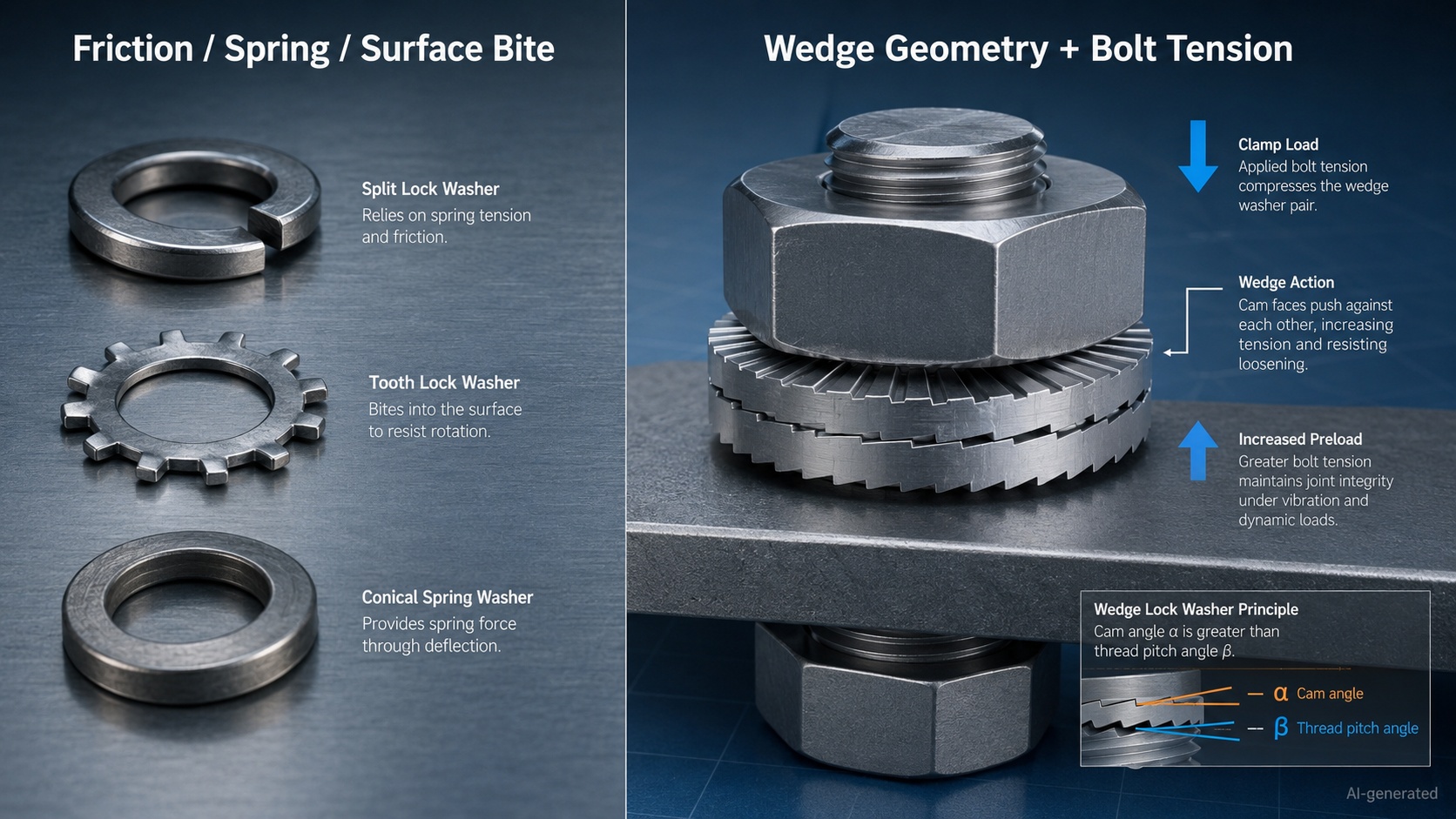
A wedge lock washer is not automatically necessary for every joint. It should be used where the application justifies the stronger locking principle.
Comparison Table
| Feature | Split Lock Washer | Tooth Lock Washer | Conical Spring Washer | Wedge Lock Washer |
| Main principle | Spring force and friction | Surface bite | Elastic preload support | Wedge geometry and bolt tension |
| High-vibration performance | Limited | Surface-dependent | Moderate to good | Strong |
| Lubricated environment | Can be less effective | Surface-dependent | Depends on joint | More suitable than friction-only methods |
| Surface damage risk | Low to moderate | Higher | Low to moderate | Teeth may mark surfaces |
| Reusability | Limited if flattened | Limited if teeth wear | Depends on condition | Often reusable if undamaged |
| Installation complexity | Simple | Simple | Simple | Requires correct pair orientation |
| Best use | Light-duty brackets | Sheet metal and grounding | Preload compensation | Critical vibration-prone joints |
| Typical sizes | M3–M12 | M3–M8 | M4–M16 | M3–M20+ |
Mechanical Technical Debt
In software, technical debt means a shortcut that creates future problems. Fasteners can create technical debt too.
Using a basic washer in a joint that really needs high-vibration resistance may look acceptable during assembly. The problem appears later, after vibration, heat, load changes, or repeated motion gradually reduce clamp force.
The machine does not send a polite calendar reminder. It drifts, rattles, wears, or stops.
When a Traditional Washer May Be Enough
Traditional washers may be suitable for:
· Light covers
· Simple brackets
· Control panels
· Low-vibration guards
· Small sensor accessories
· Non-critical frames
· Easy-to-access maintenance points
When Wedge Locking Is Worth Considering
A wedge lock washer becomes more attractive for:
· Servo motor bases
· Robotic joints
· Linear axis support structures
· Conveyor drive units
· CNC gantry frames
· High-speed actuator brackets
· Heavy machine modules
· Battery housings exposed to vibration
· Power electronics enclosures exposed to thermal cycling
The selection should be based on risk. If loosening would be costly, hard to detect, or hard to access, a stronger locking method deserves serious consideration.
6. Common Applications in Mechatronic Assemblies
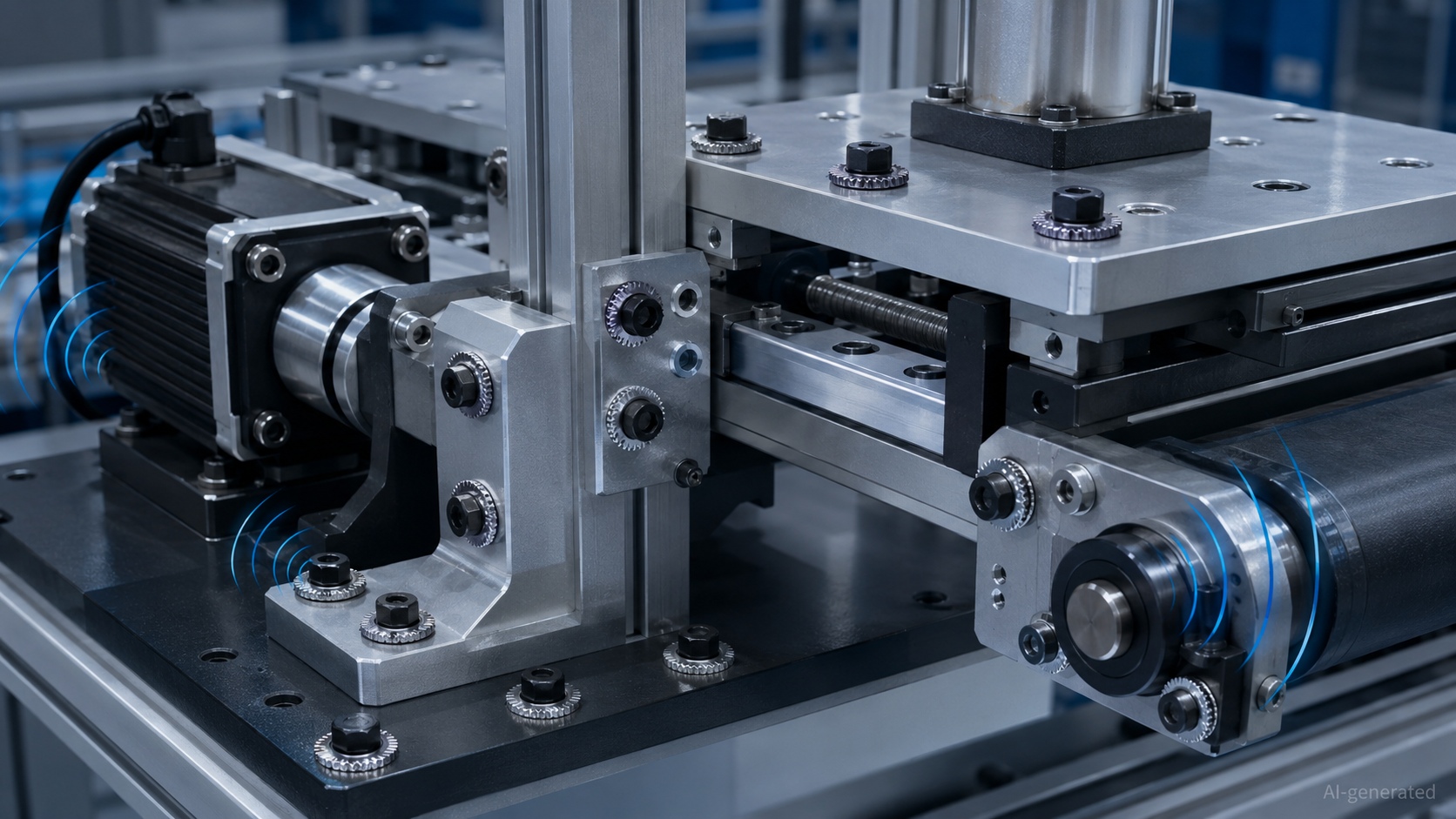
Wedge lock washers are useful in mechatronic assemblies where vibration, dynamic load, transverse movement, or thermal stress can loosen bolted joints.
Application Map
| Mechatronic Area | Common Sizes | Why Wedge Lock Washers Are Used |
| Servo motor bases | M5, M6, M8, M10 | Motor vibration and torque reaction |
| Stepper motor mounting plates | M4, M5, M6 | Repeated start-stop motion |
| Robotic arm joints | M6, M8, M10, M12 | Dynamic load and direction changes |
| Linear guide support structures | M5, M6, M8 | Moving-axis vibration and alignment stability |
| Ball screw support brackets | M6, M8, M10 | Axial load and repeated motion |
| Conveyor drive units | M8, M10, M12 | Continuous vibration and rotation |
| CNC gantry frames | M8, M10, M12, M16 | Structural stiffness and vibration control |
| Battery pack housings | M5, M6, M8 | Vibration and thermal cycling |
| Power inverter housings | M4, M5, M6 | Heat cycling and enclosure reliability |
| Cable carrier brackets | M4, M5, M6 | Repeated movement of cable chains |
Servo Motor Bases
Servo motors generate torque reaction, vibration, and repeated acceleration loads. Wedge lock washers are useful on motor mounting plates, adapter brackets, and support structures where fastener loosening could affect positioning accuracy.
Common sizes: M5, M6, M8, M10
Linear Motion Supports
Linear motion systems depend on stable support structures. Wedge lock washers may be used on surrounding brackets, frame connections, actuator bases, and support plates where vibration is present.
For precision linear guide rail mounting itself, always follow the component’s installation requirements. Do not add a washer under rail mounting screws unless the design allows it.
Common sizes: M5, M6, M8
Robotic Fixtures
Robotic arms and end-effectors experience direction changes, acceleration, shock, and repeated load cycles. Fasteners on tooling plates, brackets, and fixtures can loosen over time if the locking method is weak.
Common sizes: M6, M8, M10, M12
Conveyor Drive Units
Conveyors operate continuously, often with vibration from motors, rollers, belts, sprockets, bearings, or gearboxes. Wedge lock washers can be used around drive units, motor supports, bearing brackets, and structural side plates.
Common sizes: M8, M10, M12
Battery Pack and Power Electronics Housings
Battery pack housings, power inverter enclosures, and high-power electrical assemblies may experience vibration and thermal cycling. Expansion and contraction can challenge traditional locking methods.
Common sizes: M5, M6, M8
These examples are not a recommendation to use wedge lock washers everywhere. They are a reminder to use them where loosening risk is serious enough to justify stronger locking performance.
7. Wedge Lock Washer Sizes, Materials, and Finishes
Wedge lock washers are available in a wide range of metric sizes. In mechatronic assemblies, washer size usually matches the bolt or screw diameter.
Popular Metric Sizes
| Size | Typical Mechatronic Application |
| M3 | Small brackets, compact sensors, electronics enclosures |
| M4 | Sensor brackets, light actuator covers, small motor accessories |
| M5 | Aluminum frames, motor plates, cable carrier supports |
| M6 | Linear motion brackets, actuator bases, servo motor mounts |
| M8 | Machine frames, conveyor units, robotic fixtures |
| M10 | Larger support structures, heavy motor bases |
| M12 | Heavy-duty frames, industrial bases, large brackets |
| M16 | CNC frames, structural machine assemblies |
| M20+ | Heavy equipment and large industrial structures |
For many mechatronic applications, M6, M8, M10, and M12 are especially relevant because they often appear in motor mounting, machine frames, linear motion supports, actuator bases, and conveyor structures.
Common Materials
| Material | Main Advantage | Typical Use |
| Carbon steel | Strength and cost efficiency | General industrial machinery |
| Alloy steel | Higher strength | Heavy-duty and high-preload joints |
| Stainless steel | Corrosion resistance | Humid, clean, or outdoor-related environments |
| Surface-treated steel | Corrosion protection | Industrial automation frames and equipment |
Common Finishes
| Finish | Purpose |
| Zinc flake or Dacromet-style coating | Corrosion resistance and controlled surface protection |
| Black oxide | Appearance and mild protection |
| Zinc plating | General corrosion resistance |
| Plain stainless | Corrosion resistance without additional coating |
JLCMC Product Note
JLCMC offers double-stack self-locking washer options under the lock washer category, including carbon steel versions with Dacromet surface finishing and SUS304 stainless steel versions. These can be selected for mechatronic fastening applications where vibration resistance is important.
Material Selection Tips
Choose carbon steel or alloy steel for general strength in indoor machinery. Choose stainless steel when corrosion resistance matters. Choose coated versions when the environment requires additional surface protection.
Also check surface hardness. The radial teeth on a wedge lock washer must grip the mating surface. If the contact surface is too hard, too soft, heavily coated, or fragile, the locking performance and surface condition should be evaluated carefully.
A washer that cannot grip is like a clamp wearing mittens. It may look ready, but the job becomes questionable.
8. Installation Best Practices
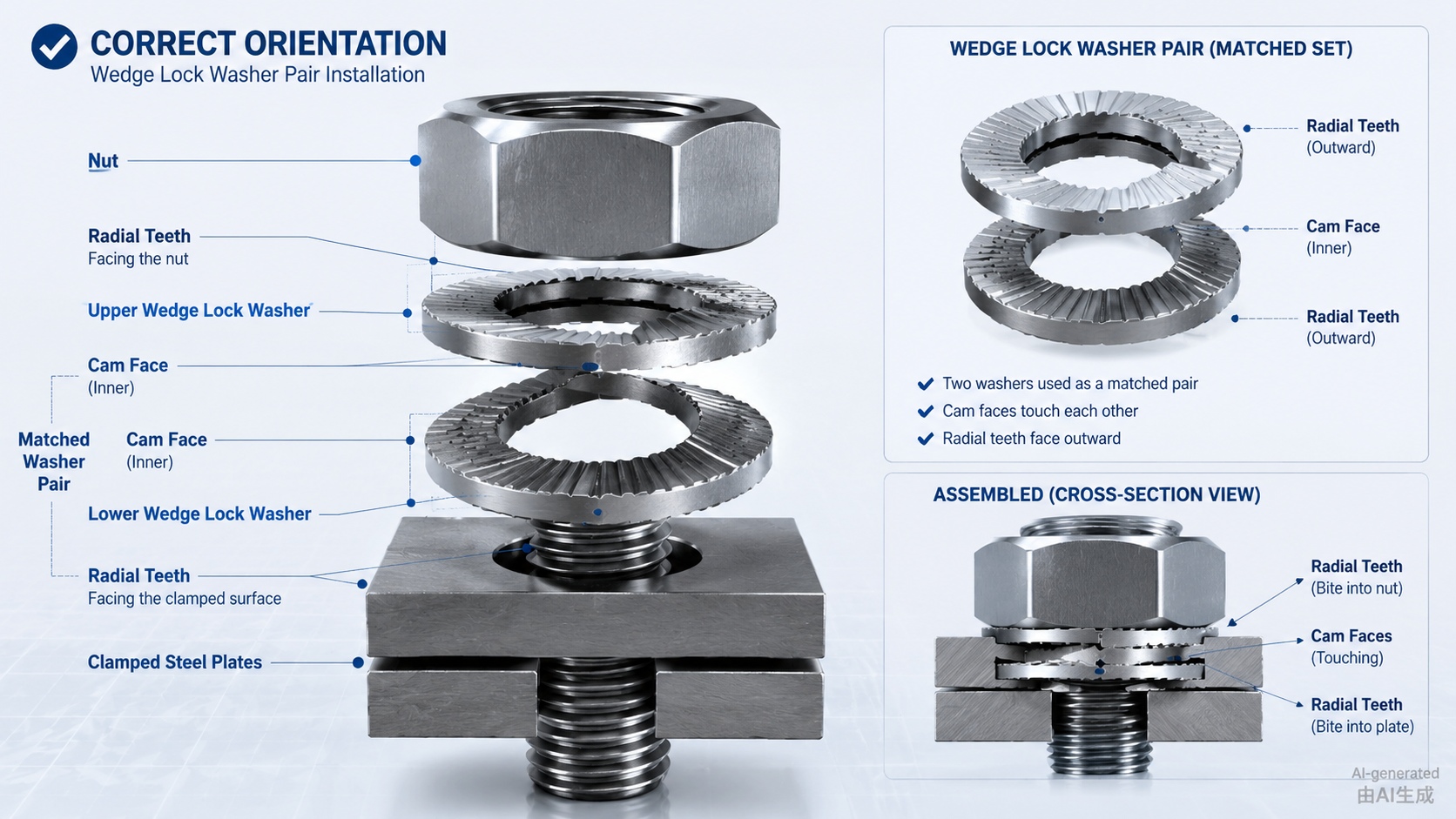
A wedge lock washer is powerful only when installed correctly. The mechanism depends on orientation, contact, and preload.
Correct Orientation
A wedge lock washer pair should be installed with:
· Cam faces against each other
· Radial teeth facing outward
· One toothed side against the bolt head or nut
· The other toothed side against the clamped surface
In simple form:
Bolt head or nut
↓
Radial teeth
↓
Washer 1
↓
Cam face
↓
Cam face
↓
Washer 2
↓
Radial teeth
↓
Clamped surface
Bolt and Nut Assembly
For a bolt-and-nut joint, the washer pair is usually placed under the side being tightened. If the nut is tightened, the washer pair is placed under the nut.
In some designs, washer pairs may be used under both the bolt head and nut, especially if both sides can rotate or the joint design requires it.
Tapped Hole Assembly
For a bolt threaded into a tapped hole, the wedge lock washer pair is usually placed under the bolt head.
Installation Checklist
Before tightening, confirm:
☐ The two washers are used as a matched pair
☐ Cam faces are facing each other
☐ Radial teeth face outward
☐ The washer size matches the bolt size
☐ The contact surface can accept tooth marks
☐ The joint has enough bearing area
☐ The fastener length is sufficient
☐ The tightening torque is correct
☐ The washer is not damaged or contaminated
☐ The joint is suitable for wedge locking
Surface Hardness and Tooth Engagement
The radial teeth must grip the mating surfaces. If the mating surface is harder than the washer teeth, the teeth may not seat properly. If the surface is too soft, the teeth may dig in too deeply.
For aluminum plates, extrusion frames, or softer materials, the surface effect should be considered. For thin parts, large holes, or slotted holes, the bearing area must be large enough to support the washer pair.
Steel Construction, Long Holes, and Oversized Holes
In steel structures or heavy frames, bolt holes may be oversized, slotted, or exposed to significant movement. In these cases, a standard outside-diameter washer may not provide enough bearing area.
Possible solutions include:
· Enlarged outside-diameter wedge lock washers
· Flange bolts
· Flange nuts
· Hardened washers
· Reinforced plates
· Larger bearing surfaces
The goal is to let the radial teeth engage while still distributing clamp force safely across the joint. This is especially important for steel structures, machine frames, CNC gantries, conveyor supports, and large automation bases.
Tightening and Reuse
Use proper tightening torque. Wedge lock washers need preload to work correctly. If the bolt is under-tightened, the joint may still move. If over-tightened, the bolt, washer, or contact surface may be damaged.
Wedge lock washers may be reusable if undamaged, but the teeth, cam faces, and contact surfaces should be inspected. If the teeth are worn, the cams are damaged, or the washer pair no longer seats properly, replace it.
9. When Not to Use a Wedge Lock Washer
Wedge lock washers are strong, but they are not universal. There are cases where another solution may be better.
Avoid or Evaluate Carefully When:
| Situation | Why It Matters |
| Very soft surfaces | Teeth may dig in excessively |
| Very hard surfaces | Teeth may not grip properly |
| Thin sheet metal | Bearing surface may deform |
| Precision seating surfaces | Washer thickness may affect alignment |
| Countersunk screws | Washer geometry may not fit |
| Low-clearance assemblies | Washer pair adds height |
| Electrical contact points | Tooth engagement may affect conductivity differently |
| Decorative surfaces | Radial teeth may leave marks |
| Plastic or 3D-printed parts | Material creep and crushing may reduce preload |
Precision Motion Components
For precision linear guide rails, bearing seats, and ball screw support units, do not add wedge lock washers under mounting screws unless the design specifically allows it. Precision seating surfaces require stable flat contact, correct torque, and controlled alignment.
Use wedge lock washers on surrounding brackets, support plates, machine frames, and mounting structures where appropriate.
Surface Appearance
The radial teeth are supposed to grip. That means they can leave marks. On hidden steel machine plates, this is usually acceptable. On visible anodized aluminum covers, it may not be.
Space Constraints
A wedge lock washer pair is thicker than a flat washer or split washer. Check bolt length, thread engagement, counterbore depth, and clearance before replacing another washer type.
Engineering is not about using the strongest part everywhere. It is about using the right part where it matters.
10. Wedge Lock Washer Selection Guide
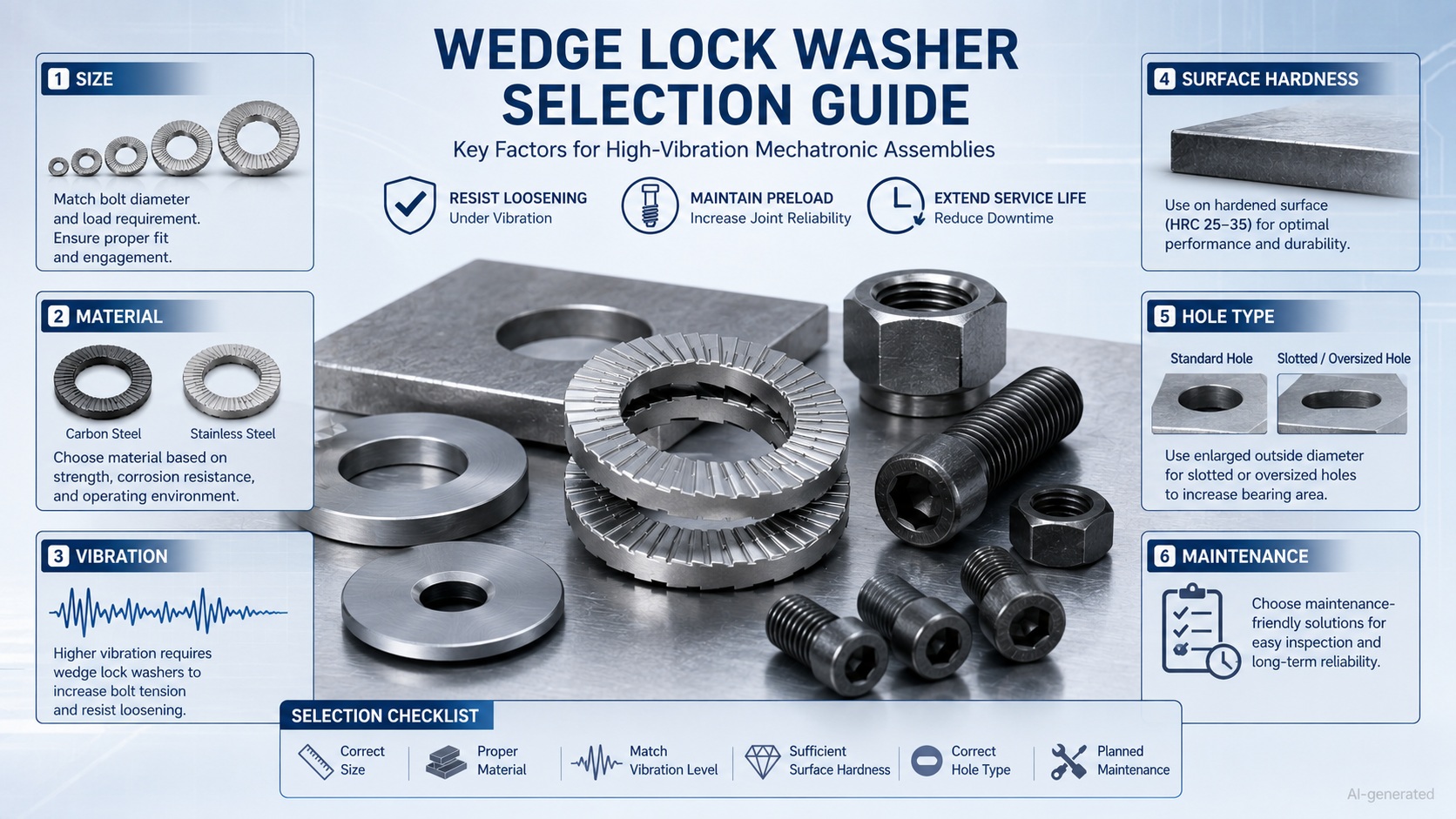
Selecting a wedge lock washer starts with the joint conditions.
Key Selection Questions
| Question | Why It Matters |
| What is the bolt size? | Washer size must match fastener size |
| Is the joint exposed to vibration? | Wedge locking is most valuable in vibration-prone joints |
| Is the joint lubricated? | Wedge locking is less dependent on friction alone |
| What is the surface material? | Teeth must grip without damaging the joint excessively |
| Is the hole standard, oversized, or slotted? | Bearing area may need enlargement |
| Is corrosion resistance required? | Material and coating selection matter |
| Is the joint frequently disassembled? | Reuse and inspection become important |
| Is the joint precision-critical? | Washer thickness and seating must be checked |
| Is the joint hard to access? | Stronger locking may reduce maintenance risk |
Selection by Application
| Application | Suggested Washer Choice | Common Sizes |
| Light sensor bracket | Split lock washer or small wedge lock washer if vibration is present | M3, M4 |
| Servo motor base | Wedge lock washer or double-stack self-locking washer | M5, M6, M8 |
| Linear motion support bracket | Wedge lock washer for vibration-prone support structures | M5, M6, M8 |
| Conveyor drive unit | Wedge lock washer | M8, M10, M12 |
| Robotic tooling plate | Wedge lock washer or flange-based locking method | M6, M8, M10 |
| Battery pack housing | Wedge lock washer with corrosion-resistant finish | M5, M6, M8 |
| CNC machine frame | Wedge lock washer or verified locking method | M8, M10, M12, M16 |
| Control cabinet panel | Usually spring washer or tooth washer unless high vibration exists | M3, M4, M5 |
Wedge Lock Washer vs Threadlocker
| Option | Better For | Notes |
| Wedge lock washer | Mechanical locking, reusable joints, vibration-prone assemblies | Requires correct surface contact |
| Threadlocker | Compact threaded joints, vibration resistance, no washer space | Needs clean threads and curing time |
| Lock nut | Bolt-and-nut assemblies | Requires nut-side access |
| Split washer | Low-cost light-duty joints | Limited high-vibration performance |
| Serrated washer | Small brackets and electrical contact | May damage surfaces |
A wedge lock washer is a strong mechanical solution when the joint must resist vibration without relying only on adhesive or friction.
11. Practical FAQ About Wedge Lock Washers
1. What is the difference between a wedge lock washer and a split lock washer?
A split lock washer mainly uses spring force and friction. A wedge lock washer uses a paired washer system with inner cams and outer radial teeth. When loosening begins, the cams increase bolt tension and resist rotation.
2. How does a wedge lock washer prevent loosening?
It prevents loosening by turning reverse rotation into increased bolt tension. The radial teeth grip the mating surfaces, and the cam faces force the washer pair to expand when the fastener tries to loosen.
3. Which direction do wedge lock washers face?
The cam faces should face each other, and the radial teeth should face outward toward the bolt head, nut, and clamped surface.
4. Can wedge lock washers be reused?
They may be reused if the washer pair is not damaged and the teeth and cams remain functional. Always inspect the washer and contact surfaces before reuse.
5. Are wedge lock washers good for high vibration?
Yes, wedge lock washers are designed for vibration-prone and dynamic-load bolted joints. They are especially useful where traditional friction-based locking methods may not be enough.
6. Can wedge lock washers be used on aluminum?
Yes, but surface damage should be considered. The radial teeth can bite into aluminum. For soft or visible surfaces, check bearing area, surface finish, and whether enlarged washers or flange fasteners are needed.
7. Do wedge lock washers work with lubricated bolts?
Wedge lock washers rely primarily on wedge-locking geometry rather than friction alone, which makes them suitable for many lubricated fastening conditions. However, torque values and joint design should still be controlled.
8. What test is used to evaluate wedge lock washers?
The Junker vibration test is commonly used to evaluate the self-loosening behavior of bolted joints under transverse vibration. It measures how well a locking method maintains bolt preload during repeated side-to-side movement. Wedge lock washers are often tested this way because their cam-based locking principle is designed to resist vibration loosening.
Final Takeaway
A wedge lock washer is not just a stronger-looking washer. It is a different locking concept.
Traditional lock washers often rely on friction, spring force, or surface bite. A wedge lock washer uses a two-piece geometry-based mechanism that turns loosening motion into increased bolt tension. That makes it especially useful for vibration-prone, dynamic, lubricated, or thermally stressed bolted joints.
In mechatronic assemblies, wedge lock washers are worth considering for servo motor bases, robotic fixtures, conveyor drive units, linear motion support structures, actuator brackets, CNC frames, battery housings, and power electronics enclosures. Popular sizes include M6, M8, M10, and M12, with smaller sizes such as M3, M4, and M5 used for compact brackets and larger sizes such as M16 or M20 used in heavier structures.
JLCMC provides washer options for mechatronic component assemblies, including lock washers, spring washers, flat washers, internal serrated lock washers, and double-stack self-locking washers. Used together with suitable screws, bolts, nuts, sensor brackets, aluminum extrusion accessories, and linear motion components, these washers help build fastening connections that are more stable, serviceable, and ready for real machine operation.
The best washer is not always the cheapest washer or the thickest washer. It is the washer whose locking principle matches the joint’s real working conditions.
A bolt that never loosens rarely gets attention. That is exactly the point.
Popular Articles
Keep Learning
Threaded Standoff vs Spacer: What Is the Difference?
Key Takeaways Threaded standoffs provide both spacing and threaded attachment points, making them ideal for modular assemblies and PCBs. Spacers are unthreaded sleeves that work with through-bolts to maintain gaps in clamped assemblies, offering a simpler and more economical solution. The right choice depends on the load path, assembly sequence, material, and service environment - not just appearance or catalog naming. A threaded standoff and a spacer can look almost identical on a workbench. Both cre......
How to Choose a Threaded Standoff for PCB and Mechatronic Assemblies
Key Takeaways Select the right configuration: Choose male-female, female-female, or male-male thread configurations based on the two mating interfaces and the intended assembly sequence. Treat height as a tolerance stack: Standoff body length must satisfy clearance, electrical, thermal, and connector requirements across the full tolerance range, not just the nominal dimension. Verify thread engagement: Check male thread length against tapped-hole depth and upper screw length against usable female thre......
Threaded Standoff Guide: Types, Sizes, Materials and Applications
Key Takeaways Thread configuration first: Choose female-female, male-female or male-male based on how both sides of the assembly attach — thread config is the most practical way to classify a threaded standoff. Body length is the critical dimension: Standoff length refers to the distance between supporting faces, not total physical length. Reading the wrong length causes incorrect mounting height or screw bottoming. Material affects more than strength: Brass, stainless steel, carbon steel, aluminum an......
Ball Nose End Mill Stepover: Scallop Height and Effective Diameter
Key Takeaways Geometric Control: Stepover directly controls geometric scallop height, but it does not automatically guarantee a measured Ra value. Cusp Height Formula: For a ball radius $R$ and pass spacing $s$ on a flat surface, the ideal cusp height is $h = R - \sqrt{R^2 - \frac{s^2}{4}}$. Tool Radius Advantage: A larger ball can use wider spacing for the same ideal cusp, provided it can reach the required geometry without gouging. Effective Diameter: The active cutting diameter near the tool tip ca......
Manual SMT Stencil Printer Sizing: Print Area, PCB Support and Frame Fit
Key Takeaways Different dimensions: Worktable size, effective print area, board envelope, and stencil frame size are different dimensions. Check the full pattern: Check the whole aperture pattern in its intended orientation, including clearance for the printing stroke. Thickness is not enough: A compatible board thickness does not prove that a populated underside or a support fixture will fit. Support and contact: Stable support and close stencil-to-board contact are necessary for a repeatable printin......
Blind Rivet Guide: Types, Sizes, Uses, Installation and Removal
A blind rivet may be small, but choosing one correctly involves more than matching a rivet to the nearest drill bit. The diameter, grip range, hole size, body material, mandrel material, head style and installation tool all influence the finished joint. A rivet that looks perfectly acceptable before installation can still spin, loosen, pull through the sheet or form incorrectly on the blind side if one of these factors is overlooked. Blind rivets are widely used in sheet-metal fabrication, electrical ......